s ustainability is an inteGral eleMent in ad aGency Jwts old - - PDF document

s
SMART_READER_LITE
LIVE PREVIEW

s ustainability is an inteGral eleMent in ad aGency Jwts old - - PDF document

I L 0 5 1 4 _ 0 2 0 - 2 0 2 0 1 4 - 0 4 - 2 4 T 1 1 : 3 7 : 5 6 + 1 0 : 0 0 May/Jun 2014 20 infolinK-bpn SuStainability SuStainability Materials rewrite office space to create new and sustainable experiences [words] Geraldine chua


slide-1
SLIDE 1

SuStainability SuStainability

Materials rewrite office space to create new and sustainable experiences

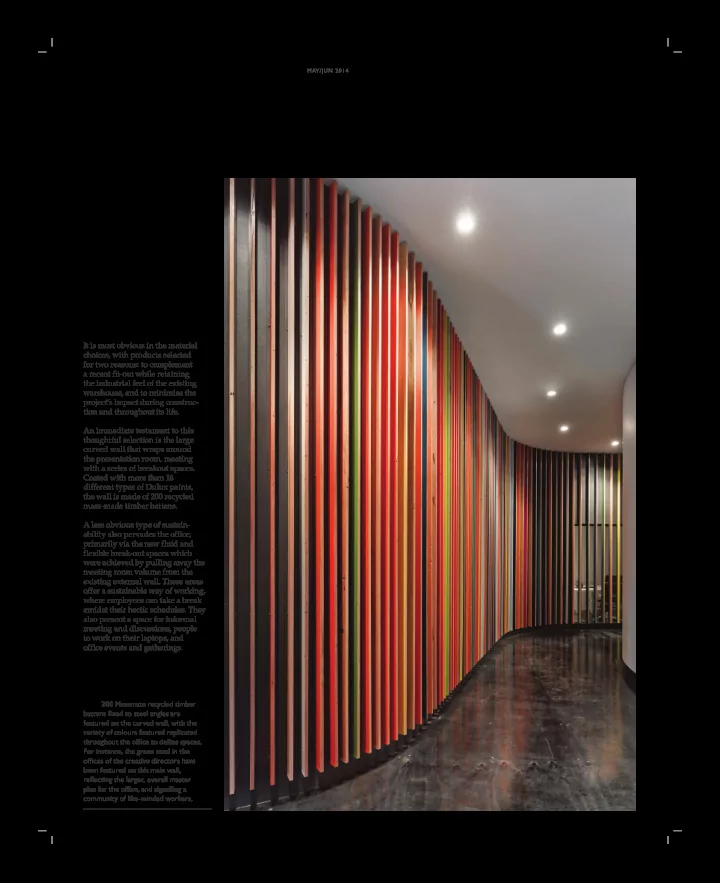
  • ver 200 Messmate recycled timber

battens fixed to steel angles are featured on the curved wall, with the variety of colours featured replicated throughout the office to define spaces. for instance, the green used in the

  • ffices of the creative directors have

been featured on this main wall, reflecting the larger, overall master plan for the office, and signalling a community of like-minded workers.

[words] Geraldine chua [photoGraphy] peter bennetts

Jwt presentation space by MaKe architecture

s

ustainability is an inteGral eleMent in ad aGency Jwt’s old rosella factory office presentation space, considered at every staGe

  • f the desiGn process.

It is most obvious in the material choices, with products selected for two reasons: to complement a recent fit-out while retaining the industrial feel of the existing warehouse, and to minimise the project’s impact during construc- tion and throughout its life. An immediate testament to this thoughtful selection is the large curved wall that wraps around the presentation room, meeting with a series of breakout spaces. Coated with more than 18 different types of Dulux paints, the wall is made of 200 recycled mass-made timber battens. A less obvious type of sustain- ability also pervades the office, primarily via the new fluid and flexible break-out spaces which were achieved by pulling away the meeting room volume from the existing external wall. These areas

  • ffer a sustainable way of working,

where employees can take a break amidst their hectic schedules. They also present a space for informal meeting and discussions, people to work on their laptops, and

  • ffice events and gatherings.

May/Jun 2014 20 infolinK-bpn

I L 0 5 1 4 _ 0 2 0 - 2 0 2 0 1 4 - 0 4 - 2 4 T 1 1 : 3 7 : 5 6 + 1 0 : 0 0

slide-2
SLIDE 2

SUSTAINABILITy

the curved wall can be animated and comes to life, with colours ranging from pinks and purples, to blues and greens revealed to the eye as one walks around and past the battens. this is affected by the steel angles, which allow more colour to peek out when walking from a particular direction. wash and wear – Low Sheen paints by dulux include Velvet Rose, tibetan Silk, domino, dandelion yellow, Blue antarctic, Red Stop, Spring Onion and

  • tingle. the dulux Powdercoat duralloy

is in white Satin and monument finishes. the plywood flooring by t&G Ply is stained, and the area is lit up by twist Fixed surface mounted Led downlight from Lighting Partners

  • australia. these are

accompanied by Cage Pendant (nud), unfold Pendant (muuto), and Float Pendant (Benjamin hubert) lights via Great dane. the white chair is from tait. the intimate spaces also run parallel to the large presentation room, with the rooms bridged by Cascade niagra aluminium sliding doors from Criterion

  • Industries. Both spaces have access to natural light through the windows,

which include the Capral 400 narrowline Series aluminium, Breezeway altair Louvre aluminium, and Criterion’s aluminium 120 Platinum Series. the rough texture of the bricks, as well as the warehouse shell, have been left untouched, although the walls are coated in murobond’s murowash and Bridge paint. this aligns with the design strategy of creating an atmosphere that was not ‘too corporate’. nikpol timber veneer in Coal Seam and Seasalt were used within the informal spaces, creating desks as well as seating areas for staff spilling out from the meeting room after long pitches and presentations. tait’s Good One Stools and Good One Bar Stools offer occupants additional areas for rest and discussion.

may/jun 2014 21 InFOLInK-BPn

I L 0 5 1 4 _ 0 2 1 - 1 0 2 0 1 4 - 0 4 - 2 4 T 0 8 : 2 1 : 0 8 + 1 0 : 0 0

slide-3
SLIDE 3

may/jun 2014 22 InFOLInK-BPn

[wOrds] GeraLdIne Chua

m

aKe arChIteCture Is a meLBOurne- Based PraCtICe whICh has GaIned reCOGnItIOn Over the years FOr PrIOrItIsInG quaLIty BeFOre quantIty In Its InnOvatIve, sIte-sensItIve desIGn

  • sOLutIOns. a drIvInG FOrCe FOr

thIs emerGInG FIrm Is Its FOundInG dIreCtOr meLIssa BrIGht, Or as we have COme tO KnOw her – meL. Before starting MAKE, Mel worked with LAB Architecture Studio on a number of large-scale commercial buildings in China. Today, the architect prefers working on smaller residential projects that add value to someone’s life or the community they live in. When asked why she chose this profession, Mel ponders for a beat before replying that she initially wanted to be an engineer in high school. In her words, “I suppose I couldn’t believe that you could do something that you really loved doing, was fun, and get paid for it.” The crossover between creative pursuit and practicality, such as having to keep the water

  • ut and complying with planning regulations,

is a relished challenge for Mel, who likes working in a creative way within technical

  • constraints. The variety of architecture, which

is not confined to visiting sites or 3D model- ling, is another reason why she continues to find her work interesting and engaging. Nothing beats seeing a project get built, though. The process of seeing something she designed come to life, at a stage where all problems have been resolved, is hugely satisfying – a magic most architects must appreciate.

G: what Is yOur desIGn PrOCess LIKe?

M: Even though at MAKE we focus on smaller projects, there’s this idea of ‘building small but thinking big’. We believe a small project can have greater ideas incorporated within it. It can give back to its community, be it by being more sustainable or positively affecting how its occupants live. This is an agenda that is always running in the office. We like the different constraints that a client’s brief brings to the process, which means there is not necessarily a prescribed style to

  • ur designs, so our buildings look different.

There’s clearly collaboration with our clients to produce a building, and you can see their personality shine through in the end result.

sustaInaBILIty Is a Key drIver FOr maKe. why dO yOu thInK a sustaInaBLe ethOs Is ImPOrtant, and hOw Is It aChIeved wIth eaCh PrOjeCt?

In the end, architecture is not really a sustainable profession – we’re building new things that use resources which are costly to the environment, and so we try to minimise

  • ur impact wherever we can. But, we’re

not necessarily doing this through add-on sustainability features that cost money. One of the conversations we’re more interested in having is how to design in a way that might help people to live sustainably. Rather than building poorly, we try to build a bit less, but make it

  • f a higher quality so it lasts much longer.

hOw dOes thIs transLate tO the jwt PresentatIOn sPaCe?

We’ve reused an existing warehouse space for the JWT project, which is a lot about sustain- ability in the office and work life. The office space has natural ventilation and access to light, and uses less energy for heating and cooling. In addition, we’ve tried to use materials with minimal impact, such as the recycled timbers. A large part of the office is its breakout spaces, which were designed for working sustainably, like allowing occupants to take time out from their desk and get away from the computer

  • screen. These little flexible spaces also perform

more than one function, and can be used for multiple reasons, tying in with our idea of building less and small, but thinking big.

what dO yOu thInK are Key OBstaCLes hInderInG austraLIan arChIteCts In desIGnInG sustaInaBLy?

I probably think the current political climate, without naming names!

what ImPrOvements dO yOu thInK shOuLd Be made sO arChIteCts Can COntrIBute tO a mOre sustaInaBLe BuILt envIrOnment?

Many of the people and clients who deal with architects know about sustainability and are engaged in that conversation, but educating people is still important. I think the biggest issue for architects is that we’re still only involved in such a small percentage of projects. We’re not relevant enough, so the suburbs are marching

  • ut and the growth boundaries keep being
  • extended. Most of the cookie cutter houses being

built are not designed by architects and have no consideration to orientation and siting.

dO yOu have any wOrds OF advICe On sustaInaBLe desIGn?

I don’t pretend to be an expert, but we work hard to think responsibly about what we

  • do. With small budget projects, we try and

integrate sustainable elements, so they are not necessarily things that you add on or take

  • ff. The most important tip I would give is to

design for place, orientation and seasons. MAKE architecture won the BPN Sustainability Award in the Single Dwelling (alterations & extensions) category for a House Reduction in Abbotsford in 2012. Entries for 2014 are now open.

meLIssa BrIGht, maKe arChIteCture – BehInd the jwt PresentatIOn sPaCe desIGn profile

I L 0 5 1 4 _ 0 2 2 - 2 2 2 0 1 4 - 0 4 - 2 4 T 0 8 : 1 2 : 0 4 + 1 0 : 0 0