S OMERSET SUN . N OURISHES OUR SOIL . G ROWS OUR GRASS . F EEDS OUR - - PowerPoint PPT Presentation

s omerset sun
SMART_READER_LITE
LIVE PREVIEW

S OMERSET SUN . N OURISHES OUR SOIL . G ROWS OUR GRASS . F EEDS OUR - - PowerPoint PPT Presentation

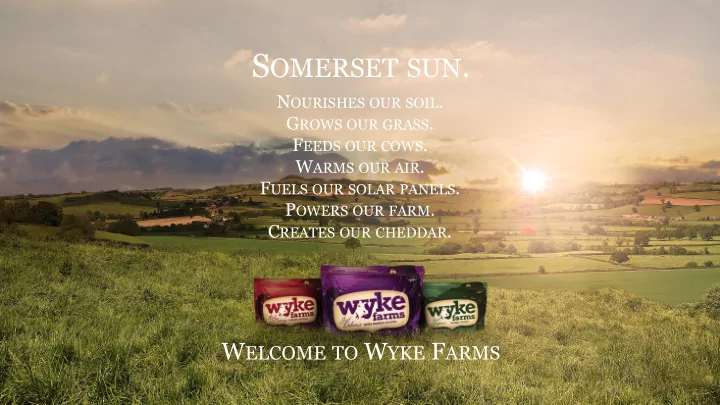
S OMERSET SUN . N OURISHES OUR SOIL . G ROWS OUR GRASS . F EEDS OUR COWS . W ARMS OUR AIR . F UELS OUR SOLAR PANELS . P OWERS OUR FARM . C REATES OUR CHEDDAR . W ELCOME TO W YKE F ARMS We wish to operate our business in a way that has minimal


slide-1
SLIDE 1

NOURISHES OUR SOIL. GROWS OUR GRASS. FEEDS OUR COWS. WARMS OUR AIR. FUELS OUR SOLAR PANELS. POWERS OUR FARM. CREATES OUR CHEDDAR.

SOMERSET SUN.

WELCOME TO WYKE FARMS

slide-2
SLIDE 2

“We wish to operate our business in a way that has minimal impact on the Somerset environment and to create a truly symbiotic relationship with the countryside that provides our food, our income and our home.”

slide-3
SLIDE 3

OUR HISTORY

Uncle Jim mowing Dad

slide-4
SLIDE 4

Wyke is an 150 year old family farmhouse cheese making business Family farm 1500 acres and have 1000 milking cows in Somerset Sourcing milk from 110 local farm assured farms within a 35 miles radius of the dairy Wyke process up to 300 million litres milk per annum Wyke is 5% of the UK cheddar market with a 25% penetration of UK households Trading in UK retailers and 160 countries inc. Carrefour, France Leading the field in Green and sustainable branding Food Manufacturing Awards ‘Dairy Company of the Year 2013’ Guardian Sustainable business of the year 2014 Grocer sustainable supplier of the year 2014

FACTS ABOUT WYKE

41k fans on Facebook 17k followers on Twitter

slide-5
SLIDE 5
  • 300 million litres per year process

capacity

  • 15,000 tonnes cheese manufacturing

capacity

O UR C HEESE P RODUCTION

slide-6
SLIDE 6

20,000t capacity scalable to 40,000t

O UR P ACKING & D ISTRIBUTION

slide-7
SLIDE 7

M ILK I NGREDIENTS A T W YKE

slide-8
SLIDE 8
slide-9
SLIDE 9
slide-10
SLIDE 10
slide-11
SLIDE 11
slide-12
SLIDE 12

S HOPPERS LOOK FOR W YKE VALUES

slide-13
SLIDE 13
slide-14
SLIDE 14
slide-15
SLIDE 15

B IOGAS P HASE 1

5000 CU METRE DIGESTOR 500KW CHP THERMAL ENERGY TO CHEESE 5000 CU METRE DIGESTOR 500KW CHP POWER TO GRID THERMAL ENERGY HEATING PROCESS POWER TO CHEESE GAS LINE TO BRUTON 20,000 TONNES DAIRY WASTE 35,000 TONNES FARM WASTE

BIOGAS PHASE ONE

5000 CU METRE DIGESTATE STORE 50,000 TONNES NITROGEN RICH MANURE Waste Pasteuriser

slide-16
SLIDE 16

B IOGAS P HASE 2

5000 CU METRE DIGESTOR 500KW CHP THERMAL ENERGY TO CHEESE 5000 CU METRE DIGESTOR 500KW CHP POWER TO GRID 5000 CU METRE DIGESTOR THERMAL ENERGY HEATING PROCESS POWER TO CHEESE GAS LINE TO BRUTON 20,000 TONNES DAIRY WASTE 35,000 TONNES FARM WASTE 100,000 TONNES NITROGEN RICH MANURE

BIOGAS PHASE TWO

65,000 TONNES OTHER FEED (ABPR)

2000 m3 GAS UPGRADING

65,000 TONNES OTHER FEED (ABPR) 65,000 TONNES OTHER FEED (ABPR) 65,000 TONNES OTHER FEED (ABPR) 65,000 TONNES OTHER FEED

GAS TO GRID

Pasteuriser

slide-17
SLIDE 17
  • 2 x 4600 m3 digesters (Biogas Nord)
  • Digestate pasteuriser (not commissioned yet!)
  • 4600 m3 secondary digester / digestate store
  • Vogelsang Energy Jet solids feeding system
  • 2 x 499 kw CHP plants MWM packaged by Pro2
  • 800 m3 per hour DMT biomethane to grid plant
  • Elster grid entry unit

M AIN P LANT C OMPONENTS

slide-18
SLIDE 18
  • 9000 m3 primary digestion capacity
  • 4600 m3 secondary digestion / digestate storage
  • Producing approx. 1500 m3 per hour biogas and building

gradually

  • Approx organic loading rate of 6kg per m3
  • Throughput per day of up to 300 tonnes

K EY NUMBERS

slide-19
SLIDE 19

Approach to feedstock's is opportunistic with very few supply contracts.

  • Pig & Cow Slurry
  • Whey Permeate and other milk waste
  • Bakery Waste
  • Surplus Grass & Maize Silage
  • Rape Seed Straw

W HAT DO WE FEED IT ON?

slide-20
SLIDE 20
  • More gas production
  • More solar
  • Transport – milk tankers?
  • Can only be as ‘Green’ as current technology allows

W HAT IS N EXT FOR W YKE?

slide-21
SLIDE 21
  • More gas from smaller digesters;
  • Separation of solid and liquid retention times
  • Improvements of pre-hydrolysis techniques
  • Increase use of crop residues like straw, chaff etc.
  • Increase yields from purpose grown crops
  • Nutrient recovery/separation from digestate

W HAT IS N EXT FOR THE A D INDUSTRY?

slide-22
SLIDE 22