ASTR 1120 General Astronomy: The SUN ast Tim Stars & Galaxies - - PowerPoint PPT Presentation

astr 1120 general astronomy
SMART_READER_LITE
LIVE PREVIEW

ASTR 1120 General Astronomy: The SUN ast Tim Stars & Galaxies - - PowerPoint PPT Presentation

ASTR 1120 General Astronomy: The SUN ast Tim Stars & Galaxies How far is the Sun? NNOUNCEMENTS What is the Sun made of? FIRST MIDTERM THIS THURSDAY, 09/17 How does the Sun produce its energy? ex observing night Tue


slide-1
SLIDE 1

ASTR 1120 General Astronomy: Stars & Galaxies

NNOUNCEMENTS FIRST MIDTERM THIS THURSDAY, 09/17

ex observing night Tue 09/22. econd homework on masring asonomy due o UESDAY, 09/22, by 5pm.

The SUN

ast Tim

How far is the Sun? What is the Sun made of? How does the Sun produce its energy?

(and how do we know?)

Why is the Sun stable? What is the structure of the Sun?

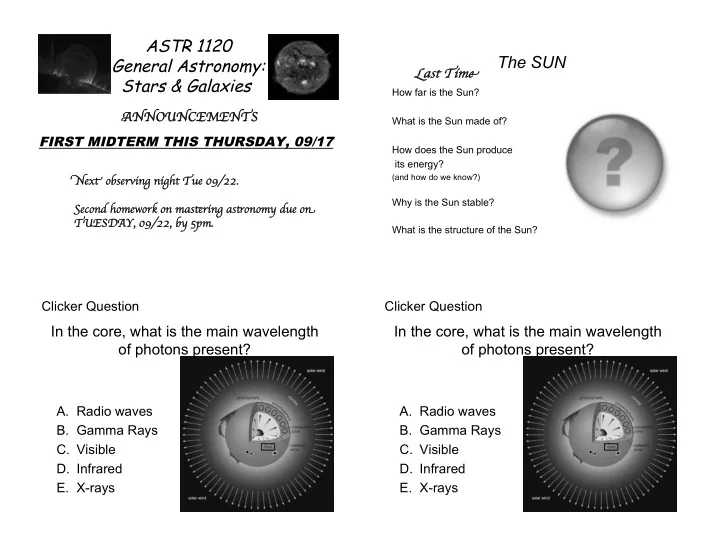
In the core, what is the main wavelength

  • f photons present?
  • A. Radio waves
  • B. Gamma Rays
  • C. Visible
  • D. Infrared
  • E. X-rays

Clicker Question

In the core, what is the main wavelength

  • f photons present?
  • A. Radio waves
  • B. Gamma Rays
  • C. Visible
  • D. Infrared
  • E. X-rays

Clicker Question

slide-2
SLIDE 2

At the photosphere, what is the main wavelength of photons present?

  • A. Radio waves
  • B. Gamma Rays
  • C. Visible
  • D. Infrared
  • E. X-rays

Clicker Question

At the photosphere, what is the main wavelength of photons present?

  • A. Radio waves
  • B. Gamma Rays
  • C. Visible
  • D. Infrared
  • E. X-rays

Clicker Question

Helioseismology: Millions of sound

waves available to probe solar interior

ACOUSTIC WAVES

Some waves bounce just below the surface Others almost make it to the center All excited by turbulent granulation visible in photosphere

How do we know what’s inside the Sun?

SOLAR OSCILLATION MODES

One of millions

  • f modes, each

with a different tone!

slide-3
SLIDE 3

Sunspots

  • Darker = cooler

– Still ~4,000 K

  • Sunspot pictured at the

bottom left covers the area of 15 Earths!

– Taken with the Solar and Heliospheric Observatory (SOHO)

Sunspots Caused By Magnetic Fields

  • Magnetic fields entrain gas in huge bubbling loops
  • Cooler areas at “liftoff” cause dark sunspots

But What Causes the Magnetic Field Lines to Stick Out Like That?

  • Differential Rotation

– The Sun rotates differently at different latitudes.

  • The Sun winds itself up

This Solar “Wind Up” Leads To The Sunspot Cycle

slide-4
SLIDE 4

During the Sunspot Cycle Sunspots Form At Different Latitudes

Complex Interplay of Convection, Magnetism and Differential Rotation.

What is believed to be the main cause of the sunspot cycle?

A. Temperature changes between the equator and poles of the Sun B. Twisting of magnetic fields lines in the Sun due to a rotation rate varying with latitude. C. Variability in the Sun’s brightness every 11 years D. Interaction between the Sun and the orbits of the innermost planets E. A variation of the fusion rate occurring in the core of the Sun.

Clicker Question What is believed to be the main cause of the sunspot cycle?

A. Temperature changes between the equator and poles of the Sun B. Twisting of magnetic fields lines in the Sun due to a rotation rate varying with latitude. C. Variability in the Sun’s brightness every 11 years D. Interaction between the Sun and the orbits of the innermost planets E. A variation of the fusion rate occurring in the core of the Sun.

Clicker Question

slide-5
SLIDE 5

If we see the sunspot edge-on, it’s called a PROMINENCE

When Prominences Go Bad

  • Occasionally the

magnetic field lines in a prominence “snap”

– Energy & Light is released

  • Flares

– Charged particles are spewed out into space

  • Coronal Mass

Ejections

Coronal MASS Ejections Blast Out Charged Particles

  • PROTONS!

– Can:

  • Damage satellites
  • Harm astronauts
  • Induce currents on Earth and destroy electric

transformers on the ground

  • Cause swelling in the Earth’s atmosphere
slide-6
SLIDE 6

Coronal Mass Ejections Movie from

Solar and Heliospheric Observatory

http://sohowww.nascom.nasa.gov/

Protons interacting with the Earth’s magnetic field produce aurora

Chromosphere

  • Temperature goes

back UP!

  • T 6,000-10,000 K
  • Very thin density
  • Heated by energy

twisting and spilling around magnetic field lines

Outside the chromospere, the temperature spikes up again!

slide-7
SLIDE 7

Corona

  • T 1,000,000 K
  • Extremely thin

density

  • X-rays
  • More magnetic

heating

X-ray image of the Sun Solar Eclipse: Sun’s light blocked by the Moon

Corona becomes clearer in visible light without glare from the rest of the Sun

Solar Wind

  • At the top of the corona,

gas is hot enough (and far enough) to escape the gravity of the Sun

  • In effect, the corona is

“evaporating”

– But replenished from below

  • Solar wind carries about

a million tons of solar matter per second!!

– Yet the sun has only lost 0.1 percent of its mass!

slide-8
SLIDE 8