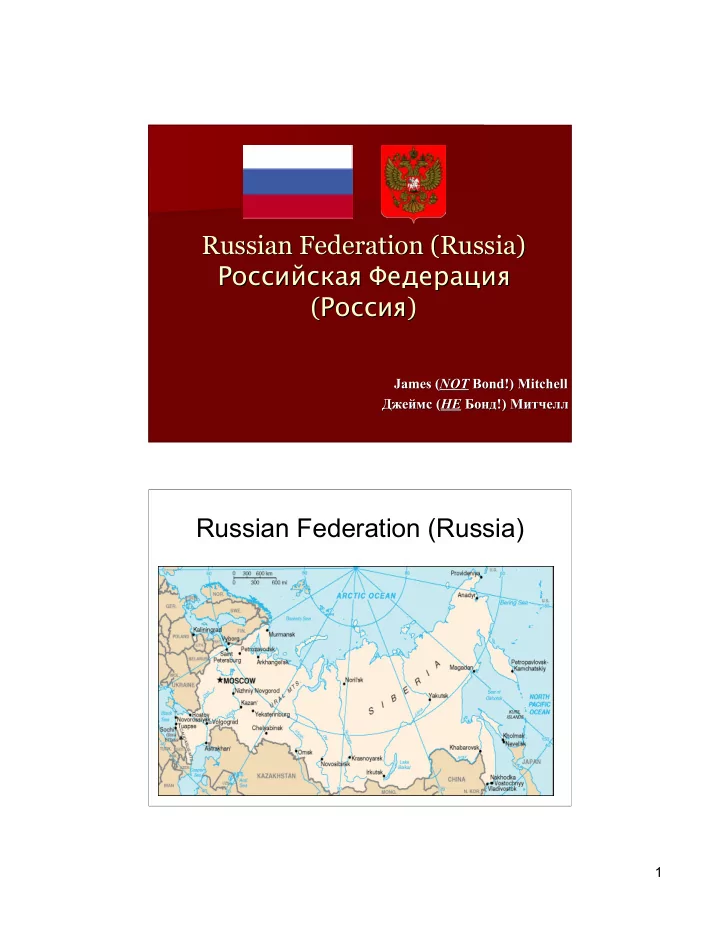
Russian Federation (Russia) Russian Federation (Russia) - - PDF document

russian federation russia russian federation russia
SMART_READER_LITE
LIVE PREVIEW

Russian Federation (Russia) Russian Federation (Russia) - - PDF document

Russian Federation (Russia) Russian Federation (Russia) ) ( ) ( James ( NOT James ( NOT Bond!) Mitchell Bond!) Mitchell (


slide-1
SLIDE 1

1

Russian Federation (Russia) Russian Federation (Russia) Российская Российская Федерация Федерация ( (Россия Россия) )

James ( James (NOT NOT Bond!) Mitchell Bond!) Mitchell Джеймс Джеймс ( (НЕ НЕ Бонд Бонд!) !) Митчелл Митчелл

Russian Federation (Russia)

slide-2
SLIDE 2

2

Geography

  • Official name: Russian Federation

(Formerly: Russian Soviet Federative Socialist Republic)

  • Capital: Moscow
  • Area: 17,075,200 sq. km (6,592,771 sq. mi)

1.8 the size of the United States

  • Population: 144,526,278 (2003 est.)

141,377,752 (2007 est.) 73% urban, overwhelmingly concentrated in European Russia

  • 10 Time Zones
  • 20,000 km (12,420 mi) of Land Boarders With 14 Countries
  • Literacy: 99.4% (2005 est.)
  • Age structure

2003 est. 2007 est. 0-14 years: 16.0% 14.6 15-64 years: 70.4% 71.1% 65 years and over: 13.6% 14.4%

  • Median age

2002 est. 2007 est. Total: 37.6 38.2 Male: 34.7 35.0 Female: 40.3 41.3

slide-3
SLIDE 3

3

Looming Demographic Crisis

2003 est. 2005 est. 2007 est.

Population growth rate .

  • 0.3%
  • 0.50% -0.50%
  • Birth rate (per thousand):

10.09

  • 10.92
  • Death rate (per thousand):

13.99

  • 16.04
  • Infant mortality rate (deaths/1,000 births):

Total: 19.51

  • 11.06

Female: 17.40

  • 9.42

Male: 21.53

  • 12.06
  • Total fertility rate :

1.33

  • 1.30

(children born/woman):

  • Labor force (2002 est.): 71.8 million (down by 10 million in 10 year)

(2007 Est.): 75.1 Million

  • Central Russia

– 3.8% of Land – 25.4% of Population

  • Northwest Russia

– 9.8% of Land – 9.9% of Population

Russian Regions

7 Federal Districts subdivided into 89 Subjects (Regions, Autonomous Republics, and Territories)

slide-4
SLIDE 4

4

  • Urals and Western

Siberia

– 10.5% of Land – 8.7% of Population

  • Volga Region

– 6.1% of Land – 22.0% of Population – 83% of Russia’s GDP

  • Central Siberia Region

– 30.0% of Land – 14.3% of Population

  • Southern Federal

District

– 3.5% of Land – 14.9% of Population

  • Russian Far East Region

– 35.4% of Land – 4.9% of Population

Wealthiest Areas

  • Moscow City

– Highest Purchasing Power, 3.3 times the National Average – Accounts for 30.0% of the National Retail Trade Turnover, with Only 7% of the Population

  • St. Petersburg
  • Moscow Region
  • Volga Region
slide-5
SLIDE 5

5

History

  • The Kiev state (Kievian Rus)

– Converted to Christianity in 988 A.D. during the reign of Vladimir I by Byzantine Orthodox monks.

  • Mongol/Tartar invasion of 1234

– 200 years of Mongol/Tartar rule. – Russia isolated from the Renaissance and Reformation in Western Europe. – Result was vast, backward agrarian empire up to the 1917 revolution.

History

  • Constantinople falls to the Turks in 1453

– Russia the last bastion of Eastern Christianity. – National ideas of Moscow as “Third Rome” and Russian messianism were born.

  • Serfdom

– imposed on the peasantry in the 16th century – abolished in 1861 (two years before American slavery abolished in 1863). – endentured to their noble masters, bound to the land, severely taxed and had to serve up to 25 years’ military service.

slide-6
SLIDE 6

6

  • After the abolition of serfdom the land was held by the

Mir (community) in trust for the peasants, who were allowed to work private plots of land. All decisions were made by a village assembly.

  • Czars continued to rule until 1917 until the Russian
  • Revolution. The Imperial family was executed, marking

the end of the last divine right monarchy in Europe.

  • In the Soviet era, collective farms were established from
  • 1930. Forced industrialization, mass urbanization and

purges.

  • Gorbachev eventually introduced perestroika in the

1980s, but the Soviet Union disintegrated in 1990.

Consequences of History

  • For much of its history, Russia has been isolated from

Europe or has rejected Western ways.

  • Mongol domination did not make Asians of Russians, but

it prevented them from becoming fully European.

  • Western pluralism, liberalism and democracy equated

with chaos.

  • Before the Revolution Russia was 90% peasants. Now
  • nly about 30% of population is rural.
  • Long history of involuntary collectivism from feudal

times, through serfdom, the Mir, and the Soviet period.

  • Xenophobia and militarism resulting from frequent wars

and invasions.

slide-7
SLIDE 7

7

Russian Orthodox Church

  • Russia was communist for 70 years. It has been

Russian Orthodox for 1000 years

  • Guardian of Russian culture during 250 years of

Mongol rule.

  • Legitimizing force for the divine right monarchy.

In addition to secular ruler, Czar titular head of

  • Church. Synod and the Patriarch appointed by

the Czar.

  • Church was an agent of the throne, particularly

regarding the peasantry via network of monasteries and churches. Main link between throne and the masses.

  • Consensus of Orthodox congregation seen as

singular truth.

  • Orthodoxy seen as egalitarian. Led to disdain for

dissidents.

  • Anti-intellectual tradition. Knowledge and

wisdom from study of scriptures and Church doctrine instead of scholarly pursuits.

  • Lack of work ethic in the Western sense.

Salvation through spiritual piety instead of worldly deeds.

  • Communist Party replaced Church - intolerance
  • f dissent continued.
slide-8
SLIDE 8

8

Analysis of Cultural Roots

  • Multi-active
  • Particularism – Very High
  • Collectivism – High
  • Power Distance – Very High
  • Uncertainty Avoidance – Very High
  • Ascribed Status to Achieved Status
  • Time Synchronous

Multi-active

  • Emotional, impulsive
  • Family-oriented
  • People-oriented rather than Task-oriented
  • Tend to do many thinks in unplanned order
  • Indifferent to schedules and punctuality
  • Value personal relationships over formal

arrangements

slide-9
SLIDE 9

9

Particularism

  • “We want to be like any other country, but you have to

make exceptions for us because we are Russian.”

  • Relationship-oriented
  • High premium on trust and personal contacts
  • Disdain for rules and laws:
  • Laws have always protected the state rather than

the individual. Therefore little respect for it.

  • Rules and regulations are for repression, not

empowerment.

  • Look for the loopholes and exceptions first.
  • Personal recommendations go much further than
  • fficial directives.
  • Preference for face-to-face negotiation, and resolve

problems via unofficial means and reciprocal personal

  • bligation
  • Personal promises are kept regardless of formal
  • bligations and legalities.
  • Favors granted and accepted.
  • Handmaiden of bribery, corruption and cronyism in

Western (linear/universalist) eyes.

slide-10
SLIDE 10

10

Collectivism

  • “Together in the mir, we will move even

mountains.”

  • - Russian proverb
  • Problems are collectively discussed, deliberated

and decided.

  • Emphasis on consensus, but decision of head of

collective final.

  • Strong egalitarian tendencies.
  • Prefer to bring others down to own level.
  • Someone else’s success is always more painful

than one’s own failures.

  • Discourages dissent and personal initiative.
  • Concept of entrepreneurial activities borders on

the illegitimate.

  • Fosters lack of personal accountability.
  • Closely intertwined with concept of extended

family.

  • Extended Family = Nuclear Family + Friends +

Collective + Contacts

slide-11
SLIDE 11

11

Power Distance

  • Historically, in Russia individuals were not

important.

  • The Russians were treated as the property of

the Czar and had no choice.

  • Individuals were destined to suffer for the sake
  • f Mother Russia.

Uncertainty Avoidance

  • Russians are conservative and tend to be risk

adverse

  • Opposed/Resistant to change, and value

stability and security due to:

  • Harsh climate
  • Violent history
  • Skepticism (change = trouble)
  • Pessimism caused by:
  • Weather
  • Wars
  • Violence
  • Catastrophic changes
  • Oppressive rule
slide-12
SLIDE 12

12

Time Synchronous

  • “The slower you go, the further you’ll get.”
  • Russian proverb
  • Time is relative, not absolute.
  • Not very punctual, but not outrageously late either.
  • Russians tend to “pool” tasks and issues and “walk

around the pool” for some time to contemplate a course of action which will take into account the inter- relating factors between the different elements.

  • Nothing should be decided or determined

piecemeal; action should only begin when an all- embracing solution has been constructed.

  • Often results in time leads/lags, delays,

procrastination and mañana behaviour.

  • Linear-active cultures are interested in speed.

Multi-active cultures and reactive cultures give priority to getting it right.

slide-13
SLIDE 13

13

General Attitudes about Business and Economics

  • Entrepreneurial tradition in Russia, but

merchants rejected economic liberalism. Monopolistic tendencies.

  • Concept of reward for performance is alien.
  • Concept of entrepreneurial activities borders on

the illegitimate.

  • Legal consciousness remains low.
  • Rule of Law weak.

Specific Practices

  • Efforts made to promote

business through official channels only are likely to founder on the rocks of bureaucracy and apathy.

  • Using key people and

personal alliances to by- pass the “system” and achieve results.

slide-14
SLIDE 14

14

Negotiations

  • Russian teams often veterans or experts,

consequently they are very experienced.

  • They negotiate as they play chess (Americans

play poker), planning several moves ahead. Opponents should consider the consequences

  • f each move in advance.
  • Sudden changes or new ideas may cause

delays, as they have to seek consensus from higher up.

  • Negotiations often relate the subject under

discussion to other issues in which they are

  • involved. This may not be clear to the other side.
  • Willingness to compromise often taken as a sign
  • f weakness.
  • Their preferred tactic in case of deadlock is to

display patience and “sit it out”.

  • The general tendency is to push forward

vigorously as the other side seems to retreat, to pull back when meeting stiff resistance.

slide-15
SLIDE 15

15

  • Delivery style may be theatrical and emotional,

intended to convey clearly their intent and requests.

  • Usually ask the other side to speak first, so they

may reflect on the position given.

  • They are status conscious and must be treated

as equals and not “talked down to”.

  • Their approach to an agreement is conceptual

and all-embracing, as opposed to American step-by-step settlement.

  • Personal relationships between the negotiating

teams can often achieve miracles in cases of deadlock.

  • A contract is considered binding only if it

continues to be mutually beneficial.