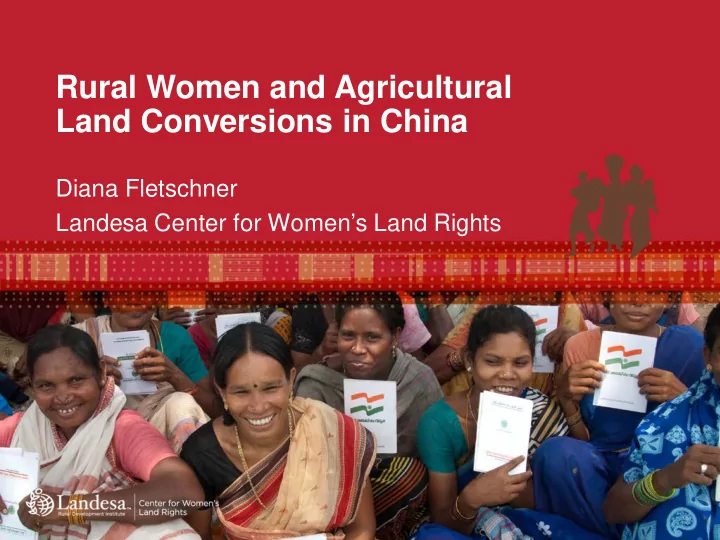
Rural Women and Agricultural Land Conversions in China Diana - - PowerPoint PPT Presentation
Rural Women and Agricultural Land Conversions in China Diana Fletschner Landesa Center for Womens Land Rights Agricultural Land Conversion in China State requisitions arable land for conversion to real estate or industrial development
2 Strengthening land rights for women
Agricultural Land Conversion in China
- State requisitions arable land for conversion to real estate or
industrial development
- Conflicts due to land conversions are among the main
problems in rural China
3 Strengthening land rights for women
Reasons for High Rates of Land Conversions
Demand-side: High rate of urbanization Supply-side: Rent seeking at the local level
- Performance of local Communist party-state officials affected by the
extent to which they attract investments
- Local public expenditures greatly surpass local taxes. Land-use fees are
now an important source of fiscal revenue
- Village collective cadres favor conversions – to cover village cadre
salaries and administrative costs. Their power is reinforced as they decide how to allocate compensations
4 Strengthening land rights for women
“Black-letter Law” on Land Rights
- State and Farmer Collectives own rural land
- Rural households have 30-year Land Use Rights
- These rights should be documented in contracts or certificates
- Big readjustments of land use rights are no longer allowed
- Small readjustments of collective land require consent by 2/3 of
villagers or villager representatives and approval by township government and county government agencies in charge of agriculture
5 Strengthening land rights for women
“Black-letter Law” on Agricultural Land Conversions
- Land can be requisitioned for the “public interest”
- Before it is approved, farmers whose land will be taken must know of:
- the purposes of the land taking,
- its location,
- the compensation standard,
- the resettlement and rehabilitation measures, and
- their right to a hearing on compensation and resettlement standards
- Farmers whose land is expropriated are supposed to be compensated
for: land lost, resettlement needs, and structures and standing crops
- Compensation is based on average annual output value of the land
for previous 3 years. If compensation is not sufficient to maintain a similar livelihood, local governments should cover the difference
6 Strengthening land rights for women
Is the “Black-letter Law” Implemented?
It co-exists with competing law-like sources of authority:
(Whiting, 2010)
- Local Communist party-state officials who make takings and
compensation decisions according to:
- Need to promote investments (part of their performance assessment)
- Fiscal needs
- Semi-autonomous villages (cadres) who covet:
- revenue to cover salaries and other administrative costs
- power from their decisions on how to allocate compensation and land
7 Strengthening land rights for women
As a Result…
- High number of farmers rendered landless
- Substantial interception of compensation by collectives or local govts
- Inadequate compensation standard for loss of land use rights
- Unfair calculation of resettlement subsidy
- Economic stakes often lead to disputes among villagers who then
tend to rely on traditional (gendered) norms
- No single, identifiable legal norm such as disputes are resolved
consistently
- In practice, often no legal recourse
8 Strengthening land rights for women
How are women affected?
Black-letter Law does NOT support differential treatment
- f men and women in distribution of land-use rights,
entitlements to compensation, or recourse to the courts
9 Strengthening land rights for women
How are women affected?
However:
- Women’s land rights are affected by the “30-year-no-change” rule
against big-readjustments in a system based on patrilocal marriage
- Women’s names are rarely included in land documents
(13% and 28% of the women interviewed versus 78% and 77% for their husbands, for contracts and certificates, respectively)
- Women tend to be affected by traditional norms followed by Village
Collectives to determine who is eligible for monetary compensation and for reallocation of remaining land. In practice, their eligibility can be affected by their marital status, by who they married, and by their and their husbands’ current residency.
10 Strengthening land rights for women
Case Studies from Guanxi Province Suggest
- Women’s eligibility for compensation and resettlement can vary
each time land is taken
- Women often receive less compensation, sometimes nothing
- Women who married out or whose husbands have urban
residency might not be eligible…
- Even if they live in the village
- Even if have kept their residential status
- Even if they possess land rights
- Women have been asked to sign documents relinquishing
claims to compensation for future land takings
- Some courts have refused to hear their land-related claims
11 Strengthening land rights for women
Questions that We Explore Here
Are women consulted before their land is taken?
- Is there a gender difference?
- In which cases are women more/less likely to be consulted?
- What can be done?
12 Strengthening land rights for women
Data
- Survey on women’s land use rights, changes in land rights
related to marriage, land conversions, and decision-making related to land use
- Summer of 2010
- Students from Renmin University interviewed:
- 380 women
- 1 interview per village
- 5 provinces (Hebei, Henan, Shandong, Sichuan, Zhejiang)
13 Strengthening land rights for women
5 Provinces covered
Hebei Henan Shandong Zhejiang Sichuan
14 Strengthening land rights for women
Findings
Women interviewed said that:
- Agricultural land in their village had been converted: 45%
- Villagers were NOT consulted before conversion: 28%
- Women were NOT consulted before conversion: 38%
Were women consulted?
- Yes, the Village Committee consulted: 29%
- Yes, male villagers consulted with their wives: 33%
- No, Women were not consulted: 38%
15 Strengthening land rights for women
Findings
Women interviewed said that:
- Agricultural land in their village had been converted: 45%
- Villagers were NOT consulted before conversion: 28%
- Women were NOT consulted before conversion: 38%
Were women consulted?
- Yes, the Village Committee consulted: 29%
- Yes, male villagers consulted with their wives: 33%
- No, Women were not consulted: 38%
16 Strengthening land rights for women
Findings
Women were NOT consulted
Were Villagers Consulted?
Yes 17% No 93%
17 Strengthening land rights for women
Findings
Women were NOT consulted
Were Villagers Consulted?
Yes 17% No 93%
18 Strengthening land rights for women
Women were NOT consulted
Provinces
Hebei 42% Henan 15% Shadong 40% Sichuan 42% Zhejiang 49%
Village distance to township or county seat
> 10Km 67% 10Km or closer 33%
Findings
19 Strengthening land rights for women
Women were NOT consulted
Provinces
Hebei 42% Henan 15% Shadong 40% Sichuan 42% Zhejiang 49%
Village distance to township or county seat
> 10Km 67% 10Km or closer 33%
Findings
20 Strengthening land rights for women
Women were NOT consulted
Provinces
Hebei 42% Henan 15% Shadong 40% Sichuan 42% Zhejiang 49%
Village distance to township or county seat
> 10Km 67% 10Km or closer 33%
Findings
21 Strengthening land rights for women
Findings
Women were NOT consulted
Household Wealth
Poor (below village average) 54% Average wealth 40% Better off (above village average) 19%
De-Facto Female-Headed Household
Husband gone for at least 6 months 16% Husband in household at least 6 months 44%
22 Strengthening land rights for women
Findings
Women were NOT consulted
Household Wealth
Poor (below village average) 54% Average wealth 40% Better off (above village average) 19%
De-Facto Female-Headed Household
Husband gone for at least 6 months 16% Husband in household at least 6 months 44%
23 Strengthening land rights for women
Findings
Women were NOT consulted
Household Wealth
Poor (below village average) 54% Average wealth 40% Better off (above village average) 19%
De-Facto Female-Headed Household
Husband gone for at least 6 months 16% Husband in household at least 6 months 44%
24 Strengthening land rights for women
Findings
Women were NOT consulted
Respondent completed elementary school
Yes 35% No 44%
Respondent is 50 or older?
Yes 44% No 35%
25 Strengthening land rights for women
Findings
Women were NOT consulted
Respondent completed elementary school
Yes 35% No 44%
Respondent is 50 or older?
Yes 44% No 35%
26 Strengthening land rights for women
Findings
Women were NOT consulted
Respondent completed elementary school
Yes 35% No 44%
Respondent is 50 or older?
Yes 44% No 35%
27 Strengthening land rights for women
Findings
Women were NOT consulted
Household has Land Use Rights Contract?
Yes 27% No 49%
Household has Land Use Rights Certificate?
Yes 33% No 44%
28 Strengthening land rights for women
Findings
Women were NOT consulted
Household has Land Use Rights Contract?
Yes 27% No 49%
Household has Land Use Rights Certificate?
Yes 33% No 44%
29 Strengthening land rights for women
Findings
Women were NOT consulted
Household has Land Use Rights Contract?
Yes 27% No 49%
Household has Land Use Rights Certificate?
Yes 33% No 44%
30 Strengthening land rights for women
For a more precise analysis, let’s consider several
- f these factors at the same time … and determine
which factors are statistically associated with the probability that women are consulted.
31 Strengthening land rights for women
Findings
Villagers consulted Women consulted by Village Committee Women consulted by Village Committee
- r by husbands
Her Human Capital
Completed Elementary School 0.151 0.293 0.107 50 or Older
- 0.447
- 0.310
0.134
Household Characteristics
Poor
- 0.394
- 0.061
- 0.381
Better off 1.646**
- 0.138
0.996 De-facto Female-headed HH 0.388 0.457 1.160**
Her Bargaining Power
She Lost Land Rights at Marriage 0.680 0.674 0.283
Village Characteristics
>10 Km from township
- 1.464***
- 1.074
- 1.573***
Province Characteristics
GDP/capita
- 0.245***
- 0.162
- 0.200**
Population Density 5.425*** 0.847 2.777 Constant 0.716
- 0.233
0.695
Prob > F(8,140)
0.0005 0.493 0.014
N.Obs.: 141 Logistic Regression
32 Strengthening land rights for women
Findings
Villagers consulted Women consulted by Village Committee Women consulted by Village Committee
- r by husbands
Her Human Capital
Completed Elementary School 50 or Older
Household Characteristics
Poor Better off
+
De-facto Female-headed HH
+
Her Bargaining Power
She Lost Land Rights at Marriage
Village Characteristics
>10 Km from township
- Province Characteristics
GDP/capita
- Population Density
+
Constant
Prob > F(8,140)
0.0005 0.493 0.014
N.Obs.: 141 Logistic Regression
33 Strengthening land rights for women
Findings
Villagers consulted Women consulted by Village Committee Women consulted by Village Committee
- r by husbands
Her Human Capital
Completed Elementary School 50 or Older
Household Characteristics
Poor Better off
+
De-facto Female-headed HH
+
Her Bargaining Power
She Lost Land Rights at Marriage
Village Characteristics
>10 Km from township
- Province Characteristics
GDP/capita
- Population Density
+
Constant
Prob > F(8,140)
0.0005 0.493 0.014
N.Obs.: 141 Logistic Regression
34 Strengthening land rights for women
Findings
Villagers consulted Women consulted by Village Committee Women consulted by Village Committee
- r by husbands
Her Human Capital
Completed Elementary School 50 or Older
Household Characteristics
Poor Better off
+
De-facto Female-headed HH
+
Her Bargaining Power
She Lost Land Rights at Marriage
Village Characteristics
>10 Km from township
- Province Characteristics
GDP/capita
- Population Density
+
Constant
Prob > F(8,140)
0.0005 0.493 0.014
N.Obs.: 141 Logistic Regression
35 Strengthening land rights for women
But are women not being consulted? Or… is it mostly villagers not being consulted?
36 Strengthening land rights for women
We use a bivariate probit model and find that: The probability that women are NOT consulted by the Village Committee or by their husbands, conditional on villagers being consulted is: 19%
37 Strengthening land rights for women
What factors may help explain this difference?
38 Strengthening land rights for women
Findings
Probability that Women were consulted by Village Committee
- r by husbands…
conditional on villagers being consulted (marginal effects) Her Human Capital
Completed Elementary School 0.281 50 or Older 0.085
Household Characteristics
Poor 0.015 Better off 0.038 De-facto Female-headed HH 0.169***
Her Bargaining Power
She Lost Land Rights at Marriage
- 0.034
Village Characteristics
>10 Km from township
- 0.194*
Province Characteristics
GDP/capita
- 0.018
Population Density 0.009
Bivariate Probit, rho=1.520*** N.Obs.: 141
When husbands are gone most of the year, women are more visible? More likely to be de-facto decision-makers?
39 Strengthening land rights for women
- Strengthen the capacity of the Women’s Federation to help
address women’s land rights and local leadership
- Institute measures to increase women’s representation in local
political institutions (Communist party-state and Village Committees)
- Quotas were perceived as “undemocratic” but yielded outcomes slightly
more gender balanced
- Performance assessment of officials to include number of women in key
positions, number of women nominated for village-level leadership, number
- f women elected
- When women are elected, it is important that they have positions of
leadership, not only tasked with “women’s work”
- Promote transparency. Ensure the compensation criteria is
clearly described, written, and posted in public spaces
Recommendations
40 Footer Text