Rural Development in a Global Countryside Michael Woods Aberystwyth - - PowerPoint PPT Presentation

rural development in a global countryside
SMART_READER_LITE
LIVE PREVIEW

Rural Development in a Global Countryside Michael Woods Aberystwyth - - PowerPoint PPT Presentation

Estonian Ministry of Rural Affairs & Estonian NRN May 2016 Rural Development in a Global Countryside Michael Woods Aberystwyth University m.woods@aber.ac.uk Lecture Outline 1. Myths about globalization and the countryside 2.


slide-1
SLIDE 1

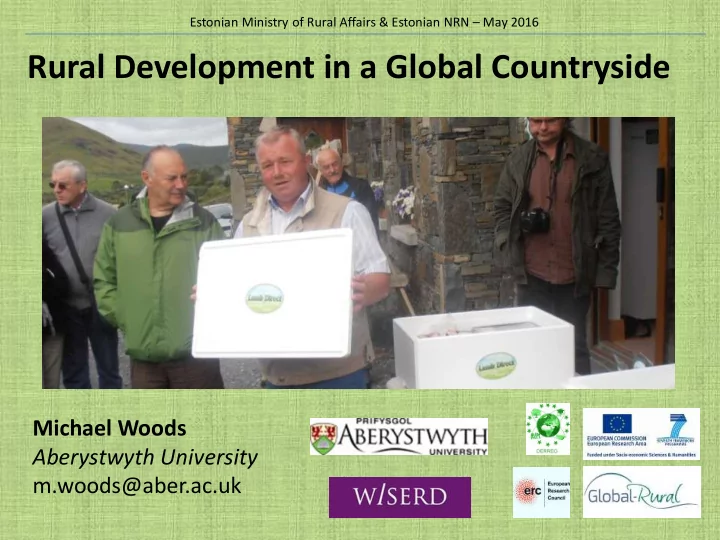
Rural Development in a Global Countryside

Michael Woods Aberystwyth University m.woods@aber.ac.uk

Estonian Ministry of Rural Affairs & Estonian NRN – May 2016
slide-2
SLIDE 2

Lecture Outline

  • 1. Myths about globalization and the

countryside

  • 2. Globalization impacts on rural regions
  • 3. Regional responses to globalization
  • 4. Factors influencing rural regional responses
  • 5. LEADER and rural development in a global

countryside

slide-3
SLIDE 3

The Challenge of Globalization

“globalization is seen to touch every walk of life – opening doors, creating opportunities, raising apprehensions … our response to globalization has moved to the heart of the EU policy agenda.”

Commission of the European Communities (2007)

slide-4
SLIDE 4

Globalization

“a multidimensional set of social processes that create, multiply, stretch and intensify worldwide social [and economic] interdependencies and exchanges while at the same time fostering in people a growing awareness of deepening connections between the local and the distant” Steger (2003), Globalization: A Very Short Introduction, p. 13

  • multiplication of social and economic networks that transcend

traditional borders;

  • stretching of social and economic relations, activities and inter-

dependencies over increasing distances;

  • intensification and acceleration of exchanges that are made across

expanding distances in ever-less time and with increasing frequency;

  • development of a global consciousness.
slide-5
SLIDE 5

Globalization Myths

  • The optimist’s myth: Globalization has produced a

level playing field that has eradicated geographical differences and disadvantages, enabling rural regions to compete with cities for investment

  • The fatalist’s myth: Rural areas are the victims of

globalization, they cannot compete with cities or regions in the developing world and are seeing their economies and cultures crushed by the unstoppable force of globalization – and there is nothing that they can do about it.

slide-6
SLIDE 6

Challenging the Myths

  • Both positions are too simplistic in their imaginings
  • f both globalization and rural areas
  • Both positions see globalization as something that

happens to rural areas

  • Both positions represent rural areas as largely static

and isolated in character

slide-7
SLIDE 7

Challenging the Myths

  • Globalization is reproduced through localities
  • Local actors are involved in mediating, resisting and

facilitating globalization processes

  • Globalization is pervasive but its impacts are not the

same everywhere

  • Globalization does not produce an homogenous

world, but creates new patterns of uneven development

slide-8
SLIDE 8

The Global Countryside

“Through these entanglements, intersections and entrapments, the experience of globalization changes rural places, but it never eradicates the

  • local. Rather, the networks, flows and actors

introduced by globalization processes fuse and combine with extant local entities to produce new hybrid formations. In this way, places in the emergent global countryside retain their local distinctiveness, but they are also different to how they were before.”

(Michael Woods, 2007, in Progress in Human Geography)

slide-9
SLIDE 9

Globalization and Rural Development

  • How are globalization processes reshaping
  • pportunities for rural development?
  • What challenges arise for rural development

from globalization?

  • What difference can regional development

policies and grassroots initiatives make in responding to globalization?

slide-10
SLIDE 10

DERREG

  • ‘Developing Europe’s Rural Regions in the Era of

Globalization’

  • EU Framework Programme 7
  • January 2009 – December 2011
  • Consortium of 9 universities & research centres

in 6 countries led by Aberystwyth University

  • www.derreg.eu
slide-11
SLIDE 11

Case Study Regions

1. Oevre Norrland, Sweden 2. West region (Roscommon), Ireland 3. Alytus, Lithuania 4. Comarca de Verín, Spain 5. Goriška, Slovenia 6. Pomurska, Slovenia 7. Jihomoravský kraj, Czech Republic 8. Westerkwartier, the Netherlands 9. Regierungsbezirk Dresden, Germany

  • 10. Saarland, Germany
slide-12
SLIDE 12

GLOBAL-RURAL project

European Research Council Advanced Grant 2014-2019 €2.27m

www.globalruralproject.wordpress.com @globalrural

Norrland Sweden Queensland North Island Wales Newfoundland Spain / Portugal Rio Grande do Sul Zambia China West of Ireland Liberia

slide-13
SLIDE 13

An interpretative model

Global Processes Regional Contexts and Capacities Catalysts Globalization impacts Policies and Grassroots Initiatives Regional Responses and Outcomes Regional Learning

slide-14
SLIDE 14

Globalization processes

Market Liberalization

  • Increased competition in domestic markets from

dismantling of trade controls

  • New opportunities to grow export markets
  • Footloose strategies by industries seeking cost efficiencies
  • FDI in sites of low cost entry to European market

Network Extension and Intensification

  • Stretching & reconfiguration of global commodity chains
  • International networking valued by rural firms
  • Increased vulnerability to external events
slide-15
SLIDE 15

Globalization processes

Intensification of International Mobility

  • Global tourism
  • International labour migration
  • Amenity migration
  • Cross-border commuting
  • Extended transnational social networks
  • Patterns of return migration and repeat emigration
slide-16
SLIDE 16

Globalization processes

Global Consciousness

  • Greater awareness of international inter-dependencies and

global perspectives

  • Global values and standards
  • Transnational campaigning
  • Challenge to established rural traditions and activities
  • Opportunities for sustainable development

Acceleration of Information Flows

  • Instantaneous transmission of information around the world
  • Information gradient between city and country eroded
  • Benefits from better market intelligence
  • Transnational cooperation and knowledge exchange
slide-17
SLIDE 17

Regional Contexts & Capacities

Geographical Location

  • New opportunities from liberalized borders
  • Some borders still less permeable
  • Continuing disadvantages of poor transport infrastructure
  • Incentives for businesses in remote, less populated regions

to develop international markets to overcome restricted local markets

Resources

  • Mineral resources and global resource boom
  • Opportunities for developing niche products
  • Cultural and environmental resources
slide-18
SLIDE 18

Regional Contexts & Capacities

Political-Economic Context

  • Legacy of socialist central planning
  • Differing ideological emphasis of policies in western

Europe

Human Capital

  • Skilled workforces attracting foreign investment
  • Migrant workers and return migrants attracted by skills

gaps

  • Mismatch of economic structure and skills base as a

driver for out-migration

slide-19
SLIDE 19

An interpretative model

Global Processes Regional Contexts and Capacities Catalysts Globalization impacts Policies and Grassroots Initiatives Regional Responses and Outcomes Regional Learning

slide-20
SLIDE 20

Catalysts

Critical role of individuals

  • Entrepreneurs
  • Social activists
  • Corporate managers
  • Tourism operators
  • Individual actors who can bridge regional and

international contexts

Institutional catalysts including policies and strategies

slide-21
SLIDE 21

Catalysts

Events as catalysts

  • Free trade agreements
  • Accession to the European Union
  • Political revolutions
  • Economic recession stimulating SMEs to

search for new markets

slide-22
SLIDE 22

Globalization Impacts

  • FDI in branch plants
  • Development of export

markets and international networks

  • Takeover of regional

companies by TNCs

  • Closure of factories due to

relocation of production or corporate retrenchment

  • Increased numbers of

international tourists

  • Purchase of properties by

foreign buyers

  • Out-migration to work abroad
  • Influx of foreign migrant

workers into some regions

  • International return migration
  • Designation of protected

landscapes following international models

  • Sustainable development

initiatives responding to global environmental concerns

slide-23
SLIDE 23

Regional Responses

  • These globalization impacts provide the context for

rural regional development in the 21st century

  • What is critical is how regions respond
  • Regional development policies and the actions of

public projects and grassroots initiatives have a critical role in shaping regional futures by assembling coherent responses to globalization impacts.

  • Typology of regional responses
slide-24
SLIDE 24

Models of engaging the global economy

  • Global resource providers
  • Global farmlands
  • Branch-plant economies
  • Global playgrounds
  • Niche innovators
  • Trans-border networkers
  • Global conservators
  • Re-localisers
  • Structurally marginalized regions
slide-25
SLIDE 25

Global resource providers

  • Mineral and energy resources
  • Benefited from global

resources boom

  • Oevre Norrland, Sweden

– Iron ore, copper, gold – 90% of forest products exported (€570 million p.a.) – Anglo-American, Blackstone Nickel, Dragon Minerals etc – State-owned mining company LKAB (exports = 75% of sales) – Steel and paper industries

Kiruna, Northern Sweden

slide-26
SLIDE 26

Global farmlands

  • Export-oriented food production
  • Industrial, productivist agriculture
  • Importance of Asian markets
  • New Zealand

– Always export-oriented, but found new markets after UK joined EEC – Growth of dairy sector in response to Chinese demand, also wine, fruit – Chinese companies building milk processing plants – International investment in land – Vulnerability to fluctuations in global markets (e.g. dairy)

Manawatu, New Zealand

slide-27
SLIDE 27

Branch-plant economies

  • Inward investment by

transnational firms as an established strategy for rural regional development

  • West Region, Ireland

– Ireland accounted for 7% of FDI in EU in 2009 – Over 70 foreign-owned firms located in West Region – Employ over 14,000 people – Medical technology and electronics companies

Castlebar, Ireland

slide-28
SLIDE 28

Branch-plant economies

  • Competitive advantage of Central & Eastern

European states

  • Low cost entry to EU
  • Relocation within EU
  • South Moravia, Czech Rep

– €2.7 bn of FDI in rural districts, 2002-2006

  • Pomurska, Slovenia

– Carthago (German camper van manufacturer)

Boskovice, Czech Republic

slide-29
SLIDE 29

Branch-plant economies

  • Vulnerability of footloose

economics

– Relocation of traditional industries – Withdrawal of branch plants

  • Pomurska, Slovenia

– Takeover of MURA clothing plant

  • Castlebar, Ireland

– Branch plants closed or downsized (e.g. American Power Conversion, Volex, Baxter Travenol)

Murska Sobota, Slovenia

slide-30
SLIDE 30

200 400 600 800 1000 1200

Employment in Castlebar by Major Foreign Firms

Baxter-Travenol (US) Cable Products (US)/Volex (UK) American Power Conversion (APC)(US)

slide-31
SLIDE 31

Global Playgrounds

  • High amenity-value areas
  • International tourism
  • Transnational amenity

migration

  • Pomurska, Slovenia

– British property-owners – Investment in local economy – Entrepreneurial activity

Pomurska, Slovenia

slide-32
SLIDE 32

Global Playgrounds

  • Queenstown, New Zealand

– ‘Adventure Capital of the World’ – Tourism worth over NZ$500m – Over 60% of tourists from

  • utside NZ

– International amenity migration – Over 20% of property owned by international purchaser – Tourism serviced by migrant workers – Local conflicts over scale of development and property prices

slide-33
SLIDE 33

Niche innovators

  • Exporting goods based on

endogenous resources to global niche markets

  • Attracting visitors to niche

events and attractions

  • Oevre Norrland, Sweden

– Niche exports, e.g. bread, berries, wood products – Kiruna ice hotel – Kiruna space centre

Kiruna space centre, Sweden

slide-34
SLIDE 34

Trans-border networkers

  • Border regions with

internationalization primarily focused on networks with neighbouring countries

  • Subverting traditional core-

periphery relations

  • Goriska, Slovenia

– Cross-border trading with Italy – Firms drawing on cross-border labour pool – Cross-border visitors to casinos

Goriska, Slovenia

slide-35
SLIDE 35

Trans-border networkers

  • Border regions with

internationalization primarily focused on networks with neighbouring countries

  • Subverting traditional core-

periphery relations

  • Saarland, Germany

– Residential mobility within Saar- Lor-Lux transnational labour market

Merzig-Wadern, Saarland

(Photo: W. Frys)

slide-36
SLIDE 36

Global Conservators

  • International designations of

natural protection and environmental conservation

  • Provision of ecosystem

services to global community

  • Sites of contestation
  • Saarland, Germany

– Bliesgau UNESCO Biosphere area promoted as model for sustainable development – Opposed by farmers and hunters

Bliesgau UNESCO Biosphere, Saarland

slide-37
SLIDE 37

Re-localisers

  • Re-action to globalization by

re-constructing local value chains

– Limitations of local resources – Potential to extend into niche export markets? – Part of a global movement?

  • Comarca de Verin, Spain

– Initiatives based on revalorizing local cattle breeds, chestnuts, and local carpentry

Vilardevos, Galicia, Spain

slide-38
SLIDE 38

Economic impact Positive Negative Vulnerability High Low Resource providers Branch-plant economies Global playgrounds Niche innovators Trans-border networkers Relocalisers Structurally marginalized Global conservators Global farmlands

slide-39
SLIDE 39

Structurally Marginalized

  • Limited international activity by

local businesses

  • Vulnerable to market and policy

changes

  • Exporter of labour
  • Alytus, Lithuania

– Limited international transactions by local firms – Little international investment – Out-migration of migrant workers – But still potential for development

Alytus, Lithuania

slide-40
SLIDE 40

Factors influencing negotiation of models of engagement

slide-41
SLIDE 41
  • 1. Government policies
  • Industrial and fiscal policies

– Tax incentives for investment – Currency – Privatization

  • Spatial planning policies

– ‘Business zones’ in Goriska, Slovenia – Westerkwartier, Netherlands

  • Scale and responsiveness of governance

– Regional government

slide-42
SLIDE 42
  • 2. Ambition

“The Swedish market is limited and considering all the raw material in the form of the large forests with exceptionally good quality that we have here, exporting has sort

  • f been incorporated in the concept for a long

time now.”

Business interviewee, Oevre Norrland

(Interview by Nordregio team)

slide-43
SLIDE 43
  • 3. Support for endogenous business
  • Even firms with strong international activities

still tend to rely on national and regional support networks

  • Access to financial capital

– Reinvestment within region

  • Support for business development

– Network brokers

slide-44
SLIDE 44
  • 4. International know-how
  • Familiarity with international markets
  • Experience of travelling and working abroad
  • Language skills
  • The Lithuanian problem

– Limited knowledge of international markets – Different legal and fiscal systems – Limited experience of travel – Limited language skills (especially English)

slide-45
SLIDE 45
  • 4. International know-how
  • Migrant communities can make a significant

contribution in creating opportunities and building bridges

  • Potential importance of return migrants

– Ireland – Lithuania

slide-46
SLIDE 46
  • 5. Reflexivity
  • Role for regional development actors in

facilitating ‘regional learning’

– Reflection on regional strengths, resources and challenges – Learning new skills and capacities (or re-learning

  • ld skills)

– Connecting knowledge actors and local actors

slide-47
SLIDE 47

Rural Learning Regions

‘region’ ‘knowledge’

learning region

development initiatives supporting policies facilities

1 2 a 3 b c

‘public administration’ ‘region’ ‘knowledge’

learning region

development initiatives supporting policies facilities

1 2 a 3 b c

‘public administration’

Dirk Roep & Wiebke Wellbrock

slide-48
SLIDE 48

The Westerkwartier

slide-49
SLIDE 49
slide-50
SLIDE 50

Brug Toekomst

  • ‘Bridge to the Future’
  • Collaboration with two universities
  • Project work for students surveying

local residents and working on ideas for rural development

  • Started dialogue between farmers,

foresters and residents, leading to formation of the Westerkwartier Initiative Group (WSI)

slide-51
SLIDE 51

Rural Cafes

  • Events to facilitate informal

exchange of ideas and networking between local residents, farmers, entrepreneurs and regional development agents

  • Opportunities for people to

present development projects and ideas

  • Discussion around development

issues

  • Themed cafes bringing together

people with shared interests

slide-52
SLIDE 52
slide-53
SLIDE 53

LEADER

  • The LEADER programme and Local Action Groups

can play a key role in regional responses to globalization

  • Facilitating regional learning
  • Supporting initiatives, especially under the ‘niche

innovation’ and ‘re-localization’ models

  • Conduits for transnational knowledge exchange

and sharing

  • Examples from DERREG Good Practice Database

http://www.derreg.eu/content/good-practice-database

slide-54
SLIDE 54

Plattelandshuis

(Rural House)

  • Westerkwartier, Netherlands
  • Combined centre for LAG and
  • ther local groups and agencies

with drop-in advice on funding for rural development initiatives

  • Under ‘Living Villages Window’

scheme, experts located in the Plattelandshuis could make small awards of up to €10,000 for projects that contribute to the ‘liveability’ of villages

slide-55
SLIDE 55

Krabat

  • Upper Lusatia, Germany
  • Registered association funded

through LEADER

  • Supporting culture of Sorbian

minority

  • Registered ‘Krabat’ as a

trademark to market regional produce and identify with Sorbian culture

  • Organization of Sorbian festivals

and cultural events

  • http://www.krabatregion.de/index.php?id=871
slide-56
SLIDE 56

LAG Biospharenreservat Bliesgau

  • Saarland, Germany
  • LEADER Local Action Group

focused on UNESCO Bliesgau Biosphere

  • Aims at sustainable

development

  • Uses international UNESCO

designation as a selling point and brand

  • Promoting regional produce
  • http://www.biosphaere-bliesgau.eu/index.php/fr/lag
slide-57
SLIDE 57

Kupujmo Goriska

(Let’s buy Goriska)

  • Goriska, Slovenia
  • Initiative funded under

LEADER

  • Promoting regional

produce

  • Providing

infrastructure for local producers to process, market and sell products locally and in Ljubljana

slide-58
SLIDE 58

Globalization and Rural Europe – The Future

  • Globalization is not something detached and distant from the rural

regions of Europe

  • Regional actors are participants in the reproduction of global

networks through rural regions

  • Regional development policies and grassroots initiatives can

consequently shape regional responses to globalization

  • Developing effective responses to globalization involves reflection

ad learning, with the successful harnessing of lay and expert knowledge, and the facilitation of entrepreneurship and grassroots action.

  • With appropriate policy support, Europe’s rural regions can engage

globalization from the bottom-up, and can have an influence in shaping their own futures

slide-59
SLIDE 59

For More Information

DERREG website

  • www.derreg.eu
  • Good Practice Database
  • Films of good practice from each of the case study regions
  • Resource centre
  • Working papers and publications

GLOBAL-RURAL website

  • www.globalruralproject.wordpress.com
  • Blog
  • Presentations and publications
  • Twitter: @globalrural