RULES PRESENTATION - SUBMITTED QUESTIONS On a measured course, on - - PDF document

rules presentation submitted questions on a measured
SMART_READER_LITE
LIVE PREVIEW

RULES PRESENTATION - SUBMITTED QUESTIONS On a measured course, on - - PDF document

RULES PRESENTATION - SUBMITTED QUESTIONS On a measured course, on the yellow or red tees how far in front or behind the marker can the tee of the day be in order to have a qualifying competition B) What is the overall change in length that must


slide-1
SLIDE 1

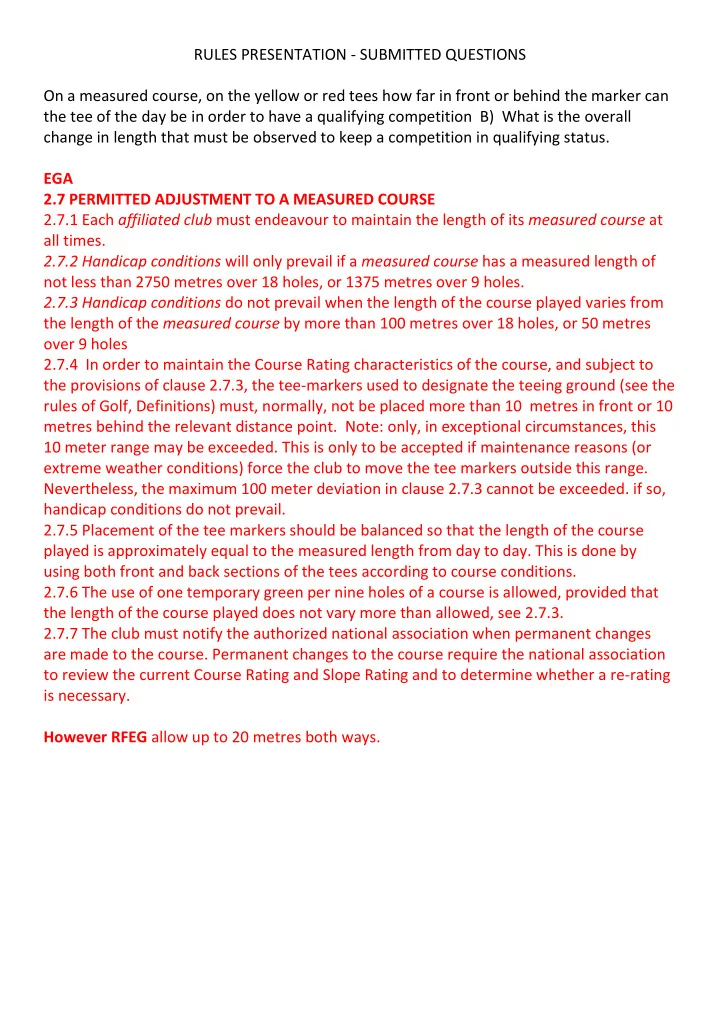
RULES PRESENTATION - SUBMITTED QUESTIONS On a measured course, on the yellow or red tees how far in front or behind the marker can the tee of the day be in order to have a qualifying competition B) What is the overall change in length that must be observed to keep a competition in qualifying status. EGA 2.7 PERMITTED ADJUSTMENT TO A MEASURED COURSE 2.7.1 Each affiliated club must endeavour to maintain the length of its measured course at all times. 2.7.2 Handicap conditions will only prevail if a measured course has a measured length of not less than 2750 metres over 18 holes, or 1375 metres over 9 holes. 2.7.3 Handicap conditions do not prevail when the length of the course played varies from the length of the measured course by more than 100 metres over 18 holes, or 50 metres

  • ver 9 holes

2.7.4 In order to maintain the Course Rating characteristics of the course, and subject to the provisions of clause 2.7.3, the tee-markers used to designate the teeing ground (see the rules of Golf, Definitions) must, normally, not be placed more than 10 metres in front or 10 metres behind the relevant distance point. Note: only, in exceptional circumstances, this 10 meter range may be exceeded. This is only to be accepted if maintenance reasons (or extreme weather conditions) force the club to move the tee markers outside this range. Nevertheless, the maximum 100 meter deviation in clause 2.7.3 cannot be exceeded. if so, handicap conditions do not prevail. 2.7.5 Placement of the tee markers should be balanced so that the length of the course played is approximately equal to the measured length from day to day. This is done by using both front and back sections of the tees according to course conditions. 2.7.6 The use of one temporary green per nine holes of a course is allowed, provided that the length of the course played does not vary more than allowed, see 2.7.3. 2.7.7 The club must notify the authorized national association when permanent changes are made to the course. Permanent changes to the course require the national association to review the current Course Rating and Slope Rating and to determine whether a re-rating is necessary. However RFEG allow up to 20 metres both ways.

slide-2
SLIDE 2

What are the rules regarding pin placement on a green in reference to gradients and also what is the minimum distance from the edge of the putting green to the hole. There are no rules, below are the R & A’s recommendations The following points should be considered: Take into account, where appropriate, the design of the hole as the architect intended it to be played. Determine the length of the shot to the green and how it may be affected by the possible conditions for the day – wind, rain and the holding nature of the green. In this connection it is recommended that a weather forecast is obtained and, if rain is likely, holes should not be cut where water would accumulate. There must be enough putting green surface between the hole and the front and the sides

  • f the green to accommodate the required shot. For example, if the hole requires a long

iron or wood shot to the green, the hole should be positioned deeper in the green and farther from its sides than would be the case if the hole requires a short pitch shot. In any case, it is recommended that generally the hole be positioned at least four paces from any edge of the green. If a bunker is close to the edge, or if the ground slopes away from the edge, the distance should be greater, especially if the shot is more than a pitch. Consideration should be given to allowing fair opportunity for recovery after a reasonably good shot that just misses the green. On the other hand, the penalty for failure is something the player must take into account in deciding whether or not to attack a particular hole position. Much will depend upon the standard of the players.

  • a. An area of two to three feet around the hole should be as level as possible. Effort should

be made to ensure that holes are not positioned within three paces of a very severe slope or ridge or of a recently used hole. If the design of the green dictates that the hole be positioned on a slope, the hole should be cut vertically, not with the slope. A player putting from above the hole should be able to stop the ball near the hole.

  • b. Consider the condition of nearby turf, especially taking care to avoid old hole plugs

which have not completely healed.

  • c. There should be a balanced selection of hole positions for the entire course with respect

to left, right, central, front and back positions. For example, beware too many positions

  • n one side or the other of the green with a resulting premium on drawn or faded shots.
  • d. For a competition played over several days the course should be kept in balance daily as

to the degree of difficulty. The course should not be set up appreciably more difficult for any round – balanced treatment is the aim. The idea of making the course progressively

slide-3
SLIDE 3

harder round after round is one that should be avoided. One form of balanced daily treatment is to select six quite difficult hole positions, six which are moderately difficult and six which are relatively easy. One should also try to keep a balance of using the left and the right of the green. For example, on the first nine there may be four to the right, four to the left and one in the centre. The second nine should be similar. Also, one should vary as much as possible the number of paces from the front edge of the green.

  • e. During practice days before a competition it is recommended that holes are positioned

in areas which will not be used during the competition so that competition positions will not be damaged by foot traffic.

  • f. Anticipate the players’ walking routes. Position holes for early rounds so that good hole

positions for later rounds will not be spoiled by players leaving the green. For example, for a four-day event, on the first day, where possible, the hole positions should be close to the exit line to the next tee. On the second day the holes should be in such a position that the players will be walking on or near the first day’s position. This should leave half

  • f the green for the last two days.

The same recommendations are included in the EGA Handicap book

slide-4
SLIDE 4

Could clarification please be given on the local rule below. My specific questions follow the local rule. WATER HAZARDS - All ponds and ditches (barancas) are water hazards whether they contain water or not. Water Hazards are marked by Yellow stakes or lines. Lateral Water Hazards are marked by Red stakes or lines. Provisional Ball.- Where there is doubt whether a ball is in or is lost in a water hazard, the player may play another ball provisionally under any of the applicable options in Rule 26-1. If the original ball is found outside the water hazard, the player must continue play with it. If the original ball is found in the water hazard, the player may either play the original ball AS IT LIES or continue with the ball played provisionally under Rule 26-1. If the original ball is not found or identified within the five-minute search period, the player must continue with the ball played provisionally Could you please clarify this rule E.G. Playing the 9th on North - you drive and are not sure if it is in the baranca or just short, do you have the choice of playing a provisional ball either 1.from the tee or point of entry to the hazard,or on a line back from the point of entry keeping the pin and entry point in line

  • r 2. Only from the tee

In brief a provisional ball is played before going forward to search to save time. On the hole you quote there is no point in playing a provisional ball as you can always drop just behind the baranca. If you consider the 14th on North long hitters try to go straight over the water but may not know if they have carried the reeds at the far end. In this case the alternatives are to play again from the tee or drop a ball in front of the water and play from there. These can be provisional balls. This rule will only apply to North 14 for Owners and thereafter.

slide-5
SLIDE 5

It is understood that if you subsequently find the original ball in the hazard you have an

  • ption to play it, however if before playing the provisional ball you can see the ball in the

hazard but cannot determine if it is playable are you permitted to play a provisional and keep the option to play the original?

  • No. Once the original is found you must decide to play it or play the provisional.

If after playing the provisional ball, the original is found outside the hazard but in an unplayable lie, can you take penalty relief with this ball? You can play a provisional until you reach the area that the ball may be. If you have not played your provisional past the original, you must play the original, If you have continued playing the provisional beyond the original ball it has become the ball in play and the

  • riginal abandoned. If it is unplayable or not is not relevant.
slide-6
SLIDE 6

If you enter a bunker and have a leaf stuck to a spike on your golf shoe are you allowed to peel it off the shoe and throw it out before taking your shot. Is there a penalty? A good question, I would say that once the loose impediment is in the bunker it should not be touched. Your ball lands in the bunker and so does the other players in your group. You take your shot first but fail to get out of the bunker, are you allowed to rake your footprints as a courtesy before the other player takes their shot? Yes the other player is entitled to have the bunker restored to its condition before the first shot was played Out of bounds. West Course. When playing 17th out of bounds is on or beyond the buggy path. My question is if my ball is in bounds, can I take relief from the buggy path (which is out of bounds) remembering that there is normally no relief from out of bounds fences or posts? Or must I play it as it lies being careful to stand in bounds, ie not on the path. The path is not an obstruction as it is out of bounds. You can stand out of bounds to play a ball in bounds. North Course. Hole 9. If my ball lies on the path just beyond the water hazard. Can I drop nearest point of relief not nearer the hole or in the hazard (in practice that would be to the right where path ends) because my ball is unplayable because of the sleepered edge of the greenside of the path. I am always unsure about these two areas and will be very grateful to know the correct answer. If I understand your query you are not referring to the buggy path. This is not therefore an artificial surface. However the sleepers are an obstruction. The nearest point of relief cannot not be in a hazard.

slide-7
SLIDE 7

17th Hole North Course - There are blue stakes, at least one or two, around the perimeter of the green which I assume mean ground under repair and you have a free drop, which you would anyway if you landed on a proper green in play on the course. However what is the situation if you land on say the right hand edge of the bunker on the left close to the green

  • r actually in the bunker? Really this bunker was part of the hole when it was changed and

I am not at all sure if it is intended to be part of the current hole. Clarification would be very helpful. This is confusing simply because the area in not marked correctly. The green itself is out of play in accordance with normal rules. The places where turf has been removed should be

  • GUR. We plan to put a DZ here and mark it correctly before the Owners Champs. The

bunkers are both in play at present. On South 14 if you hit your shot into the waste area and it ends up in the pampas grass but cannot be found what should you do? If everybody agrees that it has landed there do you still have to play stroke & distance or can it be played as an unplayable lie? A waste area is not a hazard or GUR. If you do not find your ball it is lost, stroke & distance penalty applies. On West 10 the hazard is marked as a Lateral Water Hazard (red stakes). Can I drop the ball across the hazard as long as it is no nearer the hole. On a lateral hazard you may drop within two club lengths of a point on the opposite margin

  • f a hazard that is equidistant from the point where a ball last crossed the margin.