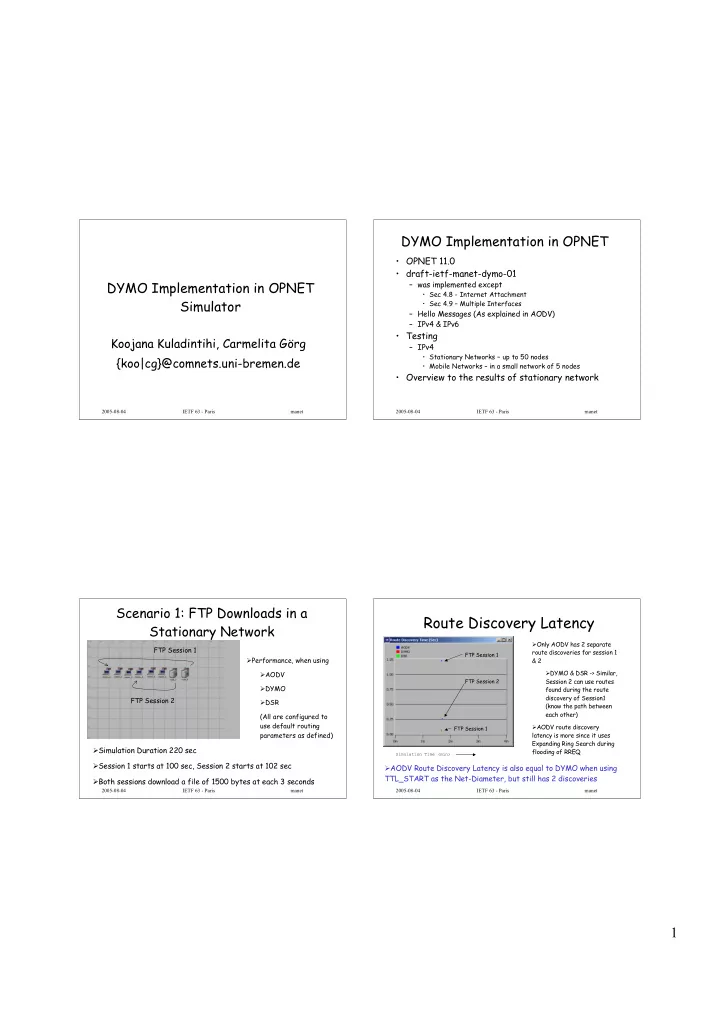
Route Discovery Latency Stationary Network Only AODV has 2 separate - - PDF document

route discovery latency
SMART_READER_LITE
LIVE PREVIEW

Route Discovery Latency Stationary Network Only AODV has 2 separate - - PDF document

DYMO Implementation in OPNET OPNET 11.0 draft-ietf-manet-dymo-01 DYMO Implementation in OPNET was implemented except Sec 4.8 - Internet Attachment Simulator Sec 4.9 Multiple Interfaces Hello Messages (As explained


slide-1
SLIDE 1

1

2005-08-04 IETF 63 - Paris manet

DYMO Implementation in OPNET Simulator

Koojana Kuladintihi, Carmelita Görg {koo|cg}@comnets.uni-bremen.de

2005-08-04 IETF 63 - Paris manet

DYMO Implementation in OPNET

  • OPNET 11.0
  • draft-ietf-manet-dymo-01

– was implemented except

  • Sec 4.8 - Internet Attachment
  • Sec 4.9 – Multiple Interfaces

– Hello Messages (As explained in AODV) – IPv4 & IPv6

  • Testing

– IPv4

  • Stationary Networks – up to 50 nodes
  • Mobile Networks – in a small network of 5 nodes
  • Overview to the results of stationary network

2005-08-04 IETF 63 - Paris manet

Scenario 1: FTP Downloads in a Stationary Network

FTP Session 2 FTP Session 1

  • Simulation Duration 220 sec
  • Session 1 starts at 100 sec, Session 2 starts at 102 sec
  • Both sessions download a file of 1500 bytes at each 3 seconds
  • Performance, when using
  • AODV
  • DYMO
  • DSR

(All are configured to use default routing parameters as defined)

2005-08-04 IETF 63 - Paris manet

Route Discovery Latency

  • Only AODV has 2 separate

route discoveries for session 1 & 2

  • DYMO & DSR -> Similar,

Session 2 can use routes found during the route discovery of Session1 (know the path between each other)

  • AODV route discovery

latency is more since it uses Expanding Ring Search during flooding of RREQ

  • AODV Route Discovery Latency is also equal to DYMO when using

TTL_START as the Net-Diameter, but still has 2 discoveries

Simulation Time (min)

FTP Session 1 FTP Session 2 FTP Session 1

slide-2
SLIDE 2

2

2005-08-04 IETF 63 - Paris manet

FTP Download Response Time (Sec)

  • At the beginning AODV

has higher Response time

  • After the routes are

made, DSR has higher response time than AODV & DYMO (due to source routing)

  • In general, DYMO has the

lowest response time

Simulation Time (min)

2005-08-04 IETF 63 - Paris manet

Total Load in bps (Link Layer)

  • AODV & DYMO have Routing overhead at the beginning (Hello Messages

are not used in this scenario)- Dymo routing overhead is higher than AODV

  • DSR has the overhead even after the routes are made

Simulation Time (min)

2005-08-04 IETF 63 - Paris manet

Scenario 2: 50-node Stationary Network

  • Simulation Duration 300 sec
  • Each node starts downloading

files (@6 sec) from the server in the middle

  • FTP Download
  • Starts at each node

between (100-300) in an uniformly distributed manner

  • Lasts abt 40 sec

2005-08-04 IETF 63 - Paris manet

Route Discovery (Sec) & Num. of RREQ packets sent

Simulation Time (min)

  • Number of Route Discoveries (AODV > DYMO > DSR)
  • AODV flooding is controlled by ERS
  • Each DYMO flooding is up to 10 hops, but no route discoveries if the paths

are known

slide-3
SLIDE 3

3

2005-08-04 IETF 63 - Paris manet

Delay in WLAN

Simulation Time (min)

2005-08-04 IETF 63 - Paris manet

Routing Traffic Sent

Simulation Time (min)

  • DYMO has sent more routing traffic (due to path accumulation)
  • Higher route discoveries than DSR and message sizes are bigger since

REBlock attachments

  • Flooding in AODV uses ERS. Total RREQ message propagation is controlled

2005-08-04 IETF 63 - Paris manet

Observations

  • Path Accumulation in DYMO (Attachment of

ReBlocks )

– Improve the performance by reducing the route discoveries when intermediate nodes want to send data (Scenario 1) – This performance is no longer valid, if intermediate nodes start the route discoveries after the lifetime of the route discovery, i.e 3 sec (Scenario 2) – Solution?

  • Send a separate RE message to extend the path lifetime

(10 sec, 100Sec, ?) after the successful route discovery or Lifetime of routes during the route discovery could be increased

2005-08-04 IETF 63 - Paris manet

Observations

  • Flooding to Net-Diameter (TTL=10)

in DYMO

– Performance is better in smaller networks (Scenario1) – For larger networks, this will increase more routing traffic overhead. (Scenario 3) – Solution?

  • Adapting a mechanism like ERS