Roundtable Discussion on Food Composition Database - - PowerPoint PPT Presentation

roundtable discussion on food composition database
SMART_READER_LITE
LIVE PREVIEW

Roundtable Discussion on Food Composition Database - - PowerPoint PPT Presentation

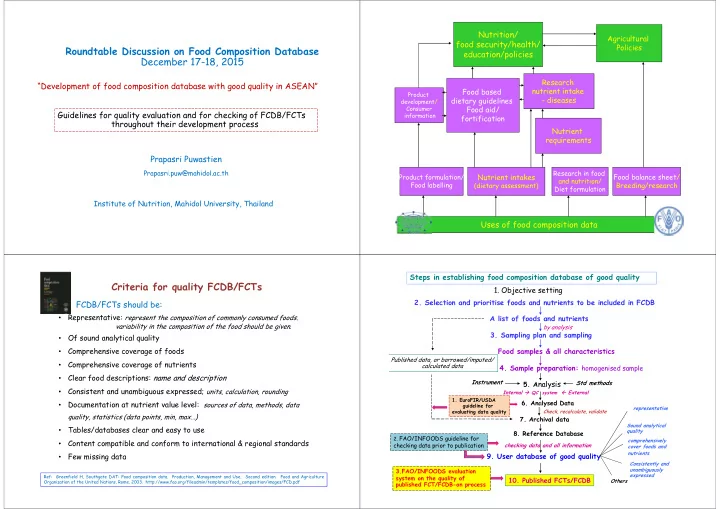
Nutrition/ Agricultural food security/health/ Policies Roundtable Discussion on Food Composition Database education/policies December 17-18, 2015 Research Development of food composition database with good quality in ASEAN Food based


slide-1
SLIDE 1

“Development of food composition database with good quality in ASEAN” Guidelines for quality evaluation and for checking of FCDB/FCTs throughout their development process

Roundtable Discussion on Food Composition Database December 17-18, 2015

Prapasri Puwastien

Prapasri.puw@mahidol.ac.th

Institute of Nutrition, Mahidol University, Thailand

Uses of food composition data

Nutrient intakes

(dietary assessment) Product formulation/ Food labelling Research in food and nutrition/ Diet formulation Food balance sheet/ Breeding/research

Research nutrient intake

  • diseases

Nutrient requirements

Nutrition/ food security/health/ education/policies

Agricultural Policies Food based dietary guidelines Food aid/ fortification

Product development/ Consumer information

Criteria for quality FCDB/FCTs

FCDB/FCTs should be:

  • Representative: represent the composition of commonly consumed foods.

variability in the composition of the food should be given.

  • Of sound analytical quality
  • Comprehensive coverage of foods
  • Comprehensive coverage of nutrients
  • Clear food descriptions: name and description
  • Consistent and unambiguous expressed; units, calculation, rounding
  • Documentation at nutrient value level: sources of data, methods, data

quality, statistics (data points, min, max…)

  • Tables/databases clear and easy to use
  • Content compatible and conform to international & regional standards
  • Few missing data

Ref: Greenfield H, Southgate DAT: Food composition data. Production, Management and Use, Second edition. Food and Agriculture Organization of the United Nations, Rome, 2003. http://www.fao.org/fileadmin/templates/food_composition/images/FCD.pdf

  • 6. Analysed Data

Food samples & all characteristics

  • 4. Sample preparation: homogenised sample
  • 2. Selection and prioritise foods and nutrients to be included in FCDB

A list of foods and nutrients

  • 3. Sampling plan and sampling
  • 5. Analysis

checking data and all information

  • 8. Reference Database

Internal  QC system  External

  • 9. User database of good quality

Steps in establishing food composition database of good quality

Std methods Instrument Published data, or borrowed/imputed/ calculated data

  • 10. Published FCTs/FCDB

by analysis

representative Sound analytical quality comprehensively cover foods and nutrients Consistently and unambiguously expressed Others

  • 1. Objective setting

Check, recalculate, validate

  • 1. EuroFIR/USDA

guideline for evaluating data quality

  • 2. FAO/INFOODS guideline for

checking data prior to publication

  • 7. Archival data

3.FAO/INFOODS evaluation system on the quality of published FCT/FCDB-on process

slide-2
SLIDE 2

EuroFIR System USDA System

For use in different countries Modified for compatibility with US system For use in the U.S. Designed for data from scientific literature, analytical reports and similar Designed for data to be included in USDA database Designed for all foods and nutrients Designed for assessment of Fe, Se, carotenoids. Modified to include flavanoids, vit B2, vit K 7 assessment categories Food description and component identification are important for data exchange 5 assessment categories More focus on sampling and analytical methods Analytical assessments designed to be used by non-expert users/compilers (with guidelines) with varying knowledge and skills Designed by experts in particular nutrients

  • 1. EuroFIR and USDA systems for quality assessment of FCD

Ref: Mark Roe: presentation at FoodComp 2015, Wageningen, the Netherland

Guidelines for assessing/checking data quality throughout the developing process

EuroFIR quality assessment of data USDA quality assessment of data Categories assessed (7 components) Categories assessed (5 categories)

  • 1. Food description:
  • for all type of foods: 12 criteria
  • for manufactured food: 5 criteria
  • 2. Component identification:

3 criteria

  • 3. Sampling plan: 6 criteria
  • Sampling Plan: 6 criteria
  • 4. Number of analytical samples:

5 criteria

  • Number of analysed samples:

1 criteria

  • 5. Sample handling: 2 criteria
  • Sample Handling: 7 criteria
  • 6. Analytical method 2 criteria
  • Analytical methods: 7 criteria,

special nutrient analysis

  • 7. Analytical quality control: 3 criteria
  • Analytical quality control:

6 criteria

Categories of quality assessment: EuroFIR and USDA

7 categories, 33 – 38 criteria 5 categories, 27 criteria

Categories of data quality for consideration

Yes NO N/A QI FOOD DESCRIPTION FOR ALL FOODS Is the food group known? (e.g. beverage, dessert, pasta dish) Was the food source of the food or of the main ingredient clearly provided? Was the part of plant or part of animal clearly indicated? If relevent, was the analyzed portion described and is it stated explicitly if the food was analsed with or without the inedible part? If relevent, was the extent of heat treatment provided? If the food was cooked, were satisfactory cooking method details provided? Was relevent information on treatment applied provided? Was information on preservation method provided? Was information on packing medium provided? Was information about the origin of food provided? If relevent, was the month or season of production indicated? Was the moisture content of the sample measured and the result given? Food Description QI (Quality Index score) COMPONENT IDENTIFICATION

Is the component described unambiguously? Is the unit unequivocal? Is the matrix unit unequivocal?

Component Identification QI (Quality Index score)

Data quality assessment: based on EuroFIR Guideline

  • 1. Food description
  • 2. Component identification
  • 3. Sampling plan
  • 4. Number of analytical samples
  • 5. Sample handling
  • 6. Analytical method
  • 7. Analytical performance

EuroFIR Guideline 7 categories

Institute of Nutrition, Mahidol University 7

EVALUATION PROCESS

  • In each category CRITERIA will be used to assess the level of quality
  • For each criterion, a compiler will give one answer: YES, NO,
  • r NOT APPLICABLE (N/A)

“NOT APPLICABLE”: the considered criterion is not relevant for the food and nutrient considered

  • Then a quality score (Quality index, QI) for each quality category will

be assigned.

Institute of Nutrition, Mahidol University 8

EuroFIR Workpackage 1.3, Task Group 4 Guidelines for Quality Index Attribution to Original Data from Scientific Literature or Reports for EuroFIR Data Interchange. http://www.eurofir.net/sites/default/files/Deliverables/EuroFIR_Quality_Index_Guidelines.pdf

slide-3
SLIDE 3

SCORING OF EACH CATEGORY

  • Based on answers to all criteria (yes/no) within a category, the compiler will

assign a score (1-5) to the category

  • Criteria for calculation/assignment of the quality score (QI) is specific for

each category depending on number and nature of considered criteria

  • Criteria that are “NOT APPLICABLE” are not counted in the quality score

Interpretation of quality scores (quality index) of each category:

5 = high quality 4 = less than high quality but better than intermediate 3 = intermediate 2 = better than low quality but less than intermediate 1 = low quality

Institute of Nutrition, Mahidol University 9

QUALITY INDEX – QI

Overall Quality Index = Sum of assigned quality score for 7 categories

Total Quality Index of a nutrient data will range from 7 (low quality) to 35 (high quality.

Categories of quality for consideration

Yes NO N/A QI

  • 1. FOOD DESCRIPTION 13 criteria

FOR ALL FOODS Is the food group known? Was the food source of the food or of the main ingredient clearly provided? Was the part of plant or part of animal clearly indicated? If relevent, was the analyzed portion described and is it stated explicitly if the food was analsed with or without the inedible part? If relevent, was the extent of heat treatment provided? If the food was cooked, were satisfactory cooking method details provided? Was relevent information on treatment applied provided? Was information on preservation method provided? Was information on packing medium provided? Was information about the origin of food provided? If relevent, was the month or season of production indicated? Was the moisture content of the sample measured and the result given?

Food Description QI

  • 2. COMPONENT IDENTIFICATION: 3 criteria

Is the component described unambiguously? Is the unit unequivocal? Is the matrix unit unequivocal?

Component Identification QI

Total (overall) Quality index = QI 1+QI 2+QI 3+….+QI 7

QI 1 QI 2

No confidence code has been assigned to the EuroFIR quality assessment process (2008)

Total quality index (QI) of all categories range: 7-35 Confidence code (CC) range: A (high quality) – D (low quality)

CONFIDENCE CODES (CC) (given in some systems)

Confidence codes (CC) is an expression of the overall trust of the compiler to the particular data.

CC

Degree of confidence

Total QI A

high quality

35-30 B

some confidence but with limitations

<30-20 C

low confidence but with best estimates

<20-12 D

no confidence in the data

<12-7 CCs can guide the FCT/FCDB users on the quality of the food data

A = Data can be used with more confidence D = Low quality data may still be useful – it may be the only value!

  • 6. Analysed Data

Food samples & all characteristics

  • 4. Sample preparation: homogenised sample
  • 2. Selection and prioritise foods and nutrients to be included in FCDB

A list of foods and nutrients

  • 3. Sampling plan and sampling
  • 5. Analysis

checking data and all information

  • 8. Reference Database

Internal  QC system  External

  • 9. User database of good quality

Steps in establishing food composition database of good quality

Std methods Instrument Published data, or borrowed/imputed/ calculated data

  • 10. Published FCTs/FCDB

by analysis

representative Sound analytical quality comprehensively cover foods and nutrients Consistently and unambiguously expressed Others

  • 1. Objective setting

Check, recalculate, validate

  • 1. EuroFIR/USDA

guideline for evaluating data quality

  • 2. FAO/INFOODS guideline for

checking data prior to publication

  • 7. Archival data

3.FAO/INFOODS evaluation system on the quality of published FCT/FCDB-on process

slide-4
SLIDE 4

2. FAO/INFOODS (2012) FAO/INFOODS Guidelines for Checking Food Composition Data prior to the Publication of a User Table/Database-Version 1.0, FAO, Rome. 38 pages. http://www.fao.org/infoods/infoods/standards‐guidelines/en/

  • The Guidelines help in checking and standardising the detailed

information in FCT/FCDB  increase quality of FCDBs.

  • It is recommended to be used by the data generators and compilers to

check the user database prior to publishing a user table/database and by the users to check the quality of printed FCT/FCDB and to get detailed information related to the process on FCD development

Guidelines for assessing/checking data quality throughout the developing process

The second guideline for checking FCD in the developing process

2. FAO / INFOODS Guidelines for Checking Food Composition Data prior to the publication of a Table/Database - Version 1.0, 2012

  • 3. Checks

3.1 Checks of food identification 3.2 Checks on components 3.3 Checks on recipes (if data derived from recipe calculation) 3.4 Checks on data documentation

Contents of the book: 38 pages

1. Background and objectives 2. General food composition issues

  • food identification
  • component nomenclature, conventions and expression
  • recipes
  • documentation in the user tables/DB
  • food composition database management system

+ 3 Important Annexes

3. Checks of 4 sections Example of components included 3.1

Checks of food identification Food names and food description, Food group classification, food coding

3.2

Checks on components

Component name and expression, mathematical check, edible/inedible parts, specific checks for individual nutrients (e.g., INFOODS tagnames, forms, calculation, conversion factors, etc.) significant figures, rounding procedures

3.3

Checks on recipes

Special list of checks on recipes before, during and after recipe calculation, documentation of recipes.

3.4

Checks on data documentation

Introduction/general information (publication year, differences/changes compared to previous version), documentation in the user table, food index and reference list.

2. FAO / INFOODS Guidelines for Checking Food Composition Data

No scoring system in this guideline, any error or mistake found, must do corrective action

  • 6. Analysed Data

Food samples & all characteristics

  • 4. Sample preparation: homogenised sample
  • 2. Selection and prioritise foods and nutrients to be included in FCDB

A list of foods and nutrients

  • 3. Sampling plan and sampling
  • 5. Analysis

checking data and all information

  • 8. Reference Database

Internal  QC system  External

  • 9. User database of good quality

Steps in establishing food composition database of good quality

Std methods Instrument Published data, or borrowed/imputed/ calculated data

  • 10. Published FCTs/FCDB

by analysis

representative Sound analytical quality comprehensively cover foods and nutrients Consistently and unambiguously expressed Others

  • 1. Objective setting

Check, recalculate, validate

  • 1. EuroFIR/USDA

guideline for evaluating data quality

  • 2. FAO/INFOODS guideline for

checking data prior to publication

  • 7. Archival data

3.FAO/INFOODS evaluation system on the quality of published FCT/FCDB-on process

slide-5
SLIDE 5
  • 3. FAO/INFOODS evaluation

system on the quality of published FCT/FCDB:

initiated in February 2015,

FAO/INFOODS evaluation framework and criteria on the quality of published food composition tables and databases

Source: Food Composition Discussion Group [InFoods-Food-Comp-L@LISTSERV.FAO.ORG], February 2015

Background Many published food composition tables and databases (FCT/FCDB) are available and new ones are published regularly. There is no publicly available evaluation system for published FCT/FCDB. However, it would be useful for compilers as well as for users to be aware of the criteria on how to judge if a published FCT/FCDB fulfills a certain quality standard. Therefore, FAO/INFOODS has developed an evaluation system

  • n the quality of published FCT/FCDB.

Objectives: The objectives are the followings:

  • To assist compilers in publishing FCT/FCDB which are

user-friendly and include the necessary information and data to facilitate a range of different uses, e.g. consumers, researchers, agriculture, decision-makers for policies and programmes

  • To provide an objective measurement tool to judge the

quality of published FCT/FCDB

  • To compare the quality of different FCT/FCDB

FAO/INFOODS evaluation framework on the quality of published food composition tables and databases

Source: Food Composition Discussion Group [InFoods‐Food‐Comp‐L@LISTSERV.FAO.ORG], February 2015

  • To demonstrate areas of improvements to compilers for future

editions

  • To be able to demonstrate an improvement of the quality of

FCT/FCDB editions over time

  • To demonstrate to decision-makers and users the strengths or

weaknesses of data in published FCT/FCDB and the uncertainty and risk they may introduce into the quality of their data, research result, policies and programmes when using the data of a specific FCT/FCDB

  • To attract funding for FCT/FCDB of higher quality, or for those

with lower quality with the objective to improve them

Objectives: (continued)

Source: Food Composition Discussion Group [InFoods‐Food‐Comp‐L@LISTSERV.FAO.ORG], February 2015

FAO/INFOODS evaluation framework on the quality of published food composition tables and databases

slide-6
SLIDE 6

INFOODS’ request to the INFOODS members

  • Comments on the content – background and objectives
  • f the FAO/INFOODS evaluation system
  • Proposed idea/opinion on criteria, sub-criteria, and

system for quality assessment of the published FCT/FCDB

Activities on FAO/INFOODS evaluation system on the quality

  • f published FCT/FCDB will be continued shortly in 2016.

Roundtable Discussion on Food Composition Database December 17-18, 2015

“Development of food composition database in ASEAN with good quality” Objectives:

 Development of criteria for quality evaluation of published FCTs/FCDB  Quality evaluation of current FCTs in ASEAN using the developed criteria and evaluating system  Identification of discrepancies and discuss possibility to harmonize FCTs/FCDB development process and components  Discussion on status of national FCTs in ASEAN, strength/weakness, problems/needs, and gaps  Developing action plan of activities for quality improvement of the FCT/FCDB  Developing action plan for succeeding workshops and future contributions and collaboration of ILSI and stake holders

Developing quality system for evaluation of Published FCT/FCDB. What do we need?

  • Criteria
  • Sub-criteria
  • Weighted score for the criteria
  • Scoring system to indicate the quality of the

evaluated FCT/FCDB

  • Ranking scoring of sub-criteria

Day 1. Development of draft criteria and system for FCT/FCDB quality evaluation

  • Brain storming on preparation of the components of FCT/FCDB quality

evaluating system: criteria, sub-criteria, weighting and scoring system

  • Discussion and agreement on the proposed system for quality evaluation of the

published FCTs/FCDB

  • Documenting the proposed draft criteria and the FCT/FCDB evaluating system

Roundtable Discussion on Food Composition Database

Activities:

Day 2. Quality evaluation of the current FCTs in ASEAN and development of future action plan

  • Quality evaluation of country-specific FCTs using the evaluating system from

Activity I

  • Discussion on the over-all quality of the current FCTs in ASEAN
  • Identifying common problems, collaboration opportunities, etc (as in the objectives)
  • Developing action plan for subsequent activities (e.g. workshops and timelines),

strengthening public-private partnership

  • Discussion of possibility for developing ASEAN FCT/FCDB