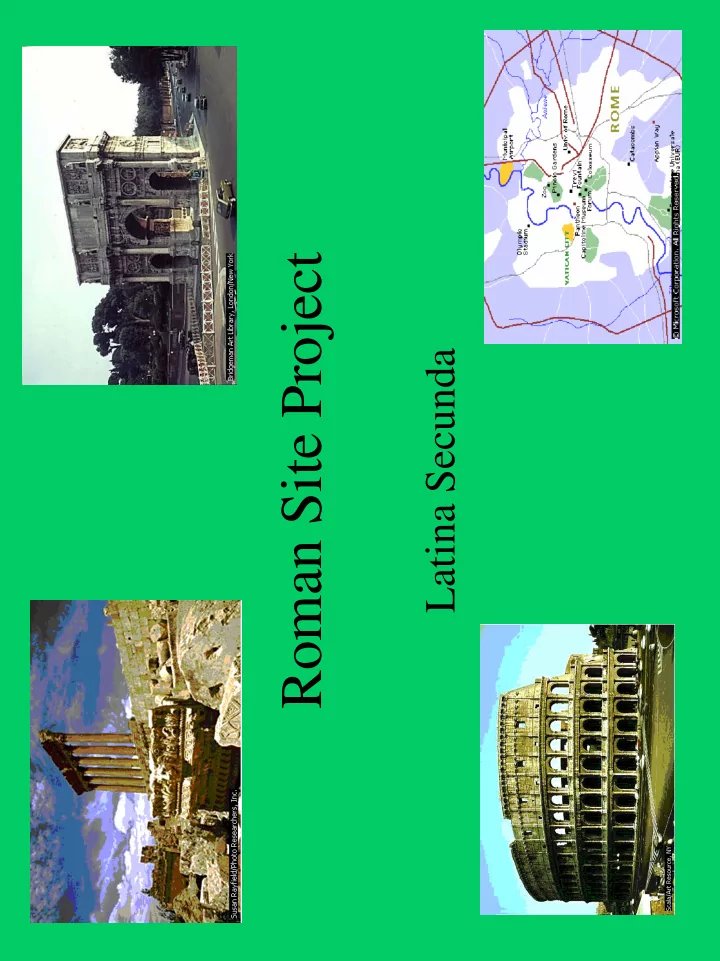
Roman Site Project Latina Secunda FLAVIANUM AMPHITHEATRUM - - PDF document

roman site project
SMART_READER_LITE
LIVE PREVIEW

Roman Site Project Latina Secunda FLAVIANUM AMPHITHEATRUM - - PDF document

Roman Site Project Latina Secunda FLAVIANUM AMPHITHEATRUM Aedificatum est in lacus Neronis loco. Primum nomen erat Flavianum Amphitheatrum. Hodie notum erat ut Colosseum. Aedificatum est consulo Vespasiano. Dedicatum


slide-1
SLIDE 1

Roman Site Project

Latina Secunda

slide-2
SLIDE 2

FLAVIANUM AMPHITHEATRUM

  • Aedificatum est in lacus

Neronis loco.

  • Primum nomen erat

Flavianum

  • Amphitheatrum. Hodie

notum erat ut Colosseum.

  • Aedificatum est consulo

Vespasiano.

  • Dedicatum est ab Tito,

eius filio (80 AD)

slide-3
SLIDE 3

Reconstruction of the Colosseum

  • Deterioration caused by:

– Lightning(2nd c.) – Earthquake(6th c.) – Shifting foundation – Re-use of material (stone and metal joints) – Traffic – Looting

slide-4
SLIDE 4

Structural Details

  • The vault formed the

basis for the Colosseum’s entrances as well as the passage- ways to the upper level seating.

slide-5
SLIDE 5

The Blood-thirsty Arena

  • Its main purpose—

entertainment.

– Thousands killed—captives, Christians, criminals, animals.

  • Mock naval battles

– Vespasian re-enacted Actium

  • Gladiatorial combat.

– Retiarius – Secutor – Thracian – Bestiarius

slide-6
SLIDE 6

The Ludus Magnus (Gladiator School)

  • Training grounds were next to

Colosseum.

  • Contained a mini amphitheater.
  • Emperor in charge of schools.
  • Lanista was head of school.
  • Types modeled on Roman

enemies, e.g., Samnite, Thracian, Gaul.

  • Gladiators were given fighting

names, e.g., Ajax, Callidromus.

slide-7
SLIDE 7

Really neat facts

  • First permanent amphitheater.
  • Naval battles (naumachia) were

reenacted.

  • Seated 50, 000.
  • It was incomplete at the time of

its dedication.

  • Women were banished to the

highest level.

  • A velarium protected spectators

in cases of extreme heat or rain.

  • Arena substructure contained an

intricate system of animal cages and elevators.

  • Arena floor held trap doors.
  • The passageways for animals

were not big enough for certain animals.

slide-8
SLIDE 8

Bibliography

  • Microsoft Encarta 2001.
  • Sear, Frank. Roman Architecture. Cornell University Press: Ithaca,

New York, 1982.