
SLIDE 1
Rolls-Royce Marine - The “Environship Concept”
System Solutions & Wave Piercing Technology
Odd Magne Horgen
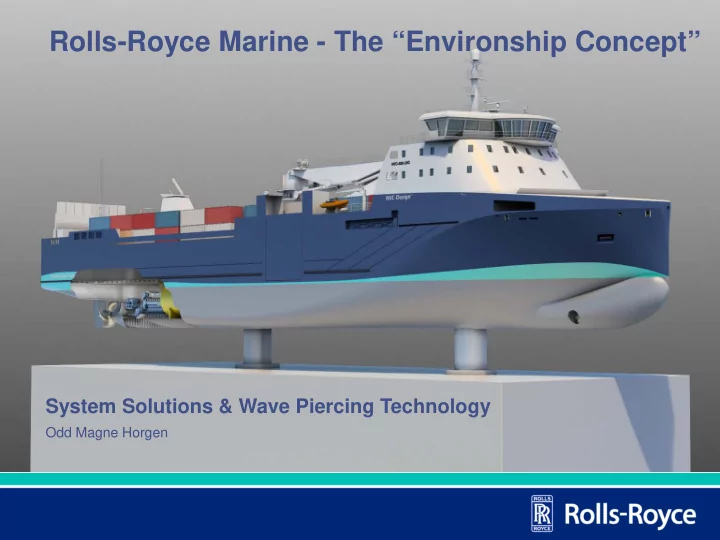
Rolls-Royce Marine - The Environship Concept System Solutions & - - PowerPoint PPT Presentation
Rolls-Royce Marine - The Environship Concept System Solutions & Wave Piercing Technology Odd Magne Horgen Content 1910 Rolls-Royce in general Engines Environmentally friendly system solutions 2007 LNG as fuel for
System Solutions & Wave Piercing Technology
Odd Magne Horgen
1910 2007
Rolls-Royce data - Restricted
Civil Aerospace Defence Aerospace Marine Energy
39 000 employees
World leading supplier addressing four global markets:
Customer
One contact, one supplier, one deal = a safe & cost-effective solution
MANOEUVRING ENGINES DECK MACHINERY AUTOMATED HANDLING SYSTEMS AUTOMATION ELECTRIC SYSTEM PROPULSION
C25:33 engine (2002-)
Output 1840 - 3000 kW Bore x stroke 250 x 330 mm Speed range 900 - 1000 rpm BMEP 22.2 - 26.7 bar Fuel types MDO, HFO Propulsion and Gen.set applications Inline: 6-8-9
Output 1400 - 2500 kW Bore x stroke 260 x 330 mm Speed range 900 - 1000 rpm BMEP 18,2 bar Fuel types Natural Gas LNG Propulsion and Gen.set applications Inline: 6-8-9
B32:40 engine (2001-)
Output
2765 - 8000 kW
Bore x stroke 320 x 400 mm Speed range 720 - 750 rpm BMEP
24.9 bar
Fuel types
MDO, HFO
Propulsion and Gen.set applications
Inline: 6-8-9 V type: 12-16 1100 B engines sold
B35:40 engine (2003-)
Output
2625 - 9600 kW
Bore x stroke 350 x 400 mm Speed range 720 - 750 rpm BMEP
18.2&20 bar
Fuel types
Natural Gas, LNG
Propulsion and Gen.set applications
In line type:6-8-& 9 Vee type : 12-16-20
141 B gas engines sold C26:33 engine (2010-) 345 C engines sold 16 C gas engines sold
But what if the ship emissions ruin it…?
Bergen - Harbour 2011
Geiranger
Foto: Atle Daae Andersen
Spark Ignited lean Burn Gas Engines:
Gas Engines, compliant with the current IMO II legislation and IMO III from 2016
Bergen Engine nett GHG (CO2-CH4 slip) reduction is 22%
Diesel Engines, compliant with the current IMO II legislation. Requries sub- equipment to meet IMO III from 2016.
2 4 6 8 10 12 14 16 18 130 200 400 600 750 800 1000 1200 1400 1600 1800 2000 2200
Rated Engine Speed NOx (g/kWh) IMO Tier I (2000) IMO Tier II (2011)
B32:40 CD C25:33 CD B35:40 gas C26:33 gas
IMO Tier III 2016
NOx curves
Gas powered propulsion Hybrid propulsion
High efficiency propulsion and manoeuvring systems: PROMAS up to -8%
Advanced hull forms
Application for patent protection by Rolls-Royce
up to -8%
BERGEN Gas engine technology – 24,6 knots
Electric Propulsion system; 3 x C2633L9AGas + 1 x C25:33L9A mdo and 4 x 100 AZP Fuel reduction >30% compared to first 5 ships (7,5 % from engine)
Complete design and equipment package: Gas engine, Gear box, propeller, LNG tank, ACON-HSG system
40% Green House Gas reduction!! 22% from engine 18% from design and Promas
Complete design and equipment package: Gas engine, Gear box, propeller, LNG tank, ACON-HSG system
ROLLS-ROYCE HSG – HYBRID SHAFT GENERATOR
HYBRID SHAFT GENERATOR
Shaft generator to switchboard power flow control. Engine and propeller can operate at variable speeds Stable network frequency Fixed voltage Benefits. Reduced fuel consumption Flexible operations Optimised propulsion mode selection Longer engine life and reduced maintenance Increased comfort on board Improved redundancy
ROLLS-ROYCE HSG – HYBRID SHAFT GENERATOR
HYBRID SHAFT GENERATOR
A range of operational modes Boost mode Transit mode Parallel mode Diesel/gas electric mode
2 x C26:33L6PG @ 1705kW, 1000rpm 2 x Aquamaster US 35
Complete design and equipment package: Gas engine, Gear box, propeller, LNG tank, ACON-HSG system
Complete design and equipment package: Gas engine, Gear box, propeller, LNG tank, ACON-HSG system
21
Today (2012) Gas availability steadily increasing worldwide LNG carriers (like “Corale Methane”) will bring gas from main- to smaller terminals and ports Gas distributors ready to increase gas availability based upon demand Gas supply in Europe superceed the LNG demand from ships per today Volume of LNG will drive down LNG price
22
1t diesel emits 3,2t CO2 1t natural gas emits 2,55t CO2 The difference is 20% reduction Due to higher energy content in gas the possible Greenouse Gas reduction is almost 30% Uncombusted Methane has a GHG effect factor 21-25 times higher than CO2 If unburned methane is released from the combustion the GHG reduction is quickly eroded
200 190 180 170 160 150 3 6 9 12
E2 weighed methane slip in g/kWh
Gas engine fuel consumption in g/kWh
Reduction of GHG in % compared to a standard Diesel engine with a specific consumption of 185 g/kWh
%
RR C engine
5 10 15 20 25 30 35 40 45 25 50 75 100 Engine Load (%) Methane emission g/kWh Engine 1 DF Engine 2 Rolls-Royce C26:33L9AG
Source : Marintek
Methane emission is 21-25 times more aggressive Green House Gas than CO2
100 % load: 267 % diff. 50 % load: 421 % diff.
Rolls-Royce data-strictly private
26
Rolls-Royce data-strictly private
No abatement systems needed Spark ignition High efficiency Methane number 70 Load response similar to a diesel engine. Minimum emissions Simplicity Lower maintenance cost
Compression ignition Some compromises to accommodate the two fuels. After-treatment to meet ECA/EPA regulations?
NOX
GHG(CO2-Methane slip)
SOX
Particulate
Invisible smoke No oil spill
Marine Gas engines represents well proven technology. LNG is available – increased demand will ensure even better distribution network. Dual fuel engines are the choice when enough LNG cannot be carried to complete the voyage. Where the application allows single fuel marine gas engines:
556 gas engines sold, over 400 in operation More than 20 mill hrs. experiences Plants with more than 140.000 hrs. The 5 ferries are doing 35 port calls/day-51000/year. The ferry Engines have logged from 18000 - 35000 running hours since
Jan 2007
So far 23 gas engines for marine are in operation
The cleanest marine engine on the market today
Fjord1 - “Bergensfjord” (2 x KVGS-12G4 + 2 x KVGS-16G4) Fjord1 - “Fanafjord” (2 x KVGS-12G4 + 2 x KVGS-16G4) Fjord1 - “Raunefjord” (2 x KVGS-12G4 + 2 x KVGS-16G4) Fjord1 - “Mastrafjord” (2 x KVGS-12G4) Fjord1 - “Stavangerfjord” (2 x KVGS-12G4) Fjord1 - “Tresfjord” (1 x C26:33L9AG + 1 x BRM-6 (diesel)) Fjord1 - “Boknafjrod” (3 x C26:33L9AG + 1 x C25:33L9LACD (diesel)) w AZP propulsion Torghatten “ferry 1” (1 x C26:33L9PG) & propulsion Torghatten “ferry 2” (1 x C26:33L9PG) & propulsion Torghatten “ferry 3” (1 x B35:40V12PG) & propulsion Torghatten “ferry 4” (1 x B35:40V12PG) & propulsion NSK Shipping (1 x C26:33L6PG) & propulsion RRM Eidsvåg Shipping 1 x C26:33L9PG & propulsion Sea Cargo “vessel 1” (1 x B35:40V12PG) hull 357 & propulsion Sea Cargo “vessel 2” (1 x B35:40V12PG) hull 358 & propulsion Coral Methane 2 x KVGB-12G4 + 2 x B32:40L8A (MFO/HFO)) & propulsion Island Offshore #1(UT776 CDG) @ 2 x C26:33L9AG + 2 x C25:33L6A CD & propulsion Island Offshore #2(UT776 CDG) @ 2 x C26:33L9AG + 2 x C25:33L6A CD & propulsion Norlines #1 TBN NVC design, 1xBL35:40L9PG & propulsion Norlines #1 TBN NVC design, 1xBL35:40L9PG & propulsion Bukser & Bergning 2 x 2 x C26:33L6PGas + 2 x Aquamaster US35 FPP system
Rolls-Royce data-strictly private
32
Designed for robustness, harsh operational environments, and exceptional levels of reliability