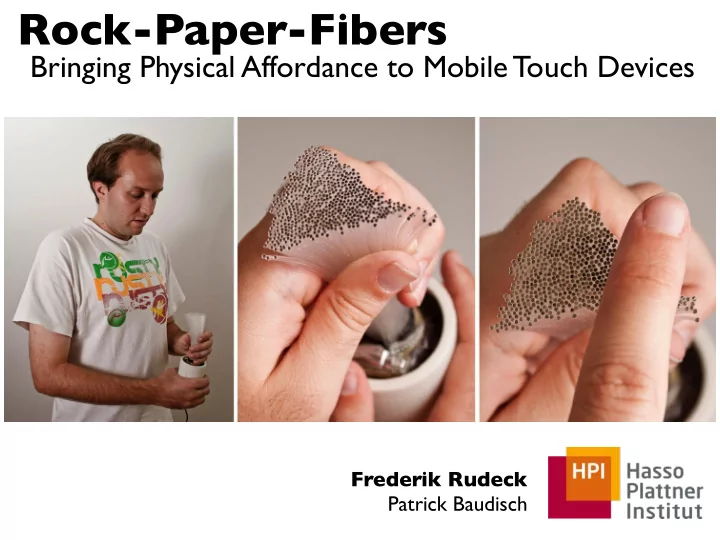
SLIDE 1 Rock-Paper-Fibers
Bringing Physical Affordance to Mobile Touch Devices
Frederik Rudeck Patrick Baudisch
SLIDE 2
Preview
SLIDE 3
SLIDE 4
Motivation
SLIDE 5 Microsoft Surface™
every interaction feels the same
SLIDE 6 Jordà, S., et al. The reacTable. TEI ’07.
SLIDE 7 Rekimoto, J., et al. DataTiles. CHI ’01.
SLIDE 8
SLIDE 9
Goal:
bring custom-shaped physical controls to mobile touch devices
SLIDE 10
Rock-Paper-Fibers
SLIDE 11
Main Idea:
create physical affordance by reshaping the device
SLIDE 12
SLIDE 13
Main Idea:
create physical affordance by reshaping the device this limits users to one widget at a time, but it is efficient using bimanual interaction
SLIDE 14 Benefit/Contribution:
- physical affordance by deforming
the device as to best match the interaction at hand
- mobility by serializing the interaction
SLIDE 15 Limitations:
- repeated reconfiguration requires
additional time and manual skills
- the range of widgets is limited
we address both later with wedges&clamps
SLIDE 16
Hardware Prototype
SLIDE 17
fiber optic bundle web cam casing
SLIDE 18
SLIDE 19
SLIDE 20
Recognition
SLIDE 21
Guessing Game: slider or play button
SLIDE 22
SLIDE 23 Challenge:
- fiber location is meaningless
- however, number of touched fibers
is meaningful
SLIDE 24 # touched fiber t t # touched fiber
count the number of touched fiber over time
SLIDE 25
convolution of finger and fiber bundle shape
SLIDE 26
slider
SLIDE 27
play button
SLIDE 28
Processing
SLIDE 29
SLIDE 30
SLIDE 31
SLIDE 32
SLIDE 33
SLIDE 34 # touched fiber t
SLIDE 35 match pattern against a database of labeled widget templates
# touched fiber t
matching
SLIDE 36 20 40 60 80 100 62.6 88.7 85.0 92.4 92.4 66.2 62.6
recognition rate of first time use
9 participants, 3 repetitions each
SLIDE 37
Wedges, Clamps and Sieves
SLIDE 38
SLIDE 39
wedges create multiple widgets
SLIDE 40
clamps give widgets custom shape
SLIDE 41
SLIDE 42
sieve ring
large interaction surface
SLIDE 43
large interaction surface
SLIDE 44
Conclusion
SLIDE 45
- bring physical affordance to mobile
touch devices
Rock-paper-fibers:
- additional expressiveness by using wedges
and clamps
- users reshape the touch device itself
SLIDE 46
Vision :: touch pads that we can really reconfigure
SLIDE 47
we think of rock-paper-fibers as a reconfigurable touch pad
SLIDE 48 Lahey, B., et al. PaperPhone. CHI ’11.
we just started to bend devices...
SLIDE 49 Wimmer, R., and Baudisch, P . Touch using TDR. UIST ’11.
…we have started to stretch touch devices...
SLIDE 50
…but this is just the first step
SLIDE 51
reconfigure the device into whatever it takes to best support our task at hand
SLIDE 52
we think of rock-paper-fibers as the first step in this direction
SLIDE 53 CHI 2011 UIST 2010 UIST 2010 CHI 2010 - best paper UIST 2009 CHI 2009 - nominated CHI 2011
berlin
CHI 2010 CHI 2011 CHI 2010
we have one open PhD/postdoc position
Patrick Baudisch
SLIDE 54 Rock-Paper-Fibers
Bringing Physical Affordance to Mobile Touch Devices
Frederik Rudeck Patrick Baudisch