RoboVis App Co nfig I K So lutio n whe re to g o fro m he - - PowerPoint PPT Presentation

robovis
SMART_READER_LITE
LIVE PREVIEW

RoboVis App Co nfig I K So lutio n whe re to g o fro m he - - PowerPoint PPT Presentation

E vo Arm Custo miza tio n! Dime nsio ns De sig n c o nstra ints Sma ll ro b o t a rm E ve ry 3D-printe d a rm c a n Se rvo c o nstra ints b e diffe re nt 3 de g re e s o f fre e do m Cha ng e me c ha nic s fo r


slide-1
SLIDE 1

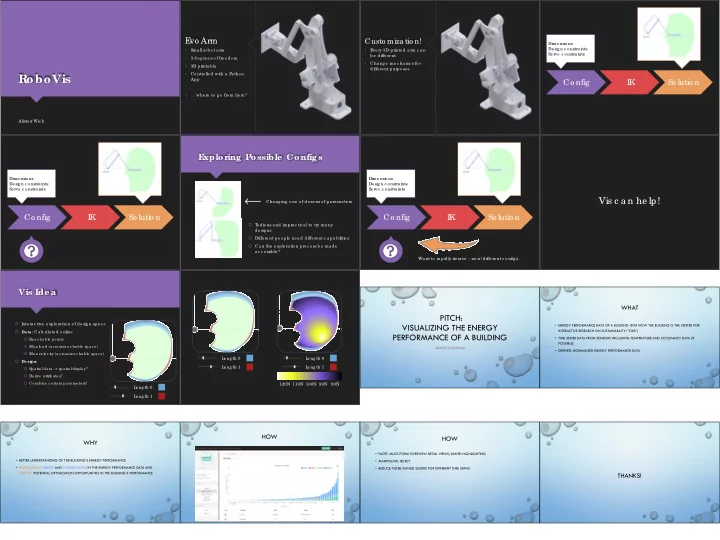
RoboVis

Alista ir Wic k

E vo Arm

  • Sma ll ro b o t a rm
  • 3 de g re e s o f fre e do m
  • 3D printa b le
  • Co ntro lle d with a Pytho n

App

  • … whe re to g o fro m he re ?

Custo miza tio n!

  • E

ve ry 3D-printe d a rm c a n b e diffe re nt

  • Cha ng e me c ha nic s fo r

diffe re nt purpo se s

Co nfig I K So lutio n

Dime nsio ns De sig n c o nstra ints Se rvo c o nstra ints

Co nfig I K So lutio n

Dime nsio ns De sig n c o nstra ints Se rvo c o nstra ints

E xplor ing Possible Configs

 T e dio us a nd impra c tic a l to try ma ny de sig ns  Diffe re nt pe o ple ne e d diffe re nt c a pa b ilitie s  Ca n the e xplo ra tio n pro c e ss b e ma de a c c e ssib le ? Cha ng ing o ne o f do ze ns o f pa ra me te rs

Co nfig I K So lutio n

Dime nsio ns De sig n c o nstra ints Se rvo c o nstra ints Wa nt to ra pidly ite ra te – ne w/ diffe re nt c o nfig s

Vis c a n he lp!

Vis Ide a

 I nte ra c tive e xplo ra tio n o f de sig n spa c e  Data: Ca lc ula te d o nline  Re a c ha b le po ints  Ma x lo a d (a c ro ss re a c ha b le spa c e )  Ma x ve lo c ity (a c ro ss re a c ha b le spa c e )  De sign:  Spa tia l da ta -> spa tia l displa y?  De rive a ttrib ute s?  Co mb ine c e rta in pa ra me te rs? L e ng th 0 L e ng th 1 L e ng th 0 L e ng th 1 L e ng th 0 L e ng th 1 120N 110N 100N 90N 80N

PITCH: VISUALIZING THE ENERGY PERFORMANCE OF A BUILDING

ARASH SHADKAM

WHAT

  • ENERGY PERFORMANCE DATA OF A BUILDING (FOR NOW THE BUILDING IS THE CENTER FOR

INTERACTIVE RESEARCH ON SUSTAINABILITY/”CIRS”)

  • TIME-SERIES DATA FROM SENSORS INCLUDING TEMPERATURE AND OCCUPANCY DATA (IF

POSSIBLE)

  • DERIVED: NORMALIZED ENERGY PERFORMANCE DATA

WHY

  • BETTER UNDERSTANDING OF THE BUILDING’S ENERGY PERFORMANCE
  • DISCOVERING TRENDS AND CORRELATIONS IN THE ENERGY PERFORMANCE DATA AND

IDENTIFY POTENTIAL OPTIMIZATION OPPORTUNITIES IN THE BUILDING’S PERFORMANCE

HOW HOW

  • FACET: MULTI-FORM OVERVIEW-DETAIL VIEWS/LINKED HIGHLIGHTING
  • MANIPULATE: SELECT
  • REDUCE: FILTER/RANGE SLIDERS FOR DIFFERENT TIME SPANS

THANKS!

slide-2
SLIDE 2

A VISUALIZATION TOOL FOR COMPUTER PROGRAM PERFORMANCE DEBUGGING

Augustine Wong

2

WHAT IS COMPUTER PROGRAM PERFORMANCE DEBUGGING? Diagnosing why a computer program is running slowly

3

Let’s look at an existing visualization tool…

HOW DO VISUALIZATION TOOLS HELP?

4

Create a visualization tool which:

  • Uses the “search, show context, expand on demand”

approach

  • Visualizes “patterns” of computer program behavior
  • Evaluates which patterns are good starting points for

initially exploring the computer program PROJECT OBJECTIVES

Quantum Annealing Visualization Austin Wallace 5th year undergraduate student Integrated Science-Machine Learning Chimera Graph

Visualiza(ons For Jus(fying Machine Learning Predic(ons

David Johnson

Mo(va(on

  • Strengths of ML allowed expansion to diverse fields
  • Fields and contexts far removed from tradi<onal ML
  • Users not trained in ML

Mo(va(on

  • Biggest factor for users is understanding how

predic<ons occur

  • Par<cularly important in1:
  • High risk applica<ons like medicine
  • Consumer-facing applica<ons such as Recommender Systems
  • Context-Aware applica<ons
1 Biran, McKeown.. 2014. Jus<fica<on Narra<ves For Individual Classifica<on

Jus(fica(on Visualiza(on

  • Visualiza<ons present important evidence for a

predic<on

  • Intensions are to <e in to thesis work

Yelp Visualization Tool

Dilan Ustek Matthew Chun

Motivation

  • Target User: Yelp end-users
  • Comparing businesses
  • Filtered visualization

The Dataset

https://www.yelp.com/dataset_challenge/dataset

Scope

  • One city but yet to be decided
  • Focus on the end users, aka the people who use the Yelp site/app
  • Data features to consider ... it depends but theme of holistic/detailed

comparison

○ Discover the “nuances” behind the existing Yelp data eg. distribution of 5 star restaurants in different price categories ○ More informed decisions for end users

Project ¡Pitch

Information ¡Visualization 2017 Felix ¡Grund

Munich

slide-3
SLIDE 3

Who ¡is ¡Scandio?

  • 2016:

– 40 ¡employees – 82 ¡clients – 176 ¡projects

  • Projects:

– Fixed ¡price (“client ¡pays ¡what’s ¡estimated”) – Time ¡and ¡material ¡(“client ¡pays ¡the ¡hours”)

What ¡is ¡a ¡fixed ¡price ¡project ¡at ¡Scandio?

  • Efforts ¡range ¡from ¡5 ¡days ¡-­‑ 100 ¡days
  • Duration ¡ranges ¡from ¡3 ¡weeks ¡– 1 ¡year
  • Before ¡project ¡starts: ¡effort ¡estimation
  • Generally ¡higher ¡risk ¡of ¡“failure”

– If ¡over ¡estimation ¡in ¡the ¡end, ¡company ¡mostly ¡has ¡ to ¡pay ¡(sometimes ¡compromises ¡with ¡client)

What ¡are ¡the ¡project ¡results?

  • Total ¡amount ¡of ¡efforts ¡in ¡the ¡end

– Exactly ¡as ¡estimated ¡(rare) – Less ¡than ¡estimated ¡(sometimes) ¡J – More ¡than ¡estimated ¡(sometimes) ¡L

What ¡are ¡the ¡key ¡attributes?

  • 1. Hours ¡worked

– Employees ¡track ¡time ¡on ¡project ¡in ¡web ¡app

  • 2. Degree ¡of ¡completion ¡(DOC)

– Estimated ¡monthly ¡by ¡project ¡lead

  • 3. Hourly ¡rate ¡for ¡project

– Determined ¡in ¡the ¡beginning ¡dependent ¡on ¡ budget ¡and ¡total ¡effort – Changes ¡retrospectively ¡depending ¡on ¡1 ¡and ¡2

? ¡Questions ¡?

  • When ¡do ¡estimation ¡and ¡degree ¡of ¡completion ¡conflict?
  • When ¡are ¡our ¡hourly ¡rates ¡too ¡low?
  • How ¡do ¡hourly ¡rates ¡change ¡retrospectively?
  • What ¡tendencies ¡can ¡we ¡observe ¡over ¡multiple ¡projects?
  • When ¡interfere ¡to ¡maintain ¡project ¡success?
  • How ¡can ¡we ¡identify ¡wrong ¡estimations ¡on ¡DOC?
  • How ¡do ¡project ¡leads ¡differ ¡in ¡their ¡monthly ¡estimations?

Is ¡there ¡still ¡time?

Time ¡Tracking Project ¡results ¡(good) Project ¡results ¡(bad)

Thanks.

Visualizing Internal Components of a Convolutional Neural Network

Mahdi Ghodsi - Hooman Shariati Background:

What is Machine Learning Machine Learning is taking over. Applied to many fields: Bioinformatics, Gaming, Medical diagnosis, Marketing, Machine Vision, ….

Convolutional Neural Network

The idea has been around since 1980s But Introduction of GPU computing with 30x speed up gave DNNs a boost

Convolutional Neural Network

ImageNet Competition Google Deep Dream

Very Popular Research Area

Convolutional Neural Network

However ...

Convolutional Neural Network

slide-4
SLIDE 4

How researchers see CNNs

Convolutional Neural Network

“Neural networks have long been known as “black boxes” be- cause it is difficult to understand exactly how any particu- lar, trained neural network functions due to the large number of interacting, non-linear parts.” Yajin Zhou Department of Computer Science North Carolina State University

How researchers see CNNs How CNNs looks like

Convolutional Neural Network

Visualizing and Understanding Convolutional Networks By M. Zeiler (NYU)

Visualizing and making sense of of CNNs in literature:

Visualizing Ambiguity

James Hicklin

Case Scenario

  • Imagine you are

Be;y

  • Just finished

chemo for breast cancer

  • Typical post-

chemo therapy is Tamoxifen for 5 years

Tamoxifen 10-year risk esGmates compared to 5-year risk esGmates (out

  • f 1000)

A"ribute Change Breast cancer recurrence ê 28 Death from breast cancer ê 28 Development of gallstones é 2 Development of endometrial cancer é 16 Stroke é 2

Point esGmates…

  • Imagine Be;y only cared about her chance of

dying from breast cancer and her chance of developing endometrial cancer

1 6 11 16 21 26 31 Decrease in deaths from BC Developing Endometrial Cancer Number of People (out of 1000)

5-year vs. 10-year Tamoxifen Therapy

With confidence intervals…

1 6 11 16 21 26 31 36 Decrease in deaths from BC Developing Endometrial Cancer Number of People (out of 1000)

5-year vs. 10-year Tamoxifen Therapy

AlternaGves to Error Bars

Violin Plots

h;p://www.datavizcatalogue.com/methods/violin_plot.html

Box Plots

h;p://www.datavizcatalogue.com/methods/box_plot.html

Dynamic Icon Arrays Gradient Plots

Project

  • Design new visualizaGon to present ambiguity

to paGents

  • InteracGvity

– Adjust bounds of error – Show best & worst case scenarios – Show how risk esGmates might change given different samples

Dviz

Visualizing Distributed Systems with Stewart Grant and Jodi Spacek

Motivation

  • Understanding the behaviour of distributed systems is hard
  • Developers need tools for comprehending their systems
  • Most distributed systems are designed around FSM
  • FSM are often how developers think of their systems
  • Can an FSM be generated from an execution so developers can check their mental

models?

Concept

  • Collect distributed snapshots (state from across the whole system)
  • Calculate a distance between each snapshot (xor distance)
  • Plot each snapshot at it’s relative distance using clustering
  • Connect each snapshot with a time curve

etcd (distributed key value store) puts -> gets Limitations

  • States are not labeled meaningfully
  • Semantics of state transitions are not clear
  • FSM’s require both
slide-5
SLIDE 5

Extensions to Project

Improving Visualization

Interaction Extension

FSM would provide a higher level on which users could zoom in on Current Proposed zoom

Filtering the Clusters

  • Partitioning: intrinsic meaning
  • Collect data invariants: filter to show aggregate data using existing tool set
  • Label: Represent clusters by their invariants
  • Visualize transitions: use the diff of cluster invariants

Research Questions

  • Scatterplots? Occlusion? Continuous scatterplots?
  • Interaction?
  • Spatial aggregation? Does it make sense?
  • Dimensionality reduction? Too much information?
  • Effective color coding?
  • Dimensional Ordering, Spacing, and Filtering Approach (DOSFA)? Similarities

show patterns?

Why this project is neat

  • Stems from an existing body of work
  • Has practical applications for debugging distributed systems
  • No end of data to represent, can easily be extended after the course

Visualizing patient clusters

Lovedeep Gondara Problem

Physician researchers are often interested in data exploration before committing to a project. Generally use descriptive statistics to see if there are any obvious signals. Is there any specific group of patients that have the worse outcome compared to the rest? Are there natural groupings in the dataset? Is there an underlying structure to the data?

Proposed solution

Cluster visualization Use dimensionality reduction methods such as t-sne. Plot resulting clusters. Draw survival plots by cluster membership. Allow investigation of cluster membership.

Thanks

Spanner, Resurrected.

CPSC 547 Project Pitch

Madison Elliott February 16, 2017

Background

  • Project originated as an MA thesis in

the CS department

Background

  • Project originated as an MA thesis in

the CS department

  • New technique that applied low-

stretch trees to network visualization

Background

  • Project originated as an MA thesis in

the CS department

  • New technique that applied low-

stretch trees to network visualization

  • Implemented novel edge-bundling

technique

Background

  • Project originated as an MA thesis in

the CS department

  • New technique that applied low-

stretch trees to network visualization

  • Implemented novel edge-bundling

technique

  • Does not rely on fixed vertices/fixed

layout or explicit hierarchical data structure

Background

  • Two iterations submitted for

publication:

  • 1. Graph Drawing (technique focused)
  • 2. Pacific Vis (more emphasis on motivation

and visualization application)

Background

  • Two iterations submitted for

publication:

  • 1. Graph Drawing (technique focused)
  • 2. Pacific Vis (more emphasis on motivation

and visualization application)

  • Both rejected L
slide-6
SLIDE 6

Background

  • Two iterations submitted for

publication:

  • 1. Graph Drawing (technique focused)
  • 2. Pacific Vis (more emphasis on motivation

and visualization application)

  • Both rejected L
  • Reviewer comments largely yearning

for a deeper/more defined motivation

Resurrection Pitch

  • Find the motivation!

Resurrection Pitch

  • Find the motivation!
  • Develop and execute a user study

Resurrection Pitch

  • Find the motivation!
  • Develop and execute a user study
  • Revise and resubmit paper

Why?

  • Lots of potential!

Why?

  • De-hairball a cluttered network:

Why?

  • Novel, layout free network idioms:

Next Steps

  • Complete literature review of network

idioms, tasks and taxonomies

Next Steps

  • Complete literature review of network

idioms, tasks and taxonomies

  • Brainstorm new cases where “set” or

intuitive network layout is not optimal

  • r necessary for a given task

Questions?

Automatic Grading Service Dataset

NICK BRADLEY NBRAD11@CS.UBC.CA

Background

Continuous grading service 5.5 GB from 13K test result records (more coming everyday) Some data fields (don’t worry if these don’t mean anything to you)

  • Grade for every commit each student made
  • Test metrics: # tests pass/fail, coverage, duration
  • Code metrics: LOC, build failures
  • Grade requests: timestamp
  • More data can be pulled from GitHub (diffs, history, branches,…)

Current Instructor Dashboard Current Operational Dashboard Idea + Impact

Student facing dashboard

  • Expanded to CS110, CS210, and CS310 + their corresponding MOOC offerings
  • Vis will be used by 1000s of students in production system
  • Challenge: make it engaging + promote ‘good’ behaviour
  • Feedback: prototype can be made available to current students

Instructor facing dashboard

  • Design study with domain expert (current CPSC310 instructor)
  • Challenge: needs to scale to 1000s of students

Analysis tool

  • Probably only if you are interested in software engineering
  • Likely end up as a SE paper

nbrad11@cs.ubc.ca

EMAIL

slide-7
SLIDE 7

Visual Methods for Analyzing Motifs in Time-Oriented Data

Soheil Kianzad PhD student CS

Stock technical analysis

Yuan Li ,GrammarViz, 2012 www.aastocks.com/en/stock/detailchart.aspx?symbol=110000 120 days
  • 10%
+12% https://nonb- abcc.ncifcrf.gov/apps/site/help_visualize

Vi ViS ccer ccer

Visualizing European soccer players

Yann Dubois

Wh Why? y?

Oth Other sports ts By By region World cu cup By By game

http://buckets.peterbeshai.com/ https://www.datainnovation.org/2014/05/predicting-the-world-cup-winner-with-data-visualization/ http://ieeexplore.ieee.org/stamp/stamp.jsp?arnumber=7042477 https://www.ibm.com/blogs/bluemix/2016/06/origins-of-soccer-superstars-part2/

Wh What? t?

  • +25,000 matches
  • +10,000 players
  • 11 European leagues
  • Players and Teams' attributes
  • Detailed match events
  • Betting odds

+ sports page scrapping

Ho How?

  • D3
  • P5.js
  • Tableau

GRADUATE STUDIES – DATA VISUALIZATIONS

J E N S L O C H E R , A S S I S T A N T D E A N – S T R A T E G I C T E C H N O L O G I E S A N D B U S I N E S S I N I T I A T I V E S 2

WHO ARE WE?

  • Responsible for academic oversight and support for approx. 300 graduate degree
programs
  • Strategic leaders in graduate education at UBC
  • Support for faculty, programs & students
  • Central hub for everything related to graduate students
  • Communications & Recruitment
  • Admission
  • Awards
  • Thesis & Dissertations
  • Doctoral Exams
  • Professional Development
  • Approx. 10,000 graduate students in Vancouver
3

DATA PROJECTS

  • Option 1: Canadian Graduate & Professional Student Survey (CGPSS)
  • Satisfaction levels in 13 sections, e.g. general, PD, research experience,
financial support, social life
  • Breakdown by discipline, year of study, degree level, gender, etc.
  • Option 2: Graduate School data
  • Application data
  • Enrolment statistics
  • Graduation statistics
  • Time in program and completion rates
4

CGPSS

5

CGPSS

Desired Outcomes: 1. Visualize key findings from 2016 study 2. Time comparison: 2010 to 2013 to 2016 3. Benchmarking: program vs. UBC vs. Canada Audiences:
  • Students
  • Units (access controlled), e.g. program or department dashboard
  • Department Head
  • Program Director
  • Faculty
6

GRADUATE SCHOOL DATA (CURRENT)

7

GRADUATE SCHOOL DATA (CURRENT)

8

GRADUATE SCHOOL DATA (ALTERNATIVE EXAMPLE)

9

TEAM Louise Mol

Systems and Data Analysis Manager

Jens Locher

Assistant Dean
slide-8
SLIDE 8

Visualizing Trends in Product Recommendations

Q.I. Leap Analytics

Who are we?

Q.I. Leap Analytics

  • Team of data scientists
  • Solutions for retail stores
  • 2 products
  • Recommender System
  • Interactive Dashboard

What is a recommender system? What’s the visualization task?

End user: Business that is using the Recommender System End user desires:

  • Which items recommended
  • Trends in item recommendations
  • Cluster users with similar purchase history
  • Cluster items with similar buying history

What kind of data would you have to work with?

Transaction data for online store

  • 50,000 transactions
  • 2,000 unique items
  • 13,000 unique customers
  • With time, date, city of purchase

Generated recommendation data

  • Customer, item viewing history, top 10 recommended items

(with scores)

Benefits beyond the classroom

  • Implemented in our dashboard product so customers would get to see how their

recommender system is being used

  • Possibility of internship on completion of project
  • Talk to me afterwards if interested in the project!

lauren.fratamico@qileap.com