SLIDE 1
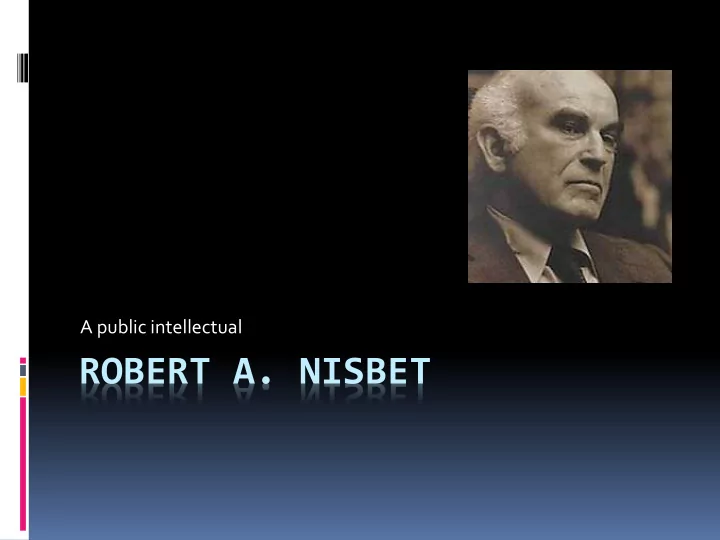
ROBERT A. NISBET
A public intellectual
SLIDE 2
Note:
This presentation is based on the theories of Robert Nisbet as presented in his works. A more complete summary of his theories (as well as the theories of other macro-theorists) can be found in Macrosociology: The Study of Sociocultural Systems, by Frank W. Elwell. If you would like to receive a .pdf file of the chapter on Nisbet please write me at felwell@rsu.edu and put Nisbet.pdf in the subject line.
SLIDE 3 A Short Biography
Robert Alexander Nisbet was born on September 30, 1913 in Los Angeles, the oldest
- f three boys born to Henry and Cynthia
- Nisbet. He began at the University of
California at Berkeley in 1932.
SLIDE 4
A Short Biography
His association with Berkeley proved both long and fruitful. He completed his Bachelor’s degree in 1936, his M.A, in 1937, and his Ph.D. in 1939.
SLIDE 5
A Short Biography
Upon obtaining his Ph.D. he accepted an instructor’s position at Berkeley, subsequently rising through the ranks to full professor there in 1953.
SLIDE 6
A Short Biography
Nisbet served in World War II, enlisting in the Army in 1943 and serving in the Pacific eventually achieving the rank of staff sergeant.
SLIDE 7
A Short Biography
In 1953 he left Berkeley to become the founding dean of the College of Letters and Science at the new Riverside campus of the University of California, later becoming vice chancellor there in 1960.
SLIDE 8
A Short Biography
In 1963 he left academic administration, believing that “administrative work, sufficiently prolonged, has a sterilizing effect upon the creative or the scholarly mind.”
SLIDE 9
A Short Biography
After 30 years, Nisbet retired from the University of California in 1972, first accepting a position at the University of Arizona, and then moving on to the Albert Schweitzer Chair at Columbia University in 1974 working with Robert K. Merton. While at Columbia, Nisbet taught both history and sociology.
SLIDE 10 A Short Biography
At the age of 65 he retired from university
- teaching. Moving to Washington in 1978, he
became affiliated with the American Enterprise Institute until 1986.
SLIDE 11
A Short Biography
Even after full retirement from university and think tank, Nisbet continued to write until his death from prostate cancer on September 9, 1996, just 21 days shy of his eighty-third birthday.
SLIDE 12
A Short Biography
His scholarship included over twenty books and more than 150 articles, book chapters, and review essays. More than a serious academic, Nisbet was a public intellectual, writing for a broad general audience.
SLIDE 13 Leviathan
Robert A. Nisbet is primarily a follower of Emile
- Durkheim. This influence can be seen in his
basic understanding of modern sociocultural systems and their drift.
SLIDE 14
Leviathan
It is his contention that society is increasingly dominated by large-scale administrative systems that have severely weakened traditional groups and organizations.
SLIDE 15
Leviathan
This concentration and centralization of social and political power and the consequent weakening of institutions that formerly mediated between the individual and centralized power has had devastating effects upon democracy, freedom, and human welfare.
SLIDE 16 Leviathan
Initially, his primary concern was parallel to Durkheim’s: the impact that this weakening
- f primary group ties had on the normative
structure of society, and the consequent lack
- f integration of individuals into the social
- rder.
SLIDE 17
Leviathan
But over the years he began to focus more upon the impact that this shift had on representative government and individual liberty.
SLIDE 18 Leviathan
The present structure of the State, argues Nisbet, began to gain overwhelming dominance in the West with the French Revolution, and since that time it has taken
- ver more and more functions from
traditional organizations and groups such as the extended family, neighborhood, class, and regional authority.
SLIDE 19
Leviathan
It is in these primary groups that the individual has roots, is formed, and internalizes the norms, values, ideologies, and outlook of the society.
SLIDE 20
Leviathan
According to Nesbit, social disorganization— the decline of family, community, and other traditional primary groups—is more properly thought of as the wearing away of these authorities caused by the “absorption” of their functions by the State.
SLIDE 21 Leviathan
It is the enlargement and centralization of State bureaucratic power that has had dramatic effect on all other forms of social
- rganization. The social fabric becomes
- frayed. “Threads are loosened by the
tightening of power at the center.”
SLIDE 22
Leviathan
Without common bond, individuals increasingly take advantage of one another; relationships become commodified, increasingly relying upon contract and cash rather than loyalty and commitment. “As the blood rushes to the head of society,” Nisbet says, “it leaves anemic the local and regional extremities.”
SLIDE 23 Leviathan
This enlargement and centralization of State power, he argues, is the root cause of the loss
- f authority and function of these
intermediate institutions and this has two principle effects:
the weakening of local and regional checks on further centralization; and
the isolation and alienation of the individual and their consequent powerlessness.
SLIDE 24 Leviathan
Further this centralization of power, a power that is external to both local groups and the individual, makes it difficult to establish true
- community. People gather together in lasting
groups and associations to accomplish things they cannot do alone, Nisbet explains.
SLIDE 25
Leviathan
When centralized power relieves local groups of these functions, it undermines the foundation for community, leaving local groups without function or authority, “what else but the social horde and alienation can be the result?”
SLIDE 26 Leviathan
This centralization and enlargement of power has been pushed by an ideology of bureaucracy, an ideology that promotes centralization, formal hierarchy, written rules
- f conduct and authority, and impersonal
administration based on military models of human organization.
SLIDE 27
Leviathan
Government bureaucracy has come from two main sources, Nisbet argues: mass war and the creation of the welfare state.
SLIDE 28 Leviathan
Nisbet’s initial focus is upon the political State as a unified “Leviathan.” It is his belief that the political State has rapidly absorbed military, economic, political, and social power in the process transforming all social
SLIDE 29
Leviathan
In later writings he details the interrelationships between State, economic, and military power in language highly reminiscent of Mills, recognizing that State power is often intimately involved in economic activities and has been since the rise of capitalism itself.
SLIDE 30
Leviathan
Beginning only with military power, it is the State’s subsequent absorption of political, economic, kinship, and religious functions as well as the State’s dislocation or outright destruction of traditional authority structures that has led to the decline of community, freedom, and democracy.
SLIDE 31
Leviathan
The modern individual has been freed from traditional hierarchies of class, religion, locality, and kinship, but this freedom has brought with it insecurity, disenchantment, and alienation. It has also subjected the individual directly to the control and manipulation of the State.
SLIDE 32
Note:
For a more extensive discussion of Nisbet’s theory, as well as a fuller discussion of its implications for understanding human behavior, refer to Macrosociology: the Study of Sociocultural Systems. For an even deeper understanding of Nisbet’s thought, read from the bibliography that follows.
SLIDE 33 Bibliography
- Nisbet, R. 1953/1990. The Quest for
Community: A Study in the Ethics of Order &
- Freedom. San Francisco: ICS Press.
- Nisbet, R. 1975. Twilight of Authority. New
York: Oxford University Press.
- Nisbet, R. 1988. The Present Age. New York:
Harper & Row, Publishers.