A Biography of George Orwell Men can only be happy when they do not - - PowerPoint PPT Presentation

a biography of
SMART_READER_LITE
LIVE PREVIEW

A Biography of George Orwell Men can only be happy when they do not - - PowerPoint PPT Presentation

A Biography of George Orwell Men can only be happy when they do not assume that the object of life is happiness. Real Name Eric Arthur Blair Lived 1903-1950 Born in India Moved to England as a small child His childhood


slide-1
SLIDE 1

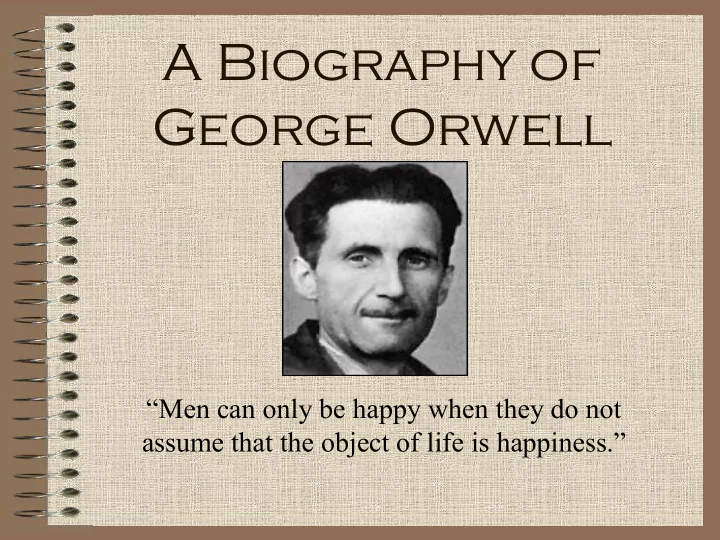
A Biography of George Orwell

“Men can only be happy when they do not assume that the object of life is happiness.”
slide-2
SLIDE 2

Real Name—Eric Arthur Blair

  • Lived 1903-1950
  • Born in India
  • Moved to England as a small child
  • His childhood dream: “From a very early age,

perhaps the age of five or six, I knew that when I grew up I should be a writer.”

  • His pen name: George “sounds solidly English”

and Orwell is the name of “a river in Suffolk, England”

slide-3
SLIDE 3

Orwell’s Education

  • Attended expensive preparatory

schools in England

  • Grew up middle class surrounded

by upper class students

  • Felt inferior to upper class boys at

school

slide-4
SLIDE 4

Schooling

Blair earned a scholarship to “the most costly and snobbish of the English Public Schools” Eton College where he attended between 1917 and 1921.

slide-5
SLIDE 5

Life at Eton

  • One of his teachers was Aldous

Huxley – who taught him French

slide-6
SLIDE 6

Life After School

  • Served in Burma with the Indian

Imperial Police

  • During the next five years, he grew to

love the Burmese and resent the

  • ppression of Imperialism and

decided to become a writer instead.

slide-7
SLIDE 7

Orwell pictured in a passport photo during his Burma years.

slide-8
SLIDE 8

Paris and London 1928-1936

In the first 6 months after his decision, Blair went on what he thought

  • f as an expedition to the

East End of London to become acquainted with the poor people of England. As a base, he rented a room in Notting Hill. In the spring, he rented a room in a working-class district of Paris.

slide-9
SLIDE 9

Career Path

  • Chose to live in

poverty

  • Worked as a

dishwasher

  • Wrote Down and Out

in Paris and London

  • Exposed harsh

working conditions of the poor

  • Investigated

England’s coal- mining industry

  • Wrote The Road to

Wigan Pier

  • Exposed terrible

conditions of the miners

slide-10
SLIDE 10

Effects of These Jobs

  • Grew to hate a “class system”
  • Became a socialist

– Socialism

  • All goods in a country are shared with
  • thers
  • No one has more than others
  • For example, “You have two cows. The

government takes one and gives it to your neighbor.”

slide-11
SLIDE 11

Spanish Civil War

In July 1936 the Spanish Civil War broke, and Orwell went to Spain. After his arrival in Barcelona, he joined the Unified Marxist Workers’ Party and served with them in action in January 1937.

slide-12
SLIDE 12

Orwell’s Political Views

  • He considered himself a democratic

socialist and was critical of communism.

  • He hated intellectuals, lying, cruelty,

political authority, and totalitarianism.

  • He strongly opposed Stalin and Hitler
  • - he was very outspoken during

WWII.

slide-13
SLIDE 13
slide-14
SLIDE 14

To Make Ends Meet

  • Writing wasn’t

paying the bills

  • Other jobs:
  • 1. Teacher
  • 2. Grocer
  • 3. Bookshop

assistant

  • 4. BBC

writer

  • Fought in Spanish

Civil War against communists

  • Shot in the throat in

battle

  • Wrote about this war
  • Homage to Catalonia
slide-15
SLIDE 15
slide-16
SLIDE 16

Personal Life

  • In 1936 Blair and once student of J.R.R.

Tolkien student Eileen O'Shaughnessy married.

  • Diagnosed with tuberculosis

in 1938.

  • In 1944 they adopted a

son Richard Horatio.

slide-17
SLIDE 17

Personal Life Continued…

  • Wife died in 1946
  • Orwell entered a London hospital

in September 1949 and the next month married Sonia Brownell (three months before his own death) .

  • He died in London on Jan. 21,

1950.

slide-18
SLIDE 18

1943

  • The year 1943 was an important one in

Orwell's life for several reasons.

– His mother died in March. – He left the BBC to become literary editor of the Tribune. – The most important event occurred late that year, when he commenced the writing of Animal Farm. – Orwell had completed this satire by February 1944.

slide-19
SLIDE 19

Most Famous Works

  • Animal Farm
  • Published in 1945
  • Wrote it “to expose

[Joseph] Stalin’s perversion of socialism”

  • Fusion of “political and

artistic purpose”

  • Immediate commercial

success

  • Quickly translated into

many languages

slide-20
SLIDE 20

Most Famous Works

  • 1984
  • Published in 1949
  • His final novel
  • Grim vision of future

society

  • “Big Brother” is

watching/controlling all

  • Considered a

masterpiece

slide-21
SLIDE 21

“During times

  • f universal deceit,

telling the truth becomes a revolutionary act.”

~George Orwell

slide-22
SLIDE 22

Final Years

  • Suffered a tubercular

hemorrhage (lung bleed)

  • Died in 1950

at age of 46

slide-23
SLIDE 23

“Writing a book is a long, exhausting struggle, like a long bout of some painful illness. One would never undertake such a thing if one were not driven by some demon whom one can neither resist or understand.”

slide-24
SLIDE 24

George Orwell Review

slide-25
SLIDE 25

Question #1

Eric Blair cast around for a pseudonym and finally landed on George Orwell, the surname being taken from an English

  • A. village
  • C. river
  • C. moor
  • D. pub
slide-26
SLIDE 26

Question #2

When Orwell was a student at Eton,

  • ne of his teachers was
  • A. Aldous Huxley
  • B. H.G. Wells
  • C. E.M. Forster
  • D. Bertrand Russell
slide-27
SLIDE 27

Question #3

Orwell’s first professional job was that of

  • A. civil servant in India
  • B. agricultural manager in Rhodesia
  • C. journalist in Spain
  • D. policeman in Burma
slide-28
SLIDE 28

Question #4

Down and Out in Paris and London, following Orwell’s experiences of “tramping” with the poor and homeless, includes the memorable section where he describes his time in Paris working as

  • A. dockhand
  • B. hospital orderly
  • C. dishwasher
  • D. lavatory attendant
slide-29
SLIDE 29

Question #5

Orwell fought in the Spanish Civil War with the

  • A. International Brigades
  • B. Unified Marxist Workers’ Party
  • C. Independent Labor Party
  • D. Union of Communist Peoples
slide-30
SLIDE 30

Question #6

In France, Animal Farm’s publisher quietly changed the name of the pig Napoleon to

  • A. César
  • B. Augustine
  • C. Alexandre
  • D. Anatole
slide-31
SLIDE 31

Question #7

What is George Orwell's real name? A.Eric Cantona B.Eric Blair C.Eric Morecambe D.Eric James

slide-32
SLIDE 32

Question #8

Which war did Orwell fight in? A.Spanish Civil War B.Korean War C.Irish Civil War D.World War II

slide-33
SLIDE 33

Question #9

Which School did George Orwell attend?

  • A. Oxford
  • B. Eton College
  • C. Charterhouse
  • D. Harrow School
slide-34
SLIDE 34

Question #10

On his deathbed in a London hospital Orwell married his second wife, the beautiful Sonia Brownell, whom many of his friends considered to be a gold-digger and collector of literary “stars.” She became extremely wealthy with the royalties of Orwell’s works and went

  • n to
  • A. marry an Italian poet
  • B. edit a stylish literary journal
  • C. die a penniless drunk in Paris
  • D. be swindled of all her money by an English lord
slide-35
SLIDE 35

Quotes

  • In a time of universal deceit - telling the

truth is a revolutionary act.

  • War is peace. Freedom is slavery.

Ignorance is strength.

  • Who controls the past controls the future.

Who controls the present controls the past.

  • Freedom is the right to tell people what

they do not want to hear.

slide-36
SLIDE 36
slide-37
SLIDE 37