
SLIDE 1
Hispanic Heritage Month Page 1 Interdisciplinary Unit
His Hispanic H panic Heritage Mo eritage Month nth Interdiscip - - PDF document
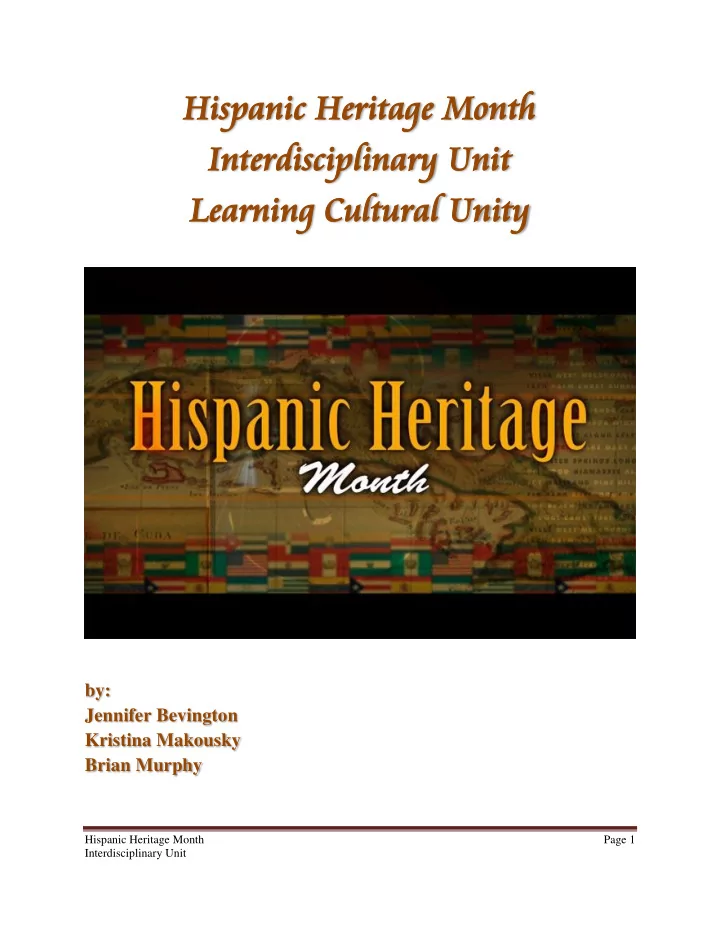
His Hispanic H panic Heritage Mo eritage Month nth Interdiscip nterdisciplinary linary Unit Unit Learning Learni ng Cultu Cultural Unity ral Unity by: Jennifer Bevington Kristina Makousky Brian Murphy Hispanic Heritage Month Page
Hispanic Heritage Month Page 1 Interdisciplinary Unit
Hispanic Heritage Month Page 2 Interdisciplinary Unit
Introduction ......................................................................................................................... 3 Background ................................................................................................................... 3 Overview....................................................................................................................... 3 Unit Calendar ................................................................................................................ 4 Letter to Parents ........................................................................................................... 5 Art ....................................................................................................................................... 6 Objectives ..................................................................................................................... 6 Classroom Approach .................................................................................................... 8 Assessment and Rubric................................................................................................. 9 English .............................................................................................................................. 13 Objectives ................................................................................................................... 13 Classroom Approach .................................................................................................. 14 Assessment and Rubric............................................................................................... 17 Spanish .............................................................................................................................. 20 Objectives ................................................................................................................... 20 Classroom Approach .................................................................................................. 22 Assessment and Rubric............................................................................................... 23 Appendix ........................................................................................................................... 25 English Class Guest Speaker Alberto Monserrate Handout ....................................... 25 English Class Sample Kids Discover Documentation .................................................. 26 Artist of the Day Trading Cards .................................................................................. 27 Spanish Class Sample Vocabulary Bingo .................................................................... 28 Spanish Class Jeopardy Input Screen ......................................................................... 29 Spanish Class Guest Speaker Ramón León Handout .................................................. 30 References ......................................................................................................................... 31
Hispanic Heritage Month Page 3 Interdisciplinary Unit
From its beginnings in the early years of the United States, the Hispanic community has played a vital role in our nation and its culture. Hispanics are the fastest growing ethnic group in the United States at four times the national average since the year 2000. There are over 53 million Hispanics in the U.S., making it the second largest ethnic group in America and the largest Spanish speaking group outside of Mexico (Brown and Lopez, 2013). This interdisciplinary unit has been developed to introduce students to the Hispanic culture, their contributions, and their history.
Grade: 8th Classes: Art, English, Spanish Unit: Hispanic Heritage Month Timing: This is a two week unit that is to be completed between Sept. 15 and Oct.15 to correspond to Hispanic Heritage Month activities throughout the United States. Unit GIO: Students will understand of the important role that Hispanic Americans have played in the culture and growth of the United States.
Hispanic Heritage Month Page 4 Interdisciplinary Unit
This calendar shows the combined teaching and activities for each discipline. Items are listed at a high level. For detailed information go to each disciplines section below. Week One Monday Tuesday Wednesday Thursday Friday Art – Includes an “Artist of the Day”
Hispanic Art: Introduction & Art Journals Salvador Dalí Journals: Focus
Pablo Picasso Journal: Focus
Joaquín Torres García Journals: Cover Art Fernando Botero Journals: Binding demonstration. Intro for Posters Wifredo Lam
English
Esperanza Rising wrap-up Introduce journal project, assign countries Guest speaker: Alberto Monserrate, President, Latino Communications Network - Immigration Computer lab research time with guided worksheets Computer lab research time with guided worksheets
Spanish
Introduction to Hispanic Heritage Month and cultural topics Vocabulary and borrowed words Compare and contrast Hispanic and American holiday traditions Vocabulary test. Continuation of tradition activities Explore contributions from famous Hispanic Americans, research
Week Two Monday Tuesday Wednesday Thursday Friday Art – Includes an “Artist of the Day”
Posters: peer review and self- reflection Ester Hernandez Posters Diego Rivera Guest Speaker: Sandra Reyes, Senior Coordinator, El Centro - Art. Carmen Lomas Garza (Posters are Due) Piñatas Frida Kahlo Piñatas Jean Michel Basquiat
English
Intro to POV Exploring first- person narrative and style In-class work time In-class work time Journal entry due Unit wrap-up
Spanish
Class work time
in Language Lab Recap of Hispanic traditions and music Guest speaker - Ramón León,
Latino Economic Development Council – Hispanic influence in business Hispanic Culture student presentations Hispanic Culture student presentations
Hispanic Heritage Month Page 5 Interdisciplinary Unit
Dear Parents, Starting Monday, September 23rd, your child’s Art, English, and Spanish classes will be working
Unity.” As part of this unit we will have a number of guest speakers including: Sandra Reyes, Senior Coordinator, El Centro who will do a presentation on Hispanic art. Alberto Monserrate, President, Latino Communications Network who will do a presentation on Hispanic literature. Ramón León, Exec. Director Latino Economic Development Council who will do a presentation on the role of Hispanics locally and nationally. There are a number of other exciting events and activities scheduled during these two weeks. The overriding objective of this unit is that the students will understand of the important role that Hispanic Americans have played in the culture and growth of the United States. We know that this unit will be a great benefit to everyone and look forward to sharing this experience with your child. Sincerely,
Hispanic Heritage Month Page 6 Interdisciplinary Unit
Teacher: Kristina Makousky Grade: 8th Unit: Hispanic Heritage Collaboration: English and Spanish
GIOs: 1. Students will demonstrate an understanding of the personal, social, cultural and historical contexts that influence the arts areas.
foundations. Planning Guide and SLOs for first GIO: Stage 1 – Desired Results
Established Goals (GLO): Students will demonstrate an understanding of the personal, social,
cultural and historical contexts that influence the arts areas.
Understandings:
work.
American art. Essential questions to ensure learning:
in the Hispanic art we have looked at?
Hispanic artists? Students be able to (SLOs):
social, cultural and historical contexts.
Stage 2 – Assessment Evidence
Performance Tasks:
art based on cultural influences they have learned about from Hispanic artists.
ten influential Hispanic artists will be compared and contrasted during class.
context can affect their art. Other Evidence:
represent Hispanic culture in different ways.
influenced their work.
Stage 3 – Learning Plan
Learning Activities: See Classroom Approach below Connected to SLO #:
Hispanic Heritage Month Page 7 Interdisciplinary Unit
Planning Guide and SLOs for second GIO (Note - numbering sequence is consecutive for each stage starting with the first GIO listed above): Stage 1 – Desired Results
Established Goals (GLO):
Students will create work in a variety of contexts in the arts area using the artistic foundations.
Understandings:
Essential questions to ensure learning:
constructive way? Students be able to (SLOs):
Stage 2 – Assessment Evidence
Performance Tasks:
supplement their original writing in the medium
a presentation on influential Hispanic Americans in the artistic foundations area of mixed media. Other Evidence:
creating a piñata with a partner.
why they created their work in class.
creative method based on the audience that would view their work.
Stage 3 – Learning Plan
Learning Activities: See Classroom Approach below Connected to SLO #:
Hispanic Heritage Month Page 8 Interdisciplinary Unit
Day SLOs Activities State Standards 1
connections among visual artwork.
Introduction on Hispanic Culture and an Introduction to Art Journaling Artist of the day – Discussion on why people make art Cut out flash cards and work together on first one
(Code 6.1.3.5.1) compare and contrast historical context/visual arts
2
Artist of the day Journal Work: Drawing (Code 6.2.1.5.1) create
artistic context
3
Artist of the day Journal Work: Collaging (Code 6.2.1.5.1) create
artistic context
4
Artist of the day Journal Work: Cover Art (Code 6.2.1.5.1) create
artistic context
5
Artist of the day Journal Work: Binding Demonstration Intro to Posters (Code 6.2.1.5.1) create
artistic context
6
Artist of the day Peer Review Class Discussion Poster Work Time (Code 6.2.1.5.2) revise work based on feedback
7
Artist of the day Poster Work Time Make sure to answer questions about creating the poster (Code 6.2.1.5.3) Develop an artistic statement
8
and styles Artist of the day Guest Speaker: Sandra Reyes, Senior Coordinator, El Centro, (can speak to art related subject) Code (6.1.3.5.1)Compare and contrast historical context/visual arts
9
Artist of the day Piñata (Code 6.1.3.5.2) Analyze the meanings and functions of visual art
10
Artist of the day Piñata (Code 6.1.3.5.2) Analyze the meanings and functions of visual art
Hispanic Heritage Month Page 9 Interdisciplinary Unit
Artist of the day Trading Cards: Due Friday Week 2 Each class period during Hispanic Heritage month will be started with a presentation on an influential Hispanic artist. Students will be required to write on the back of each artist card one fact about the artist and a reason why they think the artist created their work based on their personal, social, cultural or historical contexts and how that influenced their work. Trading cards will be traded with peers at the end of the unit. Art Journal: Collage, Drawing, Book Binding Due Monday Week 2 Students will be required to create 3 works of 2D art: one drawing, one collage and a third work
including a journal binding demonstration. Students may choose which process they will use for the three topics:
Students will be given the weekend to finish the illustrations in their journals. Journals will be due the following Monday and then brought to English class to enter their journal writings to create a completed work. Mixed Media Poster: Due Wednesday Week 2 Students will be asked to create a poster to supplement their presentation in their Spanish Language class. Posters must include collage, illustration, and text art using imagery inspired by art from one of the Hispanic artists covered in class. Students will look for feedback on their poster designs from their peers and use this feedback to make changes to their posters. Students will be required to write a short artistic statement on the back of their poster answering the following:
Piñatas: The last two days of class will be spent making piñatas in pairs of two students. Techniques will be demonstrated in class by teacher. Students will design and create their own piñatas to celebrate Hispanic Heritage month.
Hispanic Heritage Month Page 10 Interdisciplinary Unit
Hispanic History Month Hispanic American Art Journal
Category 4 - Awesome 3 - Good 2 – Fair 1 – Poor Drawing Drawings are elaborate and the images support the ideas of the journal Drawings supplement journal entries but do not have many details Drawings do not support ideas in journal and/or are not clearly drawn where content can be understood No drawing was used in the journal Collage Collage is elaborate many different pieces are used(10
content supports the ideas of the journal Collage supplements ideas of journal, more elements could be used (10 or less images) Not many elements are used(less than 5), content may not support ideas of journal No collage element was used in the journal Cover Art Meets Four Criteria for either drawing or Collaging Meets Three Criteria for either drawing or Collaging Meets two Criteria for either drawing
No cover art done, title only Binding Binding was done in a creative clean way, journal looks finished Binding is done in a standard method Binding is done, may not be held together way, looks unfinished loose strings Journal not held together with binding Overall Neatness of Poster Journal is clean and put together in a thoughtful manner with no elements listed in the 1st category* Journal could use more visual elements, may have
in appearance More than 2 elements are sloppy* journal could use more visual elements Not enough visual elements used in journal, Overall sloppy** work including: tears, sticky glue, dog eared corners etc…
Hispanic Heritage Month Page 11 Interdisciplinary Unit
Hispanic History Month Hispanic American Mixed Media Poster
Take time to think about the presentations on Hispanic American artists, their culture and styles that we have gone over in class. For this assignment you are to create a poster inspired by one of those Hispanic American artists. The topic of the poster must be a supplement to your presentation in Spanish class documenting the contributions of an influential Hispanic American to American culture and society. The posters must include collage, illustration, and text art using imagery inspired by art from at least one of the Hispanic artists covered in class. Students will have specific class time for critique and feedback on their poster designs from their peers and will use this feedback to make changes to their posters before they have completed them. Posters will be displayed in the hallway gallery of the school. Students will be required to write a short artistic statement on the back of their poster answering the following:
Poster Check List
appropriate for that audience.
poster together.
Hispanic Heritage Month Page 12 Interdisciplinary Unit
Hispanic History Month Hispanic American Mixed Media Poster
Category 4 – Awesome 3 – Good 2 – Fair 1 – Poor Use of Collage At least half the poster has collaging elements covering it, mixed media such as
mixed with print Some overlapping pieces of work, less than ¼ of the poster has collaging elements Collaging only consists of one or two elements glued
Only one collaging visible on poster Use of Drawing At least half of the poster has images that where hand drawn, at least 3 separate images Less than ¼ of the poster has hand drawn elements 2 or fewer drawings Only one or two drawing that are small and not eye catching little drawings done
Created Word Art The majority of the wording on the poster is done in word art and there are at least 3 pieces
Word art is apparent and at least 2 types
lettering types Only the Heading is done in word art No word art apparent Hispanic Artist Influence An overall influence by a specific artist or art style is apparent in the entire poster’s esthetic 1/2 of the posters elements are influenced by a Hispanic artist or style A few elements of Hispanic influence are visible but do not seem to be the main influence only Little or unnoticeable Hispanic Artist Influence Student Considered Peer Feedback (based on discussion with teacher after group idea sharing) Consideration of peer feedback was included in the design of the finished product as consulted with by teacher during class discussion Student could list feedback given during class discussion and had some ideas of how their project could be improved when discussing with teacher but did not attempt changes Student could list feedback given by peers but could not think of a way to use information No feedback considered based on discussion with teacher after class discussion Artistic Statement on Back Artist answered all 3 questions with thoughtfulness and understanding Questions are all answered but lack details that could increase proof of understanding Questions are answered in completely, not fully thought out Not all three questions answered Overall Neatness of Poster Poster is clean and put together in a thoughtful manner with no elements listed in the 1st category* Poster could use more visual elements, may have
in appearance More than 2 elements are sloppy* Poster could use more visual elements Not enough visual elements covering poster, Overall sloppy** work including: tears, sticky glue, dog eared corners etc…
Hispanic Heritage Month Page 13 Interdisciplinary Unit
Teacher: Jennifer Bevington Grade: 8th Unit: Hispanic Heritage Collaboration: Art and Spanish
GIOs: 1. Students will have a better understanding of Hispanic immigration and its role in United States history.
creative first-person narrative. Planning Guide for the GIO’s and Accompanying SLO’s: Stage 1 – Desired Results
Established Goals (GLO):
history
narrative. Understandings:
various reasons.
adapting to life in a new country.
us understand other people from different backgrounds. Essential questions to ensure learning:
Hispanic countries?
in a new country?
understand other perspectives? Students be able to (SLOs): GIO 1:
specifically during the great depression.
GIO 2:
Stage 2 – Assessment Evidence
Performance Tasks:
based on the in-class speaker topic.
Other Evidence:
questions based on the class material for that
Hispanic Heritage Month Page 14 Interdisciplinary Unit
worksheet to gather information that will be incorporated in journal assignment.
about immigration and POV to create an immigration journal. session.
Stage 3 – Learning Plan
Learning Activities: See Classroom Approach below Connected to SLO #:
Day SLOs Activities State Standards 1
for immigration
challenges faced by Hispanic immigrants
cons of immigration Esperanza Rising discussion/activity The students will have just finished reading Esperanza Rising over the past two weeks in preparation for this unit. In this class period, we will focus our discussion on the theme of immigration and its role in the book. We will begin by answering the three SLO’s with respect to the book (why Esperanza and her mother immigrated, what the challenges were, and the pros and cons). I will then explain that although this novel takes place during the great depression, people immigrating today still face challenges adjusting to new cultures and facing
about Hispanic illegal immigrants and their struggles to show the extreme side of the difficulties (http://www.youtube.com/watch?v=SvRQEUZ H-4k). The class will break into small groups to discuss their feelings on the video: what surprised them, what stood out, what they didn’t know before. 4.2: Determine central ideas or themes of a text 4.3: Analyze how and why individuals, events, and ideas develop and interact
text 2
for immigration
faced by Hispanic immigrants
cons of immigration Immigration review, introduce journal project, assign countries: To begin class, we will briefly review what we talked about the previous day to refresh the students’ memory about immigration. I will ask the students what they think would be difficult
have a student write their answers on the board, providing them with prompting if they have trouble thinking of ideas. They will then discuss with a partner which issues would be the most difficult or exciting and how they would deal with them. I will then explain the immigration journal project and give them the 4.2: Determine central ideas or themes of a text 7.3: Write narratives and other creative texts to develop real or imagined experiences
Hispanic Heritage Month Page 15 Interdisciplinary Unit
assignment sheet and rubric (provided in appendix). I will have assigned Hispanic countries ahead of time and will inform each student of their country. 3
for immigration
challenges faced by Hispanic immigrants
cons of immigration for Hispanic people Guest speaker: Alberto Monserrate, President, Latino Communications Network will discuss immigration.
questions based on Alberto Monserrate’s talk (worksheet provided in appendix) 4.7, 9.2: Integrate and evaluate content presented in diverse media and formats including visually and quantitatively, as well as in words 4
research about foreign countries
into creative writing Computer lab research time with guided worksheets (worksheet provided in appendix) 7.6: Use technology, including the Internet, to produce and publish writing 7.7: Conduct short research projects based on focused questions 5
research about foreign countries
into creative writing Computer lab research time with guided worksheets (worksheet provided in appendix) 7.6: Use technology, including the Internet, to produce and publish writing 7.7: Conduct short research projects based on focused questions 6
perspective to write a narrative Intro to Point of View (POV): I will explain the main types of POV in literature, providing examples of each. The class with work in pairs to identify the POV of several samples of narratives that I will provide. Students will complete a brief formative quiz before leaving so I can check for understanding and assess whether further explanation is needed. 4.6: Assess how point
shapes the content and style of a text 7
perspective to write a narrative Exploring first-person narrative and style: This class will aim to help students understand the style of first-person narrative to use in a journal
brief journal entry about their day so far. They will then work in small groups and discuss what they notice about their POV and the style of writing they used in their journals. As a full class we will then discuss how to apply that style to their immigration journals and I will answer any questions. 4.6: Assess how point
shapes the content and style of a text
Hispanic Heritage Month Page 16 Interdisciplinary Unit
8
into creative writing
perspective to write a narrative In-class work time on journals. I will be circulating around the classroom, answering questions and providing direction. 7.3: Write narratives and other creative texts to develop real or imagined experiences
11.3: Apply knowledge of language to understand how language functions in different contexts to make effective choices for meaning or style 9
into creative writing
perspective to write a narrative In-class work time on journals. I will be circulating around the classroom, answering questions and providing direction. 7.3: Write narratives and other creative texts to develop real or imagined experiences
11.3: Apply knowledge of language to understand how language functions in different contexts to make effective choices for meaning or style 10
immigration
challenges faced by Hispanic immigrants
cons of immigration for Hispanic people
into creative writing Journal entry due Unit wrap-up Students will share excerpts from their immigration journals with small groups. They will then discuss with those small groups various aspects of the project (ex. what was surprising, what was difficult, what was enjoyable, how their project related to what they learned about immigration). We will then open back up to the full class and representatives from each group will share what the group discussed. 4.6: Assess how point
shapes the content and style of a text 7.3: Write narratives and other creative texts to develop real or imagined experiences
11.3: Apply knowledge of language to understand how language functions in different contexts to make effective choices for meaning or style
Teacher.scholastic.com (2013) Kidsdiscover.com (2013)
Hispanic Heritage Month Page 17 Interdisciplinary Unit
Hispanic History Month Immigration Journal
In this class, we have been learning about immigration and the challenges and opportunities it
journal entries, imagining that you have immigrated with your family to a Hispanic country. You will be assigned a Hispanic country and perform guided research to learn about the culture and how it is different from the United States. Using the journals you create in visual arts class, you will write journal entries that describe life and challenges in your new home. My country for my immigration journal is ________________________________. Requirements:
write more if you want to)
more if you want to):
Tips:
writing about it in a journal or diary, not just writing a report or a list of facts.
get ideas and inspiration.
Hispanic Heritage Month Page 18 Interdisciplinary Unit
Hispanic History Month Immigration Journal
Student Name: ________________________________________ CATEGORY 4 Points 3 Points 2 Points 1 Point Requirements The journal
includes 3 or more
topics and they are well and thoughtfully written. The journal only includes 2 of the required topics or the topics are not thoughtfully written. The journal only includes 1 of the required topics
vague or poorly written. The journal includes none of the required topics.
Correct use
person POV
The journal is written completely in the first person with no errors. The journal is written mostly in the first person, with 1-2 errors. The journal is written partially in the first person, with 3 or more errors. The journal is not written in the first-person.
Style
The journal is written in a convincing style, and genuinely reads like a diary
The requirements are seamlessly integrated into the narrative. The journal reads like a real journal entry, with 1-2 exceptions. Requirements are mostly integrated into the narrative. The journal reads more like a report or list of facts. Requirements are somewhat integrated into the narrative. The writing shows no resemblance to a journal entry. No attempt is made to integrate facts into a narrative.
Accuracy of Facts
All facts presented in the journal are accurate. Almost all facts presented in the journal are accurate. Most facts presented in the journal are accurate (at least 70%). There are several factual errors in the journal.
Hispanic Heritage Month Page 19 Interdisciplinary Unit
Creativity
The journal contains many creative details and/or
author has really used imagination. The journal contains a few creative details and/or
author has used imagination. The journal contains a few creative details and/or descriptions, but they distract from the story. The author has tried to use imagination. There is little evidence of creativity in the
author does not seem to have used much imagination.
Hispanic Heritage Month Page 20 Interdisciplinary Unit
Teacher: Brian Murphy Grade: 8th Unit: Hispanic Heritage Collaboration: Art and English
GIOs: 1. Students will be aware of, and understand the Hispanic cultural and its influence on the United States.
Planning Guide and SLOs for first GIO: Stage 1 – Desired Results
Established Goals (GLO): Students will be aware of, and understand the Hispanic cultural and its influence on the United States. Understandings:
United States.
American culture and society. Essential questions to ensure learning:
changed for Hispanics in the U.S.?
role have they played in American culture? Students be able to (SLOs):
traditions.
society.
Stage 2 – Assessment Evidence
Performance Tasks:
cultural events through classroom activities and role playing.
data about famous Hispanic-Americans will be used in Jeopardy to reinforce learning.
famous Hispanic (see assessment and rubric below). Other Evidence:
classroom performance tasks.
students will be able to reflect on and self- assess their learning.
Stage 3 – Learning Plan
Learning Activities: See Classroom Approach below Connected to SLO #:
Hispanic Heritage Month Page 21 Interdisciplinary Unit
Planning Guide and SLOs for second GIO (Note - numbering sequence is consecutive for each stage starting with the first GIO listed above): Stage 1 – Desired Results
Established Goals (GLO): Students will understand the role that Spanish language has had on English. Understandings:
languages.
Essential questions to ensure learning:
Spanish words?
from Spanish? Students be able to (SLOs):
Stage 2 – Assessment Evidence
Performance Tasks:
through activities such as Mata Mosca, Team Bingo.
and/or with a partner. Other Evidence:
reinforce classroom learning.
classroom performance activities.
students will be able to reflect on and self- assess their learning.
Stage 3 – Learning Plan
Learning Activities: See Classroom Approach below Connected to SLO #:
Vocabulary Words: Adobe Independencia Bajada Inmigrante Simón Bolívar Benito Juárez Cabaña Mariachi Cafetería Panamá Comunidad Patria Cultura Patrimonio Guatemala Pintura Hondureño Piñata Huracán Zócalo
Hispanic Heritage Month Page 22 Interdisciplinary Unit
Day SLOs Activities District Standards1 1
1 – Awareness of Hispanic Culture Students brainstorm Hispanic culture topics (dance, music, art, food). From the list, students will choose several topics to explore in more detail. Divide class into groups to identify resources they could use to learn more
information to create their unit project.2 2.1 Gain Knowledge and Understanding of Other Cultures
2
4 – Borrowed Words 5 – Vocabulary Discuss how many of this week’s vocabulary words are borrowed (cognates) between English and Spanish. Practice vocabulary pronunciation as a class. Play JUGAR (BINGO) – See appendix. Will assign homework. Introduce unit’s final presentations. 1.2 Communicate in Languages Other Than English
3
2 – Compare and Contrast Hispanic celebrations with American equivalents Through PowerPoint and props demonstrate how holidays are celebrated in Latin America (i.e. New Year’s Eve, Cinco de Mayo, Semana Santa, Dia de la Patrias, Dia de los Muertos, Christmas). 2.1 Gain Knowledge and Understanding of Other Cultures
4
2 – Compare and Contrast Hispanic celebrations with American equivalents In groups, based on previous day’s demonstration, students will discuss similarities and differences between the U.S. and Latin America in the way holidays are
4.2 Develop Insight into the Nature of Language and Culture
5
3 – Explain Contributions 5 - Vocabulary Take vocabulary quiz. As class discuss contributions of Hispanic business, political, entertainment, sports, and religious leaders. Play Jeopardy3 to reinforce
work on presentations. 3.2 Connect with Other Disciplines 1.2 Communicate in Languages Other Than English
6
3 – Explain Contributions Class goes to lab to do research for their
the assessment and rubric handed out earlier. 2.2 Gain Knowledge and Understanding of Other Cultures
7
1 – Awareness of Hispanic Culture Individuals from Mexico, Guatemala, Ecuador, and Chile share experiences and discuss their culture, music, traditions. 2.2 Gain Knowledge and Understanding of Other Cultures
8
1 – Awareness of Hispanic Culture Guest Speaker: Ramón León, Executive Director, Latino Economic Development Council, discusses the role of Hispanics locally and nationally (handout located in appendix). 3.2 Connect with Other Disciplines
9
3 – Explain Contributions Class presentations. 2.2 Gain Knowledge and Understanding of Other Cultures
10
3 – Explain Contributions Class presentations.
Hispanic Heritage Month Page 23 Interdisciplinary Unit
This assessment, along with the rubric on the next page will be given to each student on day 2 when the project is introduced.
Hispanic History Month Spanish Class Cultural Presentation
As a class, together with Art and English, we have been exploring the contributions of Hispanic leaders and their culture in the United States. Using the insights you have gained, plus additional research, you will create a poster that documents the contributions of an influential Hispanic American to American culture and society. You will be given class time to work on the poster, as well as in Art class. However, you will be expected to use additional time outside of class to complete this assignment. Presentation Requirements: Background of the individual – Where he/she was born, what type of environment he/she grew up in and what trials did this individual have to overcome. Also, interesting facts about the individual’s life. Accomplishments – Important contributions the individual has made to American
Current work – If the individual is still active in the field, what he/she is doing. Include at least seven accurate facts about the individual Your views, feelings, thoughts – Explain how learning about this individual has impacted you and what you have learned from studying his/her life. Additional requirements for the design and completion of the poster will be included in the Art class rubric. Here is a list of individuals you may wish to choose from. This list is not comprehensive; you may choose someone else. Sonia Sotomayor – Law Jennifer Lopez – Actress Antonio González – Politics Jorge Perez – Business Cristina Saralegui – Media Mari Carmen Ramirez – Art Alberto González – Law Jorge Ramos – News Gustavo Santaolalla – Music Mario Molino – Medicine Robert Rodríguez – Actor José Gómez – Religion Alisa Valdés-Rodríguez – Author Sara Martínez Tucker – Business Anthony Romero – Law Marco Rubio – Politics Arturo Moreno – Sports José Canseco – Sports George Lopez – Actor Dara Torres - Sports
Hispanic Heritage Month Page 24 Interdisciplinary Unit
Hispanic History Month Spanish Class Cultural Presentation
Categories 4 Points 3 Points 2 Points 1 Point Required Elements The poster includes all required elements as well as additional information. All required elements are included on the poster. All but 1 of the required elements is included on the poster. Several required elements were missing. Content - Accuracy At least 7 accurate facts are displayed
5-6 accurate facts are displayed on the poster. 3-4 accurate facts are displayed on the poster. Less than 3 accurate facts are displayed
Labels All items of importance on the poster are clearly labeled with labels that can be read from at least 3 ft. away. Almost all items of importance on the poster are clearly labeled with labels that can be read from at least 3 ft. away. Several items of importance on the poster are clearly labeled with labels that can be read from at least 3 ft. away. Labels are too small to view OR no important items were labeled. Use of Class Time Used time well during each class
getting the project
distracted others. Used time well during each class
focused on getting the project done and never distracted
Used some of the time well during each class period. There was some focus on getting the project done but
distracted others. Did not use class time to focus on the project OR often distracted others. Grammar There are no grammatical mistakes on the poster. There is 1 grammatical mistake
There are 2 grammatical mistakes on the poster. There are more than 2 grammatical mistakes on the poster. Knowledge Gained Student can accurately answer all questions related to facts in the poster and processes used to create the poster. Student can accurately answer most (75%+) questions related to facts in the poster and processes used to create the poster. Student can accurately answer about 75% of questions related to facts in the poster and processes used to create the poster. Student appears to have insufficient knowledge about the facts or processes used in the poster.
Hispanic Heritage Month Page 25 Interdisciplinary Unit
to Minnesota in 1984 to pursue a degree from the University of Minnesota.
the Latino Communications Network (LCN), and is recognized as the leading authority on Latino media in Minnesota.
including the Neighborhood Development Center, the Hiawatha Leadership Academy, the Citizens League, The Make A Wish Foundation Minnesota chapter, La Oportunidad, and El Fondo de Nuestra Comunidad
(Democrat-Farmer-Labor party) Senate District contentions in the 1990’s
Amberto monserrate (2013)
Answer the following questions about Alberto’s presentation:
Why did Alberto Monserrate move from Puerto Rico to the United States? What were some challenges Albert Monserrate faced in Minnesota? How did Alberto overcome these challenges? What else stood out to you from Alberto’s presentation?
Hispanic Heritage Month Page 26 Interdisciplinary Unit
This image from Kids Discover provides examples of real kids who have immigrated and gives students ideas for things they might write about in their journals. http://www.youtube.com/watch?v=SvRQEUZH-4k This video will be shown in class on the first day of the unit to open the discussion on the challenges of immigration. www.worldatlas.com Students can find information about their assigned countries for their immigration journals.
Hispanic Heritage Month Page 27 Interdisciplinary Unit
Jean Michel Basquiat Fernando Botero Frida Kahlo Pablo Picasso Carmen Lomas Garza Diego Rivera Salvador Dalí Ester Hernandez
Each class period during Hispanic Heritage month we will start class with a presentation on an influential Hispanic artist. Cut
created this work based on personal, social, cultural or historical contexts that influence their work.
Joaquín Torres García Wilfredo Lam
Hispanic Heritage Month Page 28 Interdisciplinary Unit
J U G A R
Cabaña Miami New Mexico Día de la Raza Cultura Pintura La Navidad Panamá Cafetería Guatemala Sonia Sotomayor Piñata *Gratis* Comunidad Inmigrante Cinco de Mayo Huracán Benito Juárez Día de los Muertos Bajada Zócalo Independencia Patria Hondureño Simón Bolívar (Print Bingo, 2013) Sample Clues for JUGAR (BINGO): Spanish for cabin City with the largest percentage of Hispanics Central American country Mexico’s Memorial Day South America’s equivalent of George Washington The website allows for 25-75 words and/or phrases per column. The teacher can print of a number of randomly built cards to allow a wide variety of cards to choose from.
Hispanic Heritage Month Page 29 Interdisciplinary Unit
Super Teacher Tools (2013) This website allows you to build a Jeopardy game of your choosing. The game can be played either online or downloaded.
Hispanic Heritage Month Page 30 Interdisciplinary Unit
Founder, President and CEO of Latino Economic Development Council Entrepreneur and business owner since young age, in both Mexico, and the United States One of the early faith-based Latino organizers in Twin Cities through Interfaith Action and Isaiah First president of the founding board of directors of “Cooperative Mercado Central” Actively involved in economic development agenda that includes Latinos in both urban, and rural areas across the USA Sits on the boards of a number of non-profit
Latino Economic Development Council (2013)
Answer the following questions about Ramón’s presentation: Why did Sr. León become involved in so many businesses and non-profit organizations? What role has the economic growth of the Hispanic community played in Minnesota and the U.S.? What are some of the challenges that Hispanic businesses face? What does Sr. León see in the future for the Hispanic community and Hispanic leaders? What was the most interesting or important thing you found in Sr. León’s presentation?
Hispanic Heritage Month Page 31 Interdisciplinary Unit
Amberto monserrate (2013), http://albertomonserrate.org/meet_alberto.html, (Retrieved Nov. 4, 2013) Anna Brown and Mark Lopez, Mapping the Latino Population, By State, County and City (2013), http://www.pewhispanic.org/2013/08/29/mapping-the-latino-population-by-state-county- and-city/ (Retrieved Nov. 4, 2013) Anoka-Hennepin School District (2013), http://www.anoka.k12.mn.us/education/components/docmgr/ (Retrieved Nov. 1, 2013) Kidsdiscover.com (2013), http://www.kidsdiscover.com/shop/issues/immigration-for-kids/ (Retrieved Nov. 2, 2013) Latino Economic Development Council (2013), http://www.ledc-mn.org/staff.php (Retrieved
Minnesota Academic Standards, Arts K-12. 2008 Addition http://www.mcae.k12.mn.us/pdr/standards/ArtsStandards.pdf (retrieved Nov 1, 2013) NEA, Readwritethink (2013), http://www.readwritethink.org/classroom-resources/ (Retrieved
Print-Bingo (2013), http://print-bingo.com/bingo-cards-custom.php (Retrieved Oct 29, 2013) Super Teacher Tools (2013), http://www.superteachertools.com/jeopardy/editgame.php, (Retrieved Nov. 1, 2013) Teacher Scholasic (2013), http://teacher.scholastic.com/ACTIVITIES/IMMIGRATION/ (Retrieved Nov. 2, 2013)