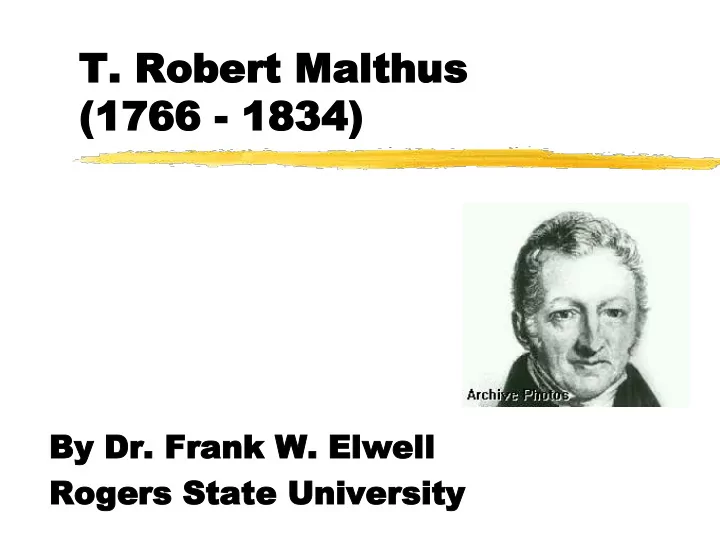
SLIDE 1
- T. Robert Ma
- T. Robert Malthus
lthus (1766 (1766 - 1834) 1834)
By By Dr.
Frank W. Elwell Elwell Rogers Rogers Stat State e University University
SLIDE 2 Note:
This presentation is based on the theories
- f T. Robert Malthus as presented in his
books listed in the bibliography. A complete summary of his and other macro-social theories can be found in Macrosociology: The Study of Sociocultural Systems, by Frank W. Elwell.
SLIDE 3 A Word of Explanation
The following slide show is a faithful summary of Malthus’s original 1798 Essay on Population. While nothing will substitute for reading the
- riginal essay with an open mind, I hope this
summary will go some way toward rehabilitating this man’s reputation.
SLIDE 4 Principle Of Principle Of Population Population
"Population, when unchecked, increases at a geometrical ratio. Subsistence increases
- nly in an arithmetical ratio. A slight
acquaintance with numbers will show the immensity of the first power in comparison with the second."
SLIDE 5
Principle Of Principle Of Population Population
"Population must always be kept down to the level of the means of subsistence.” While Malthus was not the first one to notice this, he was the first to inquire into “the means by which this level is effected.”
SLIDE 6
Principle Of Principle Of Population Population
Man has no natural predators (save for other men). "The passion between the sexes has appeared in every age to be so nearly the same, that it may always be considered, in algebraic language as a given quantity."
SLIDE 7
Principle Of Principle Of Population Population
Population, when unchecked, will double itself every twenty-five years. "...Supposing the present population equal to a thousand million, the human species would increase as the numbers 1, 2, 4, 8,16, 32, 64, 128, 256, and subsistence as 1, 2, 3, 4, 5, 6, 7, 8, 9...
SLIDE 8
Principle Of Principle Of Population Population
"In two centuries the population would be to the means of subsistence as 256 to 9; in three centuries as 4096 to 13, and in two thousand years the difference would be almost incalculable.”
SLIDE 9 Subs Subsistence Vs istence Vs. . Population Population
Please note: By writing this Malthus is not making a prediction of the future. He knows full well that population cannot grow long beyond the means of
- subsistence. He is simply trying to
illustrate to his readers the unequal powers of growth in population and food production.
SLIDE 10 Subs Subsistence Vs istence Vs. . Population Population
The following slide is a graphic illustration
- f Malthus’ conception of the unequal
strength of subsistence and population growth potential.
SLIDE 11 Gr Growt
h Pote tent ntial ial of
Sub Subsist sisten ence ce Vs.
Populat ulation ion
20 40 60 80 100 120 140 SUBSISTENCE POPULATION TIME 1 TIME 2 TIME 3 TIME 4 TIME 5 TME 7 TIME 6 TIME 7
SLIDE 12 Subs Subsistence istence
"In this supposition no limits whatever are placed on the produce
“It may increase for ever, and be greater than any assignable quantity; yet the power of population being in every period so much superior….
SLIDE 13 Law of Necessity
"The human species can only be kept down to the level of the means of subsistence by the constant
- peration of the strong law of
necessity, acting as a check upon the greater power."
SLIDE 14
Pos Positive Checks itive Checks
"The positive checks to population are extremely various, and include every cause whether arising from vice or misery, which in any degree contributes to shorten the natural duration of human life."
SLIDE 15 Pos Positive Checks itive Checks
"Under this head therefore may be enumerated all unwholesome
- ccupation, severe labour and
exposure to the season, extreme poverty...
SLIDE 16
Pos Positive Checks itive Checks
“…Bad nursing of children, excesses of all kinds, the whole train of common diseases and epidemics, wars, pestilence, plague and famine."
SLIDE 17
Pos Positive Checks: itive Checks:
War Famine Disease Infanticide
SLIDE 18
Preven Preventive Checks tive Checks
Celibacy Contraception Non-procreative sex
SLIDE 19
SLIDE 20
Preven Preventive Checks tive Checks
In Malthus’ view, birth control led to vice. Still, he maintained, it is the least evil act that can control population
SLIDE 21 Preven Preventive Checks tive Checks
"When a general corruption of morals with regard to sex pervades all classes of society, its effects must necessarily be to poison the springs
- f domestic happiness, to weaken
conjugal parental affection..."
SLIDE 22
Food Food and Population and Population
This was Malthus “principle of population,” which is basically the law of supply and demand applied to the relationships between food production and population growth.
SLIDE 23
Food Food and Population and Population
As the food supply increases, food becomes cheaper, and more children are brought into the world. As there are more mouths to feed, food becomes more expensive, thus causing more land to be put under the plow, or greater investment in fertilizer.
SLIDE 24
Food Food and Population and Population
While Malthus recognized that the relationships among the fertility of people and land are a good deal more complex than this simplified assertion, he maintained there is a recurrent reciprocal relationship between the two.
SLIDE 25
Food Food and Population and Population
Because of this reciprocal relationship between population and production, over the course of sociocultural evolution, both population and food production have grown in tandem.
SLIDE 26 Food Food and Population and Population
Periods of increase in food productivity, whether it be because of the application
- f technology or the expansion of
cultivated land, have been met with expansions of population.
SLIDE 27
Food Food and Population and Population
Periods of stability in food production, or contraction in productivity, have been marked by the same phenomena in population level.
SLIDE 28
Food Food and Population and Population
Over the course of sociocultural evolution, however, the long-term tendency has been for both productivity and population to intensify.
SLIDE 29
Food Food and Population and Population
This reciprocal growth, of course, has great affect on other parts of the sociocultural system.
SLIDE 30 The Po The Poor
Consistent with his functionalist
- rientation, Malthus asserts that a
working class is absolutely essential to every society. Labor will always be necessary to wrest subsistence from nature.
SLIDE 31 The Po The Poor
The institution of private property and self-interest provide the motivation for human thought and action. It is the goad of necessity, the desire to avoid poverty or to obtain riches that motivates much of human industry.
SLIDE 32 The Po The Poor
Unequal rewards for industry and idleness are the “master spring” of human activity. The desire for riches, or the fear of poverty, also motivates humans to regulate the number of their offspring.
SLIDE 33 The Po The Poor
The poor represent that portion of the population that is not supported through existing technology and distribution systems.
SLIDE 34 The Po The Poor
Poverty (and its consequent misery and vice), according to Malthus, is an
- utgrowth between our ability to produce
food and our tendency to reproduce the species.
SLIDE 35 The Po The Poor
Because of population’s tendency to outstrip available food supplies, the mass of people must be subjected to physical distress (lack of food and other necessities) in order to limit population increase (either through preventive checks, or failing those, positive checks).
SLIDE 36 The Po The Poor
It is because of this imbalance, Malthus states, that “millions and millions of human existences have been repressed.”
SLIDE 37 The Po The Poor
This necessity to repress population has existed in every society in the past, exists in the present, and will, Malthus says, “for ever continue to exist.”
SLIDE 38
Poor Laws Poor Laws
Malthus maintains that there is a necessity for both workers and proprietors in all societies beyond hunting and gathering levels.
SLIDE 39
Poor Laws Poor Laws
Labor is the only property owned by the poor, which they sell in exchange for money--money to purchase the necessities of life.
SLIDE 40
Poor Laws Poor Laws
Malthus does not see poverty as a consequence of moral worth or the fitness to survive. At no point does he attempt to justify the “present great inequality of property.”
SLIDE 41
Poor Poor
He views severe inequality with horror and asserts that it is not necessary nor very useful to the bulk of mankind, We are morally obligated to alleviate the plight of the poor, Malthus says, though we must recognize that we can never fully do so.
SLIDE 42 Poor Laws Poor Laws
Malthus’s critique of the British poor laws stems from three sources:
His functional analysis of poverty, welfare, and population growth The greatest good for the greatest number
The high value he places on human liberty
SLIDE 43 Poor Laws Poor Laws: : Dys Dysfunctions functions
Whether conceived in a purposeful manner to hold down the costs of labor, or conceived out of compassion to alleviate distress--the provision of welfare removes the necessity of some population checks
SLIDE 44
Poor Laws Poor Laws: : Dys Dysfunctions functions
The result of this removal is that population rises, the market becomes flooded with new laborers and those willing to work longer and harder to support their increased number of offspring.
SLIDE 45
Poor Laws Poor Laws: : Dys Dysfunctions functions
The fatal flaw of the poor laws is that it encourages population growth without increasing provisions to support that growth. In accordance with the law of supply and demand, poor laws will contribute to “raise the price of provisions and lower the real price of labour.”
SLIDE 46 Poor Laws Poor Laws: : Dys Dysfunctions functions
Labor, you will recall, is the only commodity that the poor have to sell in
- rder to obtain resources.
Thus, available provisions must be spread
- ver a greater number of people, and
distress becomes more widespread and severe.
SLIDE 47
Poor Laws Poor Laws: : The Greatest The Greatest Good Good
Poor laws serve to soften the fear of poverty. They diminish the power of the poor to save (through lowering the price of labor) and weaken a strong incentive for the poor to work. Worse, the laws remove one of the major checks to early marriage and having children.
SLIDE 48 Poor Laws Poor Laws: : The Greatest The Greatest Good Good
If subsistence does not increase, but population does, available provisions must be spread over a greater number of
- people. Thus a higher proportion of the
next generation will live in poverty as a result.
SLIDE 49
Poor Laws Poor Laws: : The Greatest The Greatest Good Good
Malthus acknowledges that it may appear hard in individual circumstances, but holding dependent poverty disgraceful, encouraging people to use preventive checks, will promote the greatest good for the greatest number.
SLIDE 50
Poor Laws Poor Laws: : Human Human Freedom Freedom
If you are going to provide assistance, Malthus asserts, you must give power to a certain class of people who will manage the necessary institutions to provide the relief. These institutions will be charged with formulating rules in order to discriminate between those who are worthy and unworthy of aid.
SLIDE 51
Poor Laws Poor Laws: : Human Human Freedom Freedom
This represents a tremendous power over the life affairs of all who are forced to ask for support.
SLIDE 52 Poor Laws Poor Laws: : Human Human Freedom Freedom
He cites a frequent complaint of the poor regarding welfare administrators, and
- bserves (somewhat sociologically): “The
fault does not lie so much in these persons, who probably, before they were in power, were not worse than other people, but in the nature of all such institutions.”
SLIDE 53
Poor Laws Poor Laws: : Human Human Freedom Freedom
Generally, Malthus believes, a government that attempts to “repress inequality of fortunes” through welfare mechanisms will be “destructive of human liberty itself.” He also greatly fears concentrating so much power into the hands of the state-- as absolute power corrupts absolutely.
SLIDE 54
Poor Laws Poor Laws: : Human Human Freedom Freedom
Finally, Malthus is also concerned with the effect of dependence on the poor themselves. Hard labor, he concedes, is evil, but dependence is far worse.
SLIDE 55
Poor Laws Poor Laws: : Human Human Freedom Freedom
In our attempts to alleviate the plight of the poor through welfare laws we sacrifice the liberties and freedom of the poor, subjecting them to “tyrannical regulations” in exchange for promises of relief.
SLIDE 56
Poor Laws Poor Laws: : Human Human Freedom Freedom
But society cannot fulfill its part of the bargain, cannot eliminate the distresses of poverty without removing necessary checks on population--thus creating more poor. The poor are forced to sacrifice their liberty and get little in return.
SLIDE 57
Welfare Reform Welfare Reform
This analysis of welfare does not lead Malthus to advocate that the poor should be left to their plight. Rather, he suggests some institutional reforms--consistent with the law of population--that will serve to make a more just, equitable society.
SLIDE 58
Welfare Reform Welfare Reform
Malthus’ proposals are an attempt to tie population growth itself to increases in the produce of the land.
SLIDE 59
Welfare Reform Welfare Reform
He advocates freedom of movement so that people can go to areas where work is plentiful. Incentives for tilling new lands to increase production and furnish an “increasing quantity of healthy work.” Establishment of county workhouses.
SLIDE 60 Welfare Reform Welfare Reform
The intent of these workhouses is to provide a place “where any person, native
- r foreigner, might do a days work at all
times and receive the market price for it.” The fare should be hard, those that are able would be obliged to work for the prevailing wage.
SLIDE 61
Welfare Reform Welfare Reform
The workhouses are intended to eliminate the most severe distress while maintaining the necessary incentive for human industry and the operation of preventive checks on population.
SLIDE 62 Welfare Reform Welfare Reform
Finally, Malthus clearly states, human benevolence and compassion must augment these social policies. For Malthus, “the proper office of benevolence” is to soften the “partial evils” arising from people acting in their
SLIDE 63 Welfare Reform Welfare Reform
But compassion and benevolence can never replace self-interest as the mainspring of human action. The poor, Malthus maintains, will always be among us. But it is our moral
- bligation to minimize inequalities as
much as the laws of nature will allow.
SLIDE 64
Welfare Reform Welfare Reform
He points out that while inequality is essential to motivate human beings to activity and productivity, the inequality need not be as great as existed in his own society.
SLIDE 65
Welfare Reform Welfare Reform
Malthus’ 1798 Essay was designed to demonstrate the impossibility of a social utopia--but he insisted that we could (indeed, should) reduce social and economic inequality through structural reform.
SLIDE 66 Malthus an Malthus and Evo d Evolution lution
Nature scatters its seeds in abundance, but it is relatively sparse in the sustenance it provides. Therefore life must continuously adapt in
SLIDE 67
Malthus an Malthus and Evo d Evolution lution
Malthus is in obvious awe of the evolutionary process--writing of the “powers of selection, combination, and transmutation” of life.
SLIDE 68 Malthus an Malthus and Evo d Evolution lution
He describes evolution as a “mighty process
- f God” that is responsible for “a constant
succession of sentient beings, rising apparently from so many specks of matter, going through a long and painful process in this world…”
SLIDE 69
Malthus an Malthus and Evo d Evolution lution
Since nature has provided for an abundance of seed, but little sustenance, human survival depends on exertion and thought. It is human intelligence, Malthus believes, that is being selected by God’s grand design.
SLIDE 70
Malthus an Malthus and Evo d Evolution lution
According to Malthus, material needs are at the base of human motivation. These needs provide the stimulant for primitive man to devise new ways of exploiting her environment
SLIDE 71 Malthus an Malthus and Evo d Evolution lution
These needs are central in providing continual stimulation for the development
- f the infant brain, and are probably
always necessary to stimulate people to productive activity.
SLIDE 72
Malthus an Malthus and Evo d Evolution lution
It is the effort to satisfy physical needs for food and shelter that stimulate humans to greater effort and innovation. It is the press of population on carrying capacity that provides the impetus for technological progress.
SLIDE 73
Malthus’s Evolutionary Sys System: tem:
Eight major points regarding evolution found in the 1798 Essay:
1) population level is severely limited by subsistence 2) when the means of subsistence increases, population increases 3) population pressures stimulate increases in productivity
SLIDE 74
Malthus’s Evolutionary Sys System: tem:
4)increases in productivity stimulates further population growth 5) since this productivity can never keep up with the potential of population growth for long, there must be strong checks on population to keep it in line with carrying capacity.
SLIDE 75 Malthus’s Evolutionary Sys System: tem:
6) it is through individual cost/benefit decisions regarding sex, work, and children that population and production are expanded
7) positive checks will come into operation as population exceeds subsistence level.
SLIDE 76
Malthus’s Evolutionary Sys System: tem:
8) The nature of these checks will have significant effect on the rest of the sociocultural system--Malthus points to misery, vice, and poverty.
SLIDE 77
Malthus’ Evolutionary Sys System: tem:
For Malthus, the engine of social change (or social evolution) is in the relationships between population and production. Elements of the sociocultural system (social institutions, norms and values) must always adapt to this material base.
SLIDE 78 Malthus’ Evolutionary Sys System: tem:
Since societies must conform to natural law-
- that is the disparity in the powers of
production and reproduction--no form of social organization or amount of technological innovation can escape these natural limits.
SLIDE 79
Malthus an Malthus and Evo d Evolution lution
It was Malthus who was responsible for the concept of the struggle for survival, or natural selection, upon which the theories of Spencer, Darwin, and Wallace later depended.
SLIDE 80 Malthus an Malthus and Evo d Evolution lution
Darwin’s principles were an application of social science concepts to the discipline of biology. As Darwin put it, “this is the doctrine
- f Malthus applied to the whole
animal and vegetable kingdoms."
SLIDE 81
Malthus an Malthus and Evo d Evolution lution
Where Malthus and Spencer, Darwin, and Wallace part company is in their view of progress and/or the perfectibility of man or society.
SLIDE 82
Progress Progress
Malthus’ essay was emphatically conceived as a refutation of the enlightenment’s faith in progress.
SLIDE 83
Progress Progress
"My object was to apply the essay to the truth of the perfectibility of man and society, which at that time excited a considerable portion of public attention."
SLIDE 84 Progress Progress
"...It seems evident that no improved form of government, no plans of emigration, no benevolent institutions, and no degree or direction of national industry, can prevent the continued action of some great check to increase in some form
SLIDE 85
Progress Progress
"...It follows that we must submit to it as an inevitable law of nature.”
SLIDE 86
Progress Progress
In Malthus’ view, no change in the political, economic, or social system could eliminate poverty, famine, and pestilence.
SLIDE 87
Progress Progress
While we could reform society and make a (somewhat) better world, we cannot create a utopia.
SLIDE 88
Bibliography
Elwell, F. (2009), Macrosociology: The Study of Sociocultural Systems. Lewiston: Edwin Mellen Press. Malthus, T. R. (1798/2001). An Essay on the Principle of Population. In F. W. Elwell, A Commentary on Malthus' 1798 Essay on the Principle of Population as Social Theory (pp. 127-294). Lewiston: Mellen Press.