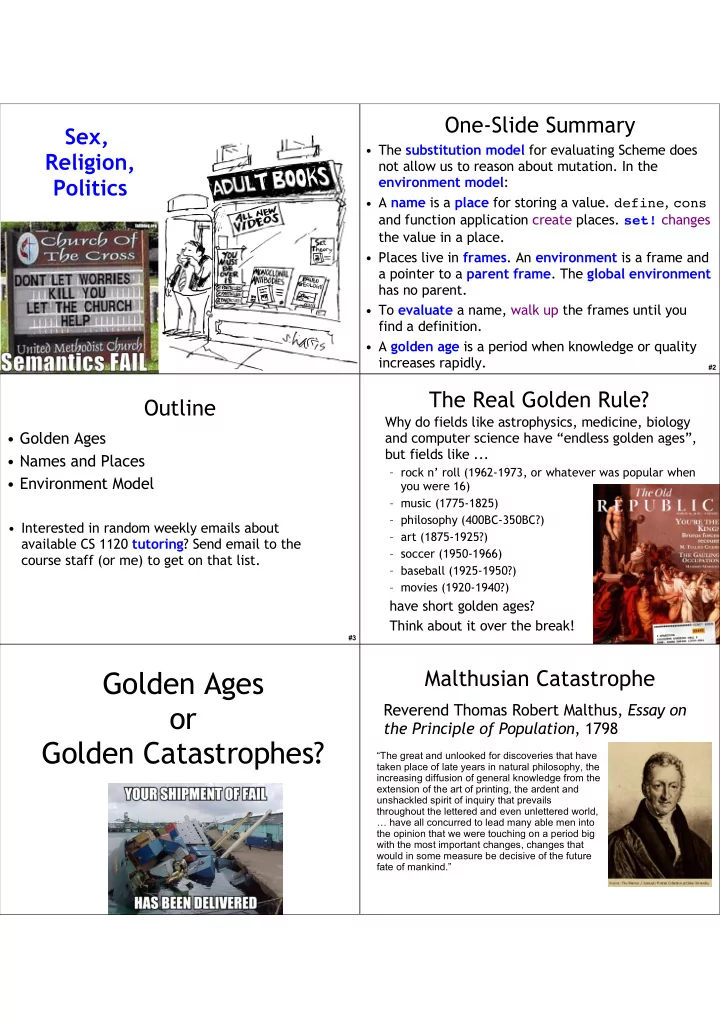
Golden Ages Malthusian Catastrophe or Reverend Thomas Robert - - PDF document

golden ages
SMART_READER_LITE
LIVE PREVIEW

Golden Ages Malthusian Catastrophe or Reverend Thomas Robert - - PDF document

One-Slide Summary Sex, The substitution model for evaluating Scheme does Religion, not allow us to reason about mutation. In the environment model : Politics A name is a place for storing a value. define , cons and function application


slide-1
SLIDE 1

#1

Sex, Religion, Politics

#2

One-Slide Summary

  • The substitution model for evaluating Scheme does

not allow us to reason about mutation. In the environment model:

  • A name is a place for storing a value. define, cons

and function application create places. set! changes the value in a place.

  • Places live in frames. An environment is a frame and

a pointer to a parent frame. The global environment has no parent.

  • To evaluate a name, walk up the frames until you

find a definition.

  • A golden age is a period when knowledge or quality

increases rapidly.

#3

Outline

  • Golden Ages
  • Names and Places
  • Environment Model
  • Interested in random weekly emails about

available CS 1120 tutoring? Send email to the course staff (or me) to get on that list.

#4

The Real Golden Rule?

Why do fields like astrophysics, medicine, biology and computer science have “endless golden ages”, but fields like ...

– rock n’ roll (1962-1973, or whatever was popular when you were 16) – music (1775-1825) – philosophy (400BC-350BC?) – art (1875-1925?) – soccer (1950-1966) – baseball (1925-1950?) – movies (1920-1940?)

have short golden ages? Think about it over the break!

Golden Ages

  • r

Golden Catastrophes?

Malthusian Catastrophe

Reverend Thomas Robert Malthus, Essay on the Principle of Population, 1798

“The great and unlooked for discoveries that have taken place of late years in natural philosophy, the increasing diffusion of general knowledge from the extension of the art of printing, the ardent and unshackled spirit of inquiry that prevails throughout the lettered and even unlettered world, … have all concurred to lead many able men into the opinion that we were touching on a period big with the most important changes, changes that would in some measure be decisive of the future fate of mankind.”

slide-2
SLIDE 2

Malthus’ Postulates

“I think I may fairly make two postulata.

– First, that food is necessary to the existence of man. – Secondly, that the passion between the sexes is necessary and will remain nearly in its present state. These two laws, ever since we have had any knowledge of mankind, appear to have been fixed laws of our nature, and, as we have not hitherto seen any alteration in them, we have no right to conclude that they will ever cease to be what they now are…”

Malthus’ Conclusion

“Assuming then my postulata as granted, I say, that the power of population is indefinitely greater than the power in the earth to produce subsistence for man. Population, when unchecked, increases in a geometrical ratio. Subsistence increases only in an arithmetical ratio. A slight acquaintance with numbers will show the immensity of the first power in comparison of the second.”

Malthusian Catastrophe

  • Population growth is geometric: Θ(kn) (k > 1)
  • Food supply growth is linear: Θ(n)

What does this mean as n→ ∞?

Food per person = food supply / population = Θ(n) / Θ(kn) As n approaches infinity, food per person approaches zero!

Liberal Arts Trivia: American Studies

  • This American social activist and leading figure
  • f the woman's movement crafted the

Declaration of Sentiments. Its presentation, at the first women's rights convention in Seneca Falls, is often credited with initiating the first woman's suffrage movement in the USA. Beyond voting rights, her work addressed parental and custody rights, employment and income rights, property rights, divorce laws, and birth control.

Liberal Arts Trivia: Classics and Drama

  • This ancient Greek tragedian playwright wrote

Ajax, Antigone, Trachinian Women, Oedipus the King, Electra, Philoctetes and Oedipus at

  • Colonus. He influenced the development of the

drama by adding a third actor (reducing the importance of the chorus in the presentation

  • f the plot) and putting a greater emphasis on

character development.

Malthus’ Fallacy

slide-3
SLIDE 3

Malthus’ Fallacy

He forgot how he started:

“The great and unlooked for discoveries that have taken place of late years in natural philosophy, the increasing diffusion

  • f general knowledge from the extension of

the art of printing, the ardent and unshackled spirit of inquiry that prevails throughout the lettered and even unlettered world…”

Golden Age of Food Production

  • Agriculture is an “endless golden age”

field: production from the same land

increases as ~ Θ(1.02n)

  • Increasing knowledge of farming, weather

forecasting, plant domestication, genetic engineering, pest repellants, distribution channels, etc.

Growing Corn

2006: 10,000 pounds per acre Michael Pollan’s The Omnivore’s Dilemma 1906: < 1,000 pounds per acre

Corn Yield

Note: Log axis! http://www.agbioforum.org/v2n1/v2n1a10-ruttan.htm

Example: Norman Borlaug

  • Father of the Green Revolution

– Nobel Peace Prize, Presidential Medal of Freedom, Congressional Gold Medal (one of five to win all three), India's Padma Vibhushan

  • "At a time when doom-sayers were hopping around saying everyone was going to

starve, Norman was working. He moved to Mexico and lived among the people there until he figured out how to improve the output of the farmers. So that saved a million lives. Then he packed up his family and moved to India, where in spite of a war with Pakistan, he managed to introduce new wheat strains that quadrupled their food output. So that saved another million. You get it? But he wasn't done. He did the same thing with a new rice in China. He's doing the same thing in Africa -- as much of Africa as he's allowed to visit. When he won the Nobel Prize in 1970, they said he had saved a billion people. That's BILLION! BUH! That's Carl Sagan BILLION with a "B"! And most of them were a different race from

  • him. Norman is the greatest human being, and you probably never heard of him."

– Penn Jillette, on the show Penn & Teller

Upcoming Malthusian Catastrophes?

  • Human

consumption of fossil fuels grows as Θ(kn) (fairly large k like 1.08?)

  • Available fuel is

constant (?)

http://wwwwp.mext.go.jp/hakusyo/book/hpag200001/hpag200001_2_006.html

slide-4
SLIDE 4

Malthus was wrong about #2 Also

Advances in science (birth control), medicine (higher life expectancy), education, and societal and political changes (e.g., regulation in China) have reduced k (it is < 1 in many countries now!)

“Cornucopian View”

  • Few resources are really finite
  • All scientific things seem to have endless

golden ages

  • (We hope) Human ingenuity and economics

and politics will solve problems before they become catastrophes

– No one will sell the last gallon of gas for $2.35

“Kay”-sian View The best way to predict the future is to invent it. — Alan Kay Charge

  • When picking majors, pick a short golden

age field that is about to enter its short golden age

– This requires vision and luck!

  • Play it safe by picking an endless golden

age field (CS is a good choice for this!)

Liberal Arts Trivia: French Literature

  • This 19th century French writer and political

activist was an exponent of the Romantic movement in France. Two of his volumes of poetry, Les Contemplations and La Légende des siècles are particularly critically acclaimed, and he is sometimes called the greatest French poet. Outside of France he is perhaps best known for Les Misérables and Notre-Dame de Paris.

  • Bonus points: Give Valjean's prisoner number.

Liberal Arts Trivia: French History

  • This 1806 Parisian

monument commemorates those who fought for France, particularly in the Napoleonic Wars. Underneath it is the Tomb of the Unknown Soldier from WWI.

slide-5
SLIDE 5

Liberal Arts Trivia: Mathematics

  • This is a major area of mathematics that

This is a major area of mathematics that combines developments and concepts from combines developments and concepts from set theory and geometry, such as those of set theory and geometry, such as those of dimension, space, transformation and shape. dimension, space, transformation and shape. Of particular importance to this field are Of particular importance to this field are homoemorphisms, which can viewed as homoemorphisms, which can viewed as continuous functions with continuous continuous functions with continuous

  • inverses. Subfields include point-set,
  • inverses. Subfields include point-set,

algebraic, and geometric. algebraic, and geometric.

Review: Names, Places, Mutation

  • A name is a place for storing a value.
  • A define creates a new place.
  • A cons application creates two new places, the

car and the cdr.

  • A frame is a collection of places.
  • An environment is a frame and a pointer to a

parent environment.

– The global environment has no parent.

  • (set! name expr) changes the value in the

place name to the value of expr.

#27

Environments

global environment

> (define x 3) >

+ : #<primitive:+> null? : #<primitive:null?>

The global environment points to the outermost

  • frame. It starts with all Scheme primitives.

x : 3

#28

Environments & Procedures

global environment

> (define (double (lambda (x) (+x x))) >

+ : #<primitive:+> null? : #<primitive:null?>

The global environment points to the outermost

  • frame. It starts with all Scheme primitives.

x : 3 double: ???

How To Draw Procedures

  • A procedure needs both code and an

environment

– Think of make-incrementer ... where are x and y?

  • (define (make-incrementer x)
  • (lambda (y) (+x y))
  • We draw pictures like this:

Environment pointer environment: parameters: y body: (+ x y)

#30

Procedures

global environment

> (define double

(lambda (x) (+ x x)))

+ : #<primitive:+> null? : #<primitive:null?> double: x : 3

environment: parameters: x body: (+ x x)

slide-6
SLIDE 6

#31

Application

  • Old rule: (Substitution model)

Apply Rule 2: Constructed Procedures. To apply a constructed procedure, evaluate the body of the procedure with each formal parameter replaced by the corresponding actual argument expression value.

#32

New Application Rule 2:

  • 1. Construct a new environment, whose

parent is the environment to which the environment pointer of the applied procedure points.

  • 2. Create places in that frame for each

parameter containing the value of the corresponding operand expression.

  • 3. Evaluate the body in the new
  • environment. Result is the value of the

application.

#33

1. Construct a new environment, parent is procedure’s environment pointer 2. Make places in that frame with the names of each parameter, and

  • perand values

3. Evaluate the body in the new environment

global environment

> (double 4)

8

+ : #<primitive:+> x : 3 x :

4 (+ x x)

double:

environment: parameters: x body: (+ x x)

(+ x x)

#34

1. Construct a new environment, parent is procedure’s environment pointer 2. Make places in that frame with the names of each parameter, and operand values 3. Evaluate the body in the new environment

global environment

> (define nest

(lambda (x) (lambda (x) (* x x)))) > ((nest 5) 4) 16

+ : #<primitive:+> x : 3 x :

5

nest:

environment: parameters: x body: (lambda (x) (* x x)) environment: parameters: x body: (+x x)

x :

4 (* x x)

#35

Evaluation Rule 2: Names

A name expression evaluates to the value associated with that name.

To find the value associated with a name, look for the name in the frame associated with the evaluation

  • environment. If it contains a place with that name, the

value of the name expression is the value in that place. If it doesn’t, the value of the name expression is the value of the name expression evaluated in the parent environment if the current environment has a parent. Otherwise, the name expression evaluates to an error (the name is not defined).

#36

evaluate-name

(define (evaluate-name name env) (if (null? env) (error “Undefined name: ...”) (if (frame-contains name (get-frame env)) (lookup name (get-frame env)) ;;; otherwise, check with the parent (evaluate-name name (parent-environment (get-frame env))))))

slide-7
SLIDE 7

#37

Homework

  • PS 5 due Wednesday
  • Read Course Book 9 and 10