
SLIDE 1
Roadmap to Brexit
Fulvio Fassone ETRC VP Business Development ATRI President
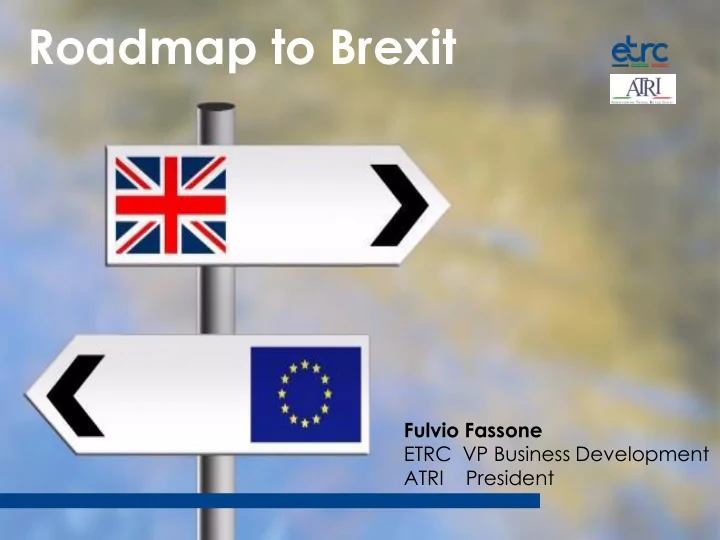
Roadmap to Brexit Fulvio Fassone ETRC VP Business Development ATRI - - PowerPoint PPT Presentation
Roadmap to Brexit Fulvio Fassone ETRC VP Business Development ATRI President Nightmare or opportunity ? 29 March 2019 11 pm GMT Brexit The Aviation regulatory framework 1986 : Airline Deregulation Act adopted in USA . The Air Transport
Fulvio Fassone ETRC VP Business Development ATRI President
1986 : Airline Deregulation Act adopted in USA . The Air Transport Market it has moved towards a progressive liberalization 1987 : Europe adoption of “packages” : "first package" (1987) and the "second package" (1990) have made the rules on tariffs and capacities more flexible. In 1992 the “third package” (consisting mainly of Council Regulations (EEC) No 2407/92, 2408/92 and 2409/92, now replaced by Regulation (EC) No 1008/2008 of the European Parliament and of the Council) has removed all remaining trade restrictions applicable to European airlines
From EU states and third countries are in force “bilateral or multilateral agreement” June 2016 : as consequence of UK referendum on EU membership, UK is moving to assume the position of “third state” and UK airlines must comply with European regulations
UK airports account for 17.7% of the total passenger traffic handled by EU27 airports (256.4 million passengers at UK airports out of 1.448 billion passengers at EU-28 airports). 3 UK airports are amongst the top 20 EU27 airports: London-Heathrow (n.1) , which is actually the busiest airport not just within the EU but on a pan-European level (with 75.1 million passengers), London-Gatwick (n. 8 with 43.1 million passengers) and Manchester (n.19 with 25.7 million passengers). With more than 1 in every 2 passengers handled by UK airports flying to/from the EU27, the UK aviation market is heavily dependent on the EU. With slightly more than 1 in 10 passengers handled by EU27 airports flying to/from the UK, the EU27 is less dependent on the UK.
There are however significant variations in the degree of exposure of individual EU27 national markets to the UK, with Ireland, the Slovak Republic, Cyprus, Malta, Poland, Lithuania and Spain being the most exposed to traffic to/from the UK.
Overall, ACI EUROPE estimates that under the current unrestricted market access regime, EU27-UK air traffic:
A significant proportion of the intra-EU27 traffic is ensured by UK air carriers. Should these UK air carriers not be able to continue operating such air services – either under a UK AOC or under an alternative EU27 Member State AOC, a number of airports in the EU27 would lose air services – resulting in degraded air connectivity.
March 2018 Today’s new draft EU guidelines for the post-Brexit relationship confirm that “specific air transport and air safety agreements will be needed to safeguard air connectivity between the UK and the EU” April 2018-October 2018 Negotiation on traffic and model of air traffic between UK and EU 27 January 2017: the UK Government clarified that the UK would not seek to remain part of the EU Single Market but that it would alternatively seek a free trade agreement with the EU “so as to give British companies the maximum freedom to do business with the EU and vice versa”. UK Government intent on exiting the Single Market without mentioning the possibility for any exception for aviation,
ACI is calling a future agreement that mirrors as closely as possible today’s arrangements. ACI note that the draft EU guidelines do not consider the rights of UK airlines to keep flying within the EU27 nor the right of EU27 airlines to keep flying within the UK, as a result of the UK leaving the Single Aviation Market. These restrictions would result in a less competitive overall Three models for the relationship between the UK and the EU Option 1: No agreements made with the EU Under this option, the UK would revert to World Trade Organisation policies and principles and would apply standard International Civil Aviation Organisation (ICAO) rules. For the UK to remove itself completely from the EU aviation market without having negotiated any form of a relationship could well leave the future of the industry in a precarious position.
Option 2: European Common Aviation Area (ECAA) membership The European Common Aviation Area is a membership group of European countries (not necessarily EU members Iceland, Norway etc ) that is defined by bilateral agreements between the countries dealing with a single market for aviation services. One model within the ECAA that is easily identified in itself is the relationship that Norway currently has with the EU and its aviation industry – that is full access to the aviation market but with that comes the requirement to apply all EU regulation and legislation with no voting rights
Option 3: UK-EU bilateral agreement This final option is similar to the model used in Switzerland where both parties have negotiated a range of opt-ins and opt-outs that suit their operating structure. This model would allow the UK some access to the EU aviation market but each individual aspect would have to be negotiated. This is more time-consuming than the previous option and also presents the possibility that the UK would have to concede on items it might otherwise have wished to avoid in order to make gains in other areas. Once more, the UK's ability to influence policy would be limited.
shall cease to apply to the State in question from the date of entry into force of the withdrawal agreement or, failing that, two years after the notification…
that will run from 3/2019 to 12/2020 . In this period UK will be considerate a member state without politic representation
Free sales item. All negotiations have to finish next October : Only few months to decide a huge number of items!
EU rules on Duty Free based on : Excise Directive (2008/118) – VAT Directive (2006/112)
excise goods supplied by tax-free shops which are carried away in the personal luggage of travellers to a third territory or third country taking a flight or sea-crossing and …(Article 4(5) : ‘third country’ means any State or
territory to which the Treaty is not applicable.
passengers travelling to a destination outside the Community. This is means that also Tax refund to UK passengers could be applyied To allow duty free sales to travellers departing the UK to the EU, UK legislation must be amended.
March April 2018
(3/2019-12/2020)
“transition period” (2019-2021) Duty free sales will be not apply
Up to October 2018
UK
sales after “transition period”
*Subject to possible extension of timeline
Till March 2019
April 2019 December 2021
January 1st 2021
*Subject to possible extension of timeline