Roadmap for OO Design What is a Relational Database? Database = - - PDF document

roadmap for oo design
SMART_READER_LITE
LIVE PREVIEW

Roadmap for OO Design What is a Relational Database? Database = - - PDF document

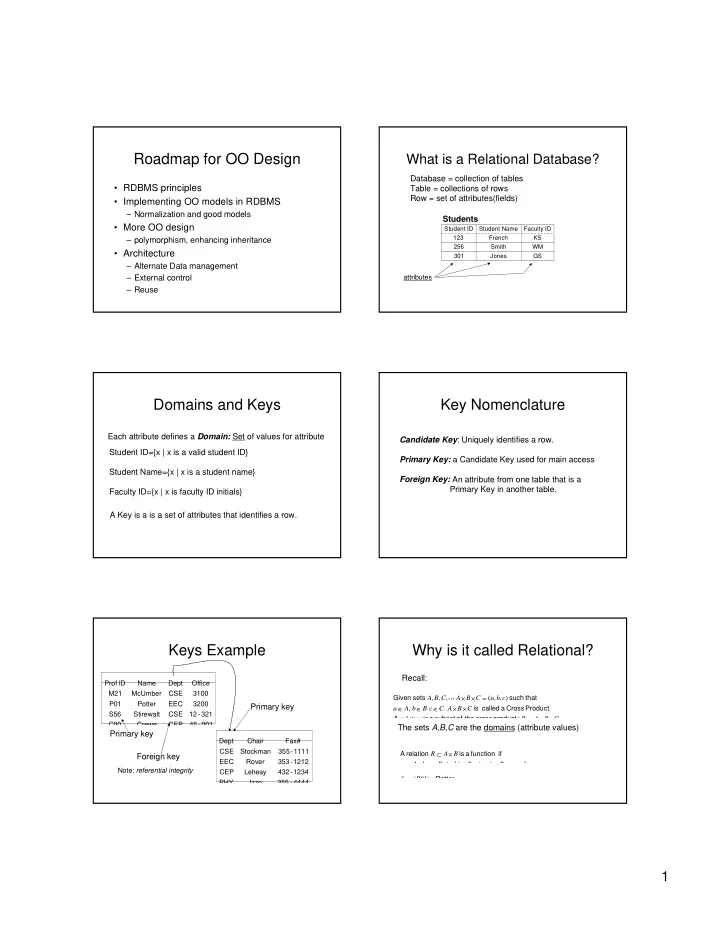
Roadmap for OO Design What is a Relational Database? Database = collection of tables RDBMS principles Table = collections of rows Row = set of attributes(fields) Implementing OO models in RDBMS Normalization and good models


slide-1
SLIDE 1

1

Roadmap for OO Design

  • RDBMS principles
  • Implementing OO models in RDBMS

– Normalization and good models

  • More OO design

– polymorphism, enhancing inheritance

  • Architecture

– Alternate Data management – External control – Reuse

What is a Relational Database?

GS Jones 301 WM Smith 256 KS French 123 ID Faculty Name Student ID Student

Database = collection of tables Table = collections of rows Row = set of attributes(fields)

attributes

Students

Domains and Keys

Each attribute defines a Domain: Set of values for attribute Student ID={x | x is a valid student ID} Student Name={x | x is a student name} Faculty ID={x | x is faculty ID initials} A Key is a is a set of attributes that identifies a row.

Key Nomenclature

Candidate Key: Uniquely identifies a row. Primary Key: a Candidate Key used for main access Foreign Key: An attribute from one table that is a Primary Key in another table.

Keys Example

4444

  • 355

Izzo PHY 1234

  • 432

Leheay CEP 1212

  • 353

Rover EEC 1111

  • 355

Stockman CSE Fax# Chair Dept 001

  • 45

CEP Crewe C00 321

  • 12

CSE Stirewalt S56 3200 EEC Potter P01 3100 CSE McUmber M21 Office Dept Name ID Prof

Foreign key Primary key Primary key

Note: referential integrity

Why is it called Relational?

Recall:

C B A R relation C B A C c B b A a c b a C B A C B A × × ⊆ × × ∈ ∈ ∈ = × × : product cross the

  • f

subset a is A Product Cross a called is that such sets Given . . , ) , , ( , , ,

  • The sets A,B,C are the domains (attribute values)

b c R c a R b a B c b A a B A R = ⇒ ∈ ∧ ∈ ∈ ∈ × ⊂ ) , ( ) , ( , , if function a is relation A Potter = ) 01 (P f name

slide-2
SLIDE 2

2

Operations on Tables

Project operator = all rows, but selected columns All the RDBMS operators act on tables to produce tables. Join A, B over column x from A, y from B = (two steps): B A C × = Form 1.

  • 2. Keep only rows where x=y

Select operator = select rows based on criteria (such as key match)

Join Example

C Jones 301 B Smith 256 A French 124 ID Faculty Name ID Student 304 EB 001 C 100 BH 201 B 201 EB 101 A Location Section ID Faculty 304 EB 001 C C Jones 100 BH 201 B B Smith 201 EB 101 A A French B.Location B.Section B.Faculty A.Faculty A.Name ID A.Student 301 256 124

Table A Table B

Support for Existence-Based Identity

  • RDBMS generates unique ID (usually

number)

  • MS-Access uses type counter (really a long

value)

  • Oracle uses type sequence
  • Other possibilities

– Date/Time (if fine grained) – pointer connected with DB (Ingres)

Implementing a Class Model

  • Objects have identity

– Value based (keys are domain values) – Existence based (keys are made-up Ids)

  • New Domains

– Identifier: contains existence Ids – Enumeration: discrete set of values

  • Class table
  • Assoc & Generalization table or relation

Implementing 1-1

A B A-Id B-Id ……. B-Id ……. Foreign key can be on either side

Implementing Many to Many

A B A-Id ………. B-Id ……. A-Id B-Id

slide-3
SLIDE 3

3

Example with Foreign Keys

City Airport

serves 1..* 1..* Lansing 01009 Albany 01007 Atlanta 01006 Houston 01005 cityName cityID

ATL 01006 LAN 01009 TEW 01008 HOU 01005 IAH 01005 e airportCod cityID Lansing LAN Hartsfield ATL Hobby HOU nential Interconti IAH e airportNam e airportCod

City Table Serves Table Airport Table

Implementing 1 to Many

A B A-Id B-Id ……. B-Id ……. B-Id A-Id ……. A-Id ……. In the “0-1” case, flipping these requires a possible null key

  • r

Exercise

Person

birthDate deathDate name

Citation

title note authors edits

  • 1. Use existence-based identity to design tables for

classes Person and Citation.

  • 2. Design tables for associations authors and edits.

Review: Implementing 1-1

A B A-Id B-Id ……. B-Id ……. Foreign key can be on either side

Review: Implementing Many to Many

A B A-Id ………. B-Id ……. A-Id B-Id

Review: Implementing 1 to Many

A B A-Id B-Id ……. B-Id ……. B-Id A-Id ……. A-Id ……. In the “0-1” case, flipping these requires a possible null key

  • r
slide-4
SLIDE 4

4

Normal Forms and OO Implementations (1)

3 TTh 20 : 10 C 2 231 CSE 3 MTF 10 : 9 Intro 3 101 CSE 3 10MWF : 4 Math 2 260 CSE 4 30MWF : 11 Software 1 470 CSE 3 MTF 00 : 8 Math 1 260 CSE Credits Time Desc Section Course + + If the description of CSE260 changes, have to change it in multiple places. Called modification anomaly. Primary key Schedule

Normal Forms

  • “Normal Form” old RDBMS concept
  • Concerned with redundancies and

dependencies between attributes.

  • With Object Models we can (almost)

ignore normalization

  • Requires good model and good

implementation.

Normal Forms and OO Implementations (2)

3 TTh 20 : 10 C 2 231 CSE 3 MTF 10 : 9 Intro 3 101 CSE 3 10MWF : 4 Math 2 260 CSE 4 30MWF : 11 Software 1 470 CSE 3 MTF 00 : 8 Math 1 260 CSE Credits Time Desc Section Course + + If I want to add CSE870, and have a description and credits, I still need a section and time before it can be added. This is an insertion anomaly. Schedule

Normal Forms and OO Implementations (3)

3 TTh 20 : 10 C 2 231 CSE 3 MTF 10 : 9 Intro 3 101 CSE 3 10MWF : 4 Math 2 260 CSE 4 30MWF : 11 Software 1 470 CSE 3 MTF 00 : 8 Math 1 260 CSE Credits Time Desc Section Course + + If no sections of CSE101 are offered, and I delete it, I lose the description and credits. This is a deletion anomaly. Schedule

Normal Forms & Correct Models

3 TTh 20 : 10 C 2 231 CSE 3 MTF 10 : 9 Intro 3 101 CSE 3 10MWF : 4 Math 2 260 CSE 4 30MWF : 11 Software 1 470 CSE 3 MTF 00 : 8 Math 1 260 CSE Credits Time Desc Section Course + + This table has problems because it has partial dependencies, and is not in in second normal form. It’s also the implementation of an incorrect

  • bject model. Description and Credits only depend on Course.

Schedule

Second Normal Form

Second normal form means there are no partial dependencies. Course Schedule 0..* Better Model 3 C 231 CSE 3 Intro 101 CSE 4 Software 470 CSE 3 Math 260 CSE Credits Desc Course + + TTh 20 : 10 2 231 CSE MTF 10 : 9 3 101 CSE MWF 30 : 11 1 470 CSE MTF 00 : 8 1 260 CSE Time Section Course Course Schedule

slide-5
SLIDE 5

5

Third Normal Form (I)

0012

  • 505

Freud 257 PSY West W4 7441

  • 555

Stockman 127 CSE Morris M3 7318

  • 555

Fui 241 EEC Jones J2 7441

  • 555

Stockman 263 CSE Brown B1 FAX Chair Office Dept Name ID Prof This “professor” class is modeled incorrectly. The table is in second normal form, but has anomalies: Modification: Changing dept chair requires multiple modifications Insertion: A new Dept requires at least one prof even if we have a chair and FAX. Why? Chair and FAX depend on only Dept. Called Transitive Dependency Key Prof

Third Normal Form (II)

Dept Professor 0..* 7318

  • 555

Fui EEC 0012

  • 505

Freud PSY 7441

  • 555

Stockman CSE FAX Chair Dept 257 PSY West W4 127 CSE Morris M3 241 EEC Jones J2 263 CSE Brown B1 Office Dept Name ID Prof Now there are no partial or transitive dependencies. Dept Professor

Things NOT To Do

Company

Name Founded

Board

boardSize

Name Founded boardSize Don’t combine optional classes

A B A-Id B-Id B-Id A-Id

Don’t double up on foreign keys

Conclusions So Far….

  • Classes are tables
  • Associations are relations or tables and

relations

  • Proper class model produces normalized

forms

  • Normalized forms eliminate anomalies
  • Concentrate on class model -- proper classes

and multiplicities and good relational model results.

Generalization

Super Sub 2 Sub 1 Super-ID Common fields Super-ID Special fields Requires a join to get the object Alternatives: Push subclass attributes up and use a “type” field Push superclass attributes down and replicate tables

Association Classes

User Table Authorization userID …… tableID owner grantee tableID grantor

grantor grantee

  • wner

User Table Authorization key FK

userID tableID userID

slide-6
SLIDE 6

6

Link Attributes

A B A-Id ………. B-Id ……. A-Id B-Id Link-attributes

Like any other association table, but add the extra attributes. attr