Risk analysis process Outline The aim of this presentation is to - - PowerPoint PPT Presentation
RISK ANALYSIS PROCESS 5th December 2018 Risk analysis process Outline The aim of this presentation is to take the Board through the FSA risk analysis process. Risk analysis is a process consisting of three components: risk
Outline
- The aim of this presentation is to take the Board through the FSA risk
analysis process.
- Risk analysis is a process consisting of three components: risk
assessment, risk management and risk communication.
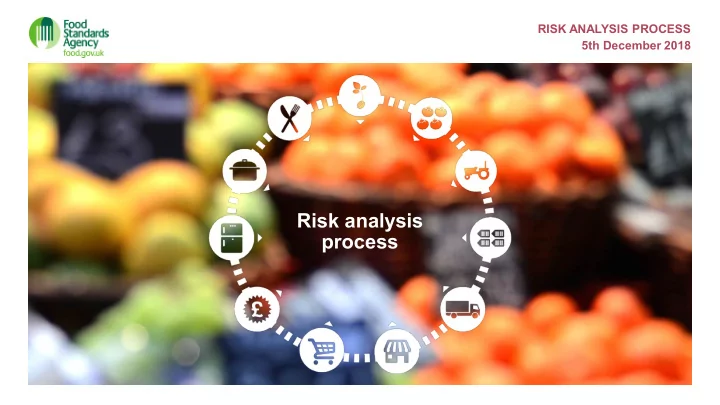
- The process is illustrated in a step by step flowchart.
Risk analysis
The three components of risk analysis are defined as follows: Risk assessment: A scientifically based process consisting of the following steps: (i) hazard identification, (ii) hazard characterization, (iii) exposure assessment, and, (iv) risk characterization. Risk management: The process, distinct from risk assessment, of weighing policy alternatives, in consultation with all interested parties, considering risk assessment and other factors relevant for the health protection of consumers and for the promotion of fair trade practices, and, if needed, selecting appropriate prevention and control options. Risk communication: The interactive exchange of information and opinions throughout the risk analysis process concerning risk, risk-related factors and risk perceptions, among risk assessors, risk managers consumers, industry, the academic community and other interested parties, including the explanation of risk assessment findings and the basis of risk management decisions.
1
Risk identificatio n
2
Preliminary activities to determine whether action is appropriate
3
Problem formulation to agree scope of risk assessment and
- ther evidence
required
Step 1 : Potential risks identified by
- ur surveillance capability and other
sources are profiled and prioritised Step 2 : Preliminary risk management activities will be carried out to determine whether risk analysis is needed Step 3 : If Step 2 identifies the need for a new assessment of relevant evidence, the question(s) to be answered in relation to risk assessment and consumers’ other interests will be agreed between risk managers and risk assessors
4
Identification of approaches to gather and analyse evidence
5
Production of risk assessment and analysis of evidence
Step 4 : The scientific/analytical discipline(s), sources and approaches needed, and the experts best placed to gather and analyse the evidence is determined by risk assessors; timescales for delivery of the evidence are agreed with risk managers and risk communicators. Step 5 : The risk assessment and other evidence are produced and drawn together into an evidence package. Our scientific advisory committees will advise us in the assessment of toxicological and microbiological risks
- 1. What we have now
Risk based standards and controls Bulk of FSA and SACs current work Risk assessment for EU and national controls Regulated products Risk assessment largely done at EFSA level COT, ACMSF Main work ACNFP ad hoc COT, ACMSF, Occasional review of EFSA RAs ACNFP National RAs
- n limited
number and type of dossiers
Key RA – risk assessment COT Committee on Toxicity TA – technical advice ACMSF Advisory Committee on Microbiological Safety of Food RM – risk management ACNFP Advisory Committee on Novel Foods & Processes FCM – food contact materials ACAF Advisory Committee on Animal Feedingstuffs
Risk Analysis - Plans for FSA Scientific Advisory Committees
ACAF Mix of RA, TA and RM
RA Technical Advice relevant to RA Other advice for RM
- 2. What we are going to do for Day 1
Risk based standards and controls RA for national controls, trade Review RA from EU/others Regulated products RA for national applications Review RA from EU/others
Key RA – risk assessment COT Committee on Toxicity TA – technical advice ACMSF Advisory Committee on Microbiological Safety of Food RM – risk management ACNFP Advisory Committee on Novel Foods & Processes FCM – food contact materials ACAF Advisory Committee on Animal Feedingstuffs
EU Exit: Plans for FSA Scientific Advisory Committees
RA TA relevant to RA Other advice for RM
COT, ACMSF – main work ACNFP, ACAF – as needed ACNFP Novel food and feed (incl. GM) COT, ACMSF, ACAF: joint groups
- Food contact
materials
- Additives
- Feed
ACAF - other advice for risk management feeds into new structures as they develop ACAF - other advice for risk management feeds into new structures as they develop
6
Quality assurance by Chief Scientific Adviser and/or Scientific Advisory Committees
7
Risk assessment and other evidence presented to risk managers
Risk assessment published
Step 6 : Quality will be assured by internal and external experts, including the FSAs’ independent Scientific Advisory Committees, Science Council and the CSA who has an overall independent assurance and challenge role Step 7 : An evidence package containing the risk assessment and information on other legitimate factors evidence is presented to risk managers.
8 Analysis of risk management
- ptions based on
risk assessment and other legitimate factors Risk managers develop advice based on available evidence and AFF
- pinion
9
FSA Advisory Forum on Food and Feed
Forum
- pinion
published
Formal consultation as necessary 10 11
FSA consult Board if necessary
12
FSA considers Board recommendations where appropriate and finalises advice
Publish FSA advice with supporting evidence
1