Risk Aggregation, Motivation Numerical Stability and a CreditRisk - - PowerPoint PPT Presentation

risk aggregation
SMART_READER_LITE
LIVE PREVIEW

Risk Aggregation, Motivation Numerical Stability and a CreditRisk - - PowerPoint PPT Presentation

Outline of Presentation Risk Aggregation, Motivation Numerical Stability and a CreditRisk + and extensions Variation of Panjers Recursion Panjers recursion Numerical stability Winter School on Mathematical Finance and


slide-1
SLIDE 1

Risk Aggregation, Numerical Stability and a Variation of Panjer’s Recursion

Winter School on Mathematical Finance CongresHotel De Werelt, Lunteren January 21–23, 2008

  • Prof. Dr. Uwe Schmock

(Dr. Stefan Gerhold, Dipl.-Ing. Richard Warnung) CD-Laboratory for Portfolio Risk Management (PRisMa Lab) Financial and Actuarial Mathematics Vienna University of Technology, Austria www.fam.tuwien.ac.at Outline of Presentation

  • Motivation
  • CreditRisk+ and extensions
  • Panjer’s recursion
  • Numerical stability

and extensions of Panjer’s recursion

  • Applications and examples
  • Quantiles, expected shortfall, risk contributions
  • Application to operational risk (time permitting)

Software implementation:

  • Dipl.-Ing. Severin Resch
  • Dipl.-Ing. Richard Warnung

c

  • Jan. 23, 2008, U. Schmock, FAM, TU Vienna

2

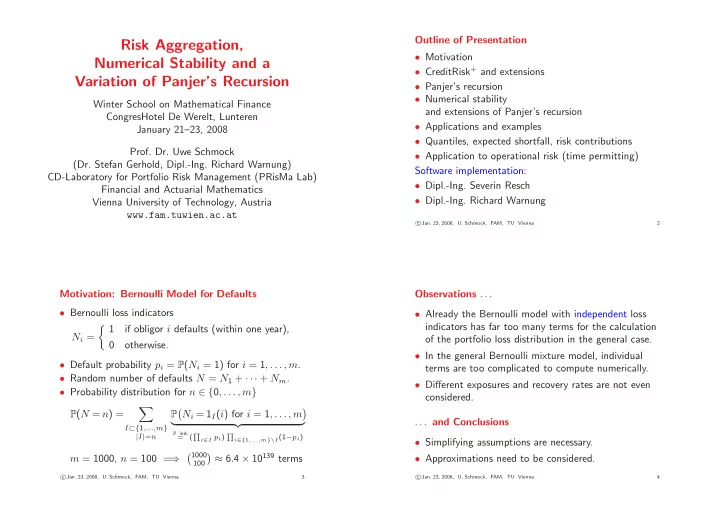
Motivation: Bernoulli Model for Defaults

  • Bernoulli loss indicators

Ni = 1 if obligor i defaults (within one year),

  • therwise.
  • Default probability pi = P(Ni = 1) for i = 1, . . . , m.
  • Random number of defaults N = N1 + · · · + Nm.
  • Probability distribution for n ∈ {0, . . . , m}

P(N = n) =

  • I⊂{1,...,m}

|I|=n

P

  • Ni = 1I(i) for i = 1, . . . , m
  • if ind.

= (

i∈I pi) i∈{1,...,m}\I(1−pi)

m = 1000, n = 100 = ⇒ 1000

100

  • ≈ 6.4 × 10139 terms

c

  • Jan. 23, 2008, U. Schmock, FAM, TU Vienna

3

Observations . . .

  • Already the Bernoulli model with independent loss

indicators has far too many terms for the calculation

  • f the portfolio loss distribution in the general case.
  • In the general Bernoulli mixture model, individual

terms are too complicated to compute numerically.

  • Different exposures and recovery rates are not even

considered. . . . and Conclusions

  • Simplifying assumptions are necessary.
  • Approximations need to be considered.

c

  • Jan. 23, 2008, U. Schmock, FAM, TU Vienna

4

slide-2
SLIDE 2

Poisson Approximation

  • X1, . . . , Xm independent default 0-1-indicators
  • Intensity λ = m

i=1 pi with pi = P(Xi = 1)

  • Number of default events W = m

i=1 Xi

  • Total variation distance

dTV(µ, ν) = sup

A⊂N0

|µ(A) − ν(A)| Quality of Poisson approximation (Barbour/Hall, 1984): dTV

  • L(W), Poisson(λ)
  • ≤ 1 − e−λ

λ

m

  • i=1

p2

i

For full proof with Stein–Chen method, see e.g. Barbour, Holst and Janson: Poisson Approximation, Clarendon Press (1992).

c

  • Jan. 23, 2008, U. Schmock, FAM, TU Vienna

5

Simple Poisson Model for Defaults

  • Number Ni of defaults of obligor i ∈ {1, . . . , m}
  • Assume Ni ∼ Poisson(λi) for all i ∈ {1, . . . , m}

(several defaults of an obligor possible).

  • Assume independence of N1, . . . , Nm.
  • Random number of defaults N = N1 + · · · + Nm.
  • N ∼ Poisson(λ) with λ = λ1 + · · · + λm, i.e.,

P(N = n) = λn n! e−λ for all n ∈ N0.

  • m = 20, λi = 0.2 =

⇒ P(N > 20) ≤ 2 × 10⁻⁹.

c

  • Jan. 23, 2008, U. Schmock, FAM, TU Vienna

6

Introduction to CreditRisk+, Standard Features

  • Developed by Credit Suisse First Boston.
  • Actuarial model for the aggregation of credit risks.
  • Based on the Poisson approximation of individual de-

faults and the divisibility of the Poisson distribution.

  • Allows for deterministic exposures/recovery rates.
  • Several independent risk factors for dependence of

default frequencies can be considered.

  • Probability generating function ϕL of the credit

portfolio loss L is available in closed form. → No Monte Carlo simulation, no stochastic error!

c

  • Jan. 23, 2008, U. Schmock, FAM, TU Vienna

7

Extensions of CreditRisk+

  • Stochastic losses of individual obligors are allowed,

distribution may depend on the causing risk factor.

  • Risk groups with dependent stochastic losses given

default are possible.

  • Risk factors for default frequencies may be dependent.
  • Risk contributions of obligors can be calculated.
  • Even with all the extensions, the probability

generating function ϕL of the credit portfolio loss L is available in closed form. → No Monte Carlo simulation, no stochastic error!

  • Distribution of L and risk contributions can be calcu-

lated from ϕγ,L with a numerically stable algorithm.

c

  • Jan. 23, 2008, U. Schmock, FAM, TU Vienna

8

slide-3
SLIDE 3

Input Parameters of CreditRisk+ (Extended Version)

  • Number of obligors m ∈ N.
  • Basic loss unit E > 0.
  • Number K ∈ N0 of risk factors or non-idiosyncratic,

(independent) default causes.

  • Relative default variances σ2

k > 0 of risk factors

k ∈ {1, . . . , K}.

  • Collection G of nonempty subsets of all obligors

{1, . . . , m}, called risk groups.

c

  • Jan. 23, 2008, U. Schmock, FAM, TU Vienna

9

Input Parameters of CreditRisk+ (Cont.) For every group g ∈ G we need

  • the (one year) default probability pg∈ [0, 1],
  • the susceptibility wg,0∈ [0, 1] to idiosyncratic risk,
  • the susceptibilities wg,k∈ [0, 1] to risk factors k ∈

{1, . . . , K},

  • the multivariate probability distributions

Qg,k = {qg,k,µ}µ∈Ng

0 on Ng

0 describing the stochastic

losses of all the obligors i ∈ g in multiples of the basic loss unit E in case the risk group g defaults due to risk k ∈ {0, . . . , K}.

c

  • Jan. 23, 2008, U. Schmock, FAM, TU Vienna

10

Further Assumptions, Notation

  • We assume that every obligor i ∈ {1, . . . , m} belongs

to at least one group g ∈ G.

  • Let Gi := {g ∈ G | i ∈ g} denote the set of all risk

groups to which obligor i ∈ {1, . . . , m} belongs, by assumption Gi = ∅.

  • We assume that for each group the susceptibilities

(also called weights) exhaustively describe the risk

  • factors. That is, for all g ∈ G,

K

  • k=0

wg,k = 1.

c

  • Jan. 23, 2008, U. Schmock, FAM, TU Vienna

11

Notation for Default Events of Risk Groups Number of defaults for every risk group g ∈ G:

  • Ng,0 due to idiosyncratic risk,
  • Ng,k due to risk k ∈ {1, . . . , K},
  • Ng := K

k=0 Ng,k total.

Notation for Default Events of Individual Obligors Number of defaults for every obligor i ∈ {1, . . . , m}

  • Ni,0 :=

g∈Gi Ng,0 due to idiosyncratic risk,

  • Ni,k :=

g∈Gi Ng,k due to risk k ∈ {1, . . . , K},

  • Ni := K

k=0 Ni,k = g∈Gi Ng total.

c

  • Jan. 23, 2008, U. Schmock, FAM, TU Vienna

12

slide-4
SLIDE 4

Notation for Stochastic Losses Loss at default number n ∈ N of risk group g ∈ G due to risk factor k ∈ {1, . . . , K} or idiosyncratic risk k = 0

  • Lg,i,k,n part attributed to obligor i ∈ g
  • Lg,k,n :=

i∈g Lg,i,k,n loss of entire group

Summation over default numbers, risks and groups:

  • Lg,k := Ng,k

n=1 Lg,k,n total loss of the group for risk k

  • Lg := K

k=0 Lg,k total loss of the risk group

  • L =

g∈G Lg portfolio loss

c

  • Jan. 23, 2008, U. Schmock, FAM, TU Vienna

13

Loss Attributed to Obligor i ∈ {1, . . . , m}

  • Due to group g ∈ Gi and risk k ∈ {0, . . . , K}

Lg,i,k :=

Ng,k

  • n=1

Lg,i,k,n.

  • Due to risk k ∈ {0, . . . , K}

Li,k :=

  • g∈Gi

Lg,i,k.

  • Total attributed loss

Li :=

K

  • k=0

Li,k.

c

  • Jan. 23, 2008, U. Schmock, FAM, TU Vienna

14

Probabilistic Assumptions for the Extended Version of CreditRisk+

  • For every group g ∈ G and every risk k ∈ {0, . . . , K},

the sequence of Ng

0-valued random vectors (Lg,i,k,n)i∈g

with n ∈ N is i.i.d. and independent of all other ran- dom variables, with distribution P(Lg,i,k,1 = µi for all i ∈ g) = qg,k,µ, µ ∈ Ng

0.

  • For each group g ∈ G, the number Ng,0 of idiosyn-

catic defaults is Poisson distributed according to the Poisson intensity λg and the susceptibility wg,0, i.e., Ng,0 ∼ Poisson(λgwg,0) for every g ∈ G.

c

  • Jan. 23, 2008, U. Schmock, FAM, TU Vienna

15

Probabilistic Assumptions (Cont.)

  • The group default numbers {Ng,0}g∈G due to id-

iosyncratic risk are independent from one another and from all other random variables.

  • The risks factors Λ1, . . . , ΛK are independent,

each one gamma distributed with E[Λk] = 1 and Var(Λk) = σ2

k > 0, i.e., αk = βk = 1/σ2 k.

  • For all groups g ∈ G and risks k ∈ {1, . . . , K},

L (Ng,k| Λ1, . . . , ΛK)

a.s.

= L (Ng,k| Λk)

a.s.

= Poisson(λgwg,kΛk) .

  • Conditionally on Λ1, . . . , ΛK, the risk factor based de-

faults

  • Ng,k
  • g ∈ G, k ∈ {1, . . . , K}
  • are independent.

c

  • Jan. 23, 2008, U. Schmock, FAM, TU Vienna

16

slide-5
SLIDE 5

Weighted Probability Generating Function In order to calculate terms needed for the risk contri- butions we will need what we call weighted probability generating functions. Definition: For L : Ω → N0 and an integrable random variable X : Ω → R, we define the X-weighted probability generating function by ϕL,X(s) = E

  • XsL

=

  • n=0

E

  • X1{L=n}
  • sn,

which is meaningful at least for all s ∈ C with |s| ≤ 1.

c

  • Jan. 23, 2008, U. Schmock, FAM, TU Vienna

17

Weighted Probability Generating Function (Cont.) We will need expressions of the form E[Λk1{L=n}] for k ∈ {1, . . . , K} and n ∈ N0, which can be derived by ϕ(n)

L,Λk(0) = n! E

  • Λk1{L=n}
  • .

Unifying approach for the γ-weighted probability gener- ating function of the loss: Fix γ = (γ1, . . . , γK) ∈ [0, ∞)K and define ϕL,γ(s) := E

  • Λγ1

1 . . . ΛγK K sL

, |s| ≤ 1, for the risk factors Λ1, . . . , ΛK and the total loss L. γ = 0 gives the probability generating function ϕL of L.

c

  • Jan. 23, 2008, U. Schmock, FAM, TU Vienna

18

The Closed Form of the WPGF ϕL,γ(s) = Cγ exp

  • ¯

λ0(ϕ0(s) − 1) −

K

  • k=1

1 σ2

k

+ γk

  • log
  • 1 − ¯

λkσ2

k(ϕk(s) − 1)

  • ,

where Cγ := K

k=1 E[Λγk k ] = 1 if all γk ∈ {0, 1}, with

PGF of mixture distributions (conditioned to be positive) ϕk(s):=

  • g∈G

λg wg,k ¯ λk ϕLg,k,1(s), ¯ λk:=

  • g∈G

λgwg,k(1−qs

g,k,0).

Numerical inversion similar to: H. Haaf, O. Reiß, J. Schoenmakers, Numerically Stable Computation of CreditRisk+, 2003.

c

  • Jan. 23, 2008, U. Schmock, FAM, TU Vienna

19

Distributions in the Panjer Class Definition: A probability distribution {qn}n∈N0 is said to belong to the Panjer(a, b, k) class with a, b ∈ R and k ∈ N0 if q0 = q1 = · · · = qk−1 = 0 and qn =

  • a + b

n

  • qn−1

for all n ∈ N with n ≥ k + 1. Important Examples: (all distributions are known)

  • Poisson(λ) ∈ Panjer(0, λ, 0) with λ > 0
  • NegBin(α, p) ∈ Panjer(q, (α − 1)q, 0)

with α > 0 and p ∈ (0, 1)

  • Log(q) ∈ Panjer(q, −q, 1) with q ∈ (0, 1) and

qn = −

qn n log(1−q) for all n ∈ N

c

  • Jan. 23, 2008, U. Schmock, FAM, TU Vienna

20

slide-6
SLIDE 6

Extended Panjer Recursion If L(N) ∈ Panjer(a, b, k), independent of the i. i. d. N0-valued sequence {Xn}n∈N, and aP(X1 = 0) = 1, then S := X1 + · · · + XN satisfies P(S = 0) = ϕN(P(X1 = 0)) with ϕN probability generating function of N, and P(S = n) = 1 1 − aP(X1 = 0)

  • P(Sk = n)P(N = k)

+

n

  • j=1
  • a + bj

n

  • P(X1 = j)P(S = n − j))
  • for all n ∈ N, where Sk = X1 + · · · + Xk.

c

  • Jan. 23, 2008, U. Schmock, FAM, TU Vienna

21

Application of Extended Panjer Recursion Remark: Recursion scheme is numerically stable for Poisson(λ), NegBin(α, p), and Log(q). Observation: If N ∼ Poisson(λ), independent of the

  • i. i. d. sequence {Xn}n∈N with X1 ∼ Log(q), then

S = X1 + · · · + XN ∼ NegBin

λ log(1 − q), 1 − q

  • .

Application: Calculate

  • Mixture distribution ϕk for risks k ∈ {0, . . . , K}.
  • Panjer recursion for log. dist. for risks k ∈ {1, . . . , K}.
  • Mixture distribution of ϕ0 and recursion results.
  • Final Panjer recursion for Poisson distribution.

c

  • Jan. 23, 2008, U. Schmock, FAM, TU Vienna

22

10 20 30 40 50 0.01 0.02 0.03 Loss distribution in a credit portfolio of 25 exposures calculated with CreditRisk+ and basic loss unit 100 000. 95% Probability Portfolio loss in millions 25 Exposures Total: 130 513 072 Largest: 20 238 895 with p = 7.5% 15 410 906 with p = 10% 7 727 651 with p = 1.6% Smallest: 358 475 with p = 30% No loss with p = 5.76%

c

  • Jan. 23, 2008, U. Schmock, FAM, TU Vienna

23

20 40 60 80 100 120 0.0005 0.001 0.0015 Loss distribution in a credit portfolio of 100 exposures calculated with CreditRisk+ and basic loss unit 100 000. 99% Probability Portfolio loss in millions

c

  • Jan. 23, 2008, U. Schmock, FAM, TU Vienna

24

slide-7
SLIDE 7

200 400 600 800 1000 0.0001 0.0002 Portfolio loss in millions Loss distribution in a credit portfolio of 1000 exposures calculated with CreditRisk+ and basic loss unit 100 000. 99% Probability

c

  • Jan. 23, 2008, U. Schmock, FAM, TU Vienna

25

Extended Logarithmic Distribution For k ∈ N\{1} and q ∈ (0, 1] define q0 = · · · = qk−1 = 0, qn = n

k

−1qn ∞

l=k

l

k

−1ql for n ≥ k. ExtLog(k, q) is in Panjer(q, −kq, k). Extended Negative Binomial Distribution For k ∈ N, α ∈ (−k, −k + 1) and p ∈ [0, 1) define q = 1 − p, q0 = · · · = qk−1 = 0 and qn = α+n−1

n

  • qn

p−α − k−1

j=0

α+j−1

j

  • qj

for n ≥ k. ExtNegBin(α, k, p) is in Panjer(q, (α − 1)q, k).

c

  • Jan. 23, 2008, U. Schmock, FAM, TU Vienna

26

Example for Numerical Instability Take N ∼ ExtNegBin(α, k, p) with k ∈ N, ε, p ∈ (0, 1) and α = −k + ε. Consider the loss distribution P(X1 = 1) = P(X1 = l) = 1/2 with l ≥ 3. Then pk+l = q k(l − 1)+εk k + l qk 2k+1 + qk+l−1 k2k+l

  • − q k(l − 1) − εl

k + l qk 2k+1 . With ε = 1/10 000, k = 1, l = 5, p = 1/10: p6 = 0.1499926 − 0.1499701 = 0.0000225 . Panjer recursion with five significant digits gives p6 = 0.0000400 . . .

c

  • Jan. 23, 2008, U. Schmock, FAM, TU Vienna

27

Panjer Recursion Replaced by Weighted Convolution Fix l ∈ N, consider N ∼ {qn}n∈N0 and ˜ Ni ∼ {˜ qi,n}n∈N0, define S = X1 + · · · + XN ∼ {pn}n∈N0 and ˜ S(i) = X1 + · · · + X ˜

Ni ∼ {˜

pi,n}n∈N0 for i ∈ {1, . . . , l}. Assume there exist k ∈ N0 and a1, . . . , al, b1, . . . , bl ∈ R such that ˜ qi,0 = · · · = ˜ qi,k+l−i−1 = 0 for i ∈ {1, . . . , l} and qn =

l

  • i=1
  • ai + bi

n

  • ˜

qi,n−i for n ≥ k + l. Then p0 = ϕN(P(X1 = 0)) and, for n ∈ N, pn =

k+l−1

  • j=1

P(Sj =n)qj +

l

  • i=1

n

  • j=0
  • ai + bij

in

  • P(Si =j)˜

pi,n−j.

c

  • Jan. 23, 2008, U. Schmock, FAM, TU Vienna

28

slide-8
SLIDE 8

Combination of Truncated Distributions Fix k ∈ N0, l ∈ N. For all i ∈ {1, . . . , l} assume that αi ≥ 0, βi ≥ −iαi (at least one =) and that the N0-valued ˜ Ni satisfies P( ˜ Ni < k + l − i) = 0. Consider q0, . . . , qk+l−1 ≥ 0 with q0 + · · · + qk+l−1 ≤ 1. Define qn = c

l

  • i=1
  • αi + βi

n

  • P( ˜

Ni = n − i) for n ≥ k + l, c =

  • (1 −

k+l−1

  • n=0

qn

  • l
  • i=1
  • αi + βi E
  • 1

i + ˜ Ni

  • .

Then {qn}n∈N0 is a probability distribution satisfying the recursion condition with ai = cαi and bi = cβi and the calculation of {pn}n∈N0 is numerically stable.

c

  • Jan. 23, 2008, U. Schmock, FAM, TU Vienna

29

Weighted Convolution for ExtLog Let k ∈ N and q ∈ (0, 1). Let N ∼ ExtLog(k+1, q) and ˜ N ∼ ExtLog(k, q), where ExtLog(1, q) means Log(q). Define S = X1 + · · · + XN and ˜ S = X1 + · · · + X ˜

N.

Then, with an explicit b1 > 0, the weighted convolution P(S = n) = b1 n

n

  • j=1

jP(X1 = j)P( ˜ S = n − j), n ∈ N, is numerically stable. Algorithm:

  • Panjer recursion for Log(1, q)
  • k−1 weighted convolutions: Log(1, q) → ExtLog(2, q)

→ · · · → ExtLog(k − 1, q) → ExtLog(k, q)

c

  • Jan. 23, 2008, U. Schmock, FAM, TU Vienna

30

Stable Algorithm for ExtLog(2,1) Let N ∼ ExtLog(2, 1). For S = X1 +· · ·+XN we have P(S = 0) = P(X1 = 0) + P(X1 ≥ 1) log P(X1 ≥ 1)) with 0 log 0 := 0 and, in the case P(X1 ≥ 1) > 0, P(S = n) = 1 n

n

  • j=1

jP(X1 = j)rn−j, n ∈ N, where r0 = − log P(X1 ≥ 1) and, recursively for n ∈ N, rn = 1 P(X1 ≥ 1)

  • P(X1 = n)+ 1

n

n

  • j=1

jP(X1 = n−j)rj

  • c
  • Jan. 23, 2008, U. Schmock, FAM, TU Vienna

31

Weighted Convolution for ExtNegBin Let k ∈ N0, α ∈ (−k, −k + 1) and p ∈ (0, 1). Let N ∼ ExtNegBin(α−1, k+1, p) and ˜ N ∼ ExtNegBin(α, k, p), where ExtNegBin(α, 0, p) means NegBin(α, p). Define S = X1 + · · · + XN and ˜ S = X1 + · · · + X ˜

  • N. Then

P(S = n) = b1 n

n

  • j=1

jP(X1 = j)P( ˜ S = n − j), n ∈ N, with an explicit b1 > 0 is numerically stable. Algorithm:

  • Panjer recursion for NegBin(α + k, p)
  • k weighted convolutions:

NegBin(α+k, p) → ExtNegBin(α+k−1, 1, p) → · · · → ExtNegBin(α + 1, k − 1, p) → ExtNegBin(α, k, p)

c

  • Jan. 23, 2008, U. Schmock, FAM, TU Vienna

32

slide-9
SLIDE 9

Stable Algorithm for ExtNegBin(α − 1,1,0) Let N ∼ ExtNegBin(α − 1, 1, 0) with α ∈ (0, 1). For S = X1 + · · · + XN we have P(S = 0) = 1 −

  • P(X1 ≥ 1)

1−α and in the case P(X1 ≥ 1) > 0 P(S = n) = 1 − α n

n

  • j=1

jP(X1 = j)rn−j, n ∈ N, where r0 =

  • P(X1 ≥ 1)

−α and, recursively for n ∈ N, rn = 1 P(X1 ≥ 1)

n

  • j=1

n − j + αj n P(X1 = j)rn−j

c

  • Jan. 23, 2008, U. Schmock, FAM, TU Vienna

33

Application: Poisson–Tempered α-Stable Mixtures Let Y be α-stable on [0, ∞) with Laplace transform E[exp(−sY )] = exp(−γα,σsα), s ≥ 0, where α ∈ (0, 1), σ > 0 and γα,σ := σα/ cos απ

2

  • .

For τ ≥ 0 define tempered stable distribution Fα,σ,τ(y) := E[e−τY 1{Y ≤y}]/E[e−τY ]. y ∈ R. Let Λ ∼ Fα,σ,τ and L(N|Λ)

a.s.

= Poisson(λΛ) for λ > 0. Then N

d

= N1 + · · · + NM with independent M ∼ Poisson(γα,σ((λ + τ)α − τ α)) and Nm ∼ ExtNegBin

  • −α, 1,

τ λ + τ

  • ,

m ∈ N.

c

  • Jan. 23, 2008, U. Schmock, FAM, TU Vienna

34

Example: Poisson–L´ evy Mixture Special case for α = 1/2 and τ = 0. L´ evy distribution: Given σ > 0, assume that Λ = Y ∼ fL(x) =

  • σ

2πx3 1/2 exp

  • − σ

2x

  • ,

x > 0. Let L(N|Λ)

a.s.

= Poisson(λΛ) with λ > 0. Then N

d

= N1 + · · · + NM with independent M ∼ Poisson

  • λσ/2
  • and

Nm ∼ ExtNegBin(−1/2, 1, 0), m ∈ N, and our numerically stable recursion is again applicable.

c

  • Jan. 23, 2008, U. Schmock, FAM, TU Vienna

35

Example: Poisson–Inverse Gaussian Mixture Fix µ, ˜ σ > 0, define σ = µ2/˜ σ2 and τ = 1/(2˜ σ2). Inverse Gaussian distribution: Λ ∼ F1/2,σ,τ has density fIG(x) = µ √ 2π˜ σ2x3 exp

  • −(x − µ)2

2˜ σ2x

  • ,

x > 0. Let L(N|Λ)

a.s.

= Poisson(λΛ) with λ > 0. Then N

d

= N1 + · · · + NM with independent M ∼ Poisson

  • σ/2(

√ λ + τ − √τ)

  • and

Nm ∼ ExtNegBin

  • −1/2, 1,

τ λ + τ

  • ,

m ∈ N.

c

  • Jan. 23, 2008, U. Schmock, FAM, TU Vienna

36

slide-10
SLIDE 10

Poisson–Reciprocal Inverse Gaussian Mixture Fix µ, ˜ σ > 0, define σ = µ2/˜ σ2 and τ = 1/(2˜ σ2). Reciprocal inverse Gaussian distribution: Assume Λ ∼ fRIG(x) = 1 √ 2π˜ σ2x exp

  • −(x − µ)2

2˜ σ2x

  • ,

x > 0. Let L(N|Λ)

a.s.

= Poisson(λΛ) with λ > 0. Then N

d

= N0 + N1 + · · · + NM with independent M ∼ Poisson

  • σ/2(

√ λ + τ − √τ)

  • ,

N0 ∼ NegBin(1/2, p), p = τ/(λ + τ), Nm ∼ ExtNegBin(−1/2, 1, p), m ∈ N.

c

  • Jan. 23, 2008, U. Schmock, FAM, TU Vienna

37

Measuring Risk by Quantiles Let X be a loss variable and δ ∈ (0, 1) a level. Definition: Lower δ-quantile of X qδ(X) := min{x ∈ R | P(X ≤ x) ≥ δ}. Remark: Quantiles are used as value-at-risk, they have bad properties concerning diversification. Properties: qδ(X) can jump when

  • the level δ varies slightly,
  • the loss variable X varies slightly.

c

  • Jan. 23, 2008, U. Schmock, FAM, TU Vienna

38

Measuring Risk by Expected Shortfall Let X be a loss variable and δ ∈ (0, 1) a level. Definition: The expected shortfall is defined as ESδ[X] := E[X1{X>qδ(X)}] + qδ(X)(P(X ≤ qδ(X)) − δ) 1 − δ . Remark: If P(X ≤ qδ(X)) = δ, in particular if the distribution function R ∋ x → P(X ≤ x) of X is also left-continuous at x = qδ(X), then ESδ[X] = E[X |X > qδ(X)].

c

  • Jan. 23, 2008, U. Schmock, FAM, TU Vienna

39

Calculation of Expected Shortfall in CreditRisk+

  • Credit portfolio loss L is a discrete random variable,

→ More complicated definition has to be used.

  • The lower quantile qδ(L) and P(L ≤ qδ(L)) can be

calculated using the CreditRisk+ algorithm.

  • Furthermore E[L1{L>qδ(L)}] = E[L]−E[L1{L≤qδ(L)}]

with E[L] =

  • g∈G

K

  • k=0

λg wg,kE[Lg,k,1] and E

  • L1{L≤qδ(L)}
  • =

qδ(L)

  • l=1

l P(L = l).

c

  • Jan. 23, 2008, U. Schmock, FAM, TU Vienna

40

slide-11
SLIDE 11

Contributions to Expected Shortfall – Definition Definition: For a subportfolio loss X ∈ L1(P) within a portfolio loss Y ∈ L1(P) define the expected shortfall contribution at level δ ∈ (0, 1) of X to Y by ESδ[X, Y ] = E[X1{Y >qδ(Y )}] + βY E[X1{Y =qδ(Y )}] 1 − δ where βY = P(Y ≤ qδ(Y )) − δ P(Y = qδ(Y )) if P(Y = qδ(Y )) > 0 and 0 otherwise. Remark: If P(Y ≤ qδ(Y )) = δ, then βY = 0 and ESδ[X, Y ] = E[X|Y > qδ(Y )].

c

  • Jan. 23, 2008, U. Schmock, FAM, TU Vienna

41

Contributions to Expected Shortfall – Calculation in Extended CreditRisk+ By consistency and linearity of the allocation ESδ[L] = ESδ[L, L] =

m

  • i=1
  • g∈Gi

K

  • k=0

ESδ[Lg,i,k, L]. Since E

  • Lg,i,k1{L>qδ(L)}
  • = E[Lg,i,k]
  • = λg wg,k E[Lg,i,k,1]

− E

  • Lg,i,k1{L≤qδ(L)}
  • ,

we will compute E[Lg,i,k1{L=l}] for l ∈ {1, . . . , qδ(L)}. This can be done using the following lemma.

c

  • Jan. 23, 2008, U. Schmock, FAM, TU Vienna

42

Lemma on Risk Contributions in CreditRisk+ For every obligor i ∈ {1, . . . , m}, every group g ∈ Gi and total loss l ∈ N0, E[Lg,i,01{L=l}] = λgwg,0

l

  • ν=1

E

  • Lg,i,0,11{Lg,0,1=ν}
  • P(L = l − ν)

and, for every risk k ∈ {1, . . . , K}, E[Lg,i,k1{L=l}] = λgwg,k

l

  • ν=1

E[Lg,i,k,11{Lg,k,1=ν}] E[Λk1{L=l−ν}].

c

  • Jan. 23, 2008, U. Schmock, FAM, TU Vienna

43

Possible Approaches to Operational Risk Modelling The Basel committee defined three approaches towards the quantification of operational risk. The two simple

  • nes define concrete formulae for the risk capital,

namely

  • Basic indicator approach (BIA).
  • Standardized approach (SA).

To reduce supervisory capital needs, an individual

  • Advanced measurement approach (AMA)

can be chosen.

c

  • Jan. 23, 2008, U. Schmock, FAM, TU Vienna

44

slide-12
SLIDE 12

Business Lines for Operational Risk

  • Eight business lines in the standardized approach:

(5) Payment & settlement, (1) Corporate finance, (6) Agency services, (2) Trading & sales, (7) Asset management, (3) Retail banking, (8) Retail brokerage. (4) Commercial banking,

  • These business lines also serve as categories

for an advanced measurement approach.

c

  • Jan. 23, 2008, U. Schmock, FAM, TU Vienna

45

Seven Loss-Types Distinguished for the Advanved Measurement Approach

  • Internal fraud
  • External fraud
  • Employment practices & workplace safety
  • Clients, products & business practice
  • Damage to physical assets
  • Business disruption & system failures
  • Execution, delivery & process management

c

  • Jan. 23, 2008, U. Schmock, FAM, TU Vienna

46

Application of Extended CreditRisk+ Methodology to Operational Risk: Reinterpretation of the Credit Risk Notation

  • Number m of obligors → number of business lines

(m = 8 for the ones given in the Basel commitee’s document is an appropriate choice).

  • Basic loss unit E stays the same (E = 10 000).
  • Number K of non-ideosyncratic risk factors

→ number of loss types (K = 7 for above list).

  • Numbers σ2

k > 0 denote the relative variance of

  • ccurrences of losses of type k ∈ {1, . . . , K}.
  • G contains the subsets of all business lines which

can incur a loss due to the same event.

c

  • Jan. 23, 2008, U. Schmock, FAM, TU Vienna

47

Notation for Business Lines and Risk Groups We need for every risk group g ∈ G of business lines

  • the (one year) intensity λg ≥ 0 for being hit by an
  • perational loss event,
  • the conditional probabilty wg,0 ∈ [0, 1] for an

idiosyncratic operational loss event not to belong to the types in {1, . . . , K}, of course wg,0 = 0 is a possible choice,

  • the conditional probabilities wg,k ∈ [0, 1] for an
  • perational loss event to be of type k ∈ {1, . . . , K},

c

  • Jan. 23, 2008, U. Schmock, FAM, TU Vienna

48

slide-13
SLIDE 13
  • the multivariate probability distribution Qg,k =

{qg,k,µ}µ∈Ng

0 on Ng

0 describing the severity of the

stochastic losses of the business lines i ∈ g in case an operational loss event of type k ∈ {0, . . . , K} hits the group g of business lines. Operational Risk Management With the adoption of the extended CreditRisk+ model for operational risk, a risk manager can

  • calculate the distribution of the operational loss,
  • calculate risk measures such as value-at-risk and

expected shortfall (might be infinity)

  • and identify risky business lines and groups by their

risk contribution (in case of finite expected shortfall).

c

  • Jan. 23, 2008, U. Schmock, FAM, TU Vienna

49