SLIDE 1 1
HIV and the Emergency Department Patient
Rachel L. Chin M.D. FACEP Professor of Emergency Medicine University of California, San Francisco San Francisco General Hospital
Why Physicians Education and patient prevention remains critical
CDC estimates 950,000 US residents are infected, 1/4 are unaware HIV infects 40,000 people each year Americans continues to die from AIDS Treatment remains difficult, life-long, expensive, and no cure
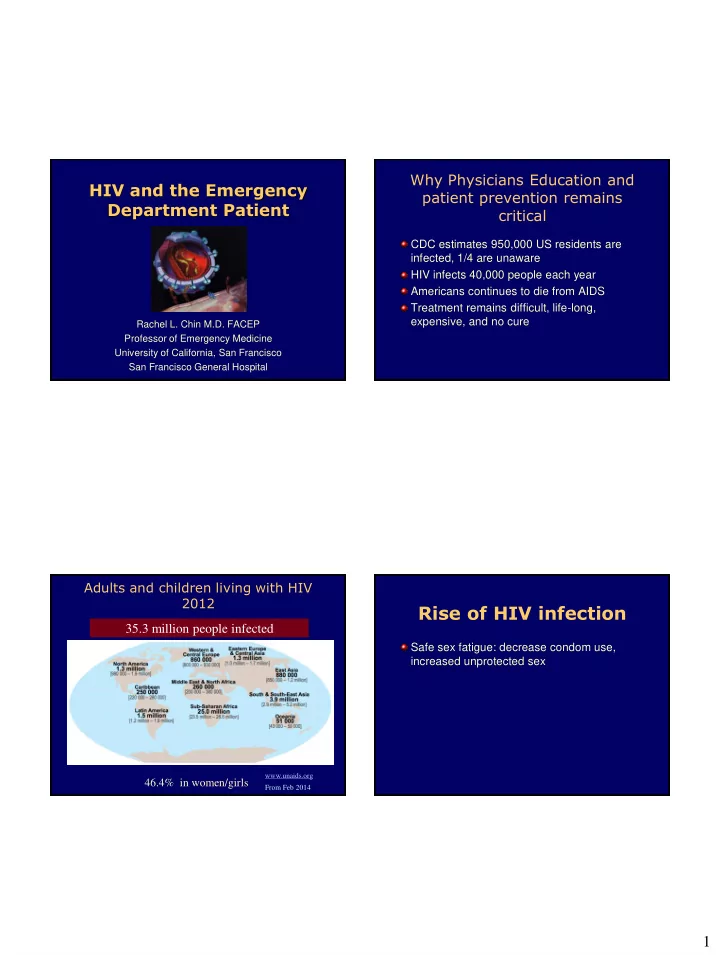
Adults and children living with HIV 2012 35.3 million people infected
46.4% in women/girls
www.unaids.org From Feb 2014
Rise of HIV infection
Safe sex fatigue: decrease condom use, increased unprotected sex
SLIDE 2
2
Rise of HIV infection
Safe sex fatigue: decrease condom use, increased unprotected sex Medications (HAART/ART)
SLIDE 3
3
SLIDE 4
4
Rise of HIV infection
Safe sex fatigue: decrease condom use, increased unprotected sex Medications (HAART/ART) Increased access to sex: internet, circuit parties, public sex venues Increased recreational drug use, esp crystal methamphetamines and ecstasy
SLIDE 5
5
Rise of HIV infection
Safe sex fatigue: decrease condom use, increased unprotected sex Medications (HAART) Increased access to sex:internet, circuit parties, public sex venues Increased recreational drug use, esp crystal methamphetamines and ecstasy Viagra Viagra + Ecstasy = Sextasy
SLIDE 6 6
Objectives
Learn how to recognize subtle complaints in the most common life-threatening AIDS infections. Identify what tests may be helpful in the diagnosis of the most common OI in the US. Summarize the treatment and management of these OI’s. Learn about the adverse effects of HIV-Therapy Become aware of drug induced metabolic changes
Case #1
28 year old HIV positive man complains of dry cough for 2-4 weeks and fevers. He has no history of Opportunistic Infection (OI’s) and takes no medicines. Normal Vital signs. O2 saturation 95%. CXR clear. Returns 10 days later with diffuse pneumonia and goes to the ICU with the diagnosis of PCP. What could have changed this management? What was the stage of the HIV infection?
What is the Stage of HIV infection?
Defined by CD4 count:
- Early: CD4 > 500/mm3
- Intermediate: CD4 200-500/mm3
- Late: CD4 < 200/mm3
- ?Very Late: CD4 < 50/mm3
SLIDE 7 7
Viral Load
Monitors therapy It is essential in suggesting the medications are not working either to
- non-adherence
- drug interactions
- malabsorption
- mutations
Always need CD4 count in your decision making < 200 and no PCP prophylaxis, all URI’s need close follow up > 200 or on prophylaxis (and compliant), then bronchitis Absolute lymphocyte count (ALC)
- < 950 x 106 cells/μL ~ CD4 < 200 x 106 cells/μL
Pretest probability
Academic Emergency Med 2011;18:385-389
Pulmonary disease is one of the most common HIV-related emergencies PCP is the leading AIDS-defining condition in the United States Pneumocystis jiroveci (“yee row vet zee” - formerly carinii) pneumonia
- CDC. HIV/AIDS Surveillance Reports
Emerging Infectious Diseases 2002;8(9):891-896
SLIDE 8 8
Pneumocystis jiroveci Pneumonia
Clinical presentation
- CD4 cell count ≤ 200 cells/mm3
- Symptoms: fever, DOE, dry cough, fatigue
- Duration: >2-4 weeks
- Signs: Nonspecific
- Labs: Serum LDH often elevated
PCP Chest Radiographic Presentation
Bilateral > Unilateral, Symmetric > Asymmetric Pattern
- Interstitial (reticular) or granular
- Alveolar (consolidation)
- Cyst(s)
- Normal
- Pneumothorax
PCP Chest Radiographic Presentation
Treatment
Trimethoprim-sulfamethoxazole Clindamycin + Primaquine Trimethoprim + Dapsone Atovaquone Pentamidine Treat for 21 days followed by prophylaxis
- Steroids 40 mg PO BID if Pa02 < 70 mm Hg
SLIDE 9 9
Bacterial Pneumonia
Clinical presentation
- CD4 cell count: any
- Symptoms: Fever, SOB, chest pain, productive
cough w/ purulent sputum
- Duration: 3-5 days
- Signs: Focal lung findings
- Labs: WBC often (relatively) elevated
Case #2
28 year old HIV + man complains of
- headache. No medications.
What do you need to know? Is his HIV infection early, intermediate, or late? CD4 < 100, need LP to rule out cryptococcal meningitis
CNS Emergencies
Cryptococcal meningitis Cryptococcal neoformans is the most common fungus responsible for infections in patients with AIDS.
Clinical presentation
- CD4 < 100 cells/mm3
- Symptoms: fever,
headaches
months
Cryptococcal meningitis
Clinical presentation
signs
negative
Treatment
for 2 wks
chronic suppressive therapy
hydrocephalus, seizures
SLIDE 10 10
CNS Emergencies
Cerebral Toxoplasmosis Toxoplasma gondii, a parasite, is the most common cause of focal brain lesions in people with AIDS Clinical presentation
- CD4 < 200 cells/mm3
- Symptoms: headache, fever, AMS, focal signs
- ver days to weeks
- Signs: seizures (25%-50%), focal signs over days
to weeks
- Labs: Toxo titers usually positive
Cerebral Toxoplasmosis
Diagnosis
enhancing lesions
to empiric therapy
Treatment
sulfadiazine, folinic acid
radiologic improvement in 2 weeks
Prophylaxis and Treatment of OI’s- What’s New?
Cessation of primary prophylaxis for PCP
- Short-term data CD4 > 200 for 3-6 months, no PCP
Cessation of prophylaxis for disseminated MAC
Cessation of treatment of CMV retinitis,
Prophylaxis for HSV (genital or oral)
- Outbreaks up-regulate HIV viral production and can
threaten HIV viral suppression, shed both HSV and HIV CDC, MMWR
HAART/ART
Highly active antiretroviral therapy/ antiretroviral therapy Combination of at least 3 drugs Standard of care
SLIDE 11 11
Therapies currently on market
Nucleoside and nucleotide RTIs
- Zidovudine, AZT (Retrovir)
- Abacavir, ABC (Ziagen)
- Lamivudine, 3TC (Epivir)
- Didanosine, ddI (Videx)
- Stavudine, d4T (Zerit)
- Tenofovir, TFV (Viread)
- Emtricitabine, FTC
(Emtriva)
- Combivir (AZT/3TC)
- Trizivir (AZT/3TC/ABC)
- Epzicom (3TC/ABC)
- Truvada (FTC/TFV)
CCR5 receptor antagonist
Integrase inhibitor
NNRTI’s:
- Delavirdine (DLV)
- Nevirapine, NVP
(Viramune)
(Sustiva)
(Intelence)
Fusion inhibitors:
- Enfuvirtide, ENF
- r T20 (Fuzeon)
Combination
(EFV/FTC/TFV)
Protease inhibitors:
(Crixivan)
(Invirase, hgc)
(Viracept)
(Agenerase)
(Reyataz)
(Lexiva)
(lopinavir/ritonavir)
- Tipranavir (Aptivus)
- Darunavir (Prezista)*
*Approved in past year Orange text – combination agents
Emergencies Related to HIV Therapy
Mitochondrial toxicity
Pancreatitis Rash by Non-Nucleoside Reverse Transcriptase Inhibitors Drug interactions
www.aidsmeds.com HIVinsite.com
SLIDE 12 12
www.epocrates.com Mitochondrial toxicity
Nucleoside reverse transcriptase inhibitors (NRTIs)
- Pancreatitis (“d” drugs, ie: ddI, d4T, ddC)
- Neuropathy (“d” drugs)
- Myopathy (AZT)
- Hepatic steatosis and lactic acidosis (all)
- Peripheral lipoatrophy (predominantly d4T)
Mitochondrial toxicity
Lipodystrophy Syndrome
- Thinning of the face, arms, or
legs (lipoatrophy)
- Fat accumulation in the belly and
back.
Fat Redistribution (“lipodystrophy”)
SLIDE 13
13
Fat Wasting (NRTI) Truncal Obesity (PI’s) Buffalo Hump (PI’s)
SLIDE 14 14
Metabolic complications- PI’s
Glucose metabolism
- Insulin resistance
- Impaired glucose tolerance
- Hyperglycemia
- Frank diabetes
Lipid metabolism
- Increased triglycerides
- Increased total and LDL cholesterol, low HDL
Are HIV patients at increased risk of premature cardiovascular disease?
Case Series/Reports:
- Early MI’s
- CVA’s
- hypercholesterolemia
- hypertriglyceridemia
- decreased HDL
- increased rates of
atherogenic lipids
- increased levels of insulin
resistance and diabetes
- higher rates of smoking
- substance use
- increased visceral
abdominal fat
All of these are known to increase the risk of CAD. CAD may be the next wave of the epidemic.
HIV infection is associated with higher rates of CAD
- Kaiser Permanente Study: CHD
hospitalization rate and MI rate significantly higher in HIV pts vs. controls
- Partners HealthCare System: AMI rates higher
in setting of HIV
- Meta analysis of literature: 1.61 RR of CVD for
untreated HIV pts vs. controls, RR of 2.00 among treated HIV pts vs. controls)
Klein JAIDS 2002, Triant JCEM 2007, Islam FM HIV Medicine 2012; DAD Study Group Lancet 2008
HIV and MI: VA Study
VA Aging Cohort Study from 2003 to 2009, 82,459 patients Outcome acute MI (871 events) HIV infection associated with a 50% increased risk of AMI even after adjustment for framingham risk factors, substance use, comorbidities (HR 1.48, 95%CI 1.27-1.72) Freiberg MS et al JAMA Internal Medicine 2013
SLIDE 15 15
How about treatment interruptions to reduce time on therapy?
Strategies for Management of Antiretroviral Therapy (SMART) Study
Eligibility: CD4> 350 (N=5472)
Baseline CD4: 596-599 CD4 nadir: 250-252
Continuous Treatment No Treatment until CD4 <250, then treatment until >350, then stop
The Strategies for Management of Antiretroviral Therapy (SMART) Study Group. CD4+ count guided interruption of antiretroviral treatment. NEJM 2006
Summary:
- Taken together, these data suggest
that HIV-infected patients have an increased cardiovascular risk, which may be due to the HIV infection itself, antiretroviral therapy, or both.
Rashes by NNRTIs
Non-nucleoside reverse transcriptase inhibitors
(Rescriptor)
(Viramune)
- Efavirenz (Sustiva)
- 27-37% in clinical
trials developed a rash
within 4-6 wks
Rashes by NNRTIs
Stevens-Johnson syndrome Toxic epidermal necrolysis 8% of pts on nevirapine Admit to burn unit
SLIDE 16
16
Stevens-Johnson syndrome
Symptoms: diffuse rash with peeling of large skin areas, blistering inside of the mouth, conjunctivitis, bronchitis, fever, myalgia, arthralgia, and malaise
Stevens-Johnson syndrome
Toxic Epidermal Necrolysis (TENS)
Rapid HIV Testing
SLIDE 17 17
www.nccc.ucsf.edu/StateLaws www.nccc.ucsf.edu
Rapid HIV testing tools for primary care and other settings
4 FDA approved rapid HIV tests: Oraquick, Multispot, Reveal G2, Unigold Results in ~20 minutes Oraquick and Uni-Gold suitable for primary care clinics
Oraquick test on whole blood
- 1. Obtain blood from fingerstick
- 2. Insert loop into vial and stir
- 3. Insert device;
test develops in 20-30 min.
SLIDE 18 18
Uni-Gold test on fingerstick blood
Add 1 drop specimen to well
- 1. Add 1 drop blood to well
- 2. Add 4 drops of wash solution
- 3. Read results in
10-12 minutes
Non-Government websites
HIV InSite Check AIDS meds Website for patients STDs Practical implementation guide for EDs www.hivinsite.ucsf.edu www.AIDSmeds.com www.healthypenis.org www.edhivtestguide.org
http://hivinsite.ucsf.edu
US Government-sponsored websites
CDC National Prevention Information Network (NPIN) AIDS Info CDC’s website on testing www.cdcnpin.org www.aidsinfo.nih.gov www.cdc.gov/hiv
SLIDE 19 19
Summary
CD4 count - early, intermediate, or late HIV HIV patients susceptible to encapsulated bacteria, such as Streptococcus pneumoniae. PCP most common AIDS defining dx - Dry cough, DOE, serum LDH level
Summary
Low CD4 with Headache - cryptococcus meningitis, serum crypt antigen HIV seizure - head CT with and without contrast - toxo, lymphoma HAART side effects Premature cardiovascular disease
National HIV Telephone Consultation Service (Warmline) 800 / 933 - 3413 National Clinicians’ Post-Exposure Prophylaxis Hotline (PEPline) 888 / HIV - 4911 National Perinatal HIV Consultation and Referral Service (Perinatal Hotline) 888 / 448 - 8765
University of California San Francisco San Francisco General Hospital Supported by Health Resources and Services Administration (HRSA) AIDS Education and Training Centers (AETCs) and Centers for Disease Control and Prevention (CDC)
SLIDE 20
20
www.healthypenis.org
SLIDE 21
21
Questions?