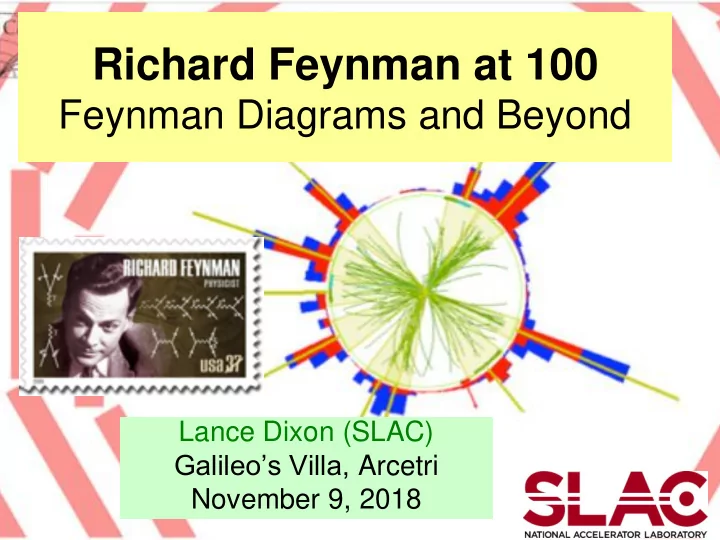
Richard Feynman at 100 Feynman Diagrams and Beyond Lance Dixon - - PowerPoint PPT Presentation
Richard Feynman at 100 Feynman Diagrams and Beyond Lance Dixon (SLAC) Galileos Villa, Arcetri November 9, 2018 Before Feynman, there was Galileo Renaissance man, theorist and experimenter Also found in Pisa: L. Dixon Feynman
Before Feynman, there was Galileo
- Renaissance man, theorist and experimenter
- L. Dixon Feynman at 100 @ Galileo's Villa
Arcetri 9 Nov. 2018 2
Also found in Pisa:
- L. Dixon Feynman at 100 @ Galileo's Villa
Arcetri 9 Nov. 2018 3
Feynman also a Renaissance man
- Besides his science, Feynman also left a legacy in art
- L. Dixon Feynman at 100 @ Galileo's Villa
Arcetri 9 Nov. 2018 4
“At least as good as Rembrandt’s physics”
- Curt Callan
Outline
- Feynman, Feynman diagrams and QED
- Feynman and early QCD
- Feynman and the weak interactions
- Feynman and quantum gravity
- Feynman and biology
- L. Dixon Feynman at 100 @ Galileo's Villa
Arcetri 9 Nov. 2018 5
Feynman’s revolutionary insights into scattering of quantum particles
- L. Dixon Feynman at 100 @ Galileo's Villa
Arcetri 9 Nov. 2018 6
were initially for Quantum ElectroDynamics
Theory of how electrons interact with the particles associated with light or electromagnetism = photons The most precise theory of all – good to a part per trillion!
Shelter Island, June 1947
- L. Dixon Feynman at 100 @ Galileo's Villa
Arcetri 9 Nov. 2018 7
NAS Archives Dirac theory of electron incomplete:
- Willis Lamb reports on Lamb shift between 2S and 2P hydrogen
- Isadore Rabi reports on electron anomaly [Nafe, Nelson, Rabi]
Lamb Oppenheimer Pais Feynman Weisskopf Uhlenbeck Marshak Schwinger Bohm Feshbach Darrow
Feynman’s thesis work birthplace of the path integral
- L. Dixon Feynman at 100 @ Galileo's Villa
Arcetri 9 Nov. 2018 8
~ How Feynman introduced quantum mechanics to us Caltech undergrads in 1979
The beginning of Feynman diagrams
- Before Feynman, quantum-mechanical calculations were
strictly time-ordered, based on the Hamiltonian H which evolves states forward in time:
- L. Dixon Feynman at 100 @ Galileo's Villa
Arcetri 9 Nov. 2018 9
Covariance and positrons
Feynman realized that time ordering is ambiguous in special relativity: Two observers moving with respect to each other can see the same two events happen in different order.
- L. Dixon Feynman at 100 @ Galileo's Villa
Arcetri 9 Nov. 2018 10
t x t x vs. e* g photon e electron g e g e g e
A positron is an electron moving backward in time
These two time-ordered contributions naturally belong together! Wheeler
A holistic view
- L. Dixon Feynman at 100 @ Galileo's Villa
Arcetri 9 Nov. 2018 11
On and off the “mass shell”
- Einstein: energy of a particle at rest is E = mc2
- Energy of a particle in motion with momentum p:
E2 = (pc)2 +(mc2)2 = p2 + m2 for c = 1.
- Energy & momentum form a relativistic four
vector, pm = (p0, p1, p2, p3) = (E,p)
- Its relativistically invariant “length” is its mass:
p2 = pm pm = E2 – p2 = m2
- Real particles are on-shell, p2 = m2
- Virtual particles are off-shell, p2 ≠ m2
- L. Dixon Feynman at 100 @ Galileo's Villa
Arcetri 9 Nov. 2018 12
Neither advanced nor retarded
In order to combine the two contributions, Feynman needed to construct a new “propagator” – the rule for how the electron gets from point A to point B. It also had to move positrons (sometimes called negative energy solutions) backward in time from point B to point A.
- L. Dixon Feynman at 100 @ Galileo's Villa
Arcetri 9 Nov. 2018 13
Retarded propagator only propagates effects to later time, it is causal. Advanced propagator only propagates effects to earlier time, it’s anti-causal Feynman propagator does either, depending on energy, it’s covariant
Freeman Dyson, interlocutor
- L. Dixon Feynman at 100 @ Galileo's Villa
Arcetri 9 Nov. 2018 14
First Feynman diagram in print! Dyson as Ben Jonson to Feynman’s Shakespeare
“Nature herself was proud of his designs, and joyed to wear the dressing of his lines.”
The most iconic Feynman diagram
- L. Dixon Feynman at 100 @ Galileo's Villa
Arcetri 9 Nov. 2018 15
electron-electron scattering in QED But it can be repurposed to also describe the most important processes in the Standard Model Carved in stone in Tuva (courtesy of Glen Cowan, Ralph Leighton)
- Phys. Rev. 76, 769
Feynman parameters
- L. Dixon Feynman at 100 @ Galileo's Villa
Arcetri 9 Nov. 2018 16
RPF, Phys. Rev. 76, 769
A mathematical trick, but an incredibly useful one.
The electron anomalous magnetic moment, a (precious) “baby” scattering amplitude
- L. Dixon Feynman at 100 @ Galileo's Villa
Arcetri 9 Nov. 2018 17
BASE, Eur. Phys. J. ST 224, 16, 3055 (2015)
Measurement doesn’t look much like particle scattering, but
ae = (ge – 2)/2 can be computed from spin-flip part of g e → e process as photon momentum → 0.
The loop expansion
- Feynman: Draw all diagrams with specified incoming
and outgoing particles, weight them by coupling factors at each vertex. For a given process, extra powers of coupling for each closed loop. In QED, each additional loop suppressed by the fine structure constant
- L. Dixon Feynman at 100 @ Galileo's Villa
Arcetri 9 Nov. 2018 18
By 3 loops, 72 diagrams!
- L. Dixon Feynman at 100 @ Galileo's Villa
Arcetri 9 Nov. 2018 19
Without Feynman’s methods, hopeless. Even with Feynman diagrams, reaching this precision would take decades.
QED state of art today: 5 loops, 12,672 diagrams
30 gauge invariant sets
- L. Dixon Feynman at 100 @ Galileo's Villa
Arcetri 9 Nov. 2018 20
The most difficult set, 6354 diagrams, leading to 389 integrals. Evaluated numerically after Feynman Parameterization. Aoyama, Hayakawa, Kinoshita, Nio, Watanabe, 2006-2017 Edward Tufte
7 decades of ge-2 theory
- L. Dixon Feynman at 100 @ Galileo's Villa
Arcetri 9 Nov. 2018 21
Schwinger 1948 Karplus, Kroll 1950 Petermann 1957 Sommerfield 1957 Kinoshita, Cvitanovic 1972 Laporta, Remiddi 1996 Aoyama, Hayakawa, Kinoshita, Nio, 2005-2007 Laporta arXiv:1704.06996 Aoyama, Hayakawa, Kinoshita, Nio, Watanabe, 2006-2017 fully analytic numerical
(+ mass-dep.)
Laporta 4 loop result in “co-action” form
- L. Dixon Feynman at 100 @ Galileo's Villa
Arcetri 9 Nov. 2018 22
Schnetz arXiv:1711.05118 Elliptic and “Unknown” Cyclotomic polylogarithms at unity, with weights that are 4th or 6th roots of unity
All needed to match incredible improvements in experimental precision
- L. Dixon Feynman at 100 @ Galileo's Villa
Arcetri 9 Nov. 2018 23
Rich, Wesley 1972 Hanneke, Hoogerheide, Gabrielse, 2006-2010 Van Dyck, Schwinberg, Dehmelt, 1977-1987
Magnetic anomaly anomalies?
- New measurement of fine structure constant in cesium:
- Leads to 2.4s discrepancy for electron
- Opposite in sign to better known 3.7s discrepancy for muon
- Could one or both of these be harbingers of new physics?
- Or statistical fluctuations or other issues?
- L. Dixon Feynman at 100 @ Galileo's Villa
Arcetri 9 Nov. 2018 24
Davoudiasl, Marciano arXiv:1806.10252
Measuring Earth-Moon distance to width of human hair: 10-13
- L. Dixon Feynman at 100 @ Galileo's Villa
Arcetri 9 Nov. 2018 25
On to real (hard) particle scattering
- Feynman’s role in understanding
structure of matter: the proton as a bound state of more fundamental objects, quarks and gluons.
- Gell-Mann and Zweig proposed quarks in
early 1960s, but were they real, or a mathematical tool to represent symmetries?
- SLAC, a lab built in the 1960s to scatter
electrons off protons at record energies, could answer question directly
- L. Dixon Feynman at 100 @ Galileo's Villa
Arcetri 9 Nov. 2018 26
Where quarks were found
- L. Dixon Feynman at 100 @ Galileo's Villa
Arcetri 9 Nov. 2018 27
End Station A at SLAC, where “deep inelastic” scattering experiments were performed that revealed “Bjorken Scaling”
Talk by Marty Breidenbach at SLAC Summer Institute 2018, “50 years of the Standard Model”
Scaling: νW2 for fixed ω vs q2
νW2
Arcetri 9 Nov. 2018 28
- L. Dixon Feynman at 100 @ Galileo's Villa
- M. Breidenbach, SSI 2018
Partons
- Many of us did not understand bj’s current algebra motivation for scaling
- Feynman visited SLAC in August 1968. He had been working on hadron-
hadron interactions with point like constituents called partons. We showed him the early data on the weak q2 dependence and scaling – and he (instantly!) explained the data with his parton model.
- In an infinite momentum frame, the point like partons were slowed, and the
virtual photon simply elastically scatters from one parton without interactions with the other partons – the impulse approximation.
- This was a wonderful, understandable model for us.
W2
(i)(ν,q2)=Q2 iδ(ν-q2/2MXi)
=Q2
ixi/ ν δ(xi-q2/2M ν)
νW2 ν, q2 = σN 𝒬(N) σi=1
N Qi
2 xfN(x)=F2(x)
x =
q2 2Mν = 1 ω
Arcetri 9 Nov. 2018 29
- M. Breidenbach, SSI 2018
Bj Bjorken
- L. Dixon Feynman at 100 @ Galileo's Villa
“pdf”
[Joan Feynman worked at NASA Ames near SLAC around 1968]
Same iconic Feynman diagram, now with quarks
- L. Dixon Feynman at 100 @ Galileo's Villa
Arcetri 9 Nov. 2018 30
Two deep inelastic structure functions, F1 and F2 But this diagram depends on spin
- f partons, and for spin ½, get
Callan-Gross relation, F2 = 2xF1 Confirmed experimentally early on (at large x where gluon can be neglected) Scaling → asymptotic freedom → nonabelian gauge theories → QuantumChromoDynamics, QCD (SU(3) color) Gross, Wilczek; Politzer 1973 Fritzsch, Gell-Mann 1972; Weinberg 1973
Feynman and the weak interaction
V – A left-handed structure also Sudarshan, Marshak
- L. Dixon Feynman at 100 @ Galileo's Villa
Arcetri 9 Nov. 2018 31
Later completed to SU(2)L x U(1) with neutral currents and a Higgs mechanism Glashow, Weinberg, Salam 1961-1968 Brout, Englert; Higgs; Guralnik, Hagen, Kibble 1964 A “shotgun” wedding!
- L. Dixon Feynman at 100 @ Galileo's Villa
Arcetri 9 Nov. 2018 32
Standard Model
- All elementary forces except
gravity in same basic framework
- Matter made of spin ½ fermions
- Forces carried by spin 1
vector bosons: g W+ W- Z0 g
- Add a spin 0 Higgs boson H to
explain masses of W+ W- Z0 → finite, testable predictions for all quantities
- Solidly in place by the early 1980s
g electromagnetism (QED) strong (QCD) weak n
Feynman and quantum gravity
- Transcript of talk at Conference on Relativistic Theories of Gravitation,
Jablonna,1962, Acta Physica Polonica 24 (1963) 697.
“There’s a certain irrationality to any work in gravitation… for example, as far as quantum effects are concerned let us consider the effect of the gravitational attraction between an electron and a proton in the hydrogen atom; it changes the energy [and hence the phase of the wave function] a little bit. The effect of gravitation on the hydrogen atom is to shift the phase by 43 seconds of phase in every hundred times the lifetime of the universe!”
- L. Dixon Feynman at 100 @ Galileo's Villa
Arcetri 9 Nov. 2018 33
Feynman and quantum gravity
“An atom made purely by gravitation, let us say two neutrons held together by gravitation, has a Bohr orbit of 108 light years. The energy of this system is 10-70 rydbergs. I wish to discuss here the possibility of calculating the Lamb correction to this thing, an energy of the order of 10-120. The irrationality is shown also in the strange gadgets
- f Prof. Weber, in the absurd creations of Prof. Wheeler
and other such things, because the dimensions are so peculiar... I am investigating this subject despite the real difficulty than there are no experiments… so I made believe that there were experiments.”
- L. Dixon Feynman at 100 @ Galileo's Villa
Arcetri 9 Nov. 2018 34
Gravitational Compton scattering
- L. Dixon Feynman at 100 @ Galileo's Villa
Arcetri 9 Nov. 2018 35
Feynman discovers ghosts
(and Feynman tree theorem)
- L. Dixon Feynman at 100 @ Galileo's Villa
Arcetri 9 Nov. 2018 36
Gravity, YM and ghosts
- L. Dixon Feynman at 100 @ Galileo's Villa
Arcetri 9 Nov. 2018 37
…
What if?
- What if Feynman had known about or
invented the helicity method in 1962? He might well have discovered Gravity = YM2
- What if Napoleon had had a B-52 at the
battle of Waterloo? [Monty Python]
- L. Dixon Feynman at 100 @ Galileo's Villa
Arcetri 9 Nov. 2018 38
Feynman’s Adventures in Biology: A Timeline
- Grad school at Princeton: Curiosity about biology led him to take a few courses
and adopt a skeptical view of the practice of professional biology.
- The 50s: Golden age of the new biology at Caltech. Feynman exercises his
curiosity by “hanging out” in Delbruck’s lab. He meets, interacts with, and impresses current and future leaders of the new field of molecular biology.
- ’59: “Plenty of Room at the Bottom” talk challenges physics to go to work at
molecular scales, imitating life. It foresaw the miniaturization revolution in computing, and espoused a physics-inspired view of the core issues of biology.
- ’61-’62: A sabbatical in place, working at the bench in Delbruck’s lab. Study of
reverting mutants of bacteriophages led to a serious Genetics paper. Further work with Meselson and Lamson on ribosomes targeted core issues of the new biology, but didn’t quite gel.
- ‘62-’64: The Feynman Lectures on Physics had one biological chapter (on color
vision). In an aside, he showed that the insect eye optimizes function subject to constraints of physics … foreshadowing a major future trend in biophysics
- ’69: The Hughes Aerospace lectures on biology and chemistry were
pedagogical, but they contain Feynman’s evolved view of the core problems of biology and some thoughts about how physics and biology should interact.
Feynman@100 39 10/23/18
- C. Callan, Feynman@100, Singapore
What did Feynman actually do in the Delbruck lab, and what was its significance?
Feynman@100 40 The goal was to map out mutations in phage strain T4D. The mutation hunt was tedious but fruitful. A paper resulted. Mutants could (rarely) revert to normal-ish. By undoing the first mutation .. or what? RPF’s specific concern was to figure out how this reversion worked. He found three mutants (s1, s2, s3) whose reversion came from a second mutation very near the
- riginal one, but not right AT it.
Two years later it was realized that this is a piece of evidence for the 3 base genetic code. Genetics 47: 179-186 February 1962.
- R. S. EDGAR, R. P. FEYNMAN, S. KLEIN, I. LIELAUSIS, AND C. M.
STEINBERG
10/23/18
- C. Callan, Feynman@100, Singapore
Feynman’s demonstration that the insect eye design is
- ptimized within the limits set by physics
Feynman@100 41
Insect eye is a spherical bundle of cone-like cells. Each cone looks at angle range df = d/R. Limits detailed seeing …. Why not make d (hence df) smaller?
Not so fast! Light has a finite wavelength l and diffraction fuzzes the angular resolution
- f aperture d by df = l/d.
The true angular resolution
- f the ommatidium is the
sum df = d/R + l/d This is smallest for dbest= √ lR
The numbers come out pretty close for many species! Evolution must know about physical law. Barlow ‘52 One ommatidium of lens diameter d 10/23/18
- C. Callan, Feynman@100, Singapore
70 years of particle scattering…
- Feynman’s insights in making perturbation theory in
QED covariant meant “anyone could compute” perturbative scattering – later on, including computers
- Feynman diagrams at the heart of almost all
quantitative comparisons between theory and experiment since 1947
- LHC demands for theory → reorganize Feynman
diagrams to incorporate unitarity (as well as many other advances in loop and phase space integration). Still ie!
- Spawned many other novel “amplitudes” developments
- But Feynman was a polymath, worked on many
different areas of physics – and even biology!
- L. Dixon Feynman at 100 @ Galileo's Villa
Arcetri 9 Nov. 2018 42
- L. Dixon Feynman at 100 @ Galileo's Villa
Arcetri 9 Nov. 2018 43
- L. Dixon Feynman at 100 @ Galileo's Villa
Arcetri 9 Nov. 2018 44
Extra Slides
- L. Dixon Feynman at 100 @ Galileo's Villa
Arcetri 9 Nov. 2018 45
- L. Dixon Feynman at 100 @ Galileo's Villa
Arcetri 9 Nov. 2018 46
2017 Precision theory, from NLO to NNLO and even NNNLO required by LHC!
- L. Dixon Feynman at 100 @ Galileo's Villa
Arcetri 9 Nov. 2018 47
Granularity vs. Fluidity
- L. Dixon Feynman at 100 @ Galileo's Villa
Arcetri 9 Nov. 2018 48
The tail of the mantis shrimp
- Reflects left and right
circularly polarized light differently
- Led biologists to discover
that its eyes have differential sensitivity
- It communicates via the
helicity formalism l/4 plate “It's the most private communication system imaginable. No other animal can see it.”
- Roy Caldwell (U.C. Berkeley)
- L. Dixon Feynman at 100 @ Galileo's Villa
Arcetri 9 Nov. 2018 49
What the biologists didn’t know
Particle theorists have also evolved capability to communicate results via helicity formalism
unpolarized any final-state polarization effects washed
- ut by fragmentation
LHC experimentalists are blind to it
must sum over all helicity configurations
Biology in “The Feynman Lectures in Physics”
Feynman@100 50
In the middle of the discussion of optics and electromagnetic waves we find two chapters on how the eye works and how we perceive color. Big change of pace! Side note: the course TAs couldn’t understand why the students had difficulty grasping Feynman’s inspiring presentation of topics in physics … until the vision/seeing lectures. These were topics that were outside their expertise and for
- nce they were blown away by the Feynman fire hose … just like the students!
Tucked away in the “Seeing” chapter was a little gem: a demonstration that the parameters of the insect eye were such as to give the best possible performance subject to the constraints of physics. Showing that evolution is a good engineer! The future would show that this approach illuminates many aspects of biology.
10/23/18