Rho vee aaaah 0 = [ V A ] incoming + [ V A ] outgoing For steady - - PowerPoint PPT Presentation

rho vee aaaah
SMART_READER_LITE
LIVE PREVIEW

Rho vee aaaah 0 = [ V A ] incoming + [ V A ] outgoing For steady - - PowerPoint PPT Presentation

Rho vee aaaah 0 = [ V A ] incoming + [ V A ] outgoing For steady flow through a fixed volume. 1|10 Danger (| V | A ) 1 = (| V | A ) 2 if A increases, then V must decrease oder? 2|10 Photo US Navy (1961,


slide-1
SLIDE 1

Rho vee aaaah

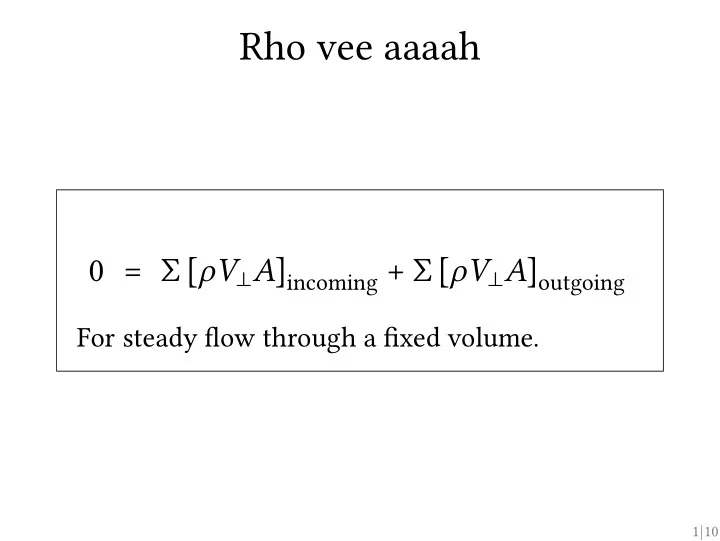
0 = Σ [휌V⟂A]incoming + Σ [휌V⟂A]outgoing

For steady flow through a fixed volume.

1|10
slide-2
SLIDE 2

Danger

(휌|V⟂|A)1 = (휌|V⟂|A)2 “if A increases, then V must decrease”

  • der?

2|10

slide-3
SLIDE 3

Photo US Navy (1961, public domain) 3|10

slide-4
SLIDE 4

Photo CC-by-sa by Airwolfhound 4|10

slide-5
SLIDE 5

Photo by Lori Losey / NASA (public domain, 2007) 5|10

slide-6
SLIDE 6

Rolls-Royce Spey

Photo CC-by-sa Arjun Sarup 6|10

slide-7
SLIDE 7

Possibly Wrong Fluid Mech

1 only true if 휌 remains constant.

OK for water flows. No heat transfer, no expansion! Supersonic flow: A ↘ can lead to V ↘ because 휌 ↗.

7|10

slide-8
SLIDE 8

Smaller A, larger V?

Photo CC-by by Amy Stanley 8|10

slide-9
SLIDE 9

Possibly Wrong Fluid Mech

2 There is no causal relationship.

A2 ↘ may mean V2 ↗, but... nothing guarantees A2V2 remains constant! (maybe ̇ m ↘). Increases in velocity are not “for free”: they require force be applied and energy be spent.

9|10

slide-10
SLIDE 10

Are you using the mass balance equation to predict velocity? → also ask yourself: what force, what power required?

10|10