
SLIDE 1
Rewriting the Rural Narrative
Speak softly and carry statistics
Benjamin Winchester Rural Sociologist
Rewriting the Rural Narrative Speak softly and carry statistics - - PowerPoint PPT Presentation
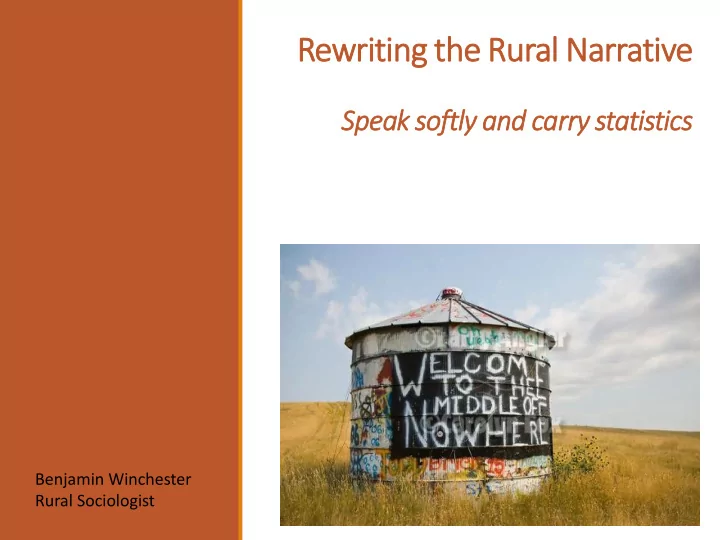
Rewriting the Rural Narrative Speak softly and carry statistics Benjamin Winchester Rural Sociologist The narrative Theres a brain drain We live in the middle of nowhere We are a sleepy town Everyone knows one another
Rewriting the Rural Narrative
Speak softly and carry statistics
Benjamin Winchester Rural Sociologist
The narrative
anecdata (noun). information which is presented as if it is based on serious research but is in fact based on what someone thinks is true
Mechanization of agriculture Roads & transportation Main street restructuring School consolidations
Rural is Changing, not Dying
Small towns are microcosms of globalization
rural) yet are more apparent in rural places
Survived massive restructuring of social and economic life (with volunteer leadership) Research base does NOT support notion that if XXXX closes, the town dies
Rural Rebound
Since 1970, rural population increased by 11%
26%
203,211,926 (53.6m rural) 308,745,538 (59.5m rural)
19%
Total Population In Infa fatuation
2000-2010
Total Population In Infa fatuation Wait it, what?
2000-2010 U.S. Census Bureau
Pop Change Occ HU Change Carter
Dawson
3% Garfield
0% Judith Basin
Phillips
Richland 1% 7% Rosebud
3% Silver Bow
3% Wheatland 4% 4%
Stability, not stagnation or sinkholes.
Kids graduate Population: -2 Households: NC Avg HH Size: 1940: 3.6 2018: 2.6 (-29%) Spouse passes Population: -1 Households: NC
Roughly 49% of Montana residents
Myth: Only the “lucky few” escape rural America
?? Brain Drain
They choose rural age
And also when they are 50-64
(since the 1970s)
The Rural Brain Gain
Newcomers: Why?
Simpler pace of life Safety and Security Low Housing Cost
Percent
Take advantage of the slower pace of life 71 To live closer to relatives 70 To find a less congested place to live 69 To live among people with similar values 68 To find lower priced housing 67 To find a safer place to live 67 To live in a smaller community 66 To find a lower cost of living 65 To find a good environment for raising children 65 To find a job that allowed a better work-life balance 61 To find a job that matches my skills 60 To take on a new job 58 To find a higher paying job 56 To live closer to friends 50 To find higher quality schools 49
Move Factors with Preference
Proportion of households that indicated it was important in some way.
Workforce Newcomers 2020: Who?
18% currently own a business (14% not a farm).
Already existed 36% Created it 65%
Question: Do you typically telecommute or work remotely for a company not located in your region? (of those in workforce)
10% currently own a farm.
Already existed 70% Created it 30% Respondent 14% Spouse 16%
Cohort Lifecycle
(6 times at age 30)
Brain Gain: migration to rural age 30-49
Newcomers look at 3-5 communities
Employee recruitment must get past “warm body” syndrome
Diversifying the rural economy
First question: How many people do we need to run our town? We have numerous leadership programs currently training leader supply, but are we keeping up with the
Nonprofit Change: 2000-2010
+33%
Social Life is Not Dyin ing
Nonprofit Growth: 2000-2010
1976 1968 1990 1996 2007 2013
Population per Organizational Role, 2010
2nd highest demand for leaders in U.S. 1 in 22 people must LEAD*
* Assumes 3 people per new group
1 in 22 people must LEAD*
* Assumes 3 people per new group
Population per Organizational Role, 2000 - 2010 794 new leaders per year
SH SHIF IFT in in Engagement
Broad geography Narrow focus Action: the small Narrow geography Broad focus Action: consensus
MOVING IN : Demand for rural and small town living!
20% live rural/small town 51% would PREFER to
Would we allow this negative language to permeate a product or service we were selling? Why do we do it? Cannot continue to portray rural success as the exception
Community Development Economic Development Tourism
The Rural Choice
These newcomers are:
recruitment)
The Rural Choice: Opening New Doors and Welcoming New Neighbors
The bottom line is people WANT to live and move here for what you are today and will be tomorrow, not what may have been! Rural Revitalization is Upon Us!
benw@umn.edu Brain Gain Landing Page http://z.umn.edu/braingain/ Reddit: Rural By Choice /r/ruralbychoice Twitter: @grokrural