Revising for Languages exams Getting the best from the brain! - - PowerPoint PPT Presentation

revising for languages exams getting the best from the
SMART_READER_LITE
LIVE PREVIEW

Revising for Languages exams Getting the best from the brain! - - PowerPoint PPT Presentation

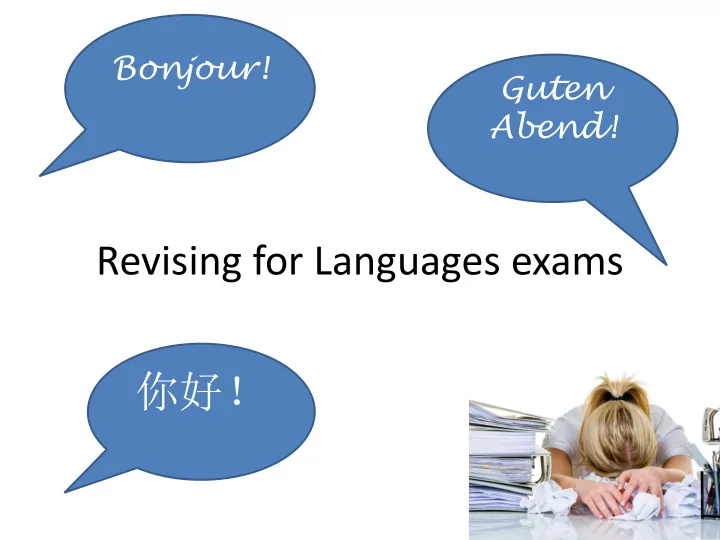
Bonjour! Guten Abend! Revising for Languages exams Getting the best from the brain! The brain needs a huge amount of energy to work well, so good nutrition and hydration is vital The brain has to recover each night, so a


slide-1
SLIDE 1

Revising for Languages exams

Bonjour!

你好!

Guten Abend!

slide-2
SLIDE 2

Getting the best from the brain!

  • The brain needs a huge amount of energy to

work well, so good nutrition and hydration is vital

  • The brain has to recover each night, so a good

night’s sleep is essential

  • The brain needs a good blood supply, so

regular exercise is important

  • Stress causes chemicals to be released into the

brain which stop it working efficiently, so a revision plan is important

  • The brain needs repetition to form new neural

connections so it can remember things

  • The number 7 is a magic brain number, so

cluster information in groups of 7

  • The brain remembers best the first and last

thing learnt, so short bursts of revision are best

  • The optimum concentration span is age + 1

minute, so about 16 minutes for most exam candidates

slide-3
SLIDE 3

Parent Power: Take the phone away!

slide-4
SLIDE 4

Key Dates

  • Chinese Controlled Assessment w/c 19th March
  • French and German GCSE speaking w/c 23rd April
  • French Listening and Reading: 15th May
  • French Writing: 18th May
  • Chinese Listening: 21st May
  • Chinese Reading: 4th June
  • German Listening and Reading: Mon 18th June
  • German Writing: Thursday 21st June

Parent Power: List

  • n the

fridge!

slide-5
SLIDE 5

Parent Power: check attendance!

Revision Sessions offered

  • Lunchtimes:

– D1 for computer based revision, open to all every day – Masterclasses:

  • Chinese: Monday/ Tuesday
  • German: Monday/ Tuesday/ Wednesday (different skills, ask

teacher which session is best)

  • French: Monday (speaking) / Tuesday to Friday (writing)

– Easter Revision classes

  • German 11th April 9am-1.30pm
  • French 12th April 9am-1.30pm (Speaking and Listening)

– Chinese Half-Term revision session: Thursday 31st May (Reading)

slide-6
SLIDE 6

On the school website

  • French/ GCSE Revision
  • German/ GCSE Revision/GCSE Revision
  • Chinese/ GCSE Revision

– Speaking exam practice (French/ German) – Writing exam practice (French/ German) – Past papers and mark schemes – Tips and techniques – Taskmagic games – Vocabulary lists – Revision timetables

Parent Power: display revision timetable!

slide-7
SLIDE 7

Controlled Assessment - Chinese

  • 15% of final grade
  • A good opportunity to improve grades before the

final exam

  • Students have work prepared in class and for

homework

  • For the CA they need to revise the material so they

can produce it under exam conditions

  • Expected to spend 6 hours learning it

–Revision should: »Start early »Be done in regular small chunks »Be active

Parent Power: ask about progress

slide-8
SLIDE 8

Speaking Exam – 25%

  • 25% of the final grade.
  • Unlike CA in recent years, no rote learning and no

second chances.

  • Students must attend on the examination day at

the listed time

  • Students have done well on mocks in Dec/ Jan
  • Speaking practice materials on L drive in GCSE

revision folders

  • Students have ‘green book’ with speaking exam

preparation

  • Students have a list of key phrases that will help

them with the photo and role play cards

Parent Power: Listen to them practise!

slide-9
SLIDE 9

Writing exam – 25%

  • Check what is required on the paper (L Drive, make

notes)

  • All the materials for the speaking exam are also

relevant here

  • Revise verb conjugations
  • Check common mistakes from marking and target

sheets and eliminate them

  • Practise writing timed answers regularly
  • Mark your answers against the structures grid in

exercise book

  • Check them for mistakes using the proof reading

skills taught in class

Parent Power: show interest!

slide-10
SLIDE 10

Listening and Reading Exams

  • Listening exam 25% (Chinese 20%)
  • Reading exam 25% (Chinese 20%)
  • Two key aspects
  • Vocabulary
  • Exam techniques
slide-11
SLIDE 11

Vocabulary Learning

  • Little and often
  • Active techniques
  • Aim for 14 new words a week, linked to the

exam

  • Sources:

– Text book – Vocab books – Games on revision areas of school website – Revision websites

Parent Power:

  • ffer to

test them!

slide-12
SLIDE 12

Useful websites

  • Linguascope www.linguascope.com

– Login: billericay – Password: students should know this, ask teacher if not – Use ‘intermediate’ section – Has comprehension exercises as well as vocab

  • Memrise www.memrise.com

– Free – Students create own password so progress can be tracked – Builds up vocab learning systematically – Use AQA GCSE French/ German or BC L5th 2014 GCSE Chinese

  • Conjuguemos www.conjuguemos.com

– Verb practice for the writing exam

  • Doddle

– Wide variety of materials for all skills plus some from our staff – Students already have their own login

slide-13
SLIDE 13

Learning should be active

  • Use a website
  • Make Flashcards
  • Look/ cover/ write/ check
  • Test yourself
  • Get someone else to test you
  • Make a song/ story with the words
  • Associate the words to a picture or idea
  • Do a past paper and check it

Parent Power: Look at what they’ve done

slide-14
SLIDE 14

Exam techniques

  • Covered extensively in class
  • Handouts available (copies in revision folder)
  • Revision sessions over Easter and just before

the Chinese exams

  • Best way to practise is past papers

– Past papers in revision folders on L: drive – Listening files also there – Mark schemes also available

Parent Power: check the checklist!

slide-15
SLIDE 15

Past paper techniques

  • Remind yourself of best way to approach them
  • Do the paper exactly as if in an exam ie timed and

without interruptions

  • Answer all the questions!
  • Write a list of words you didn’t know and look

them up

  • Check the mark scheme
  • Where you got a question wrong,

check that you now understand why. If you don’t, ask your teacher

  • Learn the words you didn’t know

Parent Power: praise!