Revised Business Plan Revised Business Plan Presented to the DC - - PowerPoint PPT Presentation

revised business plan revised business plan presented to
SMART_READER_LITE
LIVE PREVIEW

Revised Business Plan Revised Business Plan Presented to the DC - - PowerPoint PPT Presentation

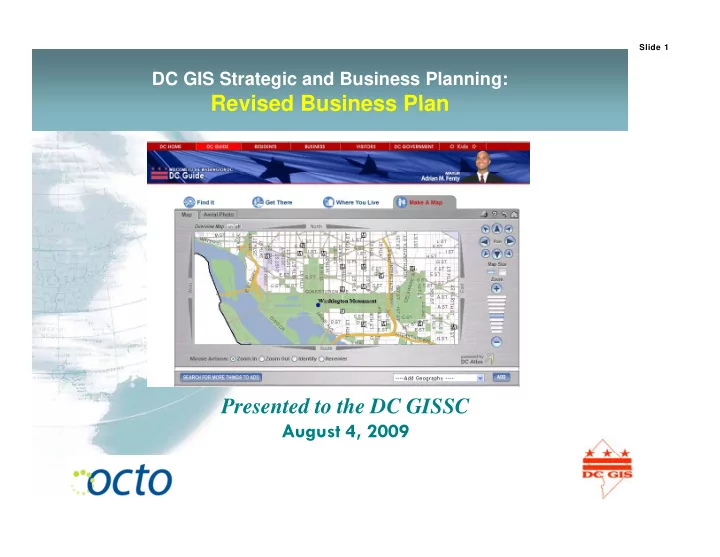
Slide 1 DC GIS Strategic and Business Planning: Revised Business Plan Revised Business Plan Presented to the DC GISSC August 4, 2009 Slide 2 Wordle View Slide 3 DC GIS Business Planning: Steps g p Form Business Plan Subcommittee (BPS)


slide-1
SLIDE 1

Slide 1

DC GIS Strategic and Business Planning:

Revised Business Plan Revised Business Plan Presented to the DC GISSC

August 4, 2009

slide-2
SLIDE 2

Slide 2

Wordle View

slide-3
SLIDE 3

Slide 3

DC GIS Business Planning: Steps g p Form Business Plan Subcommittee (BPS) at GISSC meeting (end of May 2009) meeting (end of May 2009) Share draft document with BPS (start of June 2009) Schedule teleconferences and meetings to get g g feedback and input from BPS and OCTO staff (June- July 2009) R fi d ft d d i t ti t k t t Refine draft and derive presentation to make at next GISSC meeting (August 4, 2009)

  • Provide Final Draft Business Plan document for
  • Provide Final Draft Business Plan document for

GISSC Budget Meeting (September 2009)

  • Finalize Business Plan based on Budget Meeting
slide-4
SLIDE 4

Slide 4

DC GIS Business Planning: Four-Month Schedule

slide-5
SLIDE 5

Slide 5

DC GIS Business Planning: Background

  • We got a head start in 2008 with DC GIS Staff
  • Preliminary planning focused Data Applications

Preliminary planning focused Data, Applications, and Services (i.e. Goals #2 and #3 from Strategic Plan)

  • Develop and operate enterprise mapping data
  • Develop and operate enterprise mapping data,

geospatial applications, and Web services that enhance the utility, reduce the cost, and expand the interoperability

  • f citywide and agency IT systems
  • Provide outstanding customer service and training that

enable DC GIS users and stakeholders to leverage the full power of GIS technology

P ti i t

  • Participatory: GISSC represented by Business Plan

Subcommittee (BPSubcom)

slide-6
SLIDE 6

Slide 6

DC GIS Business Planning: Portfolio Mgt

  • Applying “Portfolio Management”
  • Projects have different life-cycles and
  • Projects have different life-cycles and

investment strategies:

  • Invest (build or enhance)
  • Maintain (provide basic support)
  • Keep status quo/minimal investment
  • Version upgrades only
  • Version upgrades only
  • No active development of new capabilities
  • Sunset (migrate toward retirement & end-of-life)

( g )

  • Migrate (move to – or “reinvent” on – a new

platform)

  • Divest (shut off spending and “kill it”)
  • Divest (shut-off spending and kill it )
slide-7
SLIDE 7

Slide 7

DC GIS Business Planning: Platforms A platform is:

A base technology (or technologies) on which A base technology (or technologies) on which

  • ther technologies or processes are built

A whole “economic unit” for the purposes of aggregating and assessing costs for budget purposes

slide-8
SLIDE 8

Slide 8

DC GIS Business Planning: Program Elements Data Applications & Web Services (Dev & Sys) Applications & Web Services (Dev & Sys) Customer Service

slide-9
SLIDE 9

Slide 9

OCTO GIS Budget Allocation (Approximate)

Program Element Percent of OCTO GIS Budget * g Data 34% Applications & Web 42% pp Services (Dev & Sys) Customer Service 17% Other (Admin, Supplies, Dues) 7%

T t l (Mi f C d O

100%

Total (Mix of Cap. and Op. Funding)

100%

* Does not include stand-alone capital projects

slide-10
SLIDE 10

Slide 10

DC GIS Data Platforms

1) Photogrammetric a) Orthoimages b) Planimetrics 6) Routing (pedestrian, vehicular, & mass transit) 7) Aerial Oblique Imagery b) Planimetrics c) Impervious Surfaces d) Elevation e) 3D Buildings 2) P t 7) Aerial Oblique Imagery 8) Business Data 9) LiDAR 10) Regional Data 11) D i D t 2) Property a) VPM b) MAR c) Zoning 11) Dynamic Data 12) Partner Data 13) Utilities Data 14) All Other ) g d) Planning e) ROW f) Survey 3) Demographics ) a) OCTO Maintained b) Agency Contributed 3) Demographics 4) Ground Imagery 5) Transportation

slide-11
SLIDE 11

Slide 11

Data Platform Investment Strategies

Data Type Investment Strategy Data Type Investment Strategy Photogrammetric Maintain/Invest in Business Data Invest Photogrammetric Maintain/Invest in next cycle Business Data Invest Property Invest LiDAR Invest Demographics Invest Regional Data Maintain Ground Imagery TBD Dynamic Data Invest Transportation Maintain Partner Data Maintain Routing Invest Utilities Invest Aerial Oblique Imagery Maintain All Other Maintain

slide-12
SLIDE 12

Slide 12

DC GIS Application Platforms

1) Google Maps 2) Google Earth 10) MAR 11) ArcGIS Server (and E t i ) ) g 3) Citrix 4) EFS (Pictometry Family) Extensions) 12) Oracle 13) RouteSmart 5) ArcGIS Desktop 6) ArcIMS 7) DC G id DB 14) VM Ware (OCTO Environment) 15) ArcPAD 7) DC Guide DB 8) DC Guide WS 9) DC Guide Link ) 16) Others? 9) DC Guide Link

slide-13
SLIDE 13

Slide 13

Application Platform Investment Strategies

Platform Type Investment Strategy Platform Type Investment Strategy Google Maps Invest Route Smart Invest Google Maps Invest Route Smart Invest Google Earth Invest Oracle RDBMS Maintain EFS (Pictometry Maintain VM Ware Maintain EFS (Pictometry Family) Maintain VM Ware Maintain ESRI ArcGIS Desktop Maintain DC Guide DB Sunset ESRI ArcIMS Sunset DC Guide WS Sunset ESRI ArcGIS Server (and ext ) Maintain DC Guide Link Sunset Server (and ext.) ESRI ArcPad Maintain Citrix Maintain

slide-14
SLIDE 14

Slide 14

Data Wish List c/o BP Subcommittee (1 of 3)

1) Maintain the current set of widely used data layers, for users of both ESRI and Google technologies and applications 2) Add OGC style web services to data offerings 3) Determine the level of essentialness of each layer 3) Determine the level of essentialness of each layer by monitoring demand and identifying application dependencies and willingness to cost-share when sensible sensible 4) Budget for recurring investment in data acquisition to update planimetric layers (e.g. photogrammetric flyovers to acquire new imagery should occur every flyovers to acquire new imagery should occur every two years; once the data is acquired, it needs to be maintained and distributed to DC GIS stakeholders that depend on it) that depend on it)

slide-15
SLIDE 15

Slide 15

Data Wish List c/o BP Subcommittee (2 of 3)

5) Assess the update frequency required for other essential layers, since this is a cost-driver (i.e. for major data platforms should update frequency be major data platforms, should update frequency be increased, or decreased?) 6) Develop and refine data to support routing applications (e g oversized vehicle routing delivery applications (e.g. oversized vehicle routing, delivery

  • f meals, trash pick-up, and property assessments);

currently, multiple departments are in need of fully routable street networks, and there is a risk of , duplication of effort in acquiring suitable data sets 7) Complete the cadastral fabric needed for the District (i.e. property maps) and resolve ‘fitting’ ( p p y p ) g issues vis-à-vis what has been surveyed 8) Research the creation of photo-realistic building textures

slide-16
SLIDE 16

Slide 16

Data Wish List c/o BP Subcommittee (3 of 3) 10) Strengthen methods of notifying data subscribers of changes subscribers of changes 11) Investigate geospatial data availability and suitability for areas adjacent to the District suitability for areas adjacent to the District 12) Monitor and investigate public data for usefulness and relevance to the District use u ess a d e e a ce to t e st ct (e.g. geo-tagged photos) 13) Support Utility and ROW data collection ) pp y and data management efforts

slide-17
SLIDE 17

Slide 17

Application Wish List c/o BP Subcommittee (1 of 2)

1) As mentioned in the context of data, routing is emerging as a much needed application across many departments, and initiatives in this direction need to be coordinated and leveraged initiatives in this direction need to be coordinated and leveraged for maximum benefit to the enterprise 2) In addition to routing, new applications and/or integration to routing are needed to support mobile computing, green g pp p g, g buildings, tracking and dispatching 3) No new applications will be built on ArcIMS; it is being sunset by the vendor (ESRI) 4) Numerous applications are currently deployed on ArcIMS, which is a platform in its latter life stage; it would be disruptive to cease support for ArcIMS, but a migration strategy is needed for the applications and/or functionality currently in use including DC applications and/or functionality currently in use, including DC Guide and DC Atlas, to move or re-factor onto a new platform

slide-18
SLIDE 18

Slide 18

Application Wish List c/o BP Subcommittee (2 of 2) 5) There are not enough resources to migrate everything in lock-step, so prioritization is needed y g p, p to designate the primary candidates; the Subcommittee consensus is that DC Guide Web Services and DC Atlas will be the first to migrate Services and DC Atlas will be the first to migrate and/or reinvent onto a new platform; there are Web services linked to DC Guide that also need to be i t d b f th t i f DC G id migrated, before the current version of DC Guide can be shut down 6) Applications that are not scheduled for migration 6) Applications that are not scheduled for migration and/or re-factoring will be left running on ArcIMS for the time-being, with minimal support

slide-19
SLIDE 19

Slide 19

Web Services Wish List c/o BP Subcommittee (1 of 1) 1) For reasons mentioned above, Web services linked to DC Guide need to be migrated onto a new platform to remove any ArcIMS dependencies 2) A growing list of departments and applications that depend on DC GIS Web Services is included in this p Plan, in the section on Web Services 3) Web services tend to be less visible to end-users, but they are critically important to application they are critically important to application developers, both internal and external to OCTO and DC GIS 4) New Web services to routing ROW and utility 4) New Web services to routing, ROW, and utility data are needed to support new applications 5) Facilitate links to Google Maps Street View

slide-20
SLIDE 20

Slide 20

Applications Using DC GIS Web Services

slide-21
SLIDE 21

Slide 21

Customer Service Wish List c/o BP Subcom (1 of 4) 1) Investigate a website for knowledge-sharing (e.g. Wiki); strengthen channels of communication and ); g collaboration for GIS technicians to communicate 2) Explore getting onto the educational program for the Capital Cit Fello s ith a GIS o er ie Capital City Fellows with a GIS overview 3) Consider on-line training for specific GIS topics, including “Address-Matching” and “Cartography,” as g g g p y, an alternative to classroom training for certain topics; investigate on-line training materials, including videos that may be available for this purpose videos, that may be available for this purpose

slide-22
SLIDE 22

Slide 22

Customer Service Wish List c/o BP Subcom (2 of 4) 4) Implement formal follow-up surveys to get a sense

  • f how people are using (or not using) what they

were taught in DC GIS classes 5) Continue to develop awareness of resources

  • utside of OCTO for referrals and access to

additional expertise, and work towards a comprehensive ‘clearinghouse’ of services (i.e. a service offering catalog) g g) 6) If new applications such as routing are developed, corresponding coursework will be needed

slide-23
SLIDE 23

Slide 23

Customer Service Wish List c/o BP Subcom (3 of 4) 7) Explore a “Centers of Excellence” concept whereby various departments with special expertise and mission requirements can be leaders in certain initiatives or application areas, such as routing for instance 8) Explore collaborative approaches with external parties for alternatives to DC GIS coursework and curriculum development p 9) Apply Content Management System (CMS) as it becomes available 10)Investigate the viability of an “IT Class for 10)Investigate the viability of an “IT Class for Managers” that would include a GIS component; the GISSC could advocate for this, as an alternative to an “executive friendly” GIS only class an executive friendly GIS-only class

slide-24
SLIDE 24

Slide 24

Customer Service Wish List c/o BP Subcom (4 of 4) 11) Review departmental websites for reconciliation across departments and with regard to DC GIS 12) Continue to provide support to Jefferson Middle School teachers and students 13) Update and reconcile distribution lists for data 13) Update and reconcile distribution lists for data notifications and news dissemination

slide-25
SLIDE 25

Slide 25

Discussion Discussion

slide-26
SLIDE 26

Slide 26

Thank you!

Rich Grady rgrady@appgeo.com

slide-27
SLIDE 27

Impervious Surface Area Charge: Investing In Our Local Waterways

Presentation to the DCGIS Steering Committee August 4th, 2009 August 4th, 2009

Louis Desjardins, DCWASA

slide-28
SLIDE 28

IMPERVIOUS SURFACE AREA CHARGE PROJECT

2

slide-29
SLIDE 29

WHAT IS THE IMPERVIOUS SURFACE AREA CHARGE? CHARGE?

  • DC WASA has implemented an impervious surface

area charge to more equitably allocate the costs of the CSO† Long Term Control Plan The charge is based CSO† Long Term Control Plan. The charge is based upon contribution to surface runoff from wet weather events.

† - CSO: Combined Sewer Overflow

3

slide-30
SLIDE 30

WHAT IS THE IMPERVIOUS SURFACE AREA CHARGE (Cont )

  • Impervious Surface Area is an area that does not allow water to easily penetrate, such as

CHARGE, (Cont.)

p y p , rooftops, sidewalks, paved driveways, patios, and parking lots.

  • This fee has been implemented to recover the debt service costs of executing the Combined

This fee has been implemented to recover the debt service costs of executing the Combined Sewer Overflow – Long Term Control Plan (CSO-LTCP) .

  • The amount of impervious area on each property will be determined from information

The amount of impervious area on each property will be determined from information contained in the District of Columbia’s Geographical Information System (DCGIS).

Current Database is built on the 2004 Planimetric Data and the September 2008 Vector Property

  • Initially, all residential customers will be charged based upon one ERU (Equivalent

Residential Unit): a simplified billing that represents a typical house. – 1 ERU = 1000 square feet of impervious surface. – In line with DCWASA Board Resolution #08-34 and Policy #3 on Impervious Surface Area Charge, a preliminary review of the data and rate options to consider a multi-tier rate structure was completed. 4 – DC WASA and the District Department of the Environment (DDOE) are exploring an incentive program for the future to recognize property owners that have implemented wet weather control techniques.

slide-31
SLIDE 31

PROJECT BACKGROUND AND UNDERSTANDING UNDERSTANDING

5

slide-32
SLIDE 32

Combined Sewer Overflow (CSO) Long-Term Control Plan Control Plan

  • 2005 federal mandated twenty-year

$2.2 billion program Consent decree Consent decree Facility planning and geotechnical work has begun Projected to reduce 96% of CSOs 98% reduction on Anacostia 98% reduction on Anacostia River Plan includes: 3 large storage tunnels Pumping station improvements Pumping station improvements Targeted sewer separation Consolidation/elimination of several outfalls Low Impact Development Low Impact Development projects

Nine Minimum Control CSO improvements completed by 2008; reduce 40% of CSOs Received federal funding of about $122 million to date

  • Future additional federal funding of $20 million has been proposed

for FY 2010

6

for FY 2010

slide-33
SLIDE 33

I m pervious Surface Area I llustration

Storm Water Overflow No Overflow Combined Sewer No Overflow During Dry Weather Blue Plains Advanced 7 Blue Plains Advanced Wastewater Treatment Plant

slide-34
SLIDE 34

IAC Project Status

Cit C il d d M i d IAC l i l ti City Council approved and Mayor signed IAC legislation. The DC geographic and property data has been integrated into a database to identify all impervious area and the owners. Board proposed FY 2009 IAC Rulemaking in January 2009 and a Public Hearing was held on Wednesday February 18, 2009. IAC t b it d i d i id F b 2009 t IAC customer website was redesigned in mid February 2009 to allow individual customers to review the impervious data assigned to their accounts. IAC legislation effective March 26, 2009 Board approved IAC Final Rulemaking April 2, 2009 and Notice

  • f Final Rulemaking regarding IAC to be published in DCMR
  • f Final Rulemaking regarding IAC to be published in DCMR

April 24, 2009. “Go-Live” May 1, 2009.

8

slide-35
SLIDE 35

ESTIMATES OF IMPERVIOUS AREA ESTIMATES OF IMPERVIOUS AREA, EQUIVALENT RESIDENTIAL UNITS, IA RATE, AND CUSTOMER BILL IMPACTS AND CUSTOMER BILL IMPACTS

9

slide-36
SLIDE 36

Comparison of Share of ERUs to Share of Water Consumption by Customer Category Water Consumption by Customer Category

Category Share of Equivalent Residential Share of Metered Water Consumption Residential Units (%) Consumption Residential 24.4% 21.3% Commercial 33.2% 33.0% Multifamily 10 9% 20 7% Multifamily 10.9% 20.7% Federal 21.0% 16.9% Municipal 6.7% 3.2% DCHA 1.2% 2.9% WASA 2 6% 2 0%

  • The table compares the share of impervious area equivalent residential units to the

WASA 2.6% 2.0% Totals 100% 100%

metered water consumption for each customer category.

  • An impervious area rate structure will cause a shift in the cost allocation between

customer categories due to differences in their water use and the amount of i i impervious area.

  • Multi-family properties will see a major reduction in costs allocated to that

group due to the high-density of the land use.

10

  • Federal properties will see a larger portion of costs allocated to them due to

same reason as above.

slide-37
SLIDE 37

Impervious Area Statistics

SF Res Non Res TOTALS Number of Premises to be Billed 104,285 27,610 131,895 Total Billing Impervious Area (sq. ft.) 125,759,654 310,929,129 436,688,783 Percent of Total Billing Impervious Area (%) 28.8% 71.2% 100% Percent of Total Water Consumption (%) 21.3% 78.7% 100% M I i A Bill bl P i ( ft ) 1 206 11 261 3 269 Mean Impervious Area per Billable Premise (sq. ft.) 1,206 11,261 3,269 Median Impervious Area per Billable Premise (sq. ft.) 981

11

slide-38
SLIDE 38

CSO LTCP Costs through 2017

  • Based on DC WASA 2009 - 2017 approved ten-year financial plan

Costs range from $7.4 million in 2009 to $80+ million in 2017 Includes all DC WASA approved LTCP costs

$90,000,000 CSO "Cost Pool" $60,000,000 $70,000,000 $80,000,000 $30,000,000 $40,000,000 $50,000,000 $0 $10,000,000 $20,000,000 2009 2010 2011 2012 2013 2014 2015 2016 2017

12

slide-39
SLIDE 39

Current Proposal

  • Sewer Rate Adjustments (Effective May 1, 2009)

Decrease sanitary sewer service from $3.47 to $3.31 per Ccf; and Implement a monthly Impervious Surface Area Charge of $1.24 per Equivalent Residential Unit (ERU) for all properties in the District of C l bi Columbia

Adopted Proposed Rate FY 2009 May 1, 2009 w/IAC Rate Change E i iti U R t W t & W t t $/CCF* Exisiting Usage Rate - Water & Wastewater $/CCF* Water Rate 2.30 $ 2.30 $ Sewer Rate 3.47 $ 3.31 $ (0.16) $ Combined Rate 5.77 $ 5.61 $ (0.16) $ * 1 Ccf = 748 gallons IAC Charge $/ERU

  • 1.24

$ 13 1 Ccf 748 gallons

slide-40
SLIDE 40

Projected Monthly Residential IAC Charge Per ERU

IAC M thl Ch IAC Monthly Charge

(Per ERU)

$16.33

$16.00 $18.00

ge

$9.49 $11.46 $13.26

$10 00 $12.00 $14.00 $16.00

e Area Charg

$5.68 $ $7.21 $3 01

$6.00 $8.00 $10.00

ious Surface

$3.01 $2.20 $1.24

$0.00 $2.00 $4.00

Impervi

2009 2010 2011 2012 2013 2014 2015 2016 2017

14

slide-41
SLIDE 41

Average Monthly Bill for Residential Customer with Monthly Metered Consumption of 8.33 CCF

Monthly Bill With and Without IA Charge for SF Customer with 8.33 CCF Water Use

$100 $80 $90 $100 $60 $70 hly Bill $30 $40 $50 Total Month $10 $20 $30 $0 Fiscal Year

No IAC $56.56 $61.66 $69.26 $77.49 $83.24 $86.16 $89.14 $91.86 With IAC $56.22 $61.47 $68.99 $76.99 $82.61 $85.33 $88.14 $90.70 2009 2010 2011 2012 2013 2014 2015 2016

15

Fiscal Year

slide-42
SLIDE 42

Average Monthly Bill for Commercial Customer with Monthly Metered Consumption of 2,206.6 CCF and I i A f 46 874 ft (ERU 46 8) Impervious Area of 46,874 sq. ft. (ERUs 46.8)

$25,000 $20,000 $15,000

hly Bill

$10,000

Total Month

$5,000 $0 Commercial AH-No IAC $13,932.65 $15,284.36 $17,297.00 $19,478.02 $21,002.42 $21,775.73 $22,565.74 $23,208.79 C C $13 571 61 $14 752 83 $16 568 25 $18 105 01 $19 257 72 $19 480 62 $19 794 97 $20 001 74 2009 2010 2011 2012 2013 2014 2015 2016

16

Fiscal Year

Commercial AH-With IAC $13,571.61 $14,752.83 $16,568.25 $18,105.01 $19,257.72 $19,480.62 $19,794.97 $20,001.74

slide-43
SLIDE 43

DC WASA WEBSITE INFORMATION ON IMPERVIOUS SURFACE AREA CHARGE

17

slide-44
SLIDE 44

IAC Rate Change Calculator

18

slide-45
SLIDE 45

My Account, Cont.

19

slide-46
SLIDE 46

IAC Bill Determinant

20

slide-47
SLIDE 47

IMPERVIOUS AREA INFORMATION SYSTEM (IAIS)

21

slide-48
SLIDE 48

IAIS System Context

Buildings Sidewalks

ic

Premise Account IA Bill Determinant Revision layers are used to temporarily store information needed to assess the IA charges

  • n a property until the information becomes

available from the custodian agencies Swimming pools Sidewalks Stairs Pools/courts Roads/driveways Bridges/tunnels

DCGIS Planimetri Data

Appeal Process

CIS

Information from the Appeals Process is maintained in a separate set of layers that take precedence over other source dataset available from the custodian agencies This is where the IA Billing Master Address Repository (Weekly)

DCGIS A

IA Bill Determinant g Determinant information is stored for each premise. It also has effective start and end dates and a creation date (for historical view) Owner Poly (Monthly)

OTR/RPTA RA

Appeal Impervious Areas Revision Impervious Areas Appeal Property Boundary Vector Property

S D t

Permits (CapStat) (Weekly)

DCR

“Missing” Properties Revision Property Boundaries Revision Impervious Areas “Base” Owner Properties

Source Data

Premises Assigned Impervious Area The Assigned Impervious Area is the combined layer of all impervious areas that were derived from the source data for each land unit Sit Pl

22

IAB Data

Premises are maintained daily. Synchronized automatically with CIS every evening

EDMS

Site Plans Appeal Documentation

slide-49
SLIDE 49

IAIS vs CIS Responsibilities

IAIS Database

CIS f (

  • Geo-located premise and property

boundary information

  • IA bill determinant information

(Service Address, SSL, IA billing

  • Premise status information (pending,

active, inactive, purge) -- Daily synchronization with IAIS

  • IA Bill determinant information - Daily

(Se ce dd ess, SS , b g exemptions/hierarchy)

  • Appeals Layer Property

Boundary/Impervious Area information for successful appeals synchronization

  • Customer account information (e.g.,

billing address, outstanding balance, bill cycle, etc.) information for successful appeals

  • Revisions Layer information

(temporary storage of information needed to assess IA charges when not available through DCGIS y , )

  • Service Orders
  • Collections Activities
  • Bill Dispute/Appeals Activities

not available through DCGIS

  • Missing Properties Layer
  • Assigned impervious area to premise

Premise information Bill Dispute/Appeals Activities

  • Premise information

Primary Function Maintain Primary Function – Generate Bills, Maintain Customer Account and Customer Service Activities

23

Primary Function – Maintain Premise and Property Bill Determinant Information Information

slide-50
SLIDE 50

Database Creation Process

“G d d” ll th DCWASA i

  • “Geocoded” all the DCWASA premises

– Parsed and Normalized all the addresses – Matched against MAR – Matched against MAR using SSL Matched against MAR using SSL – Matched against OwnerPnt using address – Matched against OwnerPnt using SSL – Matched against DDOT Streets C/L

All of these had to be reviewed

– Matched against TeleAtlas – Manually Researched and Placed

  • Purged the premises that had not billed since 2001

C l d h l d b (G P i )

  • Completed the land base canvas (Gap Properties)
  • Created new “Impervious Only” Premises so that we had “a dot in every lot”.
  • Assigned the Impervious Area to each land unit

– Total Impervious Area for the land unit is truncated to the nearest 100 sq. ft.

  • Determined the “Impervious Area Charge Carrying Premise” in each land unit

24 24

slide-51
SLIDE 51

IA Types

Th i diff t t f IA E h t d t DCGIS f t l There are six different types of IA. Each type corresponds to a DCGIS feature class:

  • Buildings

– Entire building was assigned if 80% if it’s mass was in the lot – Some were manually assigned when it was obvious they belonged there – Some had to be split because the building polygons were overlapping multiple lots p g p yg pp g p

  • Outdoor Recreation

Road

  • Road
  • Sidewalk
  • Structure

These features were clipped at the property line

  • Swimming Pool

25 25

slide-52
SLIDE 52

Building vs Property Issues

80% Mass Assignment Rule Manual Assignment Rule Building Split Rule

26

slide-53
SLIDE 53

MAR vs Property vs Premises Issues

27

slide-54
SLIDE 54

Property Feature Classes

There are four parcel feature classes involved in IA assignment:

  • Base Owner – BaseOwnerPly – WASA’s 2D topologically correct version
  • f OwnerPly
  • Revise Owner – RevOwnerPly
  • Appeal Owner - AppealOwnerPly

O G O G Pl

  • Owner Gap – OwnerGapPly

Because Matt’s Data isn’t Perfect (yet!), we needed to cleanup a number of (y ), p property conflicts (in OwnerPly) and capture 500 or so land units that were not in the database.

28 28

slide-55
SLIDE 55

More Data Issues

Redevelopment

29

“Junk” Properties

slide-56
SLIDE 56

IAIS Application Design

  • The IAIS Application is built on top of the ArcGIS Job Tracking Extension

(JTX) Framework

Job Tracking for ArcGIS is a workflow management application designed to improve the efficiency of any multiuser GIS project. Job Tracking for ArcGIS (JTX) provides advanced job tracking and workflow management tools

JTX ArcMap CIS IAIS

  • JTX – Workflow (Job) Management
  • ArcMap – Standard GIS Editing
  • IAIS Tools – Premise & IA Specific Editing

30 30

  • CIS – Customer Information System (Billing)
slide-57
SLIDE 57

JTX Jobs vs IAC Procedures

IAC Procedure JTX Job 4 IAC Inquiry-Report 2,3 Manage Premise , g 2 Setup IA Charges 6,7 Revise Property-Impervious Area 5 IAC Bill Dispute Appeal 5 IAC Bill Dispute – Appeal 9 Weekly - MAR Update 10 Weekly - Property Update 1 2 3 5 6 7 D il IACF E E i 1,2,3,5,6,7 Daily - IACF Export Exceptions 11 Daily - Premise Export Exceptions 3,12 Daily - Premise Import Exceptions y p p

31 31

slide-58
SLIDE 58

Typical JTX Workflow

32 32

slide-59
SLIDE 59

IAIS Application Design

The IAIS Application is made of 3 ArcGIS Extensions and 11 batch jobs:

  • ArcGIS Extensions

– IAIS Query Tools – IAIS Manage Premise Tools – IAIS Manage IA Tools

  • IA Assignment
  • Exception Review
  • Batch Jobs

Export Premise Update – Export Premise Update – Import Premise Update Exceptions – Import Premise Extract from CIS – Import MAR – Import OwnerPly p y – Export Charge File Update – Import Charge File Update Exceptions – Administrative Routine Cleanup – Create Bill Determinant Report – Download Premise Extract – Download DCGIS Updates

33 33

slide-60
SLIDE 60

Premise Tool

  • Determine or locate the

Address (Service Address)

  • You can use either MAR

matched Address, Get MAR Address button.

  • If no MAR match can be

found use Get DDOT found, use Get DDOT Address button.

  • If DDOT Address is not

sufficient, you may manually enter an address SSL U C d W d ll

  • SSL, Use Code, Ward are all
  • btained by spatial overlay

34

slide-61
SLIDE 61

Thank You

35 35

slide-62
SLIDE 62

IAC Customer Service Contact

Contact DC WASA with your comments or questions – E-mail at info@dcwasa.com @ – Supervisor - Eric Hunt 202-354-3685 @ eric.hunt@dcwasa.com – GIS Technician - Kristian Dennis 202-354-3673 kristian.dennis@dcwasa.com – GIS Technician - James Harris 202 354 3695 202-354-3695 james.harris@dcwasa.com – GIS Technician – Mia Burton-Joyner 202-354-3650 mia l.burton-joyner@dcwasa.com C stomer Ser ice Fa 202 354 3740

36

Customer Service Fax 202-354-3740