SLIDE 1
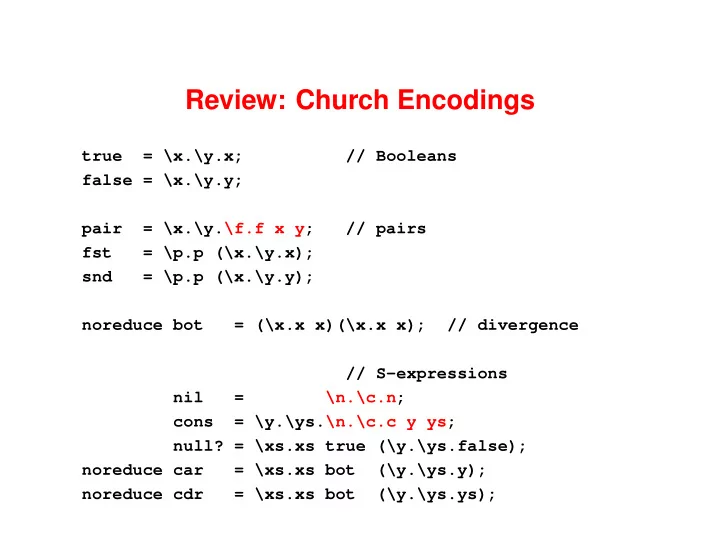
Review: Church Encodings
true = \x.\y.x; // Booleans false = \x.\y.y; pair = \x.\y.\f.f x y; // pairs fst = \p.p (\x.\y.x); snd = \p.p (\x.\y.y); noreduce bot = (\x.x x)(\x.x x); // divergence // S-expressions nil = \n.\c.n; cons = \y.\ys.\n.\c.c y ys; null? = \xs.xs true (\y.\ys.false); noreduce car = \xs.xs bot (\y.\ys.y); noreduce cdr = \xs.xs bot (\y.\ys.ys);
SLIDE 2 Review: Church Numerals
zero = \f.\x.x; succ = \n.\f.\x.f (n f x); plus = \n.\m.n succ m; times = \n.\m.n (plus m) zero; ...
\f.\x.f (f (f (f x)))
\f.\x.f (f (f x))
\f.\x.f (f (f (f (f (f (f (f (f (f (f (f x)))))))))))
SLIDE 3 Reduction rules
Central rules: substitution and optimization:
(x :M )N
[x 7! N ℄
(BETA)
x not free in M
(x :Mx )
(ETA)
Structural rules: Reduce anywhere, any time M
! M′
MN
! M′N
(NU)
N
! N′
MN
! MN′ (MU)
M
! M′ x :M ! x :M′ (XI)
(Good for both
and .)
SLIDE 4
Free variables
x is free in x x is free in M x
6= x′
x is free in
x′ :M
x is free in M x is free in MN x is free in N x is free in MN
SLIDE 5
Your turn! Free Variables
What are the free variables in each expression? \x.\y. y z \x.x (\y.x) \x.\y.\x.x y \x.\y.x (\z.y w) y (\x.z) (\x.\y.x y) y
SLIDE 6 Your turn! Free Variables
What are the free variables in each expression? \x.\y. y z
\x.x (\y.x)
\x.\y.\x.x y
\x.\y.x (\z.y w)
y (\x.z)
(\x.\y.x y) y
SLIDE 7
Capture-avoiding substitution
x [x
7! M ℄ =
M y
[x 7! M ℄ =
y
(YZ )[x 7! M ℄ = (Y [x 7! M ℄)(Z [x 7! M ℄) (x :Y )[x 7! M ℄ = x :Y (y :Z )[x 7! M ℄ = y :Z [x 7! M ℄
if x not free in Z or y not free in M
(y :Z )[x 7! M ℄ = w :(Z [y 7! w ℄)[x 7! M ℄
where w not free in Z or M Last transformation is renaming of bound variables
SLIDE 8 Renaming of bound variables
So important it has its own Greek letter: w not free in Z
y :Z
w :(Z [y 7! w ℄)
(ALPHA) Also has structural rules
SLIDE 9 Conversion and reduction
Alpha-conversion (rename bound variable) y not free in Z
x :Z
y :Z [x 7! y ℄
Beta-reduction (the serious evaluation rule)
(x :M )N
[x 7! N ℄
Eta-reduction: x not free in M
x :Mx
All structural: Convert/reduce whole term or subterm
SLIDE 10
Church-Rosser Theorem
Equivalence of convertible terms: if A
! B and A ! C
there exists D s.t. B
!∗ D and C !∗ D
SLIDE 11 Idea: normal form
A term is a normal form if It cannot be reduced What do you suppose it means to say
- A term has no normal form?
- A term has a normal form?
SLIDE 12
Idea: normal form
A term is a normal form if It cannot be reduced A term has a normal form if There exists a sequence of reductions that terminates (in a normal form) A term has no normal form if It always reduces forever (This term diverges)
SLIDE 13
Normal forms code for values
Corollary of Church-Rosser: if A
!∗ B, B in normal form, and
A
!∗ C, C in normal form
then B and C are identical (up to renaming of bound variables)
SLIDE 14
Y combinator can implement fix
Define Y such that, for any g, Y g
= g (Y g ):
Y
= f :(x :f (xx ))(x :f (xx ))
Y g
= (x :g (xx ))(x :g (xx ))
and by beta-conversion Y g
=
g
((x :g (xx ))(x :g (xx )))
Y g
=
g
(Y g )
so Y g is a fixed point of g Does Y g have a normal form?
SLIDE 15 Normal-order reduction
(If a normal form exists, find it!) Application offers up to three choices:
#1
(x :M )N
[x 7! N ℄
(BETA)
x not free in M
(x :Mx )
(ETA) #2
M
! M′
MN
! M′N
(NU) #3
N
! N′
MN
! MN′ (MU)
M
! M′ x :M ! x :M′ (XI)
Slogan: “leftmost, outermost redex”
SLIDE 16 Normal-order illustration
Not every term has a normal form:
(x :xx )(x :xx )
(x :xx )(x :xx )
But
(x :y :y )((x :xx )(x :xx ))
y :y
Think “bodies before arguments” Applicative order does not terminate!