
SLIDE 1
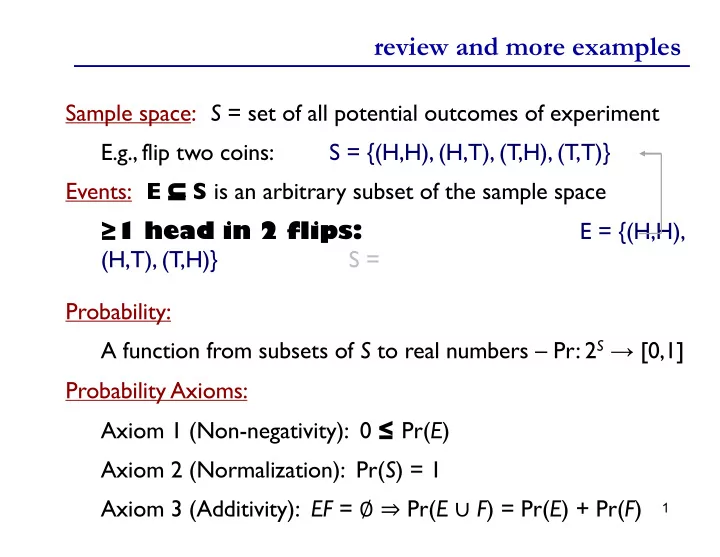
Sample space: S = set of all potential outcomes of experiment E.g., flip two coins: S = {(H,H), (H,T), (T,H), (T,T)} Events: E ⊆ S is an arbitrary subset of the sample space ≥1 head in 2 flips: E = {(H,H), (H,T), (T,H)} S = Probability: A function from subsets of S to real numbers – Pr: 2S → [0,1] Probability Axioms: Axiom 1 (Non-negativity): 0 ≤ Pr(E) Axiom 2 (Normalization): Pr(S) = 1 Axiom 3 (Additivity): EF = ∅ ⇒ Pr(E ∪ F) = Pr(E) + Pr(F)
review and more examples
1