Review: Acoustic Modeling x Observations; sequence of 40d feature - - PowerPoint PPT Presentation

review acoustic modeling
SMART_READER_LITE
LIVE PREVIEW

Review: Acoustic Modeling x Observations; sequence of 40d feature - - PowerPoint PPT Presentation

Review: Acoustic Modeling x Observations; sequence of 40d feature vectors. Lecture 6 word sequence. Language Modeling/Pronunciation Modeling HMM/GMM framework lets us model P ( x | ) . . . How likely feature vectors are given


slide-1
SLIDE 1

Lecture 6

Language Modeling/Pronunciation Modeling Michael Picheny, Bhuvana Ramabhadran, Stanley F. Chen

IBM T.J. Watson Research Center Yorktown Heights, New York, USA {picheny,bhuvana,stanchen}@us.ibm.com

15 October 2012

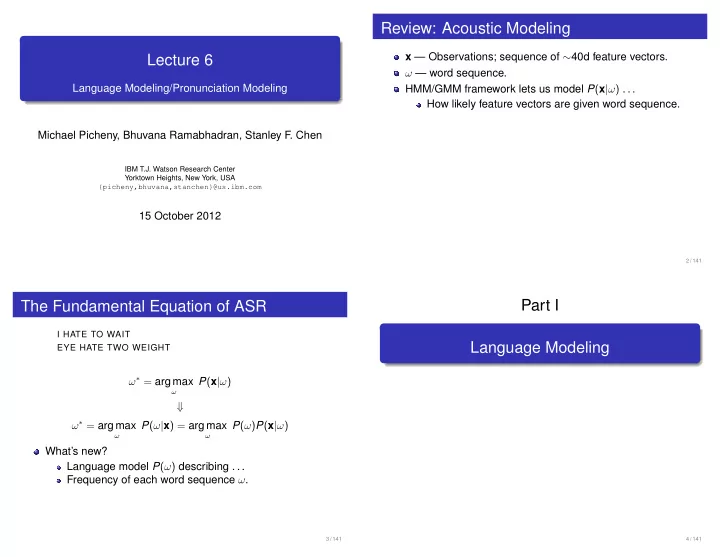
Review: Acoustic Modeling

x — Observations; sequence of ∼40d feature vectors. ω — word sequence. HMM/GMM framework lets us model P(x|ω) . . . How likely feature vectors are given word sequence.

2 / 141

The Fundamental Equation of ASR

I HATE TO WAIT EYE HATE TWO WEIGHT

ω∗ = arg max

ω

P(x|ω) ⇓ ω∗ = arg max

ω

P(ω|x) = arg max

ω

P(ω)P(x|ω) What’s new? Language model P(ω) describing . . . Frequency of each word sequence ω.

3 / 141

Part I Language Modeling

4 / 141

slide-2
SLIDE 2

Language Modeling: Goals

Describe which word sequences are likely. e.g., BRITNEY SPEARS vs. BRIT KNEE SPEARS. Analogy: multiple-choice test. LM restricts choices given to acoustic model. The fewer choices, the better you do.

5 / 141

What Type of Model?

Want probability distribution over sequence of symbols. (Hidden) Markov model! Hidden or non-hidden? For hidden, too hard to come up with topology.

6 / 141

Where Are We?

1

N-Gram Models

2

Technical Details

3

Smoothing

4

Discussion

7 / 141

What’s an n-Gram Model?

Markov model of order n − 1. To predict next word . . . Only need to remember last n − 1 words.

8 / 141

slide-3
SLIDE 3

What’s a Markov Model?

Decompose probability of sequence . . . Into product of conditional probabilities. e.g., trigram model ⇒ Markov order 2 ⇒ . . . Remember last 2 words. P(w1 · · · wL) =

L

  • i=1

P(wi|w1 · · · wi−1) =

L

  • i=1

P(wi|wi−2wi−1) P(I HATE TO WAIT) = P(I)P(HATE|I)P(TO|I HATE)P(WAIT|HATE TO)

9 / 141

Sentence Begins and Ends

Pad left with beginning-of-sentence tokens. e.g., w−1 = w0 = ⊲. Always condition on two words to left, even at start. Predict end-of-sentence token at end. So true probability, i.e.,

ω P(ω) = 1.

P(w1 · · · wL) =

L+1

  • i=1

P(wi|wi−2wi−1) P(I HATE TO WAIT) = P(I| ⊲ ⊲) × P(HATE| ⊲ I) × P(TO|I HATE)× P(WAIT|HATE TO) × P(⊳|TO WAIT)

10 / 141

How to Set Probabilities?

For each history wi−2wi−1 . . . P(wi|wi−2wi−1) is multinomial distribution. Maximum likelihood estimation for multinomials. Count and normalize! PMLE(wi|wi−2wi−1) = c(wi−2wi−1wi)

  • w c(wi−2wi−1w)

= c(wi−2wi−1wi) c(wi−2wi−1)

11 / 141

Example: Maximum Likelihood Estimation

23M words of Wall Street Journal text.

FEDERAL HOME LOAN MORTGAGE CORPORATION –DASH ONE .POINT FIVE BILLION DOLLARS OF REALESTATE MORTGAGE -HYPHEN INVESTMENT CONDUIT SECURITIES OFFERED BY MERRILL LYNCH &AMPERSAND COMPANY NONCOMPETITIVE TENDERS MUST BE RECEIVED BY NOON EASTERN TIME THURSDAY AT THE TREASURY OR AT FEDERAL RESERVE BANKS OR BRANCHES . . . . . .

P(TO|I HATE) = c(I HATE TO) c(I HATE) = 17 45 = 0.378

12 / 141

slide-4
SLIDE 4

Example: Bigram Model

P(I HATE TO WAIT) =??? P(EYE HATE TWO WEIGHT) =??? Step 1: Collect all bigram counts, unigram history counts.

EYE I HATE TO TWO WAIT WEIGHT

⊳ ∗ ⊲ 3 3234 5 4064 1339 8 22 892669

EYE

26 1 52 735

I

45 2 1 1 8 21891

HATE

40 9 246

TO

8 6 19 21 5341 324 4 221 510508

TWO

5 1617 652 4213 132914

WAIT

71 2 35 882

WEIGHT

38 45 643

13 / 141

Example: Bigram Model

P(I HATE TO WAIT) = P(I|⊲)P(HATE|I)P(TO|HATE)P(WAIT|TO)P(⊳|WAIT) = 3234 892669 × 45 21891 × 40 246 × 324 510508 × 35 882 = 3.05 × 10⁻¹¹ P(EYE HATE TWO WEIGHT) = P(EYE|⊲)P(HATE|EYE)P(TWO|HATE)P(WEIGHT|TWO) × P(⊳|WEIGHT) = 3 892669 × 735 × 246 × 132914 × 45 643 = 0

14 / 141

Recap: N-Gram Models

Simple formalism, yet effective. Discriminates between wheat and chaff. Easy to train: count and normalize. Generalizes. Assigns nonzero probabilities to sentences . . . Not seen in training data, e.g., I HATE TO WAIT.

15 / 141

Where Are We?

1

N-Gram Models

2

Technical Details

3

Smoothing

4

Discussion

16 / 141

slide-5
SLIDE 5

LM’s and Training and Decoding

Decoding without LM’s. Word HMM encoding allowable word sequences. Replace each word with its HMM.

❖◆❊ ❚❲❖ ❚❍❘❊❊ ✳ ✳ ✳ ✳ ✳ ✳ ❍▼▼♦♥❡ ❍▼▼t✇♦ ❍▼▼t❤r❡❡ ✳ ✳ ✳ ✳ ✳ ✳ 17 / 141

LM’s and Training and Decoding

Point: n-gram model is (hidden) Markov model. Can be expressed as word HMM. Replace each word with its HMM. Leave in language model probabilities.

❖◆❊✴P✭❖◆❊✮ ❚❲❖✴P✭❚❲❖✮ ❚❍❘❊❊✴P✭❚❍❘❊❊✮ ✳ ✳ ✳ ✳ ✳ ✳ ❍▼▼♦♥❡✴P✭❖◆❊✮ ❍▼▼t✇♦✴P✭❚❲❖✮ ❍▼▼t❤r❡❡✴P✭❚❍❘❊❊✮ ✳ ✳ ✳ ✳ ✳ ✳ ✳ ✳ ✳

Lots more details in lectures 7, 8. How do LM’s impact acoustic model training?

18 / 141

One Puny Prob versus Many?

♦♥❡ t✇♦ t❤r❡❡ ❢♦✉r ☞✈❡ s✐① s❡✈❡♥ ❡✐❣❤t ♥✐♥❡ ③❡r♦

19 / 141

The Acoustic Model Weight

Not a fair fight. Solution: acoustic model weight. ω∗ = arg max

ω

P(ω)P(x|ω)α α usually somewhere between 0.05 and 0.1. Important to tune for each LM, AM. Theoretically inelegant. Empirical performance trumps theory any day of week. Is it LM weight or AM weight?

20 / 141

slide-6
SLIDE 6

Real World Toy Example

Test set: continuous digit strings. Unigram language model: P(ω) = L+1

i=1 P(wi).

5 10 15 AM weight=1 AM weight=0.1 WER

21 / 141

What is This Word Error Rate Thing?

Most popular evaluation measure for ASR systems Divide total number of errors in test set . . . By total number of words. WER ≡

  • utts u(# errors in u)
  • utts u(# words in reference for u)

What is “number of errors” in utterance? Minimum number of word insertions, deletions, and . . . Substitutions to transform reference to hypothesis.

22 / 141

Example: Word Error Rate

What is the WER? reference:

THE DOG IS HERE NOW

hypothesis:

THE UH BOG IS NOW

Can WER be above 100%? What algorithm to compute WER? How many ways to transform reference to hypothesis?

23 / 141

Evaluating Language Models

Best way: plug into ASR system; measure WER. Need ASR system. Expensive to compute (especially in old days). Results depend on acoustic model. Is there something cheaper that predicts WER well?

24 / 141

slide-7
SLIDE 7

Perplexity

Basic idea: test set likelihood . . . Normalized so easy to interpret. Take (geometric) average probability pavg . . . Assigned to each word in test data. pavg = L+1

  • i=1

P(wi|wi−2wi−1)

  • 1

L+1

Invert it: PP =

1 pavg.

Interpretation: Given history, how many possible next words . . . (For acoustic model to choose from.) e.g., uniform unigram LM over V words ⇒ PP = V.

25 / 141

Example: Perplexity

P(I HATE TO WAIT) = P(I|⊲)P(HATE|I)P(TO|HATE)P(WAIT|TO)P(⊳|WAIT) = 3234 892669 × 45 21891 × 40 246 × 324 510508 × 35 882 = 3.05 × 10⁻¹¹ pavg = L+1

  • i=1

P(wi|wi−1)

  • 1

L+1

= (3.05 × 10⁻¹¹)

1 5 = 0.00789

PP = 1 pavg = 126.8

26 / 141

Perplexity: Example Values

training case+ type domain data punct PP human1 biography 142 machine2 Brown 600MW √ 790 ASR3 WSJ 23MW 120 Varies highly across domains, languages. Why?

1Jefferson the Virginian; Shannon game (Shannon, 1951). 2Trigram model (Brown et al., 1992). 3Trigram model; 20kw vocabulary.

27 / 141

Does Perplexity Predict Word-Error Rate?

Not across different LM types. e.g., word n-gram model; class n-gram model; . . . OK within LM type. e.g., vary training set; model order; pruning; . . .

28 / 141

slide-8
SLIDE 8

Perplexity and Word-Error Rate

20 25 30 35 4.5 5 5.5 6 6.5 WER log PP

29 / 141

Recap

LM describes allowable word sequences. Used to build decoding graph. Need AM weight for LM to have full effect. Best to evaluate LM’s using WER . . . But perplexity can be informative. Can you think of any problems with word error rate? What do we really care about in applications?

30 / 141

Where Are We?

1

N-Gram Models

2

Technical Details

3

Smoothing

4

Discussion

31 / 141

An Experiment

Take 50M words of WSJ; shuffle sentences; split in two. “Training” set: 25M words.

NONCOMPETITIVE TENDERS MUST BE RECEIVED BY NOON EASTERN TIME THURSDAY AT THE TREASURY OR AT FEDERAL RESERVE BANKS OR BRANCHES .PERIOD NOT EVERYONE AGREED WITH THAT STRATEGY .PERIOD . . . . . .

“Test” set: 25M words.

NATIONAL PICTURE &AMPERSAND FRAME –DASH INITIAL TWO MILLION ,COMMA TWO HUNDRED FIFTY THOUSAND SHARES ,COMMA VIA WILLIAM BLAIR .PERIOD THERE WILL EVEN BE AN EIGHTEEN -HYPHEN HOLE GOLF COURSE .PERIOD . . . . . .

32 / 141

slide-9
SLIDE 9

An Experiment

Count how often each word occurs in training; sort by count. word count ,COMMA 1156259 THE 1062057 .PERIOD 877624 OF 520374 TO 510508 A 455832 AND 417364 IN 385940 . . . . . . . . . . . . word count . . . . . . . . . . . . ZZZZ 2 AAAAAHHH 1 AAB 1 AACHENER 1 . . . . . . . . . . . . ZYPLAST 1 ZYUGANOV 1

33 / 141

An Experiment

For each word that occurs exactly once in training . . . Count how often occurs in test set. Average this count across all such words. What is actual value?

1

Larger than 1.

2

Exactly 1, more or less.

3

Between 0.5 and 1.

4

Between 0.1 and 0.5. What if do this for trigrams, not unigrams?

34 / 141

Why?

Q: How many unigrams/trigrams in test set . . . Do not appear in training set? A: 48k/7.4M. Q: How many unique unigrams/trigrams in training set? A: 135k/9.4M. On average, everything seen in training is discounted!

35 / 141

What Does This Have To Do With Anything?

Goal: estimate frequencies of n-grams in test data! MLE ⇔ frequency of n-gram in training data! P(TO|I HATE) = c(I HATE TO) c(I HATE) = 17 45 = 0.378 Point: training and test frequencies can differ a ton!

36 / 141

slide-10
SLIDE 10

Maximum Likelihood and Sparse Data

In theory, ML estimate is as good as it gets . . . In limit of lots of data. In practice, sucks when data is sparse. Can be off by large factor. e.g., for 1-count trigram, MLE =

1 25M .

Average frequency in test data = 0.25

25M .

How bad is it for zero counts?

37 / 141

Maximum Likelihood and Zero Probabilities

According to MLE bigram model . . . What is probability of sentence if contains . . . Bigram with no training counts, e.g., HATE TWO? P(I HATE TWO PEOPLE) = P(I|⊲)P(HATE|I)P(TWO|HATE)P(PEOPLE|TWO) × P(⊳|PEOPLE) How common are unseen trigrams in test data? (Brown et al., 1992): 350M word training set: 15%. What does this imply about impact on WER? Perplexity? (Inverse of geometric average of word probs.)

38 / 141

Smoothing

Adjusting ML estimates to better match test data. How to decrease probabilities for seen stuff? How to estimate probabilities for unseen stuff? Also called regularization.

39 / 141

The Basic Idea (Bigram Model)

Conditional distribution: P(w|HATE). Discount nonzero counts; move mass to zero counts. w c PMLE csmooth Psmooth TO 40 0.163 40.0000 0.162596 THE 22 0.089 20.9840 0.085301 IT 15 0.061 14.2573 0.057957 CRIMES 13 0.053 12.2754 0.049900 . . . . . . . . . . . . . . . AFTER 1 0.004 0.4644 0.001888 ALL 1 0.004 0.4644 0.001888 . . . . . . . . . . . . . . . A 0.000 1.1725 0.004766 AARON 0.000 0.0002 0.000001 . . . . . . . . . . . . . . . total 246 1.000 246 1.000000

40 / 141

slide-11
SLIDE 11

How Much To Discount Nonzero Counts?

The Good-Turing estimate (Good, 1953). How often word with k counts in training data . . . Occurs in test set of equal size? (avg. count) ≈ (# words w/ k + 1 counts) × (k + 1) (# words w/ k counts) Example: 23M words WSJ. How often do 1-count words occur in test set? Number of words with 1 count: 7419143. Number of words with 2 counts: 933493. (avg. count) ≈ 933493 × 2 7419143 = 0.252

41 / 141

How Accurate Is Good-Turing?

10 20 30 10 20 30 average test set count training set count actual Good-Turing

Bigram counts; 10M words WSJ training and test.

42 / 141

The Basic Idea (cont’d)

Use GT estimate to discount counts of seen words. How to divvy up counts among unseen words? w c PMLE csmooth Psmooth TO 40 0.163 40.0000 0.162596 THE 22 0.089 20.9840 0.085301 IT 15 0.061 14.2573 0.057957 CRIMES 13 0.053 12.2754 0.049900 . . . . . . . . . . . . . . . AFTER 1 0.004 0.4644 0.001888 ALL 1 0.004 0.4644 0.001888 . . . . . . . . . . . . . . . A 0.000 ??? ??????? AARON 0.000 ??? ??????? . . . . . . . . . . . . . . . total 246 1.000 246 1.000000

43 / 141

Backoff

Task: divide up some probability mass . . . Among words not occurring after a history. Idea: uniformly? Better: according to unigram distribution P(w). e.g., give more mass to A than AARON. P(w) = c(w)

  • w c(w)

Backoff: use lower-order distribution . . . To fill in probabilities for unseen words.

44 / 141

slide-12
SLIDE 12

Putting It All Together: Katz Smoothing

Katz (1987) PKatz(wi|wi−1) =    PMLE(wi|wi−1) if c(wi−1wi) ≥ k PGT(wi|wi−1) if 0 < c(wi−1wi) < k αwi−1PKatz(wi)

  • therwise

If count high, no discounting (GT estimate unreliable). If count low, use GT estimate. If no count, use scaled backoff probability. Choose αwi−1 so

wi PKatz(wi|wi−1) = 1.

Most popular smoothing technique for about a decade.

45 / 141

Example: Katz Smoothing

Conditional distribution: P(w|HATE). w c PMLE csmooth Psmooth TO 40 0.163 40.0000 0.162596 THE 22 0.089 20.9840 0.085301 IT 15 0.061 14.2573 0.057957 CRIMES 13 0.053 12.2754 0.049900 . . . . . . . . . . . . . . . AFTER 1 0.004 0.4644 0.001888 ALL 1 0.004 0.4644 0.001888 . . . . . . . . . . . . . . . A 0.000 1.1725 0.004766 AARON 0.000 0.0002 0.000001 . . . . . . . . . . . . . . . total 246 1.000 246 1.000000

46 / 141

Recap: Smoothing

ML estimates: way off for low counts. Zero probabilities kill performance. Key aspects of smoothing algorithms. How to discount counts of seen words. Estimating mass of unseen words. Backoff to get information from lower-order models. No downside.

47 / 141

Where Are We?

1

N-Gram Models

2

Technical Details

3

Smoothing

4

Discussion

48 / 141

slide-13
SLIDE 13

N-Gram Models

Workhorse of language modeling for ASR for 30 years. Used in great majority of deployed systems. Almost no linguistic knowledge. Totally data-driven. Easy to build. Fast and scalable. Can train on vast amounts of data; just gets better.

49 / 141

Smoothing

Lots and lots of smoothing algorithms developed. Will talk about newer algorithms in Lecture 11. Gain: ∼1% absolute in WER over Katz. With good smoothing, don’t worry models being too big! Can increase n-gram order w/o loss in performance. Can gain in performance if lots of data. Rule of thumb: if ML estimate is working OK . . . Model is way too small.

50 / 141

Does Markov Property Hold For English?

Not for small n. P(wi | OF THE) = P(wi | KING OF THE) Make n larger?

FABIO, WHO WAS NEXT IN LINE, ASKED IF THE TELLER SPOKE . . .

Lots more to say about language modeling . . . In Lecture 11.

51 / 141

References

C.E. Shannon, “Prediction and Entropy of Printed English”, Bell Systems Technical Journal, vol. 30, pp. 50–64, 1951. I.J. Good, “The Population Frequencies of Species and the Estimation of Population Parameters”, Biometrika, vol. 40,

  • no. 3 and 4, pp. 237–264, 1953.

S.M. Katz, “Estimation of Probabilities from Sparse Data for the Language Model Component of a Speech Recognizer”, IEEE Transactions on Acoustics, Speech and Signal Processing, vol. 35, no. 3, pp. 400–401, 1987. P .F. Brown, S.A. Della Pietra, V.J. Della Pietra, J.C. Lai, R.L. Mercer, “An Estimate of an Upper Bound for the Entropy of English”, Computational Linguistics, vol. 18, no. 1, pp. 31–40, 1992.

52 / 141

slide-14
SLIDE 14

Part II Administrivia

53 / 141

Administrivia

Clear (7); mostly clear (10); unclear (1). Pace: too fast/too much content (4); OK (10); too slow/not enough time on LM’s (2). Feedback (2+ votes): More demos (2). More examples (2). Post answers to lab/sooner (2). Put administrivia in middle of lecture. Muddiest: n-grams (2); . . .

54 / 141

Administrivia

Lab 1 Handed back today? Answers: /user1/faculty/stanchen/e6870/lab1_ans/ Lab 2 Due two days from now (Wednesday, Oct. 17) at 6pm. Xiao-Ming has extra office hours: Tue 2-4pm. Optional non-reading projects. Will be posted Thursday; we’ll send out announcement. Proposal will be due week from Wednesday (Oct. 24). For reading projects, oral presentation ⇒ paper.

55 / 141

Part III Pronunciation Modeling

56 / 141

slide-15
SLIDE 15

In the beginning...

... . was the whole word model. For each word in the vocabulary, decide on a topology. Often the number of states in the model is chosen to be proportional to the number of phonemes in the word. Train the observation and transition parameters for a given word using examples of that word in the training data. Good domain for this approach: digits.

57 / 141

Example topologies: Digits

Vocabulary consists of (“zero”, “oh”, “one”, “two”, “three”, “four”, “five”, “six”, “seven”, “eight”, “nine”). Assume we assign two states per phoneme. Must allow for different durations Models look like: “zero”. “oh”.

58 / 141 59 / 141 60 / 141

slide-16
SLIDE 16

How to represent any sequence of digits?

61 / 141

“911”

62 / 141

Trellis Representation

63 / 141

Whole-word model limitations

The whole-word model suffers from two main problems. Cannot model unseen words. In fact, we need several samples of each word to train the models properly. Cannot share data among models – data sparseness problem. The number of parameters in the system is proportional to the vocabulary size. Thus, whole-word models are best on small vocabulary tasks.

64 / 141

slide-17
SLIDE 17

Subword Units

To reduce the number of parameters, we can compose word models from sub-word units. These units can be shared among words. Examples include Units Approximate number Phones 50. Diphones 2000. Syllables 5,000. Each unit is small. The number of parameters is proportional to the number of units (not the number of words in the vocabulary as in whole-word models.).

65 / 141

Phonetic Models

We represent each word as a sequence of phonemes. This representation is the “baseform” for the word. BANDS

  • >

B AE N D Z Some words need more than one baseform. THE

  • >

DH UH

  • >

DH IY

66 / 141

Baseform Dictionary

To determine the pronunciation of each word, we look it up in a dictionary. Each word may have several possible pronunciations. Every word in our training script and test vocabulary must be in the dictionary. The dictionary is generally written by hand. Prone to errors and inconsistencies.

67 / 141

Phonetic Models, cont’d

We can allow for a wide variety of phonological variation by representing baseforms as graphs.

68 / 141

slide-18
SLIDE 18

Phonetic Models, cont’d

Now, construct a Markov model for each phone. Examples:

69 / 141

Embedding

Replace each phone by its Markov model to get a word model. N.b. The model for each phone will have different parameter values.

70 / 141

Reducing Parameters by Tying

Consider the three-state model. Note that. t1 and t2 correspond to the beginning of the phone. t3 and t4 correspond to the middle of the phone. t5 and t6 correspond to the end of the phone. If we force the output distributions for each member of those pairs to be the same, then the training data requirements are reduced.

71 / 141

Tying

A set of arcs in a Markov model are tied to one another if they are constrained to have identical output distributions. Similarly, states are tied if they have identical transition probabilities. Tying can be explicit or implicit.

72 / 141

slide-19
SLIDE 19

Implicit Tying

Occurs when we build up models for larger units from models of smaller units. Example: when word models are made from phone models. First, consider an example without any tying. Let the vocabulary consist of digits 0,1,2,... 9. We can make a separate model for each word. To estimate parameters for each word model, we need several samples for each word. Samples of “0” affect only parameters for the “0” model.

73 / 141

Implicit Tying, cont’d

Now consider phone-based models for this vocabulary. Training samples of “0” will also affect models for “3” and “4”. Useful in large vocabulary systems where the number of words is much greater than the number of phones.

74 / 141

Explicit Tying

Example: 6 non-null arcs, but only 3 different output distributions because of tying. Number of model parameters is reduced. Tying saves storage because only one copy of each distribution is saved. Fewer parameters mean less training data needed.

75 / 141

Variations in realizations of phonemes

The broad units, phonemes, have variants known as allophones Example: p and ph (un-aspirated and aspirated p). Exercise: Put your hand in front of your mouth and pronounce spin and then pin Note that the p in pin has a puff of air,. while the p in spin does not. Articulators have inertia, thus the pronunciation of a phoneme is influenced by surrounding phonemes. This is known as co-articulation Example: Consider k and g in different contexts.

In key and geese the whole body of the tongue has to be pulled up to make the vowel. Closure of the k moves forward compared to caw and gauze.

Phonemes have canonical articulator target positions that may or may not be reached in a particular utterance.

76 / 141

slide-20
SLIDE 20

keep

77 / 141

coop

78 / 141

Context-dependent models

We can model phones in context. Two approaches: “triphones” and "Decision Trees". Both methods use clustering. “Triphones” use bottom-up clustering, "Decision trees" implement top-down clustering. Typical improvements of speech recognizers when introducing context dependence: 30% - 50% fewer errors.

79 / 141

Triphone models

Model each phoneme in the context of its left and right neighbor. E.g. K-IY+P is a model for IY when K is its left context phoneme and P is its right context phoneme. If we have 50 phonemes in a language, we could have as many as 503 triphones to model. Not all of these occur. Still have data sparsity issues. Try to solve these issues by agglomerative clustering.

80 / 141

slide-21
SLIDE 21

Agglomerative / “Bottom-up” Clustering

Start with each item in a cluster by itself. Find “closest” pair of items. Merge them into a single cluster. Iterate. Different results based on distance measure used. Single-link: dist(A,B) = min dist(a,b) for aA, bB. Complete-link: dist(A,B) = max dist(a,b) for aA, bB.

81 / 141

Bottom-up clustering / Single Link

82 / 141

Bottom-up clustering / Complete Link

83 / 141

Dendrogram

A natural way to display clusters is through a “dendrogram”. Shows the clusters on the x-axis, distance between clusters

  • n the y-axis.

Provides some guidance as to a good choice for the number of clusters.

84 / 141

slide-22
SLIDE 22

Triphone Clustering

We can use e.g. complete-link clustering to cluster triphones. Helps with data sparsity issue. Still have an issue with unseen data. To model unseen events, we need to “back-off” to lower

  • rder models such as bi-phones and uni-phones.

85 / 141

Decision Trees

Goal of any clustering scheme is to find equivalence classes among our training samples. A decision tree maps data tagged with set of input variables into equivalence classes. Asks questions about the input variables to designed to improve some criterion function associated with the training data. Output data may be labels - criteria could be entropy Output data may be real numbers or vector - criteria could be mean-square error The goal when constructing a decision tree is significantly improve the criterion function (relative to doing nothing)

86 / 141

Decision Trees - A Form of Top-Down Clustering

DTs perform top-down clustering because constructed by asking series of questions that recursively split the training data. In our case, The input features will be phonetic context (the phones to left and right of phone for which we are creating a context-dependent model; The output data will be the feature vectors associated with each phone The criterion function will be the likelihood of the output features. Classic text: L. Breiman et al. Classification and Regression Trees. Wadsworth & Brooks. Monterey,

  • California. 1984.

87 / 141

What does a decision tree look like?

88 / 141

slide-23
SLIDE 23

Types of Input Attributes/Features

Numerical: Domain is ordered and can be represented on the real line (e.g., age, income). Nominal or categorical: Domain is a finite set without any natural ordering (e.g., occupation, marital status, race). Ordinal: Domain is ordered, but absolute differences between values is unknown (e.g., preference scale, severity

  • f an injury).

89 / 141

The Classification Problem

If the dependent variable is categorical, the problem is a classification problem. Let C be the class label of a given data point X = {X1, . . . , Xk} Let d() be the predicted class label Define the misclassification rate of d: P(d(X = {X1, . . . , Xk}) = C Problem definition: Given a dataset, find the classifier d such that the misclassification rate is minimized.

90 / 141

The Regression Problem

If the dependent variable is numerical, the problem is a regression problem.. The tree d maps observation X to prediction Y ′ of Y and is called a regression function.. Define mean squared error of d as: E[(Y − d(X = {X1, . . . , Xk}))2] Problem definition: Given dataset, find regression function d such that mean squared error is minimized.

91 / 141

Goals & Requirements

Traditional Goals of Decision Trees To produce an accurate classifier/regression function. To understand the structure of the problem. Traditional Requirements on the model: High accuracy. Understandable by humans, interpretable. Fast construction for very large training databases. For speech recognition, understandibility quickly goes out the window....

92 / 141

slide-24
SLIDE 24

Decision Trees: Letter-to-Sound Example

Let’s say we want to build a tree to decide how the letter “p” will sound in various words. Training examples: p loophole peanuts pay apple f physics telephone graph photo φ apple psycho pterodactyl pneumonia The pronunciation of “p” depends on its context. Task: Using the above training data, partition the contexts into equivalence classes so as to minimize the uncertainty

  • f the pronunciation.

93 / 141

Decision Trees: Letter-to-Sound Example, cont’d

Denote the context as . . . L2 L1 p R1 R2 . . . Ask potentially useful question: R1 = "h"? At this point we have two equivalence classes: 1. R1 = “h” and 2. R1 = “h”. The pronunciation of class 1 is either “p” or “f”, with “f” much more likely than “p”. The pronunciation of class 2 is either “p” or "φ"

94 / 141

Four equivalence classes. Uncertainty only remains in class 3.

95 / 141

Five equivalence classes, which is much less than the number of letter contexts. No uncertainy left in the classes. A node without children is called a leaf node. Otherwise it is called an internal node

96 / 141

slide-25
SLIDE 25

Test Case: Paris

97 / 141

Test Case: gopher

Although effective on the training data, this tree does not generalize well. It was constructed from too little data.

98 / 141

Decision Tree Construction

1

Find the best question for partitioning the data at a given node into 2 equivalence classes.

2

Repeat step 1 recursively on each child node.

3

Stop when there is insufficient data to continue or when the best question is not sufficiently helpful.

99 / 141

Basic Issues to Solve

The selection of the splits. The decisions when to declare a node terminal or to continue splitting.

100 / 141

slide-26
SLIDE 26

Decision Tree Construction – Fundamental Operation

There is only 1 fundamental operation in tree construction: Find the best question for partitioning a subset of the data into two smaller subsets. i.e. Take an equivalence class and split it into 2 more-specific classes.

101 / 141

Decision Tree Greediness

Tree construction proceeds from the top down – from root to leaf. Each split is intended to be locally optimal. Constructing a tree in this “greedy” fashion usually leads to a good tree, but probably not globally optimal. Finding the globally optimal tree is an NP-complete problem: it is not practical.

102 / 141

Splitting

Each internal node has an associated splitting question. Example questions: Age <= 20 (numeric). Profession in (student, teacher) (categorical). 5000*Age + 3*Salary – 10000 > 0 (function of raw features).

103 / 141

Dynamic Questions

The best question to ask about some discrete variable x consists of the best subset of the values taken by x. Search over all subsets of values taken by x at a given

  • node. (This means generating questions on the fly during

tree construction.). x ∈ {A, B, C} Q1:x ∈ {A}? Q2:x ∈ {B}? Q3:x ∈ {C}? Q4:x ∈ {A, B}? Q5:x ∈ {A, C}? Q6:x ∈ {B, C}? Use the best question found. Potential problems: Requires a lot of CPU. For alphabet size A there are

  • j

A

j

  • questions.

Allows a lot of freedom, making it easy to overtrain.

104 / 141

slide-27
SLIDE 27

Pre-determined Questions

The easiest way to construct a decision tree is to create in advance a list of possible questions for each variable. Finding the best question at any given node consists of subjecting all relevant variables to each of the questions, and picking the best combination of variable and question. In acoustic modeling, we typically ask about 2-4 variables: the 1-2 phones to the left of the current phone and the 1-2 phones to the right of the current phone. Since these variables all span the same alphabet (phone alphabet) only

  • ne list of questions.

Each question on this list consists of a subset of the phonetic phone alphabet.

105 / 141

Sample Questions

Phones Letters {P} {A} {T} {E} {K} {I} {B} {O} {D} {U} {G} {Y} {P ,T,K} {A,E,I,O,U} {B,D,G} {A,E,I,O,U,Y} {P ,T,K,B,D,G}

106 / 141

Discrete Questions

A decision tree has a question associated with every non-terminal node. If x is a discrete variable which takes on values in some finite alphabet A, then a question about x has the form: x ∈ S? where S is a subset of A. Let L denote the preceding letter in building a spelling-to-sound tree. Let S=(A,E,I,O,U). Then L ∈ S? denotes the question: Is the preceding letter a vowel? Let R denote the following phone in building an acoustic context tree. Let S=(P ,T,K). Then R ∈ S ? denotes the question: Is the following phone an unvoiced stop?

107 / 141

Continuous Questions

If x is a continuous variable which takes on real values, a question about x has the form x<q? where q is some real value. In order to find the threshold q, we must try values which separate all training samples. We do not currently use continuous questions for speech recognition.

108 / 141

slide-28
SLIDE 28

Types of Questions

In principle, a question asked in a decision tree can have any number (greater than 1) of possible outcomes. Examples: Binary: Yes No. 3 Outcomes: Yes No Don’t_Know. 26 Outcomes: A B C ... Z. In practice, only binary questions are used to build decision trees.

109 / 141

Simple Binary Question

A simple binary question consists of a single Boolean condition, and no Boolean operators. X1 ∈ S1? Is a simple question. ((X1 ∈ S1)&&(X2 ∈ S2))? is not a simple question. Topologically, a simple question looks like:

110 / 141

Complex Binary Question

A complex binary question has precisely 2 outcomes (yes, no) but has more than 1 Boolean condition and at least 1 Boolean operator. ((X1 ∈ S1)&&(X2 ∈ S2))? Is a complex question. Topologically this question can be shown as: All complex binary questions can be represented as binary trees with terminal nodes tied to produce 2 outcomes.

111 / 141

Configurations Currently Used

All decision trees currently used in speech recognition use: a pre-determined set

  • f simple,

binary questions.

  • n discrete variables.

112 / 141

slide-29
SLIDE 29

Tree Construction Overview

Let x1 . . . xn denote n discrete variables whose values may be asked about. Let Qij denote the jth pre-determined question for xi. Starting at the root, try splitting each node into 2 sub-nodes:

1

For each xi evaluate questions Qi1, Qi2, . . . and let Q′

i

denote the best.

2

Find the best pair xi, Q′

i and denote it x′, Q′

3

If Q′ is not sufficiently helpful, make the current node a leaf.

4

Otherwise, split the current node into 2 new sub-nodes according to the answer of question Q′ on variable x′. Stop when all nodes are either too small to split further or have been marked as leaves.

113 / 141

Question Evaluation

The best question at a node is the question which maximizes the likelihood of the training data at that node after applying the question. Goal: Find Q such that L(datal|µl, Σl)xL(datar|µr, Σr) is maximized.

114 / 141

Question Evaluation, cont’d

Let feature x have a set of M possible outcomes. Let x1, x2, . . . , xN be the data samples for feature x Let each of the M outcomes occur ci(i = 1, 2, . . . , M) times in the overall sample Let Q be a question which partitions this sample into left and right sub-samples of size nl and nr, respectively. Let cl

i , cr i denote the frequency of the ith outcome in the left

and right sub-samples. The best question Q for feature x is defined to be the one which maximizes the conditional (log) likelihood of the combined sub-samples.

115 / 141

log likelihood computation

The log likelihood of the data, given that we ask question Q, is: log L(x1, . . . , xn|Q) =

N

  • i=1

cl

i log pl i + N

  • i=1

cr

i log pr i

The above assumes we know the "true" probabilities pl

i, pr i

116 / 141

slide-30
SLIDE 30

log likelihood computation (continued)

Using the maximum likelihood estimates of pl

i, pr i gives:

log L(x1, . . . , xn|Q) =

N

X

i=1

cl

i log cl i

nl +

N

X

i=1

cr

i log cr i

nr =

N

X

i=1

cl

i log cl i − log nl N

X

i=1

cl

i + N

X

i=1

cr

i log cr i − log nr N

X

i=1

cr

i

=

N

X

i=1

{cl

i log cl i + cr i log cr i } − nl log nl − nr log nr

The best question is the one which maximizes this simple expression. cl

i , cr i , nl, nr are all non-negative integers.

The above expression can be computed very efficiently using a precomputed table of n log n for non-nonegative integers n

117 / 141

Entropy

Let x be a discrete random variable taking values a1, . . . , aN in an alphabet A of size N with probabilities p1, . . . , pN respectively. The uncertainty about what value x will take can be measured by the entropy of the probability distribution p = (p1p2 . . . pN) H = −

N

  • i=1

pi log2 pi H = 0 ⇔ pj = 1 for some j and pi = 0 for i = j H >= 0 Entropy is maximized when pi = 1/N for all i. Then H = log2 N Thus H tells us something about the sharpness of the distribution p.

118 / 141

What does entropy look like for a binary variable?

119 / 141

Entropy and Likelihood

Let x be a discrete random variable taking values a1, . . . aN in an alphabet A of size N with probabilities p1, . . . , pN respectively. Let x1, . . . , xn be a sample of x in which ai occurs ci times The sample log likelihood is: log L =

n

  • i=1

ci log pi The maximum likelihood estimate of pi is ˆ pi = ci/n Thus, an estimate of the sample log likelihood is log ˆ L = n

N

  • i=1

ˆ pi log2 ˆ pi ∝ − ˆ H Therefore, maximizing likelihood ⇔ minimizing entropy.

120 / 141

slide-31
SLIDE 31

“p” tree, revisited

p loophole peanuts pay apple cp = 4 f physics telephone graph photo cf = 4 φ apple psycho pterodactyl pneumonia cφ = 4, n = 12 Log likelihood of the data at the root node is log2 L(x1, . . . , x12) =

3

  • i=1

ci log2 ci − n log2 n = 4 log2 4 + 4 log2 4 + 4 log2 4 − 12 log2 12 = −19.02 Average entropy at the root node is H(x1, . . . , x12) = −1/n log2 L(x1, . . . , x12) = 19.02/12 = 1.58 bits Let’s now apply the above formula to compare three different questions.

121 / 141

“p” tree revisited: Question A

122 / 141

“p” tree revisited: Question A

Remember formulae for Log likelihood of data:

N

P

i=1

{cl

i log cl i + cr i log cr i } − nl log nl − nr log nr

Log likelihood of data after applying question A is:

log2 L(x1, . . . , x12|QA) =

cl

p

z }| { 1 log2 1 +

cl

f

z }| { 4 log2 4 +

cr

p

z }| { 3 log2 3 +

cr

φ

z }| { 4 log2 4 −

nl

z }| { 5 log2 5 −

nr

z }| { 7 log2 7 = −10.51

Average entropy of data after applying question A is

H(x1, . . . , x12|QA) = −1/n log2 L(x1, . . . , x12|QA) = 10.51/12 = .87 bits

Increase in log likelihood do to question A is -10.51 + 19.02 = 8.51 Decrease in entropy due to question A is 1.58-.87 = .71 bits Knowing the answer to question A provides 0.71 bits of information about the pronunciation of p. A further 0.87 bits of information is still required to remove all the uncertainty about the pronunciation of p.

123 / 141

“p” tree revisited: Question B

124 / 141

slide-32
SLIDE 32

“p” tree revisited: Question B

Log likelihood of data after applying question B is:

log2 L(x1, . . . , x12|QB) = 2 log2 2 + 2 log2 2 + 3 log2 3 + 2 log2 2 + 2 log2 2 − 7 log2 7 − 5 log2 5 = −18.51

Average entropy of data after applying question B is

H(x1, . . . , x12|QB) = −1/n log2 L(x1, . . . , x12|QB) = 18.51/12 = .87 bits

Increase in log likelihood do to question B is -18.51 + 19.02 = .51 Decrease in entropy due to question B is 1.58-1.54 = .04 bits Knowing the answer to question B provides 0.04 bits of information (very little) about the pronunciation of p.

125 / 141

“p” tree revisited: Question C

126 / 141

“p” tree revisited: Question C

Log likelihood of data after applying question C is:

log2 L(x1, . . . , x12|QC) = 2 log2 2 + 2 log2 2 + 2 log2 2 + 2 log2 2 + 4 log2 4 − 4 log2 4 − 8 log2 8 = −16.00

Average entropy of data after applying question C is

H(x1, . . . , x12|QC) = −1/n log2 L(x1, . . . , x12|QC) = 16/12 = 1.33 bits

Increase in log likelihood do to question C is -16 + 19.02 = 3.02 Decrease in entropy due to question C is 1.58-1.33 = .25 bits Knowing the answer to question C provides 0.25 bits of information about the pronunciation of p.

127 / 141

Comparison of Questions A, B, C

Log likelihood of data given question: A -10.51. B -18.51. C -16.00. Average entropy (bits) of data given question: A 0.87. B 1.54. C 1.33. Gain in information (in bits) due to question: A 0.71. B 0.04. C 0.25. These measures all say the same thing: Question A is best. Question C is 2nd best. Question B is worst.

128 / 141
slide-33
SLIDE 33

Using Decision Trees to Model Context Dependence in HMMs

Remember that the pronunciation of a phone depends on its context. Enumeration of all triphones is one option but has problems Idea is to use decision trees to find set of equivalence classes

129 / 141

Using Decision Trees to Model Context Dependence in HMMs

Align training data (feature vectors) against set of phonetic-based HMMs For each feature vector, tag it with ID of current phone and the phones to left and right. For each phone, create a decision tree by asking questions about the phones on left and right to maximize likelihood of data. Leaves of tree represent context dependent models for that phone. During training and recognition, you know the phone and its context so no problem in identifying the context-dependent models on the fly.

130 / 141

New Problem: dealing with real-valued data

We grow the tree so as to maximize the likelihood of the training data (as always), but now the training data are real-valued vectors. Can’t use the multinomial distribution we used for the spelling-to-sound example, instead, estimate the likelihood of the acoustic vectors during tree construction using a diagonal Gaussian model.

131 / 141

Diagonal Gaussian Likelihood

Let Y = y1, y2 . . . , yn be a sample of independent p-dimensional acoustic vectors arising from a diagonal Gaussian distribution with mean µ and variances σ2. Then log L(Y|DG( µ, σ2)) = 1

2 n

  • i=1

{p log 2π +

p

  • j=1

log σ2

j + p

  • j=1

(yij − µj)2/σ2

j }

The maximum likelihood estimates of µ and σ2 are ˆ µj = 1/n

n

  • i=1

yij, j = 1, . . . , p ˆ σ2

j = 1/n n

  • i=1

y2

ij − µ2 j , j = 1, . . . p

Hence, an estimate of log L(Y) is: log L(Y|DG( µ, σ2)) = 1/2

n

  • i=1

{p log 2π +

p

  • j=1

log ˆ σ2

j + p

  • j=1

(yij − ˆ µj)2/ ˆ σ2

j }

132 / 141

slide-34
SLIDE 34

Diagonal Gaussian Likelihood

Now

n

  • i=1

p

  • j=1

(yij − ˆ µj)2/ ˆ σj

2 = p

  • j=1

1 ˆ σj 2 n

  • i=1

(y 2

ij − 2 ˆ

µj

n

  • i=1

yij + n ˆ µj

2)

=

p

  • j=1

1 ˆ σj 2

  • (

n

  • i=1

y 2

ij ) − n ˆ

µj

2

  • =

p

  • j=1

1 ˆ σj 2nˆ

σ2

j = p

  • j=1

n Hence log L(Y|DG(ˆ µ, ˆ σ2)) = −1/2{

n

  • i=1

p log 2π +

n

  • i=1

p

  • j=1

ˆ σj

2 + p

  • j=1

n} = −1/2{np log 2π + n

p

  • j=1

ˆ σj

2 + np}

133 / 141

Diagonal Gaussian Splits

Let Q be a question which partitions Y into left and right sub-samples Yl and Yr, of size nl and nr. The best question is the one which maximizes log L(Yl) + logL(Yr) Using a diagonal Gaussian model.

134 / 141

Diagonal Gaussian Splits, cont’d

Thus, the best question Q minimizes: DQ = nl

p

  • j=1

log ˆ σ2

lj + nr p

  • j=1

log ˆ σ2

rj

Where ˆ σ2

lj = 1/nl

  • y∈Yl

y 2

j − 1/n2 l ( y∈Yl

y 2

j )

ˆ σ2

rj = 1/nr

  • y∈Yr

y 2

j − 1/n2 r ( y∈Yr

y 2

j )

DQ involves little more than summing vector elements and their squares.

135 / 141

How Big a Tree?

CART suggests cross-validation. Measure performance on a held-out data set. Choose the tree size that maximizes the likelihood of the held-out data. In practice, simple heuristics seem to work well. A decision tree is fully grown when no terminal node can be split. Reasons for not splitting a node include: Insufficient data for accurate question evaluation. Best question was not very helpful / did not improve the likelihood significantly. Cannot cope with any more nodes due to CPU/memory limitations.

136 / 141

slide-35
SLIDE 35

Recap

Given a word sequence, we can construct the corresponding Markov model by: Re-writing word string as a sequence of phonemes. Concatenating phonetic models. Using the appropriate tree for each phone to determine which allophone (leaf) is to be used in that context. In actuality, we make models for the HMM arcs themselves Follow same process as with phones - align data against the arcs Tag each feature vector with its arc id and phonetic context Create decision tree for each arc.

137 / 141

Example

138 / 141

Some Results

System T1 T2 T3 T4 Monophone 5.7 7.3 6.0 9.7 Triphone 3.7 4.6 4.2 7.0 Arc-Based DT 3.1 3.8 3.4 6.3 From Julian Odell’s PhD Thesis (Cambridge U., 1995) Word error rates on 4 test sets associated with 1000 word vocabulary (Resource Management) task

139 / 141

Strengths & Weaknesses of Decision Trees

Strengths. Easy to generate; simple algorithm. Relatively fast to construct. Classification is very fast. Can achieve good performance on many tasks. Weaknesses. Not always sufficient to learn complex concepts. Can be hard to interpret. Real problems can produce large trees... Some problems with continuously valued attributes may not be easily discretized. Data fragmentation.

140 / 141

slide-36
SLIDE 36

Course Feedback

Was this lecture mostly clear or unclear? What was the muddiest topic? Other feedback (pace, content, atmosphere, etc.).

141 / 141