Results present the complete findings in numerical terms. Wu-Lin - - PDF document

results
SMART_READER_LITE
LIVE PREVIEW

Results present the complete findings in numerical terms. Wu-Lin - - PDF document

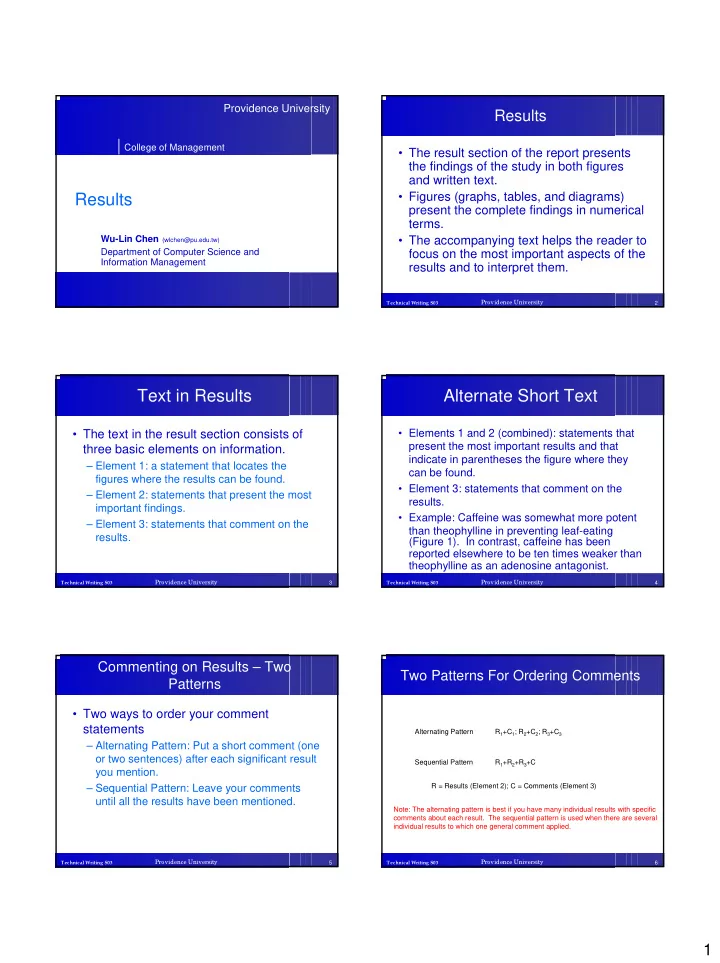
Providence University Results College of Management The result section of the report presents the findings of the study in both figures and written text. Figures (graphs, tables, and diagrams) Results present the complete findings in


slide-1
SLIDE 1

1

Providence University

College of Management

Results

Wu-Lin Chen (wlchen@pu.edu.tw) Department of Computer Science and Information Management

Technical Writing S03

Providence University 2

Results

  • The result section of the report presents

the findings of the study in both figures and written text.

  • Figures (graphs, tables, and diagrams)

present the complete findings in numerical terms.

  • The accompanying text helps the reader to

focus on the most important aspects of the results and to interpret them.

Technical Writing S03

Providence University 3

Text in Results

  • The text in the result section consists of

three basic elements on information.

– Element 1: a statement that locates the figures where the results can be found. – Element 2: statements that present the most important findings. – Element 3: statements that comment on the results.

Technical Writing S03

Providence University 4

Alternate Short Text

  • Elements 1 and 2 (combined): statements that

present the most important results and that indicate in parentheses the figure where they can be found.

  • Element 3: statements that comment on the

results.

  • Example: Caffeine was somewhat more potent

than theophylline in preventing leaf-eating (Figure 1). In contrast, caffeine has been reported elsewhere to be ten times weaker than theophylline as an adenosine antagonist.

Technical Writing S03

Providence University 5

Commenting on Results – Two Patterns

  • Two ways to order your comment

statements

– Alternating Pattern: Put a short comment (one

  • r two sentences) after each significant result

you mention. – Sequential Pattern: Leave your comments until all the results have been mentioned.

Technical Writing S03

Providence University 6

Two Patterns For Ordering Comments

Sequential Pattern R1+R2+R3+C Alternating Pattern R1+C1; R2+C2; R3+C3 R = Results (Element 2); C = Comments (Element 3) Note: The alternating pattern is best if you have many individual results with specific comments about each result. The sequential pattern is used when there are several individual results to which one general comment applied.

slide-2
SLIDE 2

2

Technical Writing S03

Providence University 7

Functions of Comments

  • The comments (Element 3) in results

sections may serve a variety of different

  • functions. Comments may:

–generalize from the results –explain possible reasons for the results –compare the results with results from

  • ther studies

Technical Writing S03

Providence University 8

Choose Verb Tense for Results

  • In Element 1, use the present tense to

locate your data in a figure.

– EX: Results of the t-tests are presented in Table 1. – EX: Table 4 summarizes the test results on precontaminated insulators.

  • Note: locational statements can be written

in either the active or passive voice.

Technical Writing S03

Providence University 9

Choose Verb Tense for Results

  • When you report your findings (Element 2),

use the past tense.

– EX: As a group, divorced mothers spent over twice as much time in employment as married mothers (Figure 2). – EX: The coefficient of correlation was found to be significant at .001 level.

  • Note: In some field such as engineering

and economics, authors may present their findings in the present tense.

Technical Writing S03

Providence University 10

Choose Verb Tense for Results

  • When commenting on the findings

(Element 3), it is conventional to use the present tense or modal auxiliaries.

Technical Writing S03

Providence University 11

Comments on The Results

  • When the comment compares your results

with the results of other studies, use the present tense.

– EX: This is consistent with earlier findings suggesting that personal characteristics are not related to attrition and teaching.

Technical Writing S03

Providence University 12

Comments on The Results

  • When the comment gives a possible

explanation for the results, use a modal auxiliary.

– EX: These results can (may) be explained by considering the voltage distribution on 230 kV insulators during freezing conditions.

slide-3
SLIDE 3

3

Technical Writing S03

Providence University 13

Comments on The Results

  • When the comment generalizes from the

results, use may.

– EX: Hyperactive children may be generally responsive to amphetamines.

Technical Writing S03

Providence University 14

Comments on The Results

  • You may also use tentative verbs in the

present tense instead of modal auxiliaries to generalize from results.

– EX: It appears (seems or is likely) that hyperactive children are generally responsive to amphetamines. – EX: These results suggest that children who display learning problems are depending on

  • nly one cerebral hemisphere.

Technical Writing S03

Providence University 15

Presenting Different Types of Findings: Comparisons Among Groups

  • If you studies involve a comparison among groups (often
  • ne or more experimental groups with a control group),

Element 2 statements are often written using comparative or superlative expressions.

Group 1 Comparison Group 2 The professional athletes had faster eye movements than our other subjects. The highest incidence of Otitis Media was found among Australian Indians. Quartz I reactors had a higher mass flow than Quartz II. Superlative Group 1

Technical Writing S03

Providence University 16

Presenting Different Types of Findings: Fluctuation of A Variable Over Time

  • To report the findings show the tendency of a variable to

fluctuate over time, use expressions of variation or special verbs of variation in your Element 2 statements.

Variable Phrase of variation Time period Prices a tendency to increase

  • ver three-year period.

The percentage of female students to decline in the second half of the decade. Verb showed tended

Technical Writing S03

Providence University 17

Presenting Different Types of Findings: Fluctuation of A Variable Over Time

Variable Verb of variation Time period The concentration of sulfur dioxide rose fell increased decreased dropped remained constant declined

  • ver the period studied.

Technical Writing S03

Providence University 18

Presenting Different Types of Findings: Relationship Between Two or More Variables

  • When you report the relationship of one variable with

another, or relationships among variables, it is common to use verbs of correlation or association in Element 2.

Variable X Verb of correlation / association Variable Y Choice of location was correlated with negatively corrected with associated with marital status. Dry weight of top growth was not highly significantly closely related to total nitrogen.