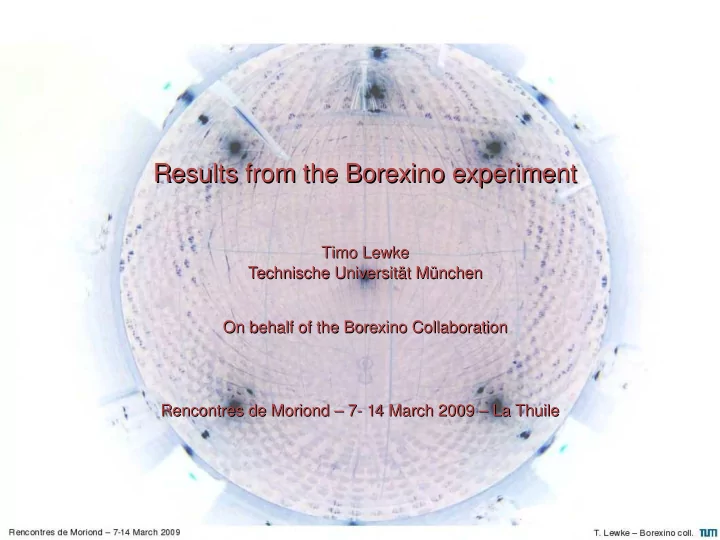
Results from the Borexino experiment Results from the Borexino - - PowerPoint PPT Presentation
Results from the Borexino experiment Results from the Borexino experiment Timo Lewke Timo Lewke Technische Universitt Mnchen Technische Universitt Mnchen On behalf of the Borexino Collaboration On behalf of the Borexino Collaboration
The Experimental Site The Experimental Site
Borexino is located in the LNGS Borexino is located in the LNGS Underground Laboratory in the Underground Laboratory in the mountains of Abruzzo, Italy. mountains of Abruzzo, Italy. Shielding provided by 1400 Shielding provided by 1400m m of rock:
- f rock:
~3800 m.w.e ~3800 m.w.e
The Borexino Detector The Borexino Detector
Scintillator: Scintillator: 270t PC+PPO 270t PC+PPO Nylon Vessel: Nylon Vessel: Inner : 4.25m Inner : 4.25m Outer: 5.50m Outer: 5.50m Carbon Steel Plates Carbon Steel Plates Water Tank: Water Tank: 208 PMTs 208 PMTs 2100m³ 2100m³ r=9m r=9m Stainless Steel Sphere: Stainless Steel Sphere: 2212 PMTs 2212 PMTs 1350m³ 1350m³ r=6.85m r=6.85m
Expected Spectrum in Borexino Expected Spectrum in Borexino
Borexino threshold Borexino threshold
Low threshold of 200keV because Low threshold of 200keV because
- f high radioactive purity:
²³ U ⁸ ²³ U ⁸ 1.6 1.6· ·10 10¯ ¯¹ g/g ⁷ ¹ g/g ⁷ ²³²Th ²³²Th 6.8 6.8· ·10 10¯¹ g/g ⁸ ¯¹ g/g ⁸
pp ⁷Be pep CNO ⁸B
Expected rates: Expected rates: ⁷ ⁷Be Be : : ~ 50 c/d/100t ~ 50 c/d/100t ⁸ ⁸B B : : ~0.3 c/d/100t ~0.3 c/d/100t First real-time measurement down to 200keV. First real-time measurement down to 200keV. First simultaneous measurement of solar First simultaneous measurement of solar neutrinos from vacuum dominated and neutrinos from vacuum dominated and matter-enhanced oscillation regions. matter-enhanced oscillation regions. Neutrino detection principle: Electron scattering Neutrino detection principle: Electron scattering +e- -> +e-
Neutrino spectrum Electron recoil spectrum
⁷ ⁷Be Solar Neutrino Flux Be Solar Neutrino Flux
Applied cuts: Applied cuts:
- Muons rejected
Muons rejected
- 2ms cut after each muon
2ms cut after each muon
- Rn daughters vetoed
Rn daughters vetoed
- FV cut
FV cut Spectrum of 192 live days Spectrum of 192 live days Measured rate: Measured rate: 49 49± ±3 3stat
stat±
±4 4sys
sysc/d/100t
c/d/100t Theoretical rate Theoretical rate
- MSW-LMA:
MSW-LMA: 48 48± ±4 c/d/100t 4 c/d/100t
- no oscillation:
no oscillation: 75 75± ±4 c/d/100t 4 c/d/100t Hypothesis of no oscillation for Be solar ⁷ Hypothesis of no oscillation for Be solar ⁷ neutrinos is rejected by the measurement neutrinos is rejected by the measurement at 4 at 4 . .
Electron recoil spectrum Electron recoil spectrum
Calculation of the pp & CNO Fluxes Calculation of the pp & CNO Fluxes
(Combining the Borexino results with other Experiments) (Combining the Borexino results with other Experiments)
Rk=∑
i
Ri , k f i Pee
i , k
f i= imeasured i predicted
Ri , k=expected rate of source i for experiment k at the nominal SSM flux Pee
i , k=survival probabilityfor source i abovethe threshold for experiment k
k=Homestake,Gallex i=pp,pep,CNO, 7Be, 8B
f f B
⁸B ⁸
= 0.83 = 0.83± ±0.07, measured by SNO and SuperK 0.07, measured by SNO and SuperK f f Be
⁷Be ⁷
= 1.02 = 1.02± ±0.10 given by the Borexino results 0.10 given by the Borexino results Performing a Performing a 2
2 based analysis of all neutrino experiments adding the luminosity constraint:
based analysis of all neutrino experiments adding the luminosity constraint: f fpp
pp = 1.005
= 1.005+0.008
+0.008
- 0.020
- 0.020 (1
(1 ) ) f fCNO
CNO < 3.80 (90% C.L.)
< 3.80 (90% C.L.) This represents the best determination of the pp solar neutrino flux. This represents the best determination of the pp solar neutrino flux.
⁸ ⁸B Solar Neutrino Flux B Solar Neutrino Flux
Cosmogenic background sources: Cosmogenic background sources:
- Muons
Muons
- Muon induced secondaries
Muon induced secondaries
- Muon induced radionuclides
Muon induced radionuclides Spectrum of 246 live days measurement. Spectrum of 246 live days measurement. Internal background: Internal background:
- Radon emanation from the nylon vessel
Radon emanation from the nylon vessel
- ²
Tl contamination of the scintillator ⁰⁸ ² Tl contamination of the scintillator ⁰⁸
raw spectrum after µ-cut after FV after 5s-µ-cut, neutron-cut,
10C-cut and 214Bi-cut
expected 208Tl spectrum, taking the light quenching into account
⁸ ⁸B Solar Neutrino Flux B Solar Neutrino Flux
Measured B neurino rate: ⁸ Measured B neurino rate: ⁸ 0.26 0.26± ±0.04 0.04stat
stat±
±0.02 0.02sys
sys
c/d/100t c/d/100t Expected rate (SSM and MSW-LMA): Expected rate (SSM and MSW-LMA): 0.27 0.27± ±0.03 0.03 c/d/100t c/d/100t MSW-LMA no oscillation Non-oscillation excluded at 4.2 Non-oscillation excluded at 4.2
Survival Probability Survival Probability
Assuming the SSM and MSW-LMA solution the measurement of Be and B neutrino rate ⁷ ⁸ Assuming the SSM and MSW-LMA solution the measurement of Be and B neutrino rate ⁷ ⁸ corresponds to: corresponds to: P Pee
ee( Be)
⁷ ( Be) ⁷ = 0.56 = 0.56± ±0.10 0.10 P Pee
ee( B)
⁸ ( B) ⁸ = = 0.35 0.35± ±0.10 at the effective energy of 8.6MeV 0.10 at the effective energy of 8.6MeV Measurement is in agreement with the prediction of the MSW-LMA solution for solar neutrinos. Measurement is in agreement with the prediction of the MSW-LMA solution for solar neutrinos.
⁷Be ⁸B MSW-LMA solution pep vacuum oscillation matter enhanced oscillation
Summary Summary
Achieved so far: Achieved so far:
- First real-time measurement of Be neutrinos
⁷ First real-time measurement of Be neutrinos ⁷
- First real-time measurement of B neutrinos down to an energy of 2.8MeV using
⁸ First real-time measurement of B neutrinos down to an energy of 2.8MeV using ⁸ a liquid scintillator a liquid scintillator
- First simultaneous measurement of solar neutrinos from vacuum dominated and
First simultaneous measurement of solar neutrinos from vacuum dominated and matter-enhanced oscillation regions matter-enhanced oscillation regions
- Current best limits for pp- and CNO-neutrinos
Current best limits for pp- and CNO-neutrinos In progress: In progress:
- Direct measurement of pep- and CNO-neutrinos
Direct measurement of pep- and CNO-neutrinos
- Source calibration to decrease systematic errors
Source calibration to decrease systematic errors In future: In future:
- Measurement of the solar pp-flux
Measurement of the solar pp-flux
- Antineutrino observations (geoneutrinos, reactor, from the sun)
Antineutrino observations (geoneutrinos, reactor, from the sun)
- Supernova neutrinos and antineutrinos (joining SNEWS during 2009)