
SLIDE 1
May 12th, 2013
Borexino: from solar to source νs
IPA 2013 (Madison, WI, USA) David Bravo Berguño (Virginia Tech)
- n behalf of the Borexino collaboration
(and geo!)
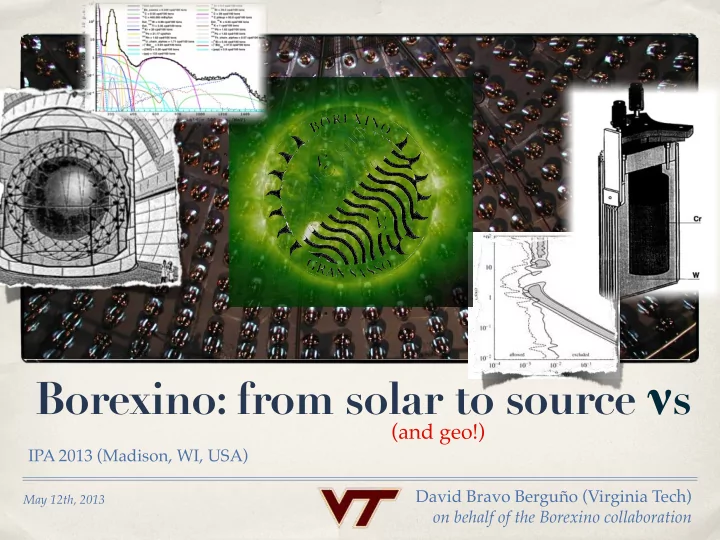
Borexino detector overview Graded shielding (onion structure) - - PowerPoint PPT Presentation
Borexino: from solar to source s (and geo!) IPA 2013 (Madison, WI, USA) David Bravo Berguo (Virginia Tech) May 12th, 2013 on behalf of the Borexino collaboration Borexino detector overview Graded shielding (onion structure)
May 12th, 2013
IPA 2013 (Madison, WI, USA) David Bravo Berguño (Virginia Tech)
(and geo!)
✤ Graded shielding (onion structure) ✤ Situated in LNGS, 3400 mwe ✤ Based on liquid scintillator
(PseudoCumene + PPO (1.5g/L) in IV, for more scintillation or DMP (5g/L lowered to 2g/L for buoyancy reasons) in OV for less)
neutrino scattering, Čerenkov light also produced to a lesser extent
✤ Ultrapure nylon vessels for
OuterVessel/InnerVessel and OV/buffer separation, “virtual” fiducial volume
2
3
300 tons of PC (+PPO in IV & DMP in OV) 100 tons FV (spherical) ~488 pe/MeV
99.33% eff. ~19% eff. PC PPO DMP
✤ Main chains fueling the Sun:
✤
pp chain
4
4 p+ → 4He + 2e+ + 2νe(26.7MeV)
✤
CNO chain
14C + 4 p+ → 12C + 4He + 2e+ + 2νe(26.7MeV)
✤ Main chains fueling the Sun:
✤
pp chain
4
4 p+ → 4He + 2e+ + 2νe(26.7MeV)
✤
pp and pep reactions (WEAK interaction - determines rate): 0.42 MeV (max), monoenergetic 1.44 MeV
✤
CNO chain
14C + 4 p+ → 12C + 4He + 2e+ + 2νe(26.7MeV)
✤ Main chains fueling the Sun:
✤
pp chain
4
4 p+ → 4He + 2e+ + 2νe(26.7MeV)
✤
pp and pep reactions (WEAK interaction - determines rate): 0.42 MeV (max), monoenergetic 1.44 MeV
✤
CNO chain
✤
ppI branch - main termination (4He+2p+); hep reaction; 7Be-producing reactions
14C + 4 p+ → 12C + 4He + 2e+ + 2νe(26.7MeV)
✤ Main chains fueling the Sun:
✤
pp chain
4
4 p+ → 4He + 2e+ + 2νe(26.7MeV)
✤
pp and pep reactions (WEAK interaction - determines rate): 0.42 MeV (max), monoenergetic 1.44 MeV
✤
CNO chain
✤
ppI branch - main termination (4He+2p+); hep reaction; 7Be-producing reactions
✤
ppII branch - 7Be destruction (into 7Li) - production of 7Be MONOENERGETIC NEUTRINOS (0.862 MeV or 0.384 MeV if Li is excited (10%))
14C + 4 p+ → 12C + 4He + 2e+ + 2νe(26.7MeV)
✤ Main chains fueling the Sun:
✤
pp chain
4
4 p+ → 4He + 2e+ + 2νe(26.7MeV)
✤
pp and pep reactions (WEAK interaction - determines rate): 0.42 MeV (max), monoenergetic 1.44 MeV
✤
CNO chain
✤
ppI branch - main termination (4He+2p+); hep reaction; 7Be-producing reactions
✤
ppII branch - 7Be destruction (into 7Li) - production of 7Be MONOENERGETIC NEUTRINOS (0.862 MeV or 0.384 MeV if Li is excited (10%))
✤
ppIII branch - rare (1/5000) but leads to 8B neutrinos
14C + 4 p+ → 12C + 4He + 2e+ + 2νe(26.7MeV)
✤ Main chains fueling the Sun:
✤
pp chain
4
4 p+ → 4He + 2e+ + 2νe(26.7MeV)
✤
pp and pep reactions (WEAK interaction - determines rate): 0.42 MeV (max), monoenergetic 1.44 MeV
✤
CNO chain
✤
ppI branch - main termination (4He+2p+); hep reaction; 7Be-producing reactions
✤
ppII branch - 7Be destruction (into 7Li) - production of 7Be MONOENERGETIC NEUTRINOS (0.862 MeV or 0.384 MeV if Li is excited (10%))
✤
ppIII branch - rare (1/5000) but leads to 8B neutrinos
14C + 4 p+ → 12C + 4He + 2e+ + 2νe(26.7MeV)
✤
CN chain 1.19 MeV endpoint; 1.73 MeV endpoint
✤ Main chains fueling the Sun:
✤
pp chain
4
4 p+ → 4He + 2e+ + 2νe(26.7MeV)
✤
pp and pep reactions (WEAK interaction - determines rate): 0.42 MeV (max), monoenergetic 1.44 MeV
✤
CNO chain
✤
ppI branch - main termination (4He+2p+); hep reaction; 7Be-producing reactions
✤
ppII branch - 7Be destruction (into 7Li) - production of 7Be MONOENERGETIC NEUTRINOS (0.862 MeV or 0.384 MeV if Li is excited (10%))
✤
ppIII branch - rare (1/5000) but leads to 8B neutrinos
14C + 4 p+ → 12C + 4He + 2e+ + 2νe(26.7MeV)
✤
CN chain 1.19 MeV endpoint; 1.73 MeV endpoint
✤
NO chain - decay of 16O* starts it, one neutrino (1.74 MeV endpoint)
✤ Main chains fueling the Sun:
✤
pp chain
4
4 p+ → 4He + 2e+ + 2νe(26.7MeV)
✤
pp and pep reactions (WEAK interaction - determines rate): 0.42 MeV (max), monoenergetic 1.44 MeV
✤
CNO chain
✤
ppI branch - main termination (4He+2p+); hep reaction; 7Be-producing reactions
✤
ppII branch - 7Be destruction (into 7Li) - production of 7Be MONOENERGETIC NEUTRINOS (0.862 MeV or 0.384 MeV if Li is excited (10%))
✤
ppIII branch - rare (1/5000) but leads to 8B neutrinos
14C + 4 p+ → 12C + 4He + 2e+ + 2νe(26.7MeV)
✤
CN chain 1.19 MeV endpoint; 1.73 MeV endpoint
✤
NO chain - decay of 16O* starts it, one neutrino (1.74 MeV endpoint) <5%
18%
✤ Main chains fueling the Sun:
✤
pp chain
4
4 p+ → 4He + 2e+ + 2νe(26.7MeV)
✤
pp and pep reactions (WEAK interaction - determines rate): 0.42 MeV (max), monoenergetic 1.44 MeV
✤
CNO chain
✤
ppI branch - main termination (4He+2p+); hep reaction; 7Be-producing reactions
✤
ppII branch - 7Be destruction (into 7Li) - production of 7Be MONOENERGETIC NEUTRINOS (0.862 MeV or 0.384 MeV if Li is excited (10%))
✤
ppIII branch - rare (1/5000) but leads to 8B neutrinos
14C + 4 p+ → 12C + 4He + 2e+ + 2νe(26.7MeV)
✤
CN chain 1.19 MeV endpoint; 1.73 MeV endpoint
✤
NO chain - decay of 16O* starts it, one neutrino (1.74 MeV endpoint) <5%
18%
(limit)
✤ Main chains fueling the Sun:
✤
pp chain
4
4 p+ → 4He + 2e+ + 2νe(26.7MeV)
✤
pp and pep reactions (WEAK interaction - determines rate): 0.42 MeV (max), monoenergetic 1.44 MeV
✤
CNO chain
✤
ppI branch - main termination (4He+2p+); hep reaction; 7Be-producing reactions
✤
ppII branch - 7Be destruction (into 7Li) - production of 7Be MONOENERGETIC NEUTRINOS (0.862 MeV or 0.384 MeV if Li is excited (10%))
✤
ppIII branch - rare (1/5000) but leads to 8B neutrinos
14C + 4 p+ → 12C + 4He + 2e+ + 2νe(26.7MeV)
✤
CN chain 1.19 MeV endpoint; 1.73 MeV endpoint
✤
NO chain - decay of 16O* starts it, one neutrino (1.74 MeV endpoint) <5%
18%
(limit)
5
Compton-scattered synthetic sample spectrum
6
Radio Radioisotope Concentrat ncentration/flux
Name Source Typical Required Achieved
muon Cosmic 200 Hz/m2 ~10-10 <10-10
Rock negligible
PMTs, SSS, Water, Vessels negligible
14C
Intrinsic ~10-12 ~10-18 ~10-18
238U/232Th
Dust ~10-5 - 10-6g/g <10-16 g/g
~<10-18g/g
40K
Dust, PPO ~2·10-6 Bq/ton <10-14 scint <10-11 PPO ~5cpd/100t (estimate)
210Bi
Surface contamination Initial stable: ~40 cpd/100t
18 cpd/100tons
210Po
Surface contamination Initial stable: ~103 cpd/100t
~300 counts/ day·100tons
222Rn
Air, emanation ~10-100 Bq/L (air-water) <1count/day·100tons
<10-19 g/g
39Ar
Air (nitrogen) ~17 mBq/m3 <1count/day·100tons ?
85Kr
Air (nitrogen) ~1 Bq/m3 <1count/day·100tons ~8 cpd/100tons
✤
Purifications in 2010/2011.
✤
Very effective on 85Kr, good on
210Bi and excellent for 238U and 232Th
✤
NO 222Rn events since June
events since October 2011.
✤
Five 85Kr candidates since 2010 210Po rate decay
✤ <5% measurement (2011) ✤ Day-night assymetry null result
in 7Be window (2012) : LargeMixingAngle solution confirmed
(90%c.l. with Borexino data alone)
✤ Annual flux modulation (2013) -
Fiducial volume control, verified no anomalous oscillations
7
Adn=0.001 ± 0.012stat ± 0.007syst cpd/100t
7Be=46.0 ± 1.5stat
± 1.61.5 syst cpd/100t
Different fiducial volumes used for different datasets
✤ pep neutrinos detected thanks
to extreme radiopurity
✤
8B result in MSW-dominated
energy range
✤ CNO limit, pushing for more
stringent measurement (210Bi
background fluctuations have hindered efforts so far)
8 8B=0.217 ± 0.038stat
± 0.008 syst cpd/100t pep=3.1 ± 0.6stat ± 0.3 syst cpd/100t CNO<7.9 cpd/100t
✤
Prompt-delayed signal from positron annihilation and neutron capture γs (2x0.511MeV + 2.22MeV): coincidence tagging - allows for full detector FV
✤
Backgrounds √ Nuclear reactor contribution from Europe (97.5%) and the world (2.5%) √ Cosmogenics (mainly 9Li-8He) √ Fast neutrons...
✤
Rate of 3.9+1.6/-1.3(stat)+5.8/-3.2(sys)
counts per year/100tons - 50:1 signal-to-noise
for reactor+geoneutrinos
9
νe + p+ → e+ + n0
✤
Prompt-delayed signal from positron annihilation and neutron capture γs (2x0.511MeV + 2.22MeV): coincidence tagging - allows for full detector FV
✤
Backgrounds √ Nuclear reactor contribution from Europe (97.5%) and the world (2.5%) √ Cosmogenics (mainly 9Li-8He) √ Fast neutrons...
✤
Rate of 3.9+1.6/-1.3(stat)+5.8/-3.2(sys)
counts per year/100tons - 50:1 signal-to-noise
for reactor+geoneutrinos
9
νe + p+ → e+ + n0
Inverse beta decay
✤
Prompt-delayed signal from positron annihilation and neutron capture γs (2x0.511MeV + 2.22MeV): coincidence tagging - allows for full detector FV
✤
Backgrounds √ Nuclear reactor contribution from Europe (97.5%) and the world (2.5%) √ Cosmogenics (mainly 9Li-8He) √ Fast neutrons...
✤
Rate of 3.9+1.6/-1.3(stat)+5.8/-3.2(sys)
counts per year/100tons - 50:1 signal-to-noise
for reactor+geoneutrinos
9
νe + p+ → e+ + n0
Inverse beta decay
✤
Prompt-delayed signal from positron annihilation and neutron capture γs (2x0.511MeV + 2.22MeV): coincidence tagging - allows for full detector FV
✤
Backgrounds √ Nuclear reactor contribution from Europe (97.5%) and the world (2.5%) √ Cosmogenics (mainly 9Li-8He) √ Fast neutrons...
✤
Rate of 3.9+1.6/-1.3(stat)+5.8/-3.2(sys)
counts per year/100tons - 50:1 signal-to-noise
for reactor+geoneutrinos
9
νe + p+ → e+ + n0
γ
(0.511MeV )
γ (0.511MeV )
Positron annihilation
✤
Prompt-delayed signal from positron annihilation and neutron capture γs (2x0.511MeV + 2.22MeV): coincidence tagging - allows for full detector FV
✤
Backgrounds √ Nuclear reactor contribution from Europe (97.5%) and the world (2.5%) √ Cosmogenics (mainly 9Li-8He) √ Fast neutrons...
✤
Rate of 3.9+1.6/-1.3(stat)+5.8/-3.2(sys)
counts per year/100tons - 50:1 signal-to-noise
for reactor+geoneutrinos
9
νe + p+ → e+ + n0
γ
(0.511MeV )
γ (0.511MeV )
γ (2.2MeV )
Neutron capture (~1m, τ~250μs)
10
Can there be a fourth (or fifth...) neutrino that doesn’t couple with the Z0 boson - STERILE?
✤
Existing (ambiguous) hints from experiments supported by theoretical framework
✤
Most promising mass scale ~<1eV2, (see-saw
type I with light sterile neutrinos, 3+1 or 3+2
models); many other models proposed
✤
Visible oscillation in short-baseline experiments (other short-distance oscillation effects on Pee?)
✤
Sterile neutrino as a dark matter candidate
✤ Borexino aims to test low L/E (anti)
neutrino anomalies using well- known external or internal sources in a well-understood detector
✤ Concept successfully implemented
(in a smaller scale) in GALLEX and SAGE
✤
Also:
low energy (~1MeV)
11 144Ce
SOX-C
144Ce
SOX-B
51Cr
SOX-A
8.25m 7.15m
Sorry for the scale!
12
✤
51Cr - neutrino source
√ Placed in Icarus Pit under the detector Four monochromatic lines √ 10MCi, 10-11 kg (36 available), 200 days √ Needs quick transportation
✤
144Ce/144Pr - antineutrino source
√ 75-50 kCi (296 days halflife) - 14 g and 1 year for statistics √ Needed refrigeration with scintillator, copper coldfinger... need to avoid convection √ More shielding requirements, better exclusion
51Cr + e− → 51V + νe(τ = 27.706days)
✤
Both sources need 1% error in FV and 1% source activity measurement
Detection threshold
12
✤
51Cr - neutrino source
√ Placed in Icarus Pit under the detector Four monochromatic lines √ 10MCi, 10-11 kg (36 available), 200 days √ Needs quick transportation
✤
144Ce/144Pr - antineutrino source
√ 75-50 kCi (296 days halflife) - 14 g and 1 year for statistics √ Needed refrigeration with scintillator, copper coldfinger... need to avoid convection √ More shielding requirements, better exclusion
51Cr + e− → 51V + νe(τ = 27.706days)
✤
Both sources need 1% error in FV and 1% source activity measurement
FUNDED
Detection threshold
✤
Timeframe: 2015-16 - official kickoff: May 3rd during Borexino’s General Meeting in Virginia Tech
✤
Uninvasive to detector, can be done as a campaign during solar neutrino data-taking
✤
Irradiation and source construction plans being finalized
✤
Enrichment of 38%
51Cr possible up to
~99%(9kg)
✤
~2 month datataking
13
✤ SOX-B: 144Ce-Pr source inside the
water tank (2015-16 timeframe)
✤ PPO in OV for enhanced
sensitivity
✤ SOX-C: 144Ce-Pr source in the
center of the detector
✤ Major refurbishment,
modifications - after solar program (>2016-17)
14
✤ Rate+shape strategy (count rate
combined with powerful direct spatial oscillation detection)
✤ Rate analysis (disappearance):
√ Counting strategy, more sensitive to
mixing angle than Δm2 (no spatial information)
✤ Rate+shape analysis
√ Observes spatial oscillations - expected
wavelength range shorter than detector size, but bigger than resolution. Direct measurement of Δm142 and θ14. √ Doesn’t need such precision on activity determination
15
Geant4 simulation (M. Pallavicini, NuTel13)
positron energy
positron energy (MeV)
16
SOX-B SOX-C 1% FV determination 1% source activity uncertainty
2% bin-to-bin to include systematics 1.5% source activity uncertainty
17
✤ Sampling
√ Samples extracted from several
positions in mixed material, at reactor √ Ionization chamber measurements √ Gamma-ray spectroscopy (HPGe) of dissolved samples
✤ Calorimetry
√ Emmited radiations will heat up source and shield √ ~216W/PBq with thermocouples √ Less precision but doesn’t depend on representative samples √ Suspended and isolated container: designed as vacuum chamber, water flow measurement
✤ Neutronics/gamma-scanning
√ Neutron flux in reactor + relevant capture cross-section √ Gamma-ray measurement from the 320keV line from irradiation to hot-cell
✤ Measurement of vanadium
√ Only daughter of 51Cr √ Also produced during irradiation, complicating analysis √ Ratio Cr/V constant
✤
Shielding for biological (<200μSv/h in contact with
shield) and background gammas (mainly
activated contaminants dangerous for signal)
✤
Transportation issues (up to 5 days - 88% of initial
activity), transport container apart from W shield
✤
Thermal: not severe problem (0.19kW/MCi) for external source. Current design: 90ºC
considering chipped chromium and no active cooling (well below sinterization at 750ºC)
✤
Irradiation possible in HFIR (ORNL, Tennessee, USA), Mayak (Russia), or Petten (Netherlands). Tests with 33mg of 97% enriched 51Cr starting now in ORNL - soon to be followed by existing GALLEX 38% 51Cr.
18
Oak Ridge National Laboratory’s (ORNL) HFIR reactor (Tennessee, USA)
PRELIMINARY DESIGN
✤ Results over a broad range of
energies already achieved
✤
7Be (<5%), 8B, geo, pep, CNO limit...
✤
Excellent (and improving) backgrounds
✤ Promising future: sterile neutrino
searches (SOX-A,B&C)
✤ Meanwhile: pp measurement,
improvement of CNO limit
19
210Bi variation - stability needed for
improvement of CNO
14C and pileup - precise fit modelling
to disentangle from pp signal - analysis ONGOING
20
Astroparticle and Cosmology Laboratory - Paris, France INFN Laboratori Nazionali del Gran Sasso - Assergi, Italy INFN e Dipartimento di Fisica dell’Università degli Studi - Genova, Italy INFN e Dipartimento di Fisica dell’Università degli Studi - Milano, Italy INFN e Dipartimento di Chimica dell’Università degli Studi - Perugia, Italy Institute for Nuclear Research - Gatchina, Russia Institute of Physics, Jagellonian University - Cracow, Poland Joint Institute for Nuclear Research - Dubna, Russia Kurchatov Institute - Moscow, Russia Max Planck Istitute fuer Kernphysik - Heidelberg, Germany Princeton University - Princeton, NJ, USA Technische Universität - Muenchen, Germany University of Massachusetts - Amherst, MA, USA University of Moscow - Moscow, Russia Virginia Tech - Blacksburg, VA, USA