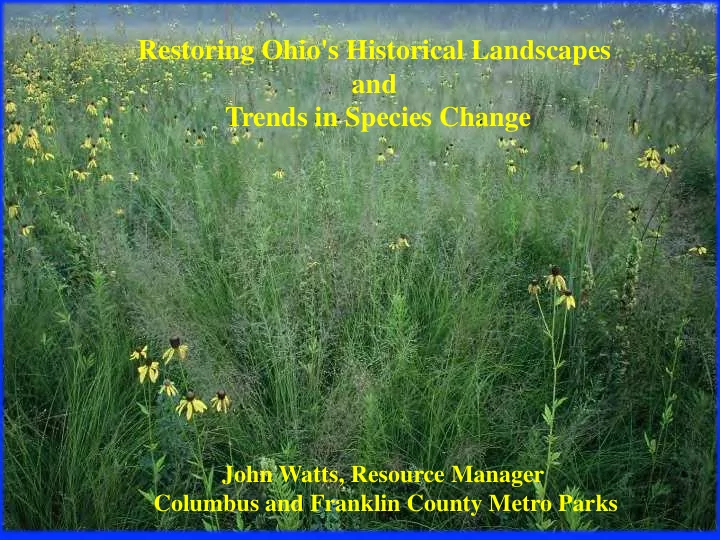
SLIDE 1
Restoring Ohio's Historical Landscapes and Trends in Species Change
John Watts, Resource Manager Columbus and Franklin County Metro Parks
SLIDE 2
SLIDE 3 “National and United States Road” through Licking County, Morris Schaff recalls that during his boyhood between 1840 and 1858 “…three fouths of Etna Township was covered by a noble primeval
- forest. And now, as I recall the stately grandeur of
the red and white oaks, many of them six feet and more in diameter, towering up royally fifty and sixty feet without a limb; the shellbark hickories and the glowing maples, both with tops far aloft; the mild and moss-covered ash trees some of them over four feet through….. I considered if fortunate that I was reared among them and walked beneath them.”
Trautman 1977
SLIDE 4
“The sedge-grass grew to an enormous height, sometimes sufficient to hide a man and horse when traveling through it…..” (History of Madison County 1883)
SLIDE 5
What did the original prairies of the Darby Plains look like?
“It is a well authenticated fact that a great portion of Madison County was, originally covered with water most of the year. The first settlers called these lands “barrens” and looked upon them as utterly unfit for farming purposes.” (History of Madison County 1883.)
SLIDE 6 Nearly every autumn prairie fires swept over the country, destroying everything in their path, endangering the lives and property of the pioneers, as well as the existence of the denizens
- f the forest that fled before the devouring elements to places of
safety; but with the gradual settlement of the country these fires grew‘less frequent, until at last they became a thing of the past.
(History of Madison County, Brown, 1883)
SLIDE 7
It was a grand sight to see those prairies on fire, especially at night, when hundreds of acres were surrounded by the destroying element, whose forked tongs shot upward above the interspersed oak openings, and its light almost equal to that of a mid-day sun, revealing the rapid retreat of the deer and other wild animals to some secluded place of safety. The very nature of the vegetation that grew upon these prairies made the fires formidable and to be dreaded by the first settlers…. (History of Madison County, Brown, 1883)
SLIDE 8
1785 Jonathan Alder then living In the Sandusky Plains recounts carrying the largest bull buffalo head he had ever seen as he was the focus of a practical joke played on him by the young braves (Davis, The Journal of Jonathon
Alder, 1988).
SLIDE 9
Native Remnant Prairies Of the Darby Plains
Smith Cemetery State Nature Preserve Bigelow Cemetery State Nature Preserve
SLIDE 10
- W. Pearl King Prairie Savanna
- 350 year old Burr Oaks
- 7 species of prairie grasses
- Rare Native Prairie Plants
Carex conoidea – T Eleocharis compressa – P Carex retroflexa – P Helianthemum bicknelli – P Carex bicknelli – T Viola pedatifida – E Viola nephrophylla - T Sporobolis heterolepis - T
SLIDE 11
SLIDE 12
Royal Catchfly -T Queen-of-the-Prairie
SLIDE 13
Bunchflower - T Prairie False Indigo - P
SLIDE 14
Sullivant’s Milkweed
SLIDE 15
Purple Coneflower
SLIDE 16
Project Area 2007
SLIDE 17
Project Area 2013
Franklin County and Columbus 1872
SLIDE 18
2018 Bull Frog
SLIDE 19
July 2011 August 2010 August 2010 June 2012
SLIDE 20
Virginia Rail - SC Swamp Sparrow American Bittern - E Sora - SC
SLIDE 21 Fall 2013-Tiger Salamander
Alvin Staffan
Summer 2014-Marsh Wren -SC Carolina Saddlebags Summer 2012 Bronze Copper
SLIDE 22
Red Admiral Common Wood Nymph Tiger Swallowtail
SLIDE 23 Report on the Birds of Ohio 1879, Dr. J.M. Wheaton of Columbus writes of the northern harrier, “In the vicinity of Columbus it was once rather common, and bred in the swamp prairies south
Northern Harrier
SLIDE 24
SLIDE 25
The Original Forests of Southeastern Ohio
SLIDE 26
SLIDE 27 ê ê
Ma March 2015
SLIDE 28 Ma March 2015 No Novem ember er 1 1924 24 Co Courtesy Co Columbus and Franklin Co County Metro Parks
SLIDE 29
Edward S. Thomas, 1923-1940: Breeding Bird Surveys in Neotoma Valley, Clear Creek Metro Park. Lawrence Hicks, 1935: Distribution of Breeding Birds of Ohio; 1937 Breeding Birds of Unglaciated Ohio. Worth Randle, 1960-1977 (1980): A Guide to Summer Birding in Hocking Hills State Parks. Tom Thomson, 1972-1997: Breeding Birds of the Clear Creek Valley in Hocking and Fairfield Counties, Ohio. Jerry Cairo, 1978-1982: Bird Surveys within the Clear Creek Valley. Bruce Peterjohn, 1982: Breeding Avifauna of the South Bloomville Quadrangle. Dave Minney, 1988: The Breeding Bird Survey of the Crane Hollow Watershed. Daniel Rice, 1998: The Breeding Birds of the South Rim of Queer Creek Gorge, Hocking State Forest. Columbus Metro Parks Staff: Breeding Bird Surveys 1994-present. John Watts 2013-present: Bird Survey of the Crane Hollow Preserve, Hocking County, Ohio.
SLIDE 30
Sugar Grove CBC: 1944-1954
Christmas Birds Counts
SLIDE 31 "As I passed a certain place called Great Lick, I saw the last flock of parrots." [He had been on the lower Scioto and the Ohio since late December and was then on his way to Tuscarawas County.] "These birds were in great abundance about Siota in winter, and in summer 'tis probable they may be seen much further towards the north." [I am fairly confident his reference is to the vicinity of Salt Creek in southwestern Hocking County (and a branch of the Scioto River)] (McKinley, 1977, p. 5). February 9, 1773 Reverend David Jones:
First Bird Record for Hocking County Carolina Parakeet
Courtesy The Museum of Biological Diversity
SLIDE 32 Golden Eagle by Dr. J. M. Wheaton appeared in his Report
- n the Birds of Ohio (1882, page 433). He notes:
“A specimen in my collection, for which I am indebted to Mr.
- J. L. Stelzig, was wounded in Hocking County in the fall of
1877, and presented to the City Park of this city [referencing Columbus, Ohio]. It died in February, 1878.”
The county’s first Bald Eagle record comes from the late 1800s. In 1882, Oliver Davie, a noted ornithologist and taxidermist, wrote of a dead Bald Eagle from Hocking County presented to him on October 4, 1880, one among a number of Bald and Golden eagles he received between 1878 and 1881.
SLIDE 33 Bewick’s Wren; April 26, 1936
Courtesy The Museum of Biological Diversity
Bachman’s Sparrows; 1929-1936
Courtesy The Museum of Biological Diversity
Last Report June 1966 Last Report June 1976
SLIDE 34
Species That Have Disappeared or Declined Since Hicks 1937
Disappeared: Bachman’s Sparrow Bewick’s Wren Loggerhead Shrike Barn Owl Upland Sandpiper Lark Sparrow Declined: Northern Bobwhite Ruffed Grouse Eastern Whip-poor-will Black-billed Cuckoo Cerulean Warbler Vesper Sparrow
12 Species Total
SLIDE 35
Species That Have Increased Since Hicks 1937
Great Blue Heron Canada Goose Mute Swan Hooded Merganser Mississippi Kite Bald Eagle Rock Pigeon Winter Wren Veery Hermit Thrush Blue-headed Vireo Canada Warbler Blue Grosbeak Purple Finch House Finch Pine Siskin Savannah Sparrow Tree Swallow Pine Warbler Prothonotary Warbler Magnolia Warbler Blackburnian Warbler Chestnut-sided Warbler 23 Species Total
SLIDE 36
Bewick’s Wren; Neotoma Valley Clear Creek Metro Park Breeding Commonly in 1920-1940 Now Gone
SLIDE 37 Photos by Nina Harfmann
Cerulean Warbler Nest
May 8 - June 9, 2016 Clear Creek Metro Park
- Hicks 1937 noted at 7 on scale of 1-10.
- 75% Decline since the mid-1960’s.
- Estimated 69,000 during the 1980’s.
- Current estimated population 28,000
Rodewald et al 2016; Second Atlas of Breeding Birds in Ohio
SLIDE 38 “To the dwellers of the plains there is an appeal to the hills which is irresistible. One never tires of feasting his eyes on the majestic cliffs and the graceful, rolling summits of the ranges.” (Sandstone Cliffs, February 4, 1923, Edward S. Thomas).
As published in Hicks, 1937. Courtesy Sewickley Valley Historical Society
Thank You