Response Prompting See school door. Open door and walk through. - - PowerPoint PPT Presentation

response prompting
SMART_READER_LITE
LIVE PREVIEW

Response Prompting See school door. Open door and walk through. - - PowerPoint PPT Presentation

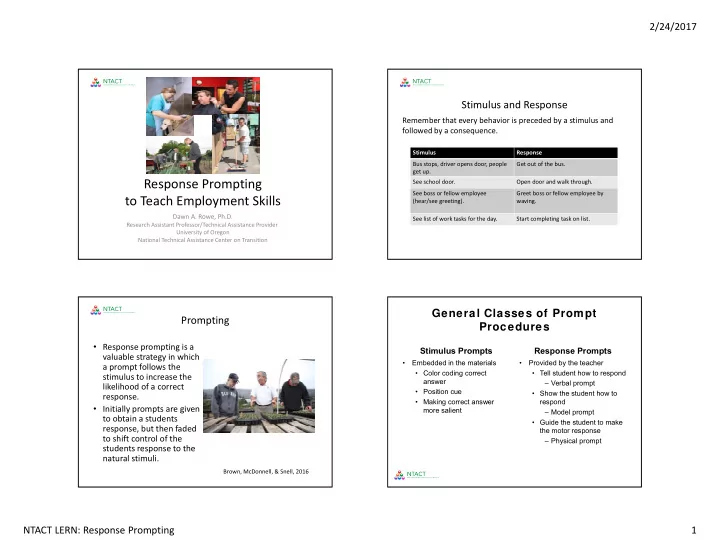
2/24/2017 Stimulus and Response Remember that every behavior is preceded by a stimulus and followed by a consequence. Stimulus Response Bus stops, driver opens door, people Get out of the bus. get up. Response Prompting See school door.


slide-1
SLIDE 1

2/24/2017 NTACT LERN: Response Prompting 1

Response Prompting to Teach Employment Skills

Dawn A. Rowe, Ph.D.

Research Assistant Professor/Technical Assistance Provider University of Oregon National Technical Assistance Center on Transition

Stimulus and Response

Remember that every behavior is preceded by a stimulus and followed by a consequence.

Stimulus Response Bus stops, driver opens door, people get up. Get out of the bus. See school door. Open door and walk through. See boss or fellow employee (hear/see greeting). Greet boss or fellow employee by waving. See list of work tasks for the day. Start completing task on list.

Prompting

  • Response prompting is a

valuable strategy in which a prompt follows the stimulus to increase the likelihood of a correct response.

  • Initially prompts are given

to obtain a students response, but then faded to shift control of the students response to the natural stimuli.

Brown, McDonnell, & Snell, 2016

General Classes of Prompt Procedures

Stimulus Prompts

  • Embedded in the materials
  • Color coding correct

answer

  • Position cue
  • Making correct answer

more salient

Response Prompts

  • Provided by the teacher
  • Tell student how to respond

– Verbal prompt

  • Show the student how to

respond – Model prompt

  • Guide the student to make

the motor response – Physical prompt

slide-2
SLIDE 2

2/24/2017 NTACT LERN: Response Prompting 2 Overview of Prompting Continued

There are all different types of prompts.

Sample Instructional prompts Example Gesture prompts

  • Nonverbal prompts
  • Pointing
  • head nods
  • hand motions

Verbal prompts

  • Specific verbal prompts
  • Nonspecific verbal prompts
  • Read the word restroom.
  • Pick up the spoon.
  • Turn the page.
  • How do we keep the story going?

Pictorial prompts

  • Words, symbols, signs
  • Match to sample
  • Picture schedule of the events of the day
  • Picture and word instructions for a task (e.g.,

picture of student at community-based employment training site) Model prompts

  • Peer demonstrates turning a page.
  • Teacher demonstrates using a paper towel to dry

hands. Physical prompts

  • Partial
  • Full
  • A tap to the elbow to encourage a choice for lunch
  • Hand over hand assistance for writing the first letter
  • f name

Prompting Hierarchy

Natural Cue Natural Cue Gesture Gesture Verbal Verbal Visual/Picture Visual/Picture Model Model Physical (Partial) Physical (Partial) Full Physical Full Physical

Brown, McDonnell, & Snell, 2016; Wolery et al., 1992

Video Examples

Commonly Used Response Prompts Systems

Simultaneous Prompts System of Least Prompts Most to Least Prompts Graduated Guidance Constant Time Delay Progressive Time Delay

Brown, McDonnell, & Snell, 2016

slide-3
SLIDE 3

2/24/2017 NTACT LERN: Response Prompting 3

General Guidelines for Using Prompts

1. Select the least intrusive prompt(s) that is effective for the student and the task (combine prompts if necessary). 2. Highlight the natural stimuli. 3. Generally wait a brief period of time before and after the prompt so that learners have a chance to respond without assistance. 4. Avoid repeating a prompt for the same response. 5. Prompt only when the student is attending. 6. Develop a plan to fade prompts as soon as possible. 7. Do not introduce prompts unnecessarily. 8. Reinforce a student for responding correctly to a prompt during early acquisition.

System of Least Prompts

Natural Cue Natural Cue Gesture Gesture Verbal Verbal Visual/Picture Visual/Picture Model Model Physical (Partial) Physical (Partial) Full Physical Full Physical

Brown, McDonnell, & Snell, 2016; Wolery et al., 1992

Response Latency (3s, 5s)

System of Least Prompts

END

Record “P”

Begin

Is Student Attending? Get Students Attention. Give instructional Cue. Wait 3-5 seconds Correct Response? Correct Response? Is Student Attending? Physically guide student through correct response while providing verbal instructions. Give Verbal Instruction. Wait 3-5 seconds. Model correct response while providing verbal instructions. Wait 3-5 seconds

YES NO NO NO NO NO

Reinforce Reinforce Reinforce Reinforce Record “M” Record “V” Record “+” Another Trial? Last step of task analysis?

YES YES YES YES N ext S tep in T ask A nalysis YES NO NO

Collins, 2012; Snell & Brown, 2010

See Additional Handouts

System of Least Response Examples

slide-4
SLIDE 4

2/24/2017 NTACT LERN: Response Prompting 4 Most-to-Least Prompts

Natural Cue Natural Cue Gesture Gesture Verbal Verbal Visual/Picture Visual/Picture Model Model Physical (Partial) Physical (Partial) Full Physical Full Physical

Brown, McDonnell, & Snell, 2016; Wolery et al., 1992

Most to Least Prompting Continued

Collins, 2012; Snell & Brown, 2010

This pattern continues for several sessions before switching to a less intrusive response

Reinforce Record “P”

YES

Most-to-Least Response Examples

If you need more information about Response Prompting…

  • ADEPT Module, Lesson 7, 8:

http://media.mindinstitute.org/education/ADEPT/Module1 Menu.html

  • Autism Internet Modules:

http://www.autisminternetmodules.org/mod_intro.php?m

  • d_id=43
  • NTACT : http://transitionta.org/effectivepractices