Basic Survey Basic Survey: Purpose A survey to obtain data that is - - PowerPoint PPT Presentation

basic survey basic survey purpose
SMART_READER_LITE
LIVE PREVIEW

Basic Survey Basic Survey: Purpose A survey to obtain data that is - - PowerPoint PPT Presentation

Basic Survey Basic Survey: Purpose A survey to obtain data that is to serve as the basis for monitoring and protecting residents' health In order to estimate external doses, individuals were asked to keep and submit a record of their behavior.


slide-1
SLIDE 1

The 4th Expert Meeting on Communications with Nuclear Disaster Victims Regarding Their Health, Ministry of the Environment

A survey to obtain data that is to serve as the basis for monitoring and protecting residents' health

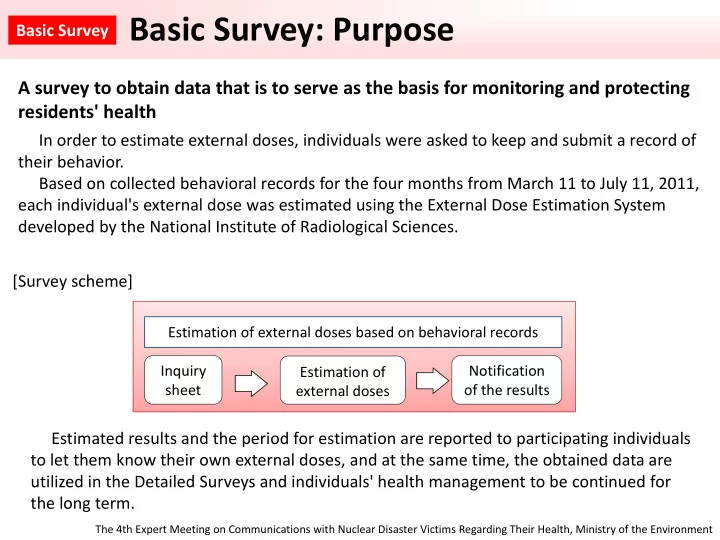
[Survey scheme] Estimated results and the period for estimation are reported to participating individuals to let them know their own external doses, and at the same time, the obtained data are utilized in the Detailed Surveys and individuals' health management to be continued for the long term.

Estimation of external doses based on behavioral records Inquiry sheet Notification

  • f the results

Estimation of external doses

Basic Survey Basic Survey: Purpose In order to estimate external doses, individuals were asked to keep and submit a record of their behavior. Based on collected behavioral records for the four months from March 11 to July 11, 2011, each individual's external dose was estimated using the External Dose Estimation System developed by the National Institute of Radiological Sciences.

slide-2
SLIDE 2

The 4th Expert Meeting on Communications with Nuclear Disaster Victims Regarding Their Health, Ministry of the Environment

[Period for estimation] Behavior during the four months from March 11 to July 11, 2011 Basic Survey Basic Survey: Outline

slide-3
SLIDE 3

All respondents were asked to record the activities they conducted on an hourly basis for the period from March 11 to March 25, but the simplified inquiry sheet allows some respondents to summarize their behavior and only enter basic behavioral patterns for a certain period of time.

In November 2013, a simplified inquiry sheet was introduced. [Requirements for using the simplified inquiry sheet]

People who have experienced none or only

  • ne significant behavioral pattern change

(such as a change of residence, school or workplace due to evacuation or moving) in the four months following the earthquake

  • Detailed version (conventional version))
  • Simplified version

Basic Survey Basic Survey: Inquiry Sheets Examples

A person who was residing in Fukushima City at the time of the earthquake, evacuated to Kanagawa on March 15 and continued staying in Kanagawa until July 11 A person who was residing in Fukushima City at the time of the earthquake, evacuated to Aizuwakamatsu on March 18 but returned to Fukushima City on June 10 Moved once Moved twice

Simplified version Detailed version

Prepared based on the website of the Radiation Medical Science Center for the Fukushima Health Management Survey, Fukushima Medical University, "Information on the Fukushima Health Management Survey"

slide-4
SLIDE 4

Calculation of cumulative effective doses Evaluate effective doses based on behavioral patterns and dose rate maps

Behavioral pattern survey Behavioral pattern survey Dose rate maps

Examine behavioral patterns based on inquiry sheets of the Fukushima Health Management Survey Survey period

Four months from March 11 to July 11, 2011

Surveyed items  Stays (places, hours and building structures)  Moves (places and hours)

Prepared based on the website of Fukushima Prefecture, "Estimation of External Doses (Outline of the External Dose Estimation System and Estimation Results by Model Pattern of Evacuation Behavior), National Institute of Radiological Sciences" (December 13, 2011)

Prepare maps showing average daily effective dose rates based on data of SPEEDI and the Ministry of Education, Culture, Sports, Science and Technology (MEXT)

Evaluation results by SPEEDI (effective dose rates)

  • From March 15
  • nward

Monitoring data released by MEXT (at that time) (ambient dose equivalent rates) Convert ambient dose equivalent rates to effective dose rates by multiplying by 0.6 ・Divide into 2 km × 2 km grids ・Interpolate discrete data using software to create a map

* Values of natural radiation are not included.

Basic Survey Basic Survey: Analysis Methods

(Behavioral Pattern Survey and Dose Rate Map)

  • March 12 to 14
slide-5
SLIDE 5

March 12 March 13 March 14 March 15 April 14 May 14 June 13 July 11 (μSv/h: microsieverts per hour)

Prepared based on the website of Fukushima Prefecture, "Estimation of External Doses (Outline of the External Dose Estimation System and Estimation Results by Model Pattern of Evacuation Behavior), National Institute of Radiological Sciences" (December 13, 2011)

Basic Survey Basic Survey: Analysis Methods

(Time‐Series Dose Rate Maps)

Effective dose rate

slide-6
SLIDE 6

Material for the 28th Prefectural Oversight Committee Meeting for Fukushima Health Management Survey

The response rate was 27.6% for the entirety of Fukushima Prefecture

Basic Survey Basic Survey: Responses

Coverage 2,055,258 Number of responses Detailed version 493,584 24.0% Simplified version 73,189 3.6% Total 566,773 27.6%

Age bracket 0‐9 10‐19 20‐29 30‐39 40‐49 50‐49 60‐ Total Response rate 46.6% 35.8% 18.1% 24.7% 22.4% 23.0% 27.9% 27.6%

Table 1 Responses to the Basic Survey

As of June 30, 2017

* Response rates are rounded off for each category.

Table 2 Response rate by age bracket As of Jun. 30, 2017

slide-7
SLIDE 7

Prepared based on the material for the 28th Prefectural Oversight Committee Meeting for Fukushima Health Management Survey

Results of estimated external effective doses by district

Past epidemiological studies have not confirmed clear health effects of radiation below 100 mSv. Therefore, the estimated external effective doses, though covering only four months, can be evaluated as values that are unlikely to show any health effects caused by radiation.

Evaluation of estimated effective doses

Latest Survey Results: http://www.pref.fukushima.lg.jp/site/portal/kenkocyosa‐kentoiinkai.html (in Japanese)

Lower than 1 mSv・・・99.3% Lower than 1 mSv ・・・20.0% Lower than 2 mSv ・・・87.0% Lower than 1 mSv ・・・77.3% Lower than 2 mSv ・・・94.9% Lower than 1 mSv ・・・99.1% Lower than 1 mSv ・・・51.5% Lower than 2 mSv ・・・92.4% Lower than 1 mSv ・・・88.2% (for 464,420 people excluding radiation workers)

Basic Survey Basic Survey: Results

Minamiaizudistrict Aizu district Northern district Soso district Central district Southern district Iwaki district

slide-8
SLIDE 8

Basic Survey

Basic Survey: Examination on the Representativeness of Dose Distribution

Latest Survey Results: http://www.pref.fukushima.lg.jp/site/portal/kenkocyosa‐kentoiinkai.html (in Japanese)

[Purpose] In light of the fact that the response rate of the Basic Survey was approximately 27%, this examination aims to ascertain whether the dose distribution based on the data obtained so far through the Basic Survey correctly reflects the actual status for all residents of the prefecture and is not biased (representativeness of the dose distribution). [Method] In FY2015, a group of people was selected at random for each of the seven districts in the prefecture, and the selected people were classified into those who had already responded to the Basic Survey and those who had not in each district. Staff visited people who had not responded to the Basic Survey to ask them to make responses, and a comparison was made between estimated doses for these people and estimated doses for people who had responded to the Basic Survey earlier. [Results] In each district, the dose distribution based on the data obtained so far was found to be unbiased and to properly represent respective districts.

Prepared based on the material for the 22nd Prefectural Oversight Committee Meeting for Fukushima Health Management Survey