RESPONDING TO STUDENT WRITING Roger Graves Director, Writing - - PowerPoint PPT Presentation

responding to student writing
SMART_READER_LITE
LIVE PREVIEW

RESPONDING TO STUDENT WRITING Roger Graves Director, Writing - - PowerPoint PPT Presentation

RESPONDING TO STUDENT WRITING Roger Graves Director, Writing Across the Curriculum University of Alberta Roger Graves http://www.ualberta.ca/~graves1/ Writing Across the Curriculum http://wac.ctl.ualberta.ca/ Response Response can come at

slide-1
SLIDE 1

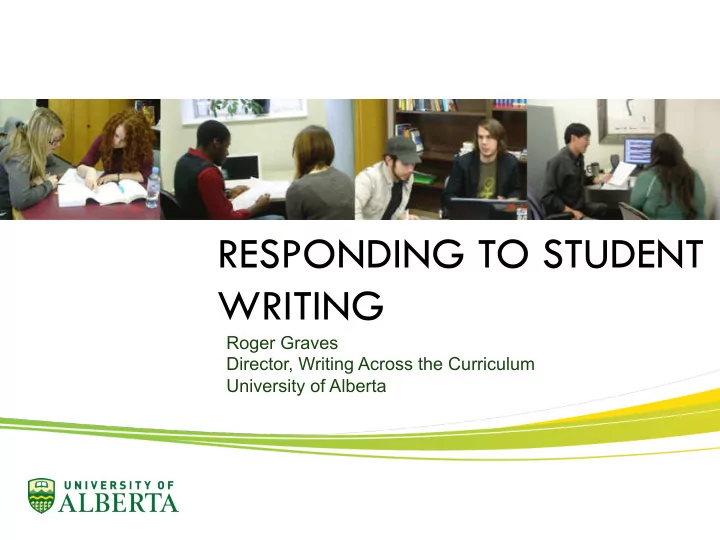
RESPONDING TO STUDENT WRITING

Roger Graves Director, Writing Across the Curriculum University of Alberta

slide-2
SLIDE 2

Roger Graves

http://www.ualberta.ca/~graves1/

slide-3
SLIDE 3

Writing Across the Curriculum http://wac.ctl.ualberta.ca/

slide-4
SLIDE 4

Response can come at any stage of the writing process:

  • Thesis statements (idea generation)
  • Outlines (organization)
  • Drafts (coherence, development)
  • Final/finished products (editing, proofreading)
  • At each stage, the focus of the response should change.

Response

slide-5
SLIDE 5

The Writing Process: A Model

Research can happen at all stages of writing Note the recursive nature of the process Identify a project Research, Read, write Share, talk Draft, refine, revise

Reflect/enjoy Retool/enjoy Resume/engage

slide-6
SLIDE 6

Summative evaluation/response sums up, totals, gives a final comment on a performance Formative evaluation helps shape

  • r form the performance in

advance of a final judgment of it Summative/Formative

= +

slide-7
SLIDE 7

Peer Feedback: Proposal Writing

  • 1. Identify the main claims made in the proposal.
  • 2. Using the schema on pages 114-115, identify the

claim, link (because statement), reason, and evidence that are explicit or implicit in at least one of these claims.

  • 3. Identify a rebuttal (challenge) that someone might

make to one of these arguments, and then suggest how the writer could counter that rebuttal.

  • 4. Using the proposal evaluation sheet as a guide,

identify 3 areas you think the writer could improve if they revised their proposal.

Sample peer response questions

slide-8
SLIDE 8
  • Peers in class
  • Centre for Writers tutors
  • Friends, family
  • Instructor

Who responds?

slide-9
SLIDE 9
  • Respond to encourage revision rather than justify a

grade

  • Organize your comments into a hierarchy—most

important to least important

  • Comment on ideas and organization first
  • Wherever possible, make positive comments
  • Avoid over-commenting: students learn faster if they must

find and correct their own errors Principles of response

Bean, John C. Engaging Ideas: The Professor’s Guide to Integrating Writing, Critical Thinking, and Active Learning in the Classroom. San Francisco: Jossey-Bass, 2001.

slide-10
SLIDE 10
  • Do not waste time on careless student work.
  • Do not extensively mark grammar and punctuation.
  • Address fundamental concerns first.
  • Consider comments without grades.
  • Use comments only for teachable moments.
  • Spend more time guiding.
  • Use only as many grade levels as you need (2= p/f to 13).
  • Limit the basis for grading.

How to respond, 1

Walvoord, Barbara E. and Virginia Johnson Anderson. Effective Grading: A tool for Learning and Assessment in College. 2nd ed. San Francisco: Jossey-Bass, 2010.

slide-11
SLIDE 11

Higher-order concerns

  • Does the draft follow the assignment?
  • Does the writer have a thesis that addresses an appropriate

problem or question?

  • If the draft has a thesis, what is the quality of the argument itself?
  • Is the draft organized effectively at the micro level?
  • Lower-order concerns
  • Are there stylistic problems that you find particularly annoying?
  • Is the draft free of errors in grammar, punctuation, and spelling?

How to respond, 2

Bean, John C. Engaging Ideas: The Professor’s Guide to Integrating Writing, Critical Thinking, and Active Learning in the Classroom. San Francisco: Jossey-Bass, 2001.

slide-12
SLIDE 12

Coach

  • Uses writing workshops to draft and revise student work

in class

  • Believes praise works better than censure
  • Depends upon students to take responsibility for their own

learning Metaphors for response

Source: Stephen W. Wilhoit, The Longman Teaching Assistant’s Handbook: A Guide for Graduate Instructors of Writing and Literature. New York: Pearson Longman, 2008.

slide-13
SLIDE 13

Editor

  • Focus on sentence-level errors
  • Conversant with rules and conventions
  • f standard edited English
  • Every word and punctuation mark counts
  • Devote much time marking essays

Metaphors for response

Source: Stephen W. Wilhoit, The Longman Teaching Assistant’s Handbook: A Guide for Graduate Instructors of Writing and Literature. New York: Pearson Longman, 2008.

slide-14
SLIDE 14

Academic reader

  • Focus on how well the paper

meets the standards of academic discourse for style, evidence, citations, sources

  • If not, what must be changed?

Metaphors for response

Source: Stephen W. Wilhoit, The Longman Teaching Assistant’s Handbook: A Guide for Graduate Instructors of Writing and Literature. New York: Pearson Longman, 2008.

slide-15
SLIDE 15

Average reader Read as if you were reading a magazine or newspaper—to see what the writer has to say Speak back to the writer about what interests you, confuses you, annoys you Metaphors for response

Source: Stephen W. Wilhoit, The Longman Teaching Assistant’s Handbook: A Guide for Graduate Instructors of Writing and Literature. New York: Pearson Longman, 2008.

slide-16
SLIDE 16

Customs officer

  • Guards the academic border to ensure
  • nly approved students pass on
  • Works from a clear set of rules
  • Applies the rules consistently

Metaphors for response

slide-17
SLIDE 17

Which of these metaphors describes how you see yourself as a responder to student writing? Is there another metaphor that captures what you are trying to accomplish when you respond to student writing? Your turn

slide-18
SLIDE 18

Coach photo: http://picasaweb.google.com/lh/photo/T4NhrhxVWMh8qfkL2NbmUw Border shot: http://farm1.static.flickr.com/52/131161403_afb1b40c45.jpg Edmonton Journal: http://www.edmontonjournal.com/ Editing: http://images.google.ca/imgres?imgurl=http://farm3.static.flickr.com/

Sources