
SLIDE 1
Researching The Slavery Past in the Netherlands
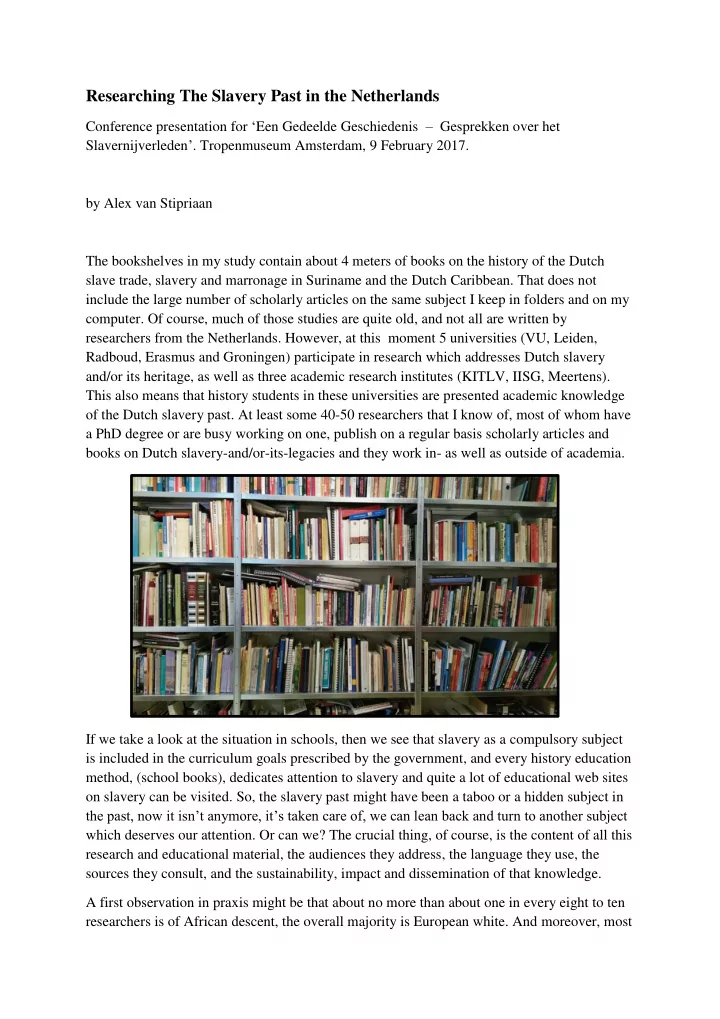
Conference presentation for ‘Een Gedeelde Geschiedenis – Gesprekken over het Slavernijverleden’. Tropenmuseum Amsterdam, 9 February 2017. by Alex van Stipriaan The bookshelves in my study contain about 4 meters of books on the history of the Dutch slave trade, slavery and marronage in Suriname and the Dutch Caribbean. That does not include the large number of scholarly articles on the same subject I keep in folders and on my
- computer. Of course, much of those studies are quite old, and not all are written by
researchers from the Netherlands. However, at this moment 5 universities (VU, Leiden, Radboud, Erasmus and Groningen) participate in research which addresses Dutch slavery and/or its heritage, as well as three academic research institutes (KITLV, IISG, Meertens). This also means that history students in these universities are presented academic knowledge
- f the Dutch slavery past. At least some 40-50 researchers that I know of, most of whom have
a PhD degree or are busy working on one, publish on a regular basis scholarly articles and books on Dutch slavery-and/or-its-legacies and they work in- as well as outside of academia. If we take a look at the situation in schools, then we see that slavery as a compulsory subject is included in the curriculum goals prescribed by the government, and every history education method, (school books), dedicates attention to slavery and quite a lot of educational web sites
- n slavery can be visited. So, the slavery past might have been a taboo or a hidden subject in