SLIDE 1
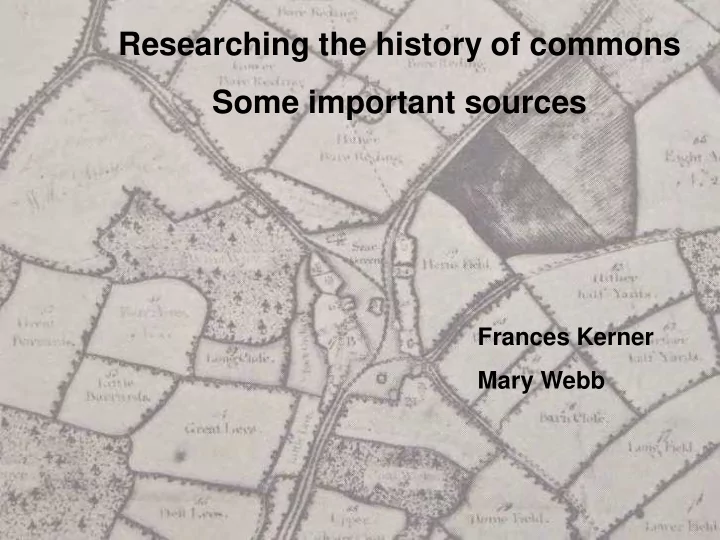
Researching the history of commons Some important sources
Frances Kerner Mary Webb
SLIDE 2
The origin and history of common lands in England is inseparably bound up with the history of the manor
Sir Thomas Edward Scrutton
Commons and Common Fields 1886
SLIDE 3
Questions The manor Definitions Court Records Maps Other records
SLIDE 4 Questions
– What was the extent in the past ? – What were its physical characteristics ? – Can common rights be identified? – How was the common’s sustainability managed ? – Is there a scheme of management ? – Has it changed hands ? – What settlement, if any, developed ? – Who used the common ? – How was it used post 1860s ? – What memories can be collected ? – What photographs have survived ?
SLIDE 5
The manor
a single administrative unit of a landed estate manor distinguished by court various size VCH: http://www.british-history.ac.uk/
SLIDE 6
SLIDE 7
SLIDE 8
Common
A profit that a Man hath in the land of another person
Giles Jacobs 1744
SLIDE 9
Common Rights (Appurtenant to property for use of dominant tenement)
Pasture Pannage Estovers Turbary Piscary Rights in soil
SLIDE 10 Waste
Waste those lands which are not in any Man’s occupation, but lie Common; which are so called, because the Lord cannot make such Profit of them as other Lands, by Reason of that Use which others have thereof in passing to and fro, etc but upon this none may build, cut down Trees or dig without the Lord’s Licence
Giles Jacobs 1744
SLIDE 11
Manorial Records
Court Rolls Court Books Surveys Orders Pains Bylaws Admissions and Surrenders
SLIDE 12
Manorial Documents Register The National Archives
Buckinghamshire Hertfordshire Bedfordshire Oxfordshire
SLIDE 13
Encroachment
Who is presented at court for encroachment ? What are encroachers fined for? Property & landholding
SLIDE 14 Wm Sharpe of the parish of Fingest for digging Clay in the Lord of this Manor’s Waste
SLIDE 15
The decline of the manorial court
Who manages the common ? Schemes of regulation Minute books Committees
SLIDE 16 Other sources
Title deeds
Valuations, Sale Plans, 1910 IR Letters Maps/Sketches/plans Wills Parish Records Newspapers Census Photographs
SLIDE 17 Maps
- Ordnance Survey
- County and Estate
- Tithe Maps and Apportionments
- Enclosure Maps and Awards
SLIDE 18
Stokenchurch
SLIDE 19
Ordnance Survey Historic maps Surveyors Drawings 1789 - c1840 2”to mile
SLIDE 20
1805- 1874 1st edition
1” to a mile (1:63 360)
SLIDE 21
1850-1880 1st ed. 6” to 1 mile 1:10560)
SLIDE 22
1860- 1870 25” to a mile (1:2,500) Part of Cadmore End Common (1881)
SLIDE 23
County maps Late 18th and early 19th century Oxon 1797 Richard Davis Bucks 1770 Thomas Jefferys Bucks 1824 Arthur Bryant Herts 1820 Arthur Bryant Beds 1794 John Carey
SLIDE 24
SLIDE 25 Estate Maps
- Maps made for land owners at various
dates
- Less easily accessible than other types,
- ften held by owners
- Fairly accurate; more detail than county
maps
- West Wycombe Estate Maps c1700 &
1767 private
SLIDE 26
SLIDE 27
SLIDE 28
SLIDE 29
SLIDE 30
SLIDE 31 Tithe Maps & Apportionments c1840
- Tithes – originally payment in kind to the
Church (a tenth of produce)
- Disarray by early 19thC; resentment from
Non-conformists, towns
- Tithe Commutation Act 1836
- Surveys and Valuations of 75% of parishes
in England and Wales
SLIDE 32 Tithe Maps & Apportionments c1840
vary in appearance and size; show numbered plots
record plot number and name; land owner and occupier; land use; acreage.
- Commons and ponds recorded
SLIDE 33
Stokenchurch Tithe Map 1842
SLIDE 34 Parliamentary Enclosure
- Most Chilterns common land enclosed under the
1845 (General Enclosure Act).
- Maps show numbered plots for enclosure; new
roads; ponds; allotments for the labouring poor and for recreation.
- Awards record roads to be laid out or stopped up;
ponds; plot number and land owner. Allotments for individuals, the labouring poor, for recreation
SLIDE 35
Extent of Commons Stokenchurch
SLIDE 36
Stokenchurch Enclosure Map 1861
SLIDE 37
SLIDE 38
SLIDE 39 Field work
- Remnant vegetation: Bracken, gorse,
woodland plants such as bluebells, dog’s mercury or wood anemone
- Enclosure hedges: straight lines;
hawthorn; little ground flora
- Old hedges (non-enclosure): mixed
hedge species; old stumps or evidence of hedge laying; varied ground flora including woodland plants
SLIDE 40 Further Sources:
- Victoria County History (VCH)
- Local writers relating to parish or village
- Old floras may provide some clues to
appearance of commons e.g. Druce 1886
- Agricultural histories and comment e.g.
Arthur Young 1813
- Early travellers around England e.g.
Daniel Defoe 1724, John Leland 1535-43.