Research Rubric During the ELO process, the student will grow in - - PowerPoint PPT Presentation

research rubric
SMART_READER_LITE
LIVE PREVIEW

Research Rubric During the ELO process, the student will grow in - - PowerPoint PPT Presentation

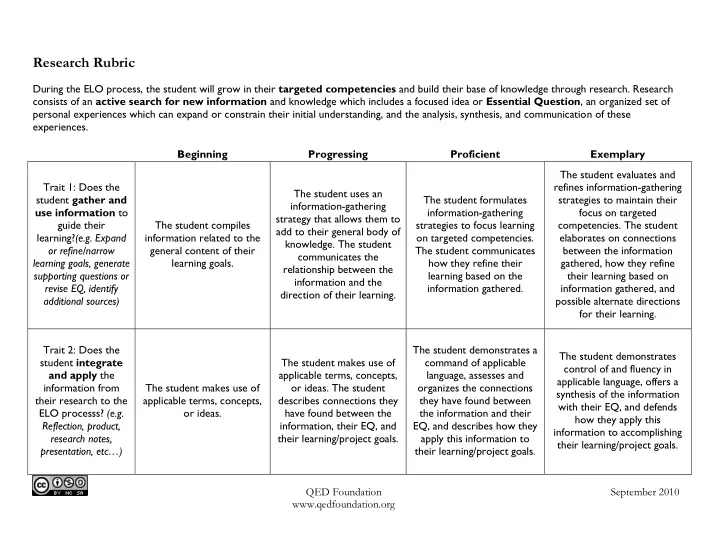
Research Rubric During the ELO process, the student will grow in their targeted competencies and build their base of knowledge through research. Research consists of an active search for new information and knowledge which includes a focused idea or


slide-1
SLIDE 1

QED Foundation September 2010 www.qedfoundation.org

Research Rubric

During the ELO process, the student will grow in their targeted competencies and build their base of knowledge through research. Research consists of an active search for new information and knowledge which includes a focused idea or Essential Question, an organized set of personal experiences which can expand or constrain their initial understanding, and the analysis, synthesis, and communication of these experiences. Beginning Progressing Proficient Exemplary Trait 1: Does the student gather and use information to guide their learning?(e.g. Expand

  • r refine/narrow

learning goals, generate supporting questions or revise EQ, identify additional sources) The student compiles information related to the general content of their learning goals. The student uses an information-gathering strategy that allows them to add to their general body of

  • knowledge. The student

communicates the relationship between the information and the direction of their learning. The student formulates information-gathering strategies to focus learning

  • n targeted competencies.

The student communicates how they refine their learning based on the information gathered. The student evaluates and refines information-gathering strategies to maintain their focus on targeted

  • competencies. The student

elaborates on connections between the information gathered, how they refine their learning based on information gathered, and possible alternate directions for their learning. Trait 2: Does the student integrate and apply the information from their research to the ELO processs? (e.g. Reflection, product, research notes, presentation, etc…) The student makes use of applicable terms, concepts,

  • r ideas.

The student makes use of applicable terms, concepts,

  • r ideas. The student

describes connections they have found between the information, their EQ, and their learning/project goals. The student demonstrates a command of applicable language, assesses and

  • rganizes the connections

they have found between the information and their EQ, and describes how they apply this information to their learning/project goals. The student demonstrates control of and fluency in applicable language, offers a synthesis of the information with their EQ, and defends how they apply this information to accomplishing their learning/project goals.

slide-2
SLIDE 2

QED Foundation September 2010 www.qedfoundation.org Beginning Progressing Proficient Exemplary Trait 3: Does the student assess the relevance of the information? The student uses information in their ELO. The student identifies information connected to their learning goal and/or essential question. The student describes their choices to include/exclude information based on relevance to their learning goals and/or essential question. The student defends the inclusion/exclusion of information based on relevance to their learning goals and/or essential question. Trait 4: Does the student assess and analyze the credibility of their information? The student uses information from sources without checking credibility. The student gathers information while checking credibility of sources. The student analyzes the validity of information by investigating the degree of

  • bjectivity and accuracy of

sources. The student defends the validity of information by evaluating the degree of

  • bjectivity and accuracy of

sources. Trait 5: Does the student use a variety

  • f information

sources? The student uses information from a single source. The student uses information from sources representing a single perspective related to the learning goals. The student uses information from a variety of documented sources that represent multiple perspectives related to the learning goals. The student compares and contrasts information from a variety of documented sources that represent multiple perspectives related to the learning goals.

slide-3
SLIDE 3

QED Foundation September 2010 www.qedfoundation.org

ELO Reflection Rubric

Reflections allow students the opportunity to think about their experiences and "get the learning out" of these experiences. Through reflection, students develop and adjust their short and long term goals, explore problems and solutions encountered during their ELOs, and connect their experiences to their learning goals. Reflections are an important part of the feedback loop between the student and their HQT/mentor. Therefore, sharing the learning with the HQT/mentor in a timely manner allows the HQT/mentor to offer formative guidance through timely responses to the reflection, which increases student learning. Beginning Progressing Proficient Exemplary Trait 1: How does the student use goal setting to manage his/her learning? The student identifies short and long term goals. The student occasionally refers to short-term and long-term goals, and uses them to determine work along the way. The student regularly refers to short-term and long-term goals,

  • utlines “next steps”

for achieving their goals, and uses them to guide their work. The student regularly evaluates their short-term goals and explains how this leads to successfully meeting their long- term goals, and, based on their evaluation, is able to make adjustments to their work along the way Trait 2: How does the student connect their experiences with the learning goals? The student reflects on experiences, but connections to learning goals are not made. The student reflects on experiences and makes a connection to a learning goal. The student reflects

  • n and analyzes the

connections between specific experiences and learning goal(s). The student reflects on and analyzes the connections between experiences and learning goals and predicts future behaviors/decisions based on their analysis (“Next time,…”).

slide-4
SLIDE 4

QED Foundation September 2010 www.qedfoundation.org Beginning Progressing Proficient Exemplary Trait 3: How does the student deal with the challenges/problems encountered during their ELO? The student identifies problem(s) encountered during ELO work. The student describes the identified problem(s) and states possible solution(s). The student identifies and analyzes problem(s), states solutions, and assesses solutions for the problem(s). The student identifies and analyzes problems, assesses solutions for the problems, identifies a chosen solution for a specific problem, and evaluates the effectiveness of their choice. Trait 4: How does the student's thinking develop as a result of ELO experiences? The student summarizes personal experiences. The student makes connections between a personal idea and an experience to establish the basis of a reflection. The student analyzes their own growth by making connections between personal ideas and their ELO experiences. The student analyzes their

  • wn growth by making

connections between personal ideas and their ELO experiences, leading them to new perspectives or insights. Trait 5: How does the student use appropriate language, vocabulary, syntax, and grammar to communicate effectively with the mentor and HQT? The student demonstrates a lack of control over media-appropriate language including vocabulary, syntax, and

  • grammar. Reflection is not

in an organized structure. Errors disrupt the flow of communication. The student demonstrates inconsistent control of media-appropriate language including vocabulary, syntax, and grammar. Organization of the reflection's structure may

  • r may not be evident.

Errors detract from communication. The student demonstrates control of media-appropriate language including vocabulary, syntax, and grammar within an

  • rganized structure.

Errors do not interfere with communication. The student demonstrates control of media-appropriate language including vocabulary, syntax, and grammar within an

  • rganized structure. Few, if

any, errors. Intention of thought is clearly communicated.

slide-5
SLIDE 5

QED Foundation September 2010 www.qedfoundation.org

ELO Project Rubric

The project is the application of the student's learning and consists of the process of designing, creating, implementing, and assessing a product, which will be an artifact or event that the student uses to demonstrate the culmination of their learning and/or achievement of competencies related to the ELO. Targeted goals, competencies and Essential Question are identified in the student’s ELO learning plan. The product will be an original piece of work designed to promote the student's personal growth and/or to benefit a larger community. The product can be a physical artifact like an art, technical, or craft piece in any appropriate medium. It can be an event like a live or recorded performance or demonstration of skill/competency. The product may be a process, developing an original design of a device, procedure, or

  • system. The product should meet standards of quality work deemed appropriate to the student's level of experience by the HQT and/or
  • mentor. The product will be shared with an authentic audience within an authentic context. Feedback from the specialists, audience

and users will be collected by the student. Beginning Progressing Proficient Exemplary Trait 1: Does the product demonstrate student achievement of learning goals and targeted competencies? The product is completed with little, if any, evidence of the targeted goals and competencies. The product demonstrates connections to the targeted goals and competencies, dependent upon further explanation. The product independently illustrates relevant connections to all the targeted goals and competencies. The product illustrates discovery of complexity and/or connectivity of the targeted competencies. Trait 2: Did the product meet the quality criteria set by the student, mentor and/or HQT? The product has little, if any, evidence

  • f meeting the

design criteria established by the mentor, HQT and student in the plan. The product meets half the design criteria established by the mentor, HQT and student in the plan. The product meets all of the design criteria established by the mentor, HQT and student in the plan. The product meets all of the design criteria established by the mentor, HQT and student in the plan and additionally reflects modifications made in response to authentic feedback.

slide-6
SLIDE 6

QED Foundation September 2010 www.qedfoundation.org Beginning Progressing Proficient Exemplary Trait 3: How was the product shared with an authentic audience for feedback? The product has been shared with mentor

  • r HQT for

evaluation. The product has been shared with the mentor

  • r HQT and an authentic

user/audience within an appropriate context. Possible sources of feedback are identified. The product has been evaluated by the mentor

  • r HQT and an authentic

audience within an appropriate environment. Feedback has been collected. The product has been evaluated by the mentor or HQT and an authentic audience. Modifications have been made based on feedback or expert critique and/or the product has been adopted for use by the authentic user/audience. Trait 4: How does the product reflect the individual voice and worldview of the student? The product was external to student interest and/or the needs of the user/audience. (product is the result of an assignment) The product shows evidence of a design based either on the needs

  • f an authentic

user/audience or the interest of the student. The product is recognized by the mentor /HQT as an uncommon but successful solution to the design criteria. The product reflects a fusion of student interest with the needs of the user/audience. The product is recognized by the mentor/HQT as a unique and original solution to the design criteria. The product reflects a fusion of student interest with the needs

  • f the user/audience. The

product is recognized by the mentor/HQT as a unique and

  • riginal solution to the design

criteria and is adopted for use. Trait 5: How well did the student document the design process (designing, creating, using, assessing and modifying) for their product? The student creates a collection of artifacts and/or information used in creating the product. The student creates a collection with appropriate student- created documentation that was used during or describes the process of creating the product. The student creates a collection of artifacts that was used during or describes the process of creating the product and includes clear representation of feedback. The student creates a collection

  • f artifacts containing artifacts

used during or describing the process of creating the product and includes clear representation of authentic

  • feedback. Student’s intentional

selection of artifacts illustrates key learning breakthroughs.

slide-7
SLIDE 7

QED Foundation September 2010 www.qedfoundation.org

ELO Presentation Rubric

The Presentation is designed to assess the student's ability to clearly communicate their learning during the ELO process to an audience that could include members who are either expert or novice in the disciplines related to the ELO's goals and/or Essential Question (EQ) identified in the plan. The presentation should clearly describe the nature of the particular ELO: its goals and EQ and the growth in the targeted competencies that resulted from their participation in the ELO process. The student should clearly and accurately illustrate the development of this growth during the ELO process (documentation). The student should be also be able to communicate what they learned through the successes and challenges of the ELO experience and how they changed as a result of it (metacognition). Beginning Progressing Proficient Exemplary Trait 1: How well does the student communicate the information using a variety

  • f strategies? (e.g. Eye

contact, speaking rate, volume, articulation, enunciation, pronunciation, inflection, voice modulation, intonation, rhythm, and gesture) The presentation does not communicate intended information because

  • rganization,

and/or delivery interfere. The presentation communicates the information, with inconsistent

  • rganization, and/or

delivery. The presentation communicates the information through logical

  • rganization and clear focus.

The student's delivery is appropriate to the audience, context, and purpose. The presentation communicates the information seamlessly through logical organization, introduction of and clear focus

  • n the topic, smooth transitions,

well-chosen supporting details, and a coherent conclusion. The student's delivery uses a variety

  • f strategies to engage the

audience and responds to audience cues.

slide-8
SLIDE 8

QED Foundation September 2010 www.qedfoundation.org Trait 2: How does the student use supporting materials (e.g. posters, graphics, illustrations, recordings, models, samples, mic/amps, videos, PPT, etc.) as part of the presentation? The student has materials that interfere with their presentation

  • r are not

referenced. The student infrequently references supporting materials, which may or may not add information to the presentation. The student integrates relevant supporting materials that add or clarify information for the presentation. The student frequently integrates relevant supporting materials that add or clarify information for the presentation. Beginning Progressing Proficient Exemplary Trait 3: Does the student communicate why they chose this ELO and how they used it to target competencies? The student identifies the goals

  • f the ELO and/or

the targeted competencies. The student explains the reasons for choosing the goals of the ELO or the targeted competencies. The student explains the reasons for choosing the goals of the ELO and how the student used the ELO to address the targeted competencies. The student explains the reasons for choosing the goals

  • f the ELO, communicates how

the student used the ELO to address the targeted competencies, and makes further connections to prior and future learning. Trait 4: Does the student communicate how they used inquiry to address the Essential Question*? The student makes no reference to the Essential Question. The student states their Essential Question, but is unable to articulate how it guided their work. The student presents their response to the Essential

  • Question. The student

describes how it guided their work, and whether or not the question changed at all. The student presents their response to the Essential Question and explains how they used it to generate emerging questions, extensions or cross- curricular relationships.

slide-9
SLIDE 9

QED Foundation September 2010 www.qedfoundation.org Trait 5: Does the student use prior work (e.g. reflections, research, and the project) in the presentation? The student provides examples

  • f 1 of the 3 prior

ELO components in describing their learning goals. The student provides examples of 2 out of the 3 prior ELO components in describing their progress toward achieving learning goals. The student provides examples of how their research, reflection and project illustrate their progress toward achieving their learning goals. The student selects and presents examples of how their research, reflection and project are interconnected and describes how each impacted their learning along the way. Trait 6: Does the student communicate what they learned through their ELO experience? The student identifies a success

  • r a challenge of

the ELO experience without any details. The student identifies a success and a challenge of the ELO experience, with few details or commentary. The student communicates what they learned through the successes and challenges

  • f the ELO experience.

The student communicates what they learned through the successes and challenges of the ELO experience and how they changed as a result of their learning.