Research Challenge SmartCampus, a sensor network for experiments - - PowerPoint PPT Presentation

research challenge
SMART_READER_LITE
LIVE PREVIEW

Research Challenge SmartCampus, a sensor network for experiments - - PowerPoint PPT Presentation

This is a team effort, started in 2014! # # # " # P. Collet M. Blay-Fornarino S. Bonnieux # # C. Cecchinel $ # # ! % J.M. Bruel S. Mosser G. Nolet G. Miton $ $ Software Composition Sbastien Mosser Ptidej seminar at


slide-1
SLIDE 1 Crédit Images: Pixabay & Pexels

Software Composition in a Cyber-Physical World

Sébastien Mosser

Ptidej seminar at Concordia University 13.12.2019

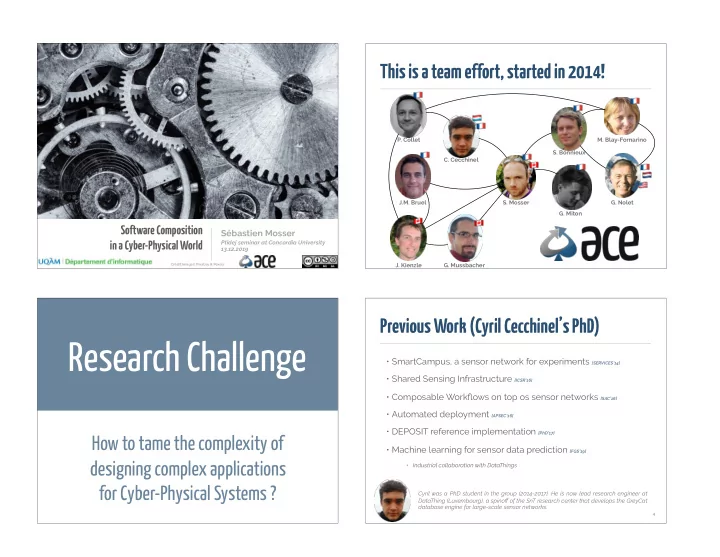
This is a team effort, started in 2014!

  • C. Cecchinel
  • P. Collet

J.M. Bruel

  • J. Kienzle
  • G. Mussbacher
  • S. Mosser
  • G. Nolet
  • S. Bonnieux
  • M. Blay-Fornarino
  • G. Miton

! " # # # # # $ $ $ # % # #

Research Challenge

How to tame the complexity of designing complex applications for Cyber-Physical Systems ? Previous Work (Cyril Cecchinel’s PhD)

  • SmartCampus, a sensor network for experiments [SERVICES’14]
  • Shared Sensing Infrastructure [ICSR’16]
  • Composable Workflows on top os sensor networks [SAC’16]
  • Automated deployment [APSEC’16]
  • DEPOSIT reference implementation [PhD’17]
  • Machine learning for sensor data prediction [FGS’19]
  • Industrial collaboration with DataThings
4

Cyril was a PhD student in the group (2014-2017). He is now lead research engineer at DataThing (Luxembourg), a spinoff of the SnT research center that develops the GreyCat database engine for large-scale sensor networks.

slide-2
SLIDE 2

5

SMARTC AMPUS

SMARTC AMPUS.G IT H UB.IO

SmartCampus Playground 2.3 hectares of building 500 parking slots >3000 students Ongoing work : the MERMAID project

  • Sébastien Bonnieux’s PhD Thesis (2017-…)
  • collaboration with the Geoscience institute in Nice (FR) [OCEANS’19]
  • Using oceans to monitor earthquakes, and other “stuff”
  • Research challenge: allow the scientist to understand

what is happening at the code level

6

Projet MERMAID (ERC Advanced Guust Nolet)

(PI: G. Nolet)

energy consumption interference

7

Agenda

Automated deployment of data collection policies at large scale*

* I had to made choices … and this contributions covers several dimension of the work!

slide-3
SLIDE 3

AUTOMATED DEPLOYMENT OF DATA COLLECTION POLICIES OVER HETEROGENEOUS SHARED SENSING INFRASTRUCTURES

  • C. CECCHINEL, S. MOSSER. P. COLLET

9 SOFTWARE DEVELOPMENT FOR THE IOT

TRADITIONAL SOFTWARE DEVELOPMENT

REQUIREMENTS

Software Engineer

IMPLEMENTS

10 SOFTWARE DEVELOPMENT FOR THE IOT

IOT DEVELOPMENT

REQUIREMENTS

Software Engineer

IMPLEMENTS

SENSOR NETWORKS CONFIGURED AT THE HARDWARE LEVEL LOW-LEVEL PROGRAMMING LANGUAGES TEDIOUS AND ERROR-PRONE ACTIVITIES

11

≠ IOT ENGINEER

SOFTWARE DEVELOPMENT FOR THE IOT

AD-HOC NETWORKS

Fire prevention Heatwave alert Temperature map ... Temperature sensors across Europe

AD-HOC NETWORKS DATASET ISOLATED NO SHARING DIFFICULT TO (RE-)USE

12

slide-4
SLIDE 4

« The most obvious drawback of the current WSNs is that they are domain-specific and task-oriented, tailored for particular applications with little or no possibility of

reusing them for newer applications »

« This strategy leads to redundant deployments when new applications are contemplated »

Khan, I., Belqasmi, F., Glitho, R., Crespi, N., Morrow, M., & Polakos, P. (2015). Wireless Sensor Network Virtualization: A Survey.

SOFTWARE DEVELOPMENT FOR THE IOT 13 SOFTWARE DEVELOPMENT FOR THE IOT

CONTRIBUTION

▸ A toolchain that supports: ▸ High-level data collection policies ▸ Platforms and network representations ▸ Composition and deployment over heterogeneous

sensing infrastructures

14

FULLY AUTOMATED APPROACH

SOFTWARE DEVELOPMENT FOR THE IOT

REQUIREMENTS

▸ Separation of concerns ▸ Automatic tailoring of policies ▸ Automatic projection of policies ▸ Automatic sharing

15 SOFTWARE DEVELOPMENT FOR THE IOT

REQUIREMENTS

▸ Separation of concerns ▸ Automatic tailoring of policies ▸ Automatic projection of policies ▸ Automatic sharing

16

slide-5
SLIDE 5

17

DATA COLLECTION POLICY

Software engineer WSN expert

INFRASTRUCTURE MODEL TOOLCHAIN SOURCE CODE SOURCE CODE SOURCE CODE

RIGHT CONCERNS FOR THE RIGHT PERSON

DATA COLLECTION POLICY

18

Must be abstracted enough to let the software

engineer focused on her business activities

« a set of operations performed on data to convert them into knowledge » [1]

[1] J. Gubbi, R. Buyya, S. Marusic, and M. Palaniswami. Internet of things (iot): A vision, architectural elements, and future

  • directions. Future Generation Computer Systems, 29(7), 2013.

« a sequence of activities performed in a business that produces a result of observable value to an individual actor of the business » [2]

Software engineer

[2] K. Kang, S. Cohen, J. Hess, W. Novak, and S. Peterson. Feature- Oriented Domain Analysis (FODA). Technical Report CMU/SEI-90-TR-21, 1990.

RIGHT CONCERNS FOR THE RIGHT PERSON 19

DATA COLLECTION POLICY

▸ A domain-specific language to define Data Collection Policies ▸ Sensor/Collectors declaration ▸ Activity definition ▸ Data-flows definition

Software engineer

RIGHT CONCERNS FOR THE RIGHT PERSON

INFRASTRUCTURE MODEL

20

Three models to describe the sensing infrastructure

  • Platform variability model
  • Network topology model
  • Deployment strategy model
ARD_1_443 ARD_2_443 RP_443_XBEE Remote DOOR_443 PRESENCE_443 WINDOW_443 AC_443 TEMP_443 X B e e XBee WAN WSN experts
slide-6
SLIDE 6

DATA COLLECTION POLICY DEVICES MODEL NETWORK TOPOLOGY DEPLOYMENT STRATEGY

SEPARATION OF CONCERNS

21

DATA COLLECTION POLICY DEVICES MODEL NETWORK TOPOLOGY DEPLOYMENT STRATEGY

deploy( , ) =

SOURCE CODE PLATFORM #1 SOURCE CODE PLATFORM #2 SOURCE CODE PLATFORM #N

22 SOFTWARE DEVELOPMENT FOR THE IOT

REQUIREMENTS

▸ Separation of concerns ▸ Automatic tailoring of policies ▸ Automatic projection of policies ▸ Automatic sharing

23

DATA COLLECTION POLICY

Platform-independent

SUB DATA COLLECTION POLICY #1 SUB DATA COLLECTION POLICY #2 SUB DATA COLLECTION POLICY #N

Platform #1 specific Platform #2 specific Platform #N specific

Build platform specific data collection policies from a platform independent policy

slide-7
SLIDE 7

Decomposition

Two operators defined at the data collection policy layer: req returns the subset of sensors needed for the realization of the activity req(

ACTIVITY 훂

) = { S2 ; S3 } isDeployable check if an activity is deployable on a given platform

ACTIVITY 훂

i s D e p l
  • y
a b l e

25

An operator defined at the network topology layer: reach returns the subset of sensors reachable from a given platform reach( ) = {S1 ; S2 ; S3 }

platform #1

26

Decomposition

An operator defined at the deployment strategy layer: place For a set of platforms, return the platform that maximize the strategy’s objectives place( ) = P1

ACTIVITY 훂

, {P1;P2;P3}

27

Decomposition

For each activity a, find platforms p satisfying the property:

req(a) ⊂ reach(p) ∧ isDeployable(a, p)

ACTIVITY 훂 ACTIVITY 훽 ACTIVITY 휔

{platform #1, platform #3, platform #4} {platform #2, platform #4} {platform #3} 28 If no platform satisfies the property, an error is returned to the software engineer

Decomposition …

slide-8
SLIDE 8

Use the place operator to select the appropriate target platform among the available candidates

{platform #1, platform #3, platform #4} {platform #2, platform #4} {platform #3}

place(

, ,

place( place(

,

) = platform #3 ) = platform #4 ) = platform #1

29

Decomposition …

ACTIVITY 훂 ACTIVITY 훽 ACTIVITY 휔

Web

Routing

  • n each platform

not involved in the process

AUTOMATIC TAILORING OF POLICIES AUTOMATIC PROJECTION OF POLICIES

30

Decomposition WHAT IF A POLICY HAS ALREADY BEEN DEPLOYED ON THE TARGETED PLATFORM ?

SOFTWARE DEVELOPMENT FOR THE IOT

REQUIREMENTS

▸ Separation of concerns ▸ Automatic tailoring of policies ▸ Automatic projection of policies ▸ Automatic sharing

32

slide-9
SLIDE 9

Composition

An operator defined at the platform-specific data collection policy layer: + compose two policies together + =

Extension of the graph series composition

33

DATA COLLECTION POLICY

Platform-independent

SUB DATA COLLECTION POLICY #1 SUB DATA COLLECTION POLICY #2

Platform #1 specific Platform #2 specific

OTHER DATA COLLECTION POLICY #1 OTHER DATA COLLECTION POLICY #2

+ +

AUTOMATIC COMPOSITION

34

Composition

OVERVIEW

TOOLCHAIN IN ONE SLIDE

35

WSN experts Infrastructure model Global policy Sub-Policy (Platform 1) Sub-Policy (Platform 2) Sub-Policy (Platform n) Global policy (Platform 1) Global policy (Platform 2) Global policy (Platform n) Code (Platform 1) Code (Platform 2) define Software engineers Decomposition Composition Composition Composition Generation Deployment strategy Other sub- policies (platform 1) Other sub- policies (platform 2) Other sub- policies (platform n) Network topology Platform features descriptions compose compose Code (Platform n) pilots pilots with with with with with pilots compose define ❶ ❸ ❷

[ASSESSMENT]

slide-10
SLIDE 10

Data collEction POlicies for Sensing InfrasTructures

Open-source toolchain available on Github

https://github.com/ace-design/DEPOSIT

DEPOSIT

ASSESSMENT

DATA COLLECTION POLICY

38

▸ As a software engineer, I would like to receive AC data if

the door and the window are opened for office 443 to monitor the energy loss

ASSESSMENT

VALIDATION CRITERIA

39

▸ Separation of concerns: Design using only activities Deployment without a-priori knowledge ▸ Automatic tailoring of policies Generated code should call the right libraries ▸ Automatic projection of policies Activities are projected on the appropriate platform Ready-to-flash code

ASSESSMENT

USING THE TOOLCHAIN

We consider 15 minutes as the required time for a network expert to write and enact the code for a given office without using any aspect of the toolchain

40

slide-11
SLIDE 11

ASSESSMENT

USING THE TOOLCHAIN

41

▸ Automatic sharing

Successful deployment of multiple applications

App #1: Air conditioning warning App #2: Fahrenheit converter App #3: Parking space occupancy

100 OFFICES 250 PARKING SPACES BLANK INFRASTRUCTURE ONE BORDER-ROUTER

ASSESSMENT

USING THE TOOLCHAIN

42

Deployment of App #1 - no composition triggered Deployment of App #2 - 101 compositions triggered Deployment of App #3 - 1 composition triggered

[LARGE-SCALE ASSESSMENT]

HERE “LARGE” MEANS “REALISTIC”

ASSESSMENT

LARGE SCALE ASSESSMENT

44

Topology to simulate SmartSantander deployment

slide-12
SLIDE 12

ASSESSMENT

FIT IOT LAB

45

French national platform for IoT experiments Think “Compute Canada”, but for the IoT. 6 cities, 1786 sensors nodes

ASSESSMENT

METHODOLOGY

46

  • 1. Select a use-case from an existing SmartCity / Building
  • 2. Deploy a prototype on SmartCampus (up to 50 sensors)
  • 3. Scale-up with FIT IoT Lab (up to 500 sensors)
  • 4. Use simulation to scale-up to 60,000+ sensors

Step 1 based on existing literature, platforms & documentation Steps 2 & 3 deployed on real hardware Step 4 extrapolate from the previous results

ASSESSMENT

LINEAR ANALYSIS OF THE TOPOLOGY

47

“In practice, it works”

ASSESSMENT

LINEAR DEPLOYMENT TIME OF A POLICY

48

“In practice, it works”

slide-13
SLIDE 13

[CONCLUSIONS]

CONCLUSIONS

PERSPECTIVES (FRQNT TEAM PROJECT, UNDER REVIEW)

51

S o f t w a r e M o d e l l i n g f o r Constrained Environments with Domain Experts in the loop

Explainable composition & human-in-the-loop optimization