Research at the big machines Traditional research talks are often - - PowerPoint PPT Presentation

research at the big machines
SMART_READER_LITE
LIVE PREVIEW

Research at the big machines Traditional research talks are often - - PowerPoint PPT Presentation

Research at the big machines Traditional research talks are often seminars crammed into 20 minutes This will be a short and non- traditional research talk (I hope!) November 5, 2010 UVa Research Talk Bob Hirosky 1 What's it all about?


slide-1
SLIDE 1

November 5, 2010 Bob Hirosky 1 UVa Research Talk

Research at the big machines

Traditional research talks are

  • ften seminars crammed into 20

minutes This will be a short and non- traditional research talk (I hope!)

slide-2
SLIDE 2

November 5, 2010 Bob Hirosky 2 UVa Research Talk

What's it all about?

Well (excluding gravity), we have a very successful model to describe all know phenomena, so far... Exercise 1.1.1.1.1a: Given locality, causality, Lorentz invariance, and known physical data since 1860, show that the Lagrangian describing all

  • bserved physical

processes (sans gravity) can be written:

slide-3
SLIDE 3

November 5, 2010 Bob Hirosky 3 UVa Research Talk

What's it all about?

Well (excluding gravity), we have a very successful model to describe all know phenomena, so far... Exercise 1.1.1.1.1b: Given your solution to Exercise 1.1.1.1.1a, show how this model can be simplified at higher energy scales by addition of extra spacial dimensions and/or new particle states.

slide-4
SLIDE 4

November 5, 2010 Bob Hirosky 4 UVa Research Talk

Research at the big machines

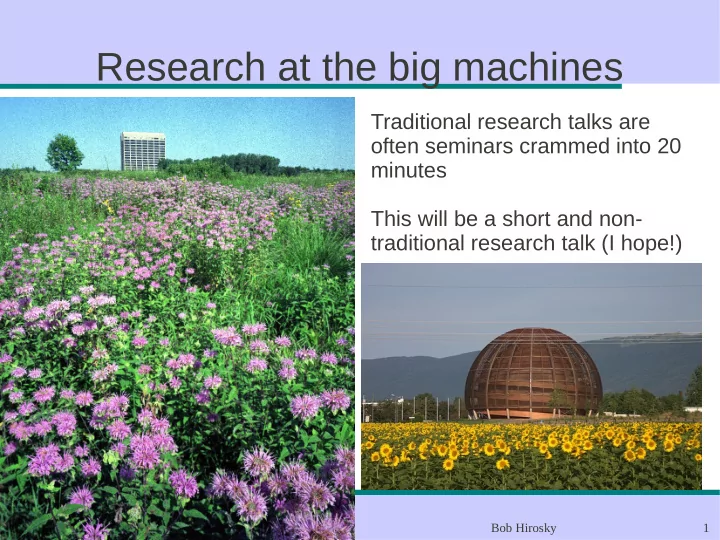
Yes, the flowers are a nice distraction!

slide-5
SLIDE 5

November 5, 2010 Bob Hirosky 5 UVa Research Talk

Research at the big machines

Fear not, for those experimentalists out there, we can concentrate

  • n the observational part:

Exercise 1.1.1.1.1a: … known physical data ... describing all observed physical processes... Exercise 1.1.1.1.1c: Choosing some subset of the (extended) Lagrangian, ask the question: “Is this physics, or is something more indicated?”

slide-6
SLIDE 6

November 5, 2010 Bob Hirosky 6 UVa Research Talk

How is my group asking these questions?

Totally fabricated quotes

Shannon Zelitch (recent graduate)/Marc Buehler (research scientist): “So if the standard model needs a Higgs boson to account for mass, where is it?” Our group is now readying a new publication

  • n the world's first search for a standard

model Higgs going to WW boson pair that decays to a lepton-hadron state.

slide-7
SLIDE 7

November 5, 2010 Bob Hirosky 7 UVa Research Talk

How is my group asking these questions?

Totally fabricated quotes

Mike Mulhearn (Postdoc): “For a lighter Higgs boson, we can search for the production of ZH, with H-> b-quarks.” Recent work led by Mike has improved

  • ur sensitivity by 40% WRT earlier

analysis. With graduate student Huong Nguyen and undergraduate David Kamensky, we are looking for more improvements independent verifications of this work using advanced computational techniques on the Virginia Cross Camus Computing Grid (think 10,000's of CPU hours per computation....)

slide-8
SLIDE 8

November 5, 2010 Bob Hirosky 8 UVa Research Talk

How is my group asking these questions?

Totally fabricated quotes

Undergraduate Dan Moser will do an independent study working with Huong and our Fermilab colleagues to examine new kinematic variables to try to improve S/B separation in out H->WW-lnujj analysis

slide-9
SLIDE 9

November 5, 2010 Bob Hirosky 9 UVa Research Talk

Tevatron Higgs

The race is on with the LHC, but pbars are an advantage for the lower mases... Precise measurements

  • f top/W

crucial to testing for standard model EW symmetry breaking or much more exotic physics

slide-10
SLIDE 10

November 5, 2010 Bob Hirosky 10 UVa Research Talk

How is my group asking these questions?

Totally fabricated quotes

Chuanzhe Lin: “How can we best study high energy photons produced at the LHC? What will we find by looking at photons and heavy flavor jets for the first time at LHC energies?”

Radiated gluons optional

eg.

slide-11
SLIDE 11

November 5, 2010 Bob Hirosky 11 UVa Research Talk

How is my group asking these questions?

Totally fabricated quotes

Chuanzhe Lin: “How can we best study high energy photons produced at the LHC? What will we find by looking at photons and heavy flavor jets for the first time at LHC energies?” Chuanzhe is also working on algorithms to accurately identify photons in he CMS detector and is involved in work to measure and ensure the stability of the CMS EM calorimeter. He had also been developing our first code for an embedded controller project

slide-12
SLIDE 12

November 5, 2010 Bob Hirosky 12 UVa Research Talk

The LHC is very much here

slide-13
SLIDE 13

November 5, 2010 Bob Hirosky 13 UVa Research Talk

Enormous physics reach for LHC

Limits of Tevatron

slide-14
SLIDE 14

November 5, 2010 Bob Hirosky 14 UVa Research Talk

Stellar performance for LHC detectors Already extending physics reach with very first data

slide-15
SLIDE 15

November 5, 2010 Bob Hirosky 15 UVa Research Talk

We are looking forward to more T-shirts...

slide-16
SLIDE 16

November 5, 2010 Bob Hirosky 16 UVa Research Talk

Tech

Good physics come from good measurements, you can't buy a lot

  • f what we need off the shelf...

The is absolutely vital to the research. Projects in the queue: Computing Grid computing: efficiently perform 10,000s of CPU-hour analytical physics calculations for data/background models Cluster work: need local solutions for distributed file systems, cluster redesign to handle local computing jobs

slide-17
SLIDE 17

November 5, 2010 Bob Hirosky 17 UVa Research Talk

Tech

Electronics Rad hard, high performance light detectors. R&D for future LHC upgrades. Short term: Setup portable DAQ based on new platform from Fermilab engineers. Program full DAQ to work from laptop + ~250MHz digitizer board to scan operating points in local and remote tests of new devices. Microcontroller programming to access SRAM, FLASH, ethernet, I2C devices. Implement control system for uTCA readout system.

slide-18
SLIDE 18

November 5, 2010 Bob Hirosky 18 UVa Research Talk

Tech

Advanced analysis techniques Continue work with multivariate analysis tools to optimize search strategies for Higgs boson and other new physics. Techniques to unfold detector effects from physics cross sections

slide-19
SLIDE 19

November 5, 2010 Bob Hirosky 19 UVa Research Talk

Future plans / Opportunities

Several opportunities to get involved Hardware development / physics with first data on LHC. Many first measurements in data collected over the next year. Tentative plans to extend Fermilab Tevatron running through 2014 Possible to contribute to competitive low mass Higgs searches,

  • r precision EW measurements.

Good strategy: consider an independent study in the Spring to get the flavor of some of these projects.

slide-20
SLIDE 20

November 5, 2010 Bob Hirosky 20 UVa Research Talk

More info

Bob Hirosky: hirosky@virginia.edu Whitepaper discussing extension of Tevatron run through 2014: http://www.fnal.gov/directorate/Tevatron/Tevatron-whitepaper.pdf CMS Times: http://cmsinfo.cern.ch/outreach/CMSTimes.html