Research and Development of Soy Based Road Dust Suppressants at NDSU - - PowerPoint PPT Presentation

research and development of soy based road dust
SMART_READER_LITE
LIVE PREVIEW

Research and Development of Soy Based Road Dust Suppressants at NDSU - - PowerPoint PPT Presentation

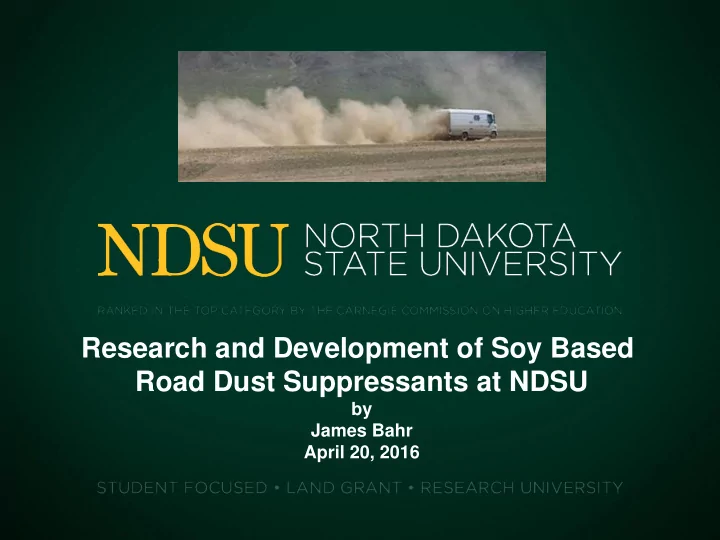
Research and Development of Soy Based Road Dust Suppressants at NDSU by James Bahr April 20, 2016 The Problem Over 1.3 million miles of unpaved roads in US Fugitive road dust generated is a hazard for people, livestock and crops


slide-1
SLIDE 1

Research and Development of Soy Based Road Dust Suppressants at NDSU

by James Bahr April 20, 2016
slide-2
SLIDE 2

The Problem

  • Over 1.3 million miles of unpaved roads in US
  • Fugitive road dust generated is a hazard for people, livestock and crops
  • Current widespread use of magnesium and calcium chloride create environmental

concerns and cause corrosion to vehicles and infrastructure

  • With population growth, more roads are being treated with chlorides
  • Better options for road dust mitigation are needed
slide-3
SLIDE 3

Objectives

  • Utilize waste glycerol from biodiesel production to synthesize road dust

suppressants (~200 million gallons generated per year)

  • Combine crude glycerol with soy based products to create a dust suppression

agent that is water dispersible and crosslink forming

  • Reduce the current use of corrosive salts on gravel roads by developing

alternative technologies

  • Produce a dust control product that wont easily wash away

in the rain (longer lasting)

  • Produce a dust control product that is non-toxic, non-corrosive and

biodegradable (safe for the environment)

slide-4
SLIDE 4

Laboratory Synthesis

  • Dual 10 liter glass reactors
  • Excellent thermal control
  • Vacuum distillation
  • Periodic sample collection
  • Extensive track record of

Soy based material synthesis

  • High pressure reactor

available- 6 liter 3,000 psi

slide-5
SLIDE 5

Materials Made

HPLC analysis to monitor conversion Apply to class 5 gravel Form emulsion in water Over 40 batches yielding 160 samples

slide-6
SLIDE 6

Technical Approach Testing

Apply treatments to 10 lbs.

  • f class 5 gravel

Dry/cure treated samples Modified cement mixer for dust collection

slide-7
SLIDE 7

Preliminary Findings

  • Non hardening, low odor
  • Product easily dispersed in water
  • Forms a stable emulsion
  • Works in very dry conditions
  • Is not easily washed away
  • One step synthesis in less than 2 hrs
  • Provisional patent filed last fall
slide-8
SLIDE 8

Benefits of this Technology

  • Increased demand for biodiesel waste products
  • More options for dust control on gravel roads
  • Non-corrosive and biodegradable
  • Minimize the use of corrosive salts currently used on gravel roads
  • Expanded market for soybean oil
slide-9
SLIDE 9

Future Work- 2nd Year Funding

  • Transition from lab scale testing to road testing
  • Synthesize large quantities of soy based dust control agent
  • Work with state and local agencies to test on gravel roads
  • Apply dust control agents to roadbed and monitor for 3 months
  • Find an industrial partner that can commercialize the technology
slide-10
SLIDE 10

Future Road Testing

  • Section of gravel road on the

NDSU campus (daily monitoring)

  • Section of rural Cass County road

(heavy traffic) TBD

slide-11
SLIDE 11

Road Dust Measurement

Road dust generation will be measured with a vehicle mounted particulate monitoring system similar to this setup developed at Penn State. Respirable aerosol concentrations of PM10 will be measured in real-time.

slide-12
SLIDE 12

Partnering with NDSU

Center for Advanced Technology Development and Commercialization (CATCOM)

  • Purpose- Improve and refine NDSU and/or private sector inventions leading to

the manufacturing of new products

  • Match requirements- $2 from private sector (cash/in-kind) per $1 of state funds

Research ND

  • Purpose- Create a long term positive economic impact on the state through the

development of new markets

  • Match Requirements- $1 from private sector per $1 of state funds, no in-kind
slide-13
SLIDE 13

Acknowledgment

Questions?