+ .~~` REQUIREMENT AB 1234 TRAINING (Government Code Sec. - - PDF document

requirement ab 1234 training government code sec 53235 f
SMART_READER_LITE
LIVE PREVIEW

+ .~~` REQUIREMENT AB 1234 TRAINING (Government Code Sec. - - PDF document

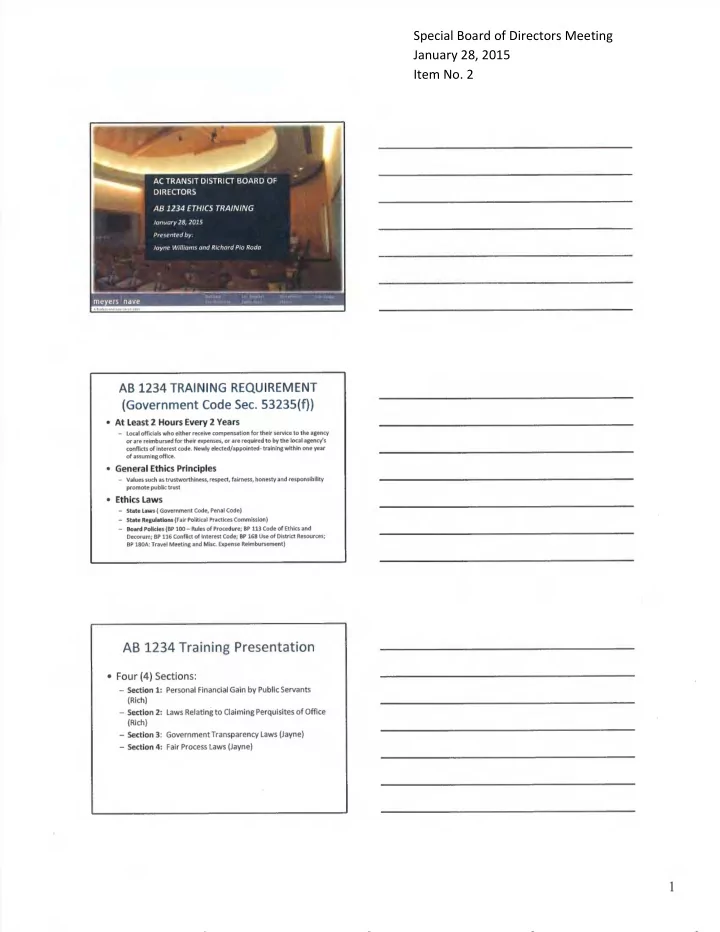
Special Board of Directors Meeting January 28, 2015 Item No. 2 a~ . + .~~` REQUIREMENT AB 1234 TRAINING (Government Code Sec. 53235(f)) At Least 2 Hours Every 2 Years service to the agency Local officials who either


slide-1
SLIDE 1

a~ .

+ .~~`

AB 1234

TRAINING

REQUIREMENT (Government Code

Sec. 53235(f))

  • At

Least

2

Hours Every

2

Years

— Local

  • fficials who

either receive compensation fortheir service to the agency

  • r

are reimbursed for their expenses,

  • r

are required to by the local agencys conflicts

  • f

interest code. Newly elected/appointed-training within

  • ne

year

  • f

assumingoffice.

  • General

Ethics Principles

— Values such as

trustworthiness, respect, fairness, honesty and responsibility promote public trust

  • Ethics

Laws

— State Laws (Government Code, Penal Code) — State Regulations(Fair

POliticalProctices

Commission) — Board

Policies

(BP 100— Rules

  • f

Procedure; BP 113 Code

  • f

Ethics and

Decorum; BP 116

Conflict

  • f

Interest

Code; BP 168 Use

  • f

District Resources;

BP 180A: Trevel Meeting and Misc. Expense Reimbursement)

AB 1234

Training Presentation

  • Four

(4)

Sections:

— Section

is Personal Financial Gain

by Public Servants (Rich) — Section 2: Laws

Relating to Claiming Perquisites

  • f

Office (Rich)

Section 3: Government Transparency Laws (Jayne)

Section 4: Fair Process Laws (Jayne)

Special Board of Directors Meeting January 28, 2015 Item No. 2

slide-2
SLIDE 2

Section

1

Personal F i n a n c i a l G a i n by P u b l i c Servants

  • Bribery
  • C
  • n

f l i c t s

  • f

I n t e r e s t

under the

Political Reform

A c t

  • C
  • n

t r a c t u a l Conflicts

  • f

I n t e r e s t

( G

  • v

. C

  • d

e

§

1090)

  • Conflicts
  • f

I n t e r e s t

a n d Campaign

Contributions

  • C
  • n

f l i c t s

  • f

I n t e r e s t

W h e n

L e a v i n g O f f i c e

. 1

~ i ~ i

i y r

1

=~

~R ~

~

t ~

1

~ '

~~

`

4 . .

TO

WHOM

DOES THE A C T

A P P L Y ?

  • P

u b l i c

  • fficials
  • W

i t h a

f i n a n c i a l i n t e r e s t

  • M

a k i n g ,

participating in,

  • r

attempting t

  • influence

a g

  • v

e r n m e n t a l

decision

— (Gov. C

  • d

e

§

8 7 1 )

  • BP

1

Sec. 2.7: Conflict

  • f

I n t e r e s t

  • BP

1 1 6 :

C

  • n

f l i c t

  • f

I n t e r e s t

C

  • d

e

2

slide-3
SLIDE 3

W H E N

DOES A

PUBLIC OFFICIAL

H A V E A

C O N F L I C T

U N D E R THE P R A ?

B a s i c Rule Public

  • f

f i c i a l s

have a

disqualifying conflict

  • f

interest

under the

P

  • l

i t i c a l

R e f

  • r

m Act

  • f

1974 when the

d e c i s i

  • n

is

  • Reasonably

f

  • r

e s e e a b l e that the d e c i s i

  • n

w i l l

have a

  • Material

financial effect

  • n

the public

  • f

f i c i a l ' s

  • E

c

  • n
  • m

i c

interest

  • D

i f f e r e n t

from the

public generally

i

THE

8

STEPS

T O DETERMINE

CONFLICT

O F

INTEREST

8

S T E P T E S T

  • OVERVIEW

Step

1 :

Is

the individual a public

  • f

f i c i a l ?

Step 2: Is the

  • f

f i c i a l making, p a r t i c i p a t i n g

  • r

influencing a g

  • v

e r n m e n t a l decision? Step 3: What constitutes the economic

interests

  • f

the

  • f

f i c i a l ?

Step 4: Is the economic interest

directly

  • r

indirectly a f f e c t e d

b y the decision? Step 5: How

w i l l

t h e economic interest b e affected? ( m a t e r i a l financial affect) Step 6 :

Is i t

reasonablyforeseeablethat the economic interest

will

b e

m a t e r i a l l y affected? Step 7 : Distinguishablefrompublicgenerally? Step 8: Does the "legally required participation" r u l e apply?

slide-4
SLIDE 4

Key Steps —Step

# 3

  • Step

3: Economic Interests

— Business Investments

  • $2,000
  • r

more —

Business

Management

Position

— Director,

Official,

Partner, Trustee

  • r

any

position

  • f

management —

Real Property

  • $2,000
  • r

more — Sources

  • f

Income

  • $500
  • r

more

within

12 months —

Sources

  • f

Gifts

  • $460
  • r

more

within

12 months —

Personal Finances— increase

  • r

decrease within

12 months

STEPSS &6

  • #5

— Materiality Standards:

For any "directly involved"

economic

interest,

the material

financial affect

is any

foreseeable economic impact.

  • For

any

"indirectly involved"

economic

interest,

the material

financial affect varies

by the type

  • f

interest.

  • #6

— Reasonably

foreseeable

is if there is a

substantial likelihood (better

than SO%).

STEPS

7 AND

8:

THE

EXCEPTIONS

  • Step

7: Distinguishable

from the

public generally? (Significant

Segment) Step

~: Does the

"legally required participation" rule

apply? — when no

alternative source

  • fdecision-making

—not

to break a

tie

— not

if quorum

can

possibly be

convened

  • f
  • ther

members who do

not have a

conflict

slide-5
SLIDE 5

RECUSAL ACTIONS REQUIRED

Public

  • fficial with

a

disqualifying interest

must:

  • Publicly

identify interest in sufficient detail

  • Recuse

self

from

discussions

  • r

acting

  • n

matter Leave room, unless matter

  • n

consent agenda

Exception: May speak during public

comment

if

the interest

is

  • ne's

personal interest

QU

~Z Can

the Board Member Participate?

  • A

Board member rents a commercial space for

$900

per

month

within the

District

  • The

District

considers a project that

will

eliminate street access to the property for

3

months

  • This

action will trigger

an automatic

rent reduction provision

in the

lease —Can

the Board member be involved

in making

the decision?

QUIZ

Can a Board

Member Who

Recuses Him/Herself Urge Support Before a Decision

is Made?

  • Assume

the Board member

is aware

  • f

the

  • bligation

to recuse him/herself

  • Before

the meeting, the

member

contacts individual board members to support the project — Can he/she do that? — What

if the

Board member merely communicated with the General Manager urging him to support the project?

slide-6
SLIDE 6

PENALTIES

FOR

V I O L A T I O N

OF

POLITICAL

REFORM A C T

Civil Remedy If

  • fficial derived

economic

benefit

from

decision, fine could

amountto

3

times the benefit Criminal Sanctions

If

the

  • fficial knowingly
  • r

willingly v i

  • l

a t e d

the law: misdemeanor conviction,

f i n e

  • f

$10,000

  • r

3

times v a l u e

  • f

b e n e f i t conferred (whichever

is

g r e a t e r )

and the

  • fficial may

n

  • t

b e a c a n d i d a t e

for public

  • ffice

for

4

years

CAMPAIGN C O N T R I B U T I O N S

  • "Directly

elected" e x c e p t i

  • n
  • Official

is disqualified

from making a

d e c i s i

  • n

involving a license, permit,

  • r

entitlement f

  • r

use

if

  • fficial has

a c c e p t e d a c a m p a i g n contribution exceeding

$250

in preceding

12 months.

  • Official may

not accept

a

c a m p a i g n

contribution exceeding

$250

while an application

is pending,

and

for three

months

after

the decision

is made.

"REVOLVING

DOOR

RULE"

! ^ .

~

.. ~'~ ~

Officials d i s q u a l i f i e d

from m a k i n g govt.

decisions directly relating to

any person

with whom he / s h e

is

n e g

  • t

i a t i n g re: their prospective

employment

Revolving

Door

Rule

—1

year

restriction against

l

  • b

b y i n g f

  • r

m e r agency

slide-7
SLIDE 7

CONTRACTS

S U B J E C T

T O

S E C T I O N 1 9

P r

  • h

i b i t s

an

  • fficer
  • r

employee

  • f

a

public

a g e n c y from

p a r t i c i p a t i n g in the

m a k i n g

  • f

a

contract

in which

h e / s h e has a

f i n a n c i a l i n t e r e s t

  • Renewal,

e x t e n s i

  • n

,

  • r

renegotiation

  • f

e x i s t i n g contract

i s

a l s

  • s

u b j e c t t

  • t

h e p r

  • h

i b i t i

  • n

SECTION 1 9 : " P A R T I C I P A T I O N "

IN MAKING

A CONTRACT

— Preliminary

discussions

— Negotiations — Compromises — Reasoning — Planning — D r a w i n g

  • f

p l a n s a n d s p e c i f i c a t i

  • n

s

— Solicitation

f

  • r

bids

— Signing

  • f

c

  • n

t r a c t

7

slide-8
SLIDE 8

SCOPE OF SECTION 1090

CONFLICT

  • For

members

  • f

governing body, abstention does not cure Section 1090 problem

  • Entire

governing body

is precluded

from

entering into the contract

EXCEPTIONS

TO

SECTION 1090

  • Remote

interest — disqualifies

  • fficial,

but Board

may

act

  • Non-interest — financial

interest "doesn't count"

and

is

ignored

  • Rule
  • f

necessity

VIOLATION

OF

SECTION 1090

  • Contract

is void

and unenforceable

  • Payments

made

to the contracting party must be returned to the public agency

  • Public

agency

may

keep the

benefit

  • f

the contract

slide-9
SLIDE 9

SECTION 1090

PERSONAL CONSEQUENCES

  • Willful

violations

  • f

Section

1090

are punishable by fine, imprisonment, and

permanent

disqualification

from holdingany

  • ffice

in C a l i f

  • r

n i a

( G C 1097)

  • FPPC

now

has

jurisdiction

and can

issue fines

I~

''

Y ~ , ..

QUIZ

1090

Violation?

  • Board member

is

also the paid Executive Director

  • f

anon-profit

  • Intending

to apply f

  • r

District

f u n d i n g , s h e does n

  • t

p a r t i c i p a t e in the

m e e t i n g s

  • r

discussions concerning distribution of t h e funds,

and s u b m i t s an

application

  • The

District Board,

with the board member-Exec.

Dir.

recusing herself,

awards the grant funds to t h e non-

profit

QU

~Z

1090

Violation?

  • W

h a t

would happen

i f the

E x e c u t i v e Director

  • f

the non-profit instead

is the

husband

  • f

the Board

Member?

slide-10
SLIDE 10

gUIZ

1090

Violation?

  • What

if

the Board Member-Executive Director

is no

longer

  • n

the Board when she submits the grant application?

1~

slide-11
SLIDE 11

SIGNIFICANT R E S T R I C T I O N S

ON

"PERKS"

R e g u l a t e d categories include:

  • Transportation

by t r a n s p

  • r

t a t i

  • n

companies

  • Gifts
  • T

r a v e l

P a y m e n t s

  • Honoraria
  • Misuse
  • f

Public Resources

  • Mass

Mailing at Public Expense

  • Gifts
  • f

Public

Funds

I L L E G A L GIFTS

OF TRANSPORTATION

PROHIBITION*

  • No

f r e e passes

  • r

'~

d i s c

  • u

n t s from transportation companies

~ ,~~

Severe penalty

  • Applies

to

a l l

forms

  • f

transportation

slide-12
SLIDE 12

G I F T RESTRICTIONS

  • No

g i f t s

f r

  • m

a single s

  • u

r c e a g g r e g a t i n g

i n excess

  • f

$ 4 6

  • Gifts

aggregating

$ 5

  • r

m

  • r

e must b e

d i s c l

  • s

e d

  • n

a

Form 7

  • Gifts

i n excess

  • f

limit

from a

single

s

  • u

r c e during a

1 2 month

p e r i

  • d

a r e d i s q u a l i f y i n g

G I F T RESTRICTIONS

~

  • What

i s

a

gift? *Anything

  • f

v a l u e that provides a personal b e n e f i t for w h i c h the d

  • n
  • r

d

  • e

s n

  • t

r e c e i v e equivalent c

  • n

s i d e r a t i

  • n

. Includes rebates

  • r

d i s c

  • u

n t s unless g i v e n

in

t h e r e g u l a r course

  • f

business t

  • members
  • f

t h e

p u b l i c .

  • When

i s a g i f t

a c c e p t e d ?

* A

g i f t

h a s been r e c e i v e d

  • r

accepted

w h e n

the p u b l i c

  • fficial

k n

  • w

i n g l y t a k e s a c t u a l possession

  • f

the

gift

  • r

exercises d i r e c t i

  • n
  • r

c

  • n

t r

  • l
  • ver

the

gift,

i n c l u d i n g d i s c a r d i n g t h e

gift

  • r

t u r n i n g

it over

t

  • another

person

E X C E P T I O N S

TO

G I F T L I M I T A T I O N S

  • Gifts

returned

  • Gifts

donated t

  • c

h a r i t y (without claiming a d e d u c t i

  • n

)

  • Gifts

from

f a m i l y

m e m b e r s

~ ~

  • I

n f

  • r

m a t i

  • n

a l m a t e r i a l

  • Devise
  • r

inheritance

~?

slide-13
SLIDE 13

MORE

GIFT

EXCEPTIONS

  • Home

hospitality

  • Gift

exchanges

  • f

equal value

  • Leave

credits

  • Disaster

relief provisions

  • Travel

and subsistence as

part

  • f

campaign

activities

  • Entrance

to an event while performing a ceremonial role (includes

  • ne

guest)

  • Prizes

received

in a bona fide

competition

  • Benefits

received as a guest attending a

wedding

  • Bereavement
  • fferings

And More

Gift

Exceptions

  • Acts
  • f

neighborliness

  • Reciprocal

exchanges

in a social

relationship

  • Plaques
  • r

trophies valued at less than

$250

  • Bona

fide

date

  • r

dating relationship

  • Acts
  • f

human

compassion

  • Gifts

from long-term,

close personal friends

  • Exceptions
  • Lobbyists
  • "Interested party'

GIFTS

TO MEMBERS OF AN

OFFICIAL'S

FAMILY

  • May

be considered a payment to the

public

  • fficial

when

there

is either: — No established relationship that

would make the

gift

suitable;

  • r

—There

is evidence

to suggest that the donor had a purpose to influence the

  • fficial.

13

slide-14
SLIDE 14

GIFTS

TO

THE

PUBLIC

AGENCY

Gifts

to the

Public

Agency

are

  • kay,

if:

  • Agency

must

control use

  • f

the

gift

s

Gift

must be used

for

"official

agency business"

  • Agency

must

report

gift

  • n

Form 801

TICKETS

OR

PASSES

  • Admission

to a

facility,

event,

show

  • r

performance for an entertainment, amusement, recreational

  • r

similar

purpose

  • Not

a

gift, if provided: — for

  • fficial's

admission to an event at which the he/she performs a ceremonial role

  • r

function

  • n

behalf

  • f

the agency;

OR — by

  • fficial's

agency when

  • fficial

treats the ticket

  • r

pass as income consistent with tax laws and the agency reports the ticket

  • r

pass as income to the

  • fficial

— by

  • fficial's

agency

in accordance

with policy, ticket not earmarked for

  • fficial,

and agency

reports

  • n

form 802 — Two

tickets to a fundraiser

by a nonprofit

  • r

political

  • rg.

QU

~Z

Gift Rules

A

business acquaintance mistakenly thinks you, a Board Member, are a football fan

and

gives you

two

tickets to a local

game

and a team

  • jersey. You

don't

really like football, plus

you think the fans are

a

little

  • scary. So,

you forget

all about

the

game, and game day

passes without the items being used.

The

face value

  • n

the

tickets

is

$225

  • each. Violation?

14

slide-15
SLIDE 15

Qulz

Gift

Rules

  • W

h a t

i f

instead

you d

  • n

a t e d the

tickets

and the

jersey to a local charity? — Have

y

  • u

received a gift?

HONORARIA BAN

~• .

  • What

is

a n honorarium?

*Any payment made

in c

  • n

s i d e r a t i

  • n

f

  • r

any speech given,

a r t i c l e published,

  • r

attendance

  • f

any

p u b l i c

  • r

p r i v a t e conference, convention, meeting, social event,

meal

  • r

a

like g a t h e r i n g .

1.5

slide-16
SLIDE 16

Honoraria Ban Exceptions

  • Bona

Fide business (teaching, practicing law, banking, medicine)

  • Returned

honorarium

  • Donated

to agencygeneral fund

  • Made

directly

to a bona fide non-profit

  • Campaign

contributions (but

must be reported)

Misuse

  • f

and

Gifts

  • f

Public

Funds

Basic Rule:

local

  • fficers

and employees may not use publicfunds

  • r

resources for personal purposes, including partisan

political

  • activity. Public

funds /resources can be used to educate about

ballot

measures. Constitutional Prohibition:

  • Public

agencies

may

not

make

gifts of public

funds.

  • An

expenditure

is not

a

gift if it

serves a public purpose, even

if it benefits

a

private party.

  • Legislative body's

determination

  • f

a public

purpose

is

given great deference.

GIFTS

OF

PUBLIC

FUNDS

  • Pubiic

Funds: Includes

money

as well as equipment, supplies, compensated

staff

time, and use

  • f

telephone, computers and fax machines. State law

perrnits

minimal/incidental use

  • f

agency resources.

  • Penalty:

If misuse

  • f

public

funds

is more

than

incidental

  • r

minimal,

it may

be prosecuted as

a felony crime

and

violators may

be barred from holding

  • ffice

16

slide-17
SLIDE 17

MASS

MAILING RESTRICTIONS

M a s s

mailings

m a y

not be sent at p u b l i c expense.

  • A

" m a s s

m a i l i n g "

is:

  • a

t a n g i b l e item sent

  • r

delivered

  • to

2

  • r

more p e

  • p

l e w i t h i n a calendar month

  • that"features'

an elected

  • f

f i c e r b y :

  • I

n c l u d i n g a photograph

  • r

signature,

  • r
  • Singling
  • u

t the

  • fficer

by the manner

  • f

display

  • f

n a m e

  • r
  • f

f i c e in l a y

  • u

t , such as headlines, c a p t i

  • n

s , font

  • r

color.

  • For

which the costs

  • f

d e s i g n , production and printing exceed

$50 and

are paid with p u b l i c m

  • n

e y s .

E X C E P T I O N S

T O M A S S

M A I L I N G RESTRICTIONS

  • Letterhead
  • Press

releases

  • C
  • m

m u n i c a t i

  • n

s between g

  • v

e r n m e n t agencies

  • Intra-agency

c

  • m

m u n i c a t i

  • n
  • B

i l l s and

legal notices

  • Telephone

directory,

  • rganizational

chart

  • r

similar roster Q ~\ 1

J

GOVERNMENT

/ ~ ~

TRANSPARENCY

L A W S

  • E

c

  • n
  • m

i c

i n t e r e s t d i s c l

  • s

u r e

u n d e r the

P

  • l

i t i c a l

Reform Act

  • B

r

  • w

n Act

  • Public

Records Act

1 7

slide-18
SLIDE 18

Economic

Interest Disclosure

  • A

Form 700 must be

filed upon

t a k i n g

  • ffice,

leaving

  • ffice,

and

  • n

an a n n u a l

basis

  • Require

disclosure

  • f

personal f i n a n c i a l interests

  • Alert

public

  • f

f i c i a l s

to personal i n t e r e s t s that might be a f f e c t e d

  • Help

inform the p u b l i c about potential

conflicts

  • f

interest

  • Public

d

  • c

u m e n t

GOVERNMENT

TRANSPARENCY LAWS The

Ralph M.

B r

  • w

n

Act

"ALL MEETINGS

OF THE

LEGISLATIVE

BODY OF THE

LOCAL AGENCY SHALL BE OPEN

AND

PUBLIC

AND

ALL PERSONS SHALL BE PERMITTED

TO ATTEND ANY MEETING

E X C E P T AS OTHERWISE PROVIDED" ( G

  • v

. Code

§

54953)

~H

slide-19
SLIDE 19

LEGISLATIVE

B O D I E S

  • L
  • c

a l Governing

B

  • d

y (eg: B

  • a

r d

  • f

D i r e c t

  • r

s ) , i n c l u d i n g

n e w l y e l e c t e d

m e m b e r s who h a v e

not a s s u m e d

  • f

f i c e .

  • S

t a n d i n g C

  • m

m i t t e e s

  • f

B

  • a

r d

  • G
  • v

e r n i n g body

  • f

p r i v a t e

  • r

g a n i z a t i

  • n

i n l i m i t e d

circumstances.

  • C
  • m

m i s s i

  • n
  • r

Committee

  • f

B

  • a

r d ( a p p

  • i

n t e d )

EXCEPTIONS

  • A

n " a d h

  • c

"

a d v i s

  • r

y

c

  • m

m i t t e e

c

  • n

s i s t i n g solely

  • f

less

t h a n a q u

  • r

u m

  • f

the

l e g i s l a t i v e

b

  • d

y .

  • G

r

  • u

p s t h a t

a d v i s e a s i n g l e decision maker. ~~~~~~

_e ,i..... , . . ' '

~ . . ~ _ ~ ~ r —

' ~

'

  • W

H A T

I S A

M E E T I N G ?

  • Any

g a t h e r i n g

  • f

a majority

  • f

the

l e g i s l a t i v e

b

  • d

y to "hear,

discuss, d e l i b e r a t e ,

  • r

take a c t i

  • n

"

  • n

a m a t t e r within the agency's s u b j e c t m a t t e r

j u r i s d i c t i

  • n

.

  • Oral

c

  • l

l e c t i v e b r i e f i n g s .

  • L

e g i s l a t i v e r e t r e a t s

  • S

e r i a l

m e e t i n g s

~

~ )

slide-20
SLIDE 20

N O T

MEETINGS

  • I

n d i v i d u a l c

  • n

t a c t s

  • A

t t e n d a n c e

at:

— a c

  • n

f e r e n c e

  • p

e n to

p u b l i c

— a c

  • m

m u n i t y m e e t i n g — asocial

  • r

c e r e m

  • n

i a l f u n c t i

  • n

— a n

  • p

e n meeting

  • f

another

public

a g e n c y — a n

  • p

e n m e e t i n g

  • f

t h e b

  • d

y ' s s t a n d i n g c

  • m

m i t t e e s , as

  • bserver

S E R I A L

M E E T I N G S

  • "HUB

A N D

S P O K E "

  • O

u t s i d e a meeting, a m a j

  • r

i t y

  • f

t h e

l e g i s l a t i v e

b

  • d

y m a y n

  • t

d i s c u s s , d e l i b e r a t e ,

  • r

take a c t i

  • n

b y

d i r e c t

c

  • m

m u n i c a t i

  • n

, i n t e r m e d i a r i e s ,

  • r

t e c h n

  • l
  • g

y

(e.g.,

e m a i l &social m e d i a ) — D

  • e

s n

  • t

p r e v e n t e m p l

  • y

e e s a n d

  • fficials

from e n g a g i n g

i n i n d i v i d u a l

conversations

  • r

b r i e f i n g s

  • u

t s i d e a m e e t i n g p r

  • v

i d e d n

  • t

f

  • r

p u r p

  • s

e

  • f

g a t h e r i n g a "concurrence"

among m e m b e r s .

— Unilateral written c

  • m

m u n i c a t i

  • n

s

OK

MEETING

  • L

O C A T I O N

  • A

c c e s s i b l e t

  • persons

w i t h

d i s a b i l i t i e s

  • Inside

t h e public a g e n c y ' s b

  • u

n d a r i e s , e x c e p t . . .

— Meeting w i t h

S t a t e / F e d e r a l

  • fficials

— Inspecting property — Complying w i t h Court

  • r

d e r — Multi a g e n c y m e e t i n g

i n

a n

  • t

h e r

jurisdiction

2

slide-21
SLIDE 21

TELECONFERENCE

  • Agenda

posted at

all

l

  • c

a t i

  • n

s , with teleconference l

  • c

a t i

  • n

s specifically '; identified

:>

  • A

l l

locations

  • pen

to the public with

~. r

.

public participation possible a t

each

~ . , ~ ~ l

  • c

a t i

  • n

'•.

'

  • .

,

,

At

least

quorum

  • f

body must

+.;'

  • '

'

~

'

p a r t i c i p a t e

from

locations within

..i.,, agency

boundaries

  • Roll

call votes

  • nly

MEETING R U L E S

  • No

Required Sign-in — Voluntary

sign-in permitted

if sheet

specifies

it is

voluntary

  • Broadcasting,

videotaping

and photography must be permitted

  • Board

can adopt Rules

if not in

c

  • n

f l i c t w i t h state

law ( s e e Board

Policy

100)

R E G U L A R M E E T I N G S

Regular Meeting Notice:

  • 72

hours a d v a n c e posting, i n c l u d i n g

  • n

website

  • Time

and

l

  • c

a t i

  • n
  • Description
  • f

each business item

(brief general)

  • Alternative

formats f

  • r

persons with

d i s a b i l i t i e s

  • Public

c

  • m

m e n t

period

  • No

d i s c u s s i

  • n
  • f

non-agendized items

(brief responses to q u e s t i

  • n

s

  • kay)
  • P

u b l i c a l l y

announce vote

  • n

a l l

actions taken

(new)

7J

slide-22
SLIDE 22

SPECIAL

MEETINGS

Special Meetings — Called by

presiding

  • fficer
  • r

majority — 24 hour posting/notice, and content

same

as regular agendas — No discussion

  • f

salaries for local

agency executives — Public

comment

  • nly
  • n

agenda items — No

consideration

  • f

non-agendized matters

"OPEN

AND

PUBLIC"

  • Cannot

discuss

non—agenda items

Exceptions

  • "Emergency"

:Majority vote

  • required. Prompt

action required

due to

"disruption

  • r

threatened disruption

  • f

public

facilities,

work stoppage

  • r
  • ther

activity impairing public health, safety,

welfare

  • r

crippling disaster."

  • "Urgency

": 2/3 vote

  • required. A

need to take "immediate'

action

and the need came to the

attention

  • f

the agency

after

the posting

  • f

the agenda.

PUBLIC PARTICIPATION RIGHTS

  • Regular

meetings must provide an

  • pportunity

for the public to

speak regarding any matters

within the body's jurisdiction during "public

comment"

  • Legislative body

may

briefly discuss

these items (non-agenda) and refer matters to

staff,

but cannot take action

  • Public

can address body an any agendized matters before

  • r

during consideration

  • f

the item

  • Public

has the

right to

make

audio/video recordings

22

slide-23
SLIDE 23

UNLAWFUL

MEETINGS PENALTIES

AND

REMEDIES

  • Criminal

Violation

A meeting where

"action

is

taken"

in violation of

the Act and with intent to deprive public

  • f

information.

  • Civil Remedies

— DA

  • r

any

interested person may bring

an

action

— Court

  • rder

to stop

  • r

prevent

violations (injunction,

mandamus,

declaratory

relief)

Invalidation of Action

— Demand

to Cure must be

made

(within

30

days) — Attorney's Fees

  • During

public

comment

for items not

listed on

the agenda, a speaker requested the Board to write a

letter

  • f

support

  • n

behalf

  • f

his

  • cause. The

Board proceeded to vote

  • n

writing

the

letter

and

it passed unanimously. Is this

a Brown Act violation?

QUIZ

Did the Chair Act Consistently with the

Brown

Act?

  • Ex-husband
  • f

a high level District

employee comes

to the podium during public

comment

  • Makes

uncomplimentary

comments

about

his

ex-wife's character

  • utside
  • f

work

  • Board

Chair cuts speaker

  • ff,

saying matter

is

not within the

District

  • r

the Board's purview.

23

slide-24
SLIDE 24

QUIZ

Have the Board Members

Violated

the Brown Act?

  • Assume

husband'scommentaryconcerned information that

reflected on

employee performance

  • Aboard

member

asks the General

Manager

to respond

  • General

Manager:

"I will

look into the allegations"

  • Thereafter,

board members have a lengthy conversation about the alleged conduct

QUIZ

Did Anyone Violate

the Brown Act?

  • General

Manager

learns

  • f

a grant

  • pportunity

after

the agenda for the regular meeting

is posted

  • Grant

deadline

is

two

days after the meeting

  • At

the Board meeting, the

GM

asks to add item

  • During

discussion

  • n

whether to add, two

  • f

the

five

members

express the view that they are against receiving federal money

  • Board

votes

3

  • 2

to add item and then proceeds to hear

it

QU

~Z

UNLAWFUL

MEETING?

  • The

District Board establishes a

standing committee

  • f

three

  • f

its

seven members, which meets

  • monthly. A

fourth member

  • f

the Board wants to attend these meetings and

participate.

  • Can

the

member

attend? Participate?

24

slide-25
SLIDE 25

C L O S E D SESSIONS

  • Regular

agenda

notice requirements

  • "Safe

harbor" agenda item language

  • Confidential

/closed door meetings.

  • Attendance

limited to

Board members a n d relevant

staff

  • r

c

  • n

s u l t a n t s .

  • A

n n

  • u

n c e m e n t s

  • f

reportable (final) actions

in

  • pen

session

and vote

TYPES

OF C L O S E D

SESSIONS

  • Real

estate :direction to n e g

  • t

i a t

  • r

re: price

and terms

  • f

purchase

  • r

lease.

  • Litigation

e x i s t i n g ,

threatened

  • r

to decide to

i n i t i a t e .

Meet

with legal counsel.

  • Personnel

/Public

Employment—

c

  • n

s i d e r appointment,

employment,

evaluation

  • f

specific p u b l i c

employee

  • r

potential

employee

  • ver

whom

the

District

exercises appointing a u t h

  • r

i t y .

  • Labor

n e g

  • t

i a t i

  • n

s — to meet and give d i r e c t i

  • n

to n e g

  • t

i a t

  • r

.

  • Public

security— threat to public s e r v i c e

  • r

facilities

CONFIDENTIALITY (Government Code

Sec.

54963)

  • General

Rule:

A

person may not disclose confidential i n f

  • r

m a t i

  • n

that h a s been acquired by being present

in a legally

authorized closed session to a person not entitled to r e c e i v e

i t ,

unless the

legislative body

authorizes disclosure

  • f

the

confidential i n f

  • r

m a t i

  • n

.

  • "Confidential

information"

means

a communication

made

in a

closed session that

is specifically

related to the basis for the legislative body to meet in closed session.

25

slide-26
SLIDE 26

UNAUTHORIZED DISCLOSURES

Penalties

  • Violation may

be addressed by the use

  • f

such remedies as are currently available by law, including, but not

limited to:

Injunctive relieve to prevent disclosure

  • f

confidential information

Disciplinary action against

an employee

who

willfully disclosed confidential

information

in violation of

law; — Referral

  • f

a member

  • f

the

legislative body

to the grand jury

Confidentiality Disclosure

  • Exceptions

A

Iocai

agency

may

not take any authorized action against a person, nor

shall

it be

deemed

a violation for doing the following: — Making a

confidential inquiry

  • r

complaintto

adistrict attorney

  • r

grand jury concerning a perceived

violation

— Expressing an

  • pinion

concerning the propriety

  • r

legality

  • f

actions taken inclosed session, including disclosure

  • f

the nature and extent

  • f

the

illegal or potentially illegal

action

— Disclosing information acquired by being present

in a closed session

that

is not

confidential

— Disclosures under Labor Code "whistleblower"

statutes

QUIZ

Can a Board

member

discuss a sensitive personnel matter

in closed

session? It is brought

to the attention

  • f

a Board member that

some

District maintenance

employees

may

be

involved

in activities in violation of District policies.

You want

to discuss

what you have

heard

in closed

session

—can you? What

if the

allegations involved

the General Manager?

26

slide-27
SLIDE 27

QUIZ

Is i t

c

  • n

f i d e n t i a l ?

In closed

s e s s i

  • n

legal

counsel presents a status r e p

  • r

t

  • n

a pending lawsuit and

recommends

a settlement amount.

T h e Board approves the

settlement r e c

  • m

m e n d a t i

  • n

and

authorizes legal counsel t

  • settle

the

  • case. Is the

Board required to "report

  • ut"

following the closed s e s s i

  • n

the action t

  • authorize

the settlement and the

amount?

QUIZ

Is i t confidential?

In

c l

  • s

e d session the

D i s t r i c t ' s

labor n e g

  • t

i a t

  • r

recommends

to the Board a range

  • f
  • ptions

for

upcoming

labor

  • negotiations. The

Board continues the d i s c u s s i

  • n

to the next closed session and does not give any direction. A f t e r the meeting, a Board

member

discusses the proposed

  • ptions

with a union r e p r e s e n t a t i v e to get h e r feedback

  • n

the u n i

  • n

' s position before the next

  • meeting. Was

that

OK ?

2~

slide-28
SLIDE 28

CALIFORNIA PUBLIC

RECORDS ACT

(Gov. Code

§

6250

et seq.)

The

Public Records Act

makes

all non-exempt,

state

and

local

government agency records

(including reasonably segregable,

non-exempt

portions

  • f
  • therwise

exempt

records)

in any

form

  • r

medium

subject to public inspection during

  • ffice hours
  • r

copying upon

payment

  • f

duplication costs "...any writing containing information relating to the

conduct

  • f

the

public's business

prepared,

  • wned,

used,

  • r

retained by

any

state

  • r

local

agency regardless

  • f

physical

form

  • r

characteristics."

(Gov. Code

§

6252(e))

WHAT

IS A

PUBLIC

RECORD?

(cont'd)

...any writing... Includes

any handwriting,

typewriting, printing, photostating, photographing, photocopying, transmitting by electronic mail

  • r

facsimile,

and every

  • ther

means

  • f

recording

upon any

tangible thing

any form

  • f

communication

  • r

representation, including letters, words, pictures, sounds,

  • r

symbols,

  • r

combinations thereof, and any record thereby created, regardless

  • f

the manner

in which

the record has been stored. (Gov. Code

§

6252(f).)

28

slide-29
SLIDE 29

WHAT

IS A

PUBLIC

RECORD?

(cont'd)

"...information relating to

the conduct

  • f

the

public's business..:'

The mere custody

  • f

a writing by a public agency does not

make

it a

"public record"

under the

Act. But

if

a record

is kept

by an

  • fficer

because

it is

necessary

  • r

convenient to the discharge

  • f
  • fficial

duties,

it is a

"public record."

DUTY TO

ASSIST

Agencies are required

to:

  • Assist

the requester to

identify records

and information that are responsive to the request

  • r

to the purpose

  • f

the request,

if

stated

  • Describe

the information technology and physical location

in which

the records

exist

  • Provide

suggestions for

  • vercoming

any

practical basis for

denying access to the records

  • r

information sought

PUBLIC

RECORDS EXEMPT

FROM

DISCLOSURE

  • Preliminary

drafts, draft notes

  • r

draft interagency

and

intra-agency

memoranda

  • Pending

litigation

  • Personnel

records

  • Medical,

dental and

  • ther

insurance records

  • Closed

session minutes

and

legal memoranda

and

  • ther

materials distributed in a closed session

  • Records

protected by the attorney-client privilege (note: inadvertent disclosure

may

waive

privilege)

  • Records

created and maintained

  • n

personal computers/smart phones

m
slide-30
SLIDE 30

PUBLIC

RECORDS

  • Any

person can bring a lawsuit to enforce the right to inspect

  • r

receive public

  • records. A

prevailing party

will recover its court

costs

and reasonable

attorneys' fees.

  • Improper

disclosure

  • f

records involving privacy rights may create

liability.

  • Criminal

penalties apply to disclosure

  • f

some exempt

records.

QU

~Z

Public

Records?

Over the course

  • f

several years,

two

Board

members exchanged

emails about fundraisingfor their campaigns. The Board

members exchanged no

  • ther

emails.

All

the emails were sent to and from

their private email accounts

  • n

their

  • wn

computers, which the

members

use for

District business.

A member

  • f

the public asks the

District for

all emails

between the two Board members. — How should the

District

respond? — Would the

result

be

different

if

the Board Members used

their District email accounts?

QU

(

Z

Public

Records?

A

request

is made

by a contractor for the responses to a RFP for consulting

  • services. The

award

  • f

the contract

is under

consideration

and has not been approved by the Board. The request

for copies

  • f

the proposals

is denied. Are

the proposals public records?

30

slide-31
SLIDE 31

FAIR

PROCESS REQUIREMENTS FAIR

P R O C E S S E S

The

Constitution, state l a w ,

and the

c

  • m

m

  • n

law

a l l

have

a role in ensuring that p u b l i c agencies

  • perate

fairly

and avoid

arbitrary d e c i s i

  • n

s .

The laws

include:

  • Due

process requirements

  • C
  • m

m

  • n

law

bias prohibitions

  • I

n c

  • m

p a t i b l e

  • ffices
  • i

n c

  • m

p a t i b l e

activities

  • C
  • m

p e t i t i v e b i d d i n g requirements

  • Anti-nepotism

laws

DUE PROCESS

  • in quasi-judicial

proceedings

(i.e.,

those involving the application

  • f

existing rules to a s p e c i f i c set

  • f

facts),

  • fficials

should: (a) Act

in a fair

and

impartial

manner; (b) Apply

legal

standards to

facts;

and (c) P r

  • v

i d e an

  • pportunity

for p a r t i e s to

be heard and to rebut e v i d e n c e

(

"procedural

due

process

")

~~

slide-32
SLIDE 32

COMMON

LAW

PROHIBITION AGAINST BIAS

  • A

public

  • fficer must

exercise the

powers conferred

  • n

him

  • r

her with disinterested

skill,

zeal

and

diligence,

and

primarily for

the benefit

  • f

the public

  • No

pre-determined, unchangeable positions for

  • r

against a particular party

  • r

individual

  • May

be

disqualified

from

participating

INCOMPATIBLE OFFICES

  • Now

codified at

Government Code

Sec. 1099.

  • Elements
  • A

person may not hold

two

public

  • ffices

simultaneously

  • If

the potential for

conflict

  • r
  • verlap

in the

functions

  • r

responsibilities in the

  • ffice

exist

  • Forfeiture
  • f

first office

  • An

employee

elected to the Board

  • f

the agency that he/she

is employed

must

resign

employment.

What

is ethics,

anyway?

  • The

way

in which

an

  • fficial

should act and perform

when

fulfilling official duties

  • Represents

a set

  • f

values, moral principles,

  • r

rules

  • f

conduct

  • Concerns

both individual and group/agency behavior

  • Important

framework

for maintaining public confidence

in the integrity

and

professionalism of

government

32

slide-33
SLIDE 33

THANK YOU

33