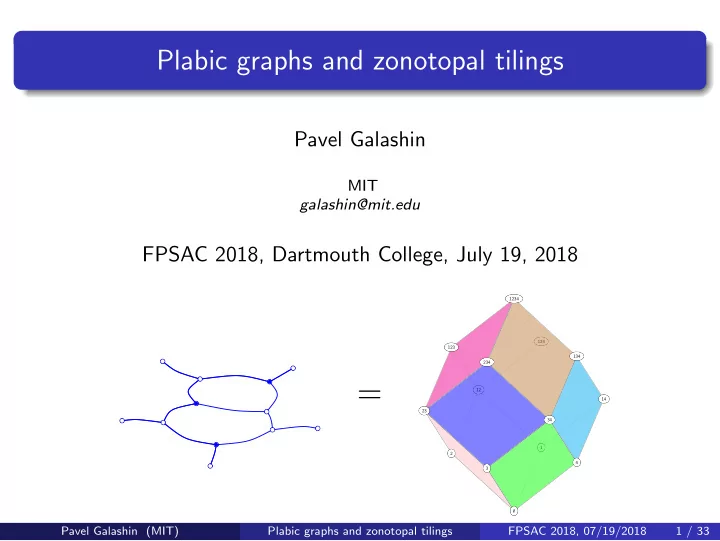
= 12 12 14 14 14 23 23 23 34 34 34 1 1 2 2 2 4 4 4 - - PowerPoint PPT Presentation

12 12 14 14 14 23 23 23 34 34 34 1 1 2 2 2 4 4 4 3 3 3
SMART_READER_LITE
LIVE PREVIEW

= 12 12 14 14 14 23 23 23 34 34 34 1 1 2 2 2 4 4 4 - - PowerPoint PPT Presentation

Plabic graphs and zonotopal tilings Pavel Galashin MIT galashin@mit.edu FPSAC 2018, Dartmouth College, July 19, 2018 1234 1234 1234 124 124 123 123 123 134 134 134 234 234 234 = 12 12 14 14 14 23 23 23 34 34 34 1 1 2


slide-1
SLIDE 1

Plabic graphs and zonotopal tilings

Pavel Galashin

MIT galashin@mit.edu

FPSAC 2018, Dartmouth College, July 19, 2018

=

∅ 1 2 3 4 12 14 23 34 123 124 134 234 1234 ∅ 1 2 3 4 12 14 23 34 123 124 134 234 1234 ∅ 2 3 4 14 23 34 123 134 234 1234

Pavel Galashin (MIT) Plabic graphs and zonotopal tilings FPSAC 2018, 07/19/2018 1 / 33

slide-2
SLIDE 2

Main result

Theorem (G. (2017))

(k, n)-plabic graphs

planar

← − − →

dual

horizontal sections at level k of fine zonotopal tilings of Z(n, 3)

Pavel Galashin (MIT) Plabic graphs and zonotopal tilings FPSAC 2018, 07/19/2018 2 / 33

slide-3
SLIDE 3

Main result

Theorem (G. (2017))

(k, n)-plabic graphs

planar

← − − →

dual

horizontal sections at level k of fine zonotopal tilings of Z(n, 3)

∅ 1 2 3 4 5 1 2 1 5 2 3 3 4 4 5 1 2 3 1 2 5 1 4 5 2 3 4 3 4 5 1 2 3 4 1 2 3 5 1 2 4 5 1 3 4 5 2 3 4 5 1 2 3 4 5 ∅ 1 2 3 4 5 1 2 1 5 2 3 3 4 4 5 1 2 3 1 2 5 1 4 5 2 3 4 3 4 5 1 2 3 4 1 2 3 5 1 2 4 5 1 3 4 5 2 3 4 5 1 2 3 4 5 ∅ 3 4 5 1 5 2 3 3 4 4 5 1 4 5 2 3 4 3 4 5 1 2 3 4 1 2 4 5 1 3 4 5 2 3 4 5 1 2 3 4 5

Z(n, 3) for n = 5

Pavel Galashin (MIT) Plabic graphs and zonotopal tilings FPSAC 2018, 07/19/2018 2 / 33

slide-4
SLIDE 4

Main result

Theorem (G. (2017))

(k, n)-plabic graphs

planar

← − − →

dual

horizontal sections at level k of fine zonotopal tilings of Z(n, 3)

∅ 1 2 3 4 5 1 2 1 5 2 3 3 4 4 5 1 2 3 1 2 5 1 4 5 2 3 4 3 4 5 1 2 3 4 1 2 3 5 1 2 4 5 1 3 4 5 2 3 4 5 1 2 3 4 5 ∅ 1 2 3 4 5 1 2 1 5 2 3 3 4 4 5 1 2 3 1 2 5 1 4 5 2 3 4 3 4 5 1 2 3 4 1 2 3 5 1 2 4 5 1 3 4 5 2 3 4 5 1 2 3 4 5

level = 0 level = 1 level = 2 level = 3 level = 4 level = 5

∅ 1 2 3 4 5 1 2 1 5 2 3 3 4 4 5 1 2 3 1 2 5 1 4 5 2 3 4 3 4 5 1 2 3 4 1 2 3 5 1 2 4 5 1 3 4 5 2 3 4 5 1 2 3 4 5 ∅ 1 2 3 4 5 1 2 1 5 2 3 3 4 4 5 1 2 3 1 2 5 1 4 5 2 3 4 3 4 5 1 2 3 4 1 2 3 5 1 2 4 5 1 3 4 5 2 3 4 5 1 2 3 4 5 ∅ 3 4 5 1 5 2 3 3 4 4 5 1 4 5 2 3 4 3 4 5 1 2 3 4 1 2 4 5 1 3 4 5 2 3 4 5 1 2 3 4 5

Z(n, 3) for n = 5

Pavel Galashin (MIT) Plabic graphs and zonotopal tilings FPSAC 2018, 07/19/2018 2 / 33

slide-5
SLIDE 5

Main result

Theorem (G. (2017))

(k, n)-plabic graphs

planar

← − − →

dual

horizontal sections at level k of fine zonotopal tilings of Z(n, 3)

∅ 1 2 3 4 5 1 2 1 5 2 3 3 4 4 5 1 2 3 1 2 5 1 4 5 2 3 4 3 4 5 1 2 3 4 1 2 3 5 1 2 4 5 1 3 4 5 2 3 4 5 1 2 3 4 5 1 3 3 5 2 3 5 1 3 5 ∅ 1 2 3 4 5 1 2 1 5 2 3 3 4 4 5 1 2 3 1 2 5 1 4 5 2 3 4 3 4 5 1 2 3 4 1 2 3 5 1 2 4 5 1 3 4 5 2 3 4 5 1 2 3 4 5

level = 0 level = 1 level = 2 level = 3 level = 4 level = 5

1 3 3 5 1 3 5 2 3 5 ∅ 1 2 3 4 5 1 2 1 5 2 3 3 4 4 5 1 2 3 1 2 5 1 4 5 2 3 4 3 4 5 1 2 3 4 1 2 3 5 1 2 4 5 1 3 4 5 2 3 4 5 1 2 3 4 5 ∅ 1 2 3 4 5 1 2 1 5 2 3 3 4 4 5 1 2 3 1 2 5 1 4 5 2 3 4 3 4 5 1 2 3 4 1 2 3 5 1 2 4 5 1 3 4 5 2 3 4 5 1 2 3 4 5 ∅ 3 4 5 1 5 2 3 3 4 4 5 1 4 5 2 3 4 3 4 5 1 2 3 4 1 2 4 5 1 3 4 5 2 3 4 5 1 2 3 4 5

Z(n, 3) for n = 5

Pavel Galashin (MIT) Plabic graphs and zonotopal tilings FPSAC 2018, 07/19/2018 2 / 33

slide-6
SLIDE 6

Main result

Theorem (G. (2017))

(k, n)-plabic graphs

planar

← − − →

dual

horizontal sections at level k of fine zonotopal tilings of Z(n, 3)

∅ 1 2 3 4 5 1 2 1 5 2 3 3 4 4 5 1 2 3 1 2 5 1 4 5 2 3 4 3 4 5 1 2 3 4 1 2 3 5 1 2 4 5 1 3 4 5 2 3 4 5 1 2 3 4 5 1 3 3 5 2 3 5 1 3 5 ∅ 1 2 3 4 5 1 2 1 5 2 3 3 4 4 5 1 2 3 1 2 5 1 4 5 2 3 4 3 4 5 1 2 3 4 1 2 3 5 1 2 4 5 1 3 4 5 2 3 4 5 1 2 3 4 5

level = 0 level = 1 level = 2 level = 3 level = 4 level = 5

1 3 3 5 1 3 5 2 3 5 ∅ 1 2 3 4 5 1 2 1 5 2 3 3 4 4 5 1 2 3 1 2 5 1 4 5 2 3 4 3 4 5 1 2 3 4 1 2 3 5 1 2 4 5 1 3 4 5 2 3 4 5 1 2 3 4 5 ∅ 1 2 3 4 5 1 2 1 5 2 3 3 4 4 5 1 2 3 1 2 5 1 4 5 2 3 4 3 4 5 1 2 3 4 1 2 3 5 1 2 4 5 1 3 4 5 2 3 4 5 1 2 3 4 5 ∅ 3 4 5 1 5 2 3 3 4 4 5 1 4 5 2 3 4 3 4 5 1 2 3 4 1 2 4 5 1 3 4 5 2 3 4 5 1 2 3 4 5

Z(n, 3) for n = 5

Pavel Galashin (MIT) Plabic graphs and zonotopal tilings FPSAC 2018, 07/19/2018 2 / 33

slide-7
SLIDE 7

Main result

Theorem (G. (2017))

(k, n)-plabic graphs

planar

← − − →

dual

horizontal sections at level k of fine zonotopal tilings of Z(n, 3)

1 2 1 5 2 3 3 4 4 5 1 3 3 5 1 2 1 5 2 3 3 4 4 5

level = 2

1 3 3 5 ∅ 1 2 3 4 5 1 2 1 5 2 3 3 4 4 5 1 2 3 1 2 5 1 4 5 2 3 4 3 4 5 1 2 3 4 1 2 3 5 1 2 4 5 1 3 4 5 2 3 4 5 1 2 3 4 5 ∅ 1 2 3 4 5 1 2 1 5 2 3 3 4 4 5 1 2 3 1 2 5 1 4 5 2 3 4 3 4 5 1 2 3 4 1 2 3 5 1 2 4 5 1 3 4 5 2 3 4 5 1 2 3 4 5 ∅ 3 4 5 1 5 2 3 3 4 4 5 1 4 5 2 3 4 3 4 5 1 2 3 4 1 2 4 5 1 3 4 5 2 3 4 5 1 2 3 4 5

Z(n, 3) for n = 5

Pavel Galashin (MIT) Plabic graphs and zonotopal tilings FPSAC 2018, 07/19/2018 2 / 33

slide-8
SLIDE 8

Main result

Theorem (G. (2017))

(k, n)-plabic graphs

planar

← − − →

dual

horizontal sections at level k of fine zonotopal tilings of Z(n, 3)

1 2 1 5 2 3 3 4 4 5 1 3 3 5 1 2 1 5 2 3 3 4 4 5

level = 2

1 3 3 5 ∅ 1 2 3 4 5 1 2 1 5 2 3 3 4 4 5 1 2 3 1 2 5 1 4 5 2 3 4 3 4 5 1 2 3 4 1 2 3 5 1 2 4 5 1 3 4 5 2 3 4 5 1 2 3 4 5 ∅ 1 2 3 4 5 1 2 1 5 2 3 3 4 4 5 1 2 3 1 2 5 1 4 5 2 3 4 3 4 5 1 2 3 4 1 2 3 5 1 2 4 5 1 3 4 5 2 3 4 5 1 2 3 4 5 ∅ 3 4 5 1 5 2 3 3 4 4 5 1 4 5 2 3 4 3 4 5 1 2 3 4 1 2 4 5 1 3 4 5 2 3 4 5 1 2 3 4 5

Z(n, 3) for n = 5

Pavel Galashin (MIT) Plabic graphs and zonotopal tilings FPSAC 2018, 07/19/2018 2 / 33

slide-9
SLIDE 9

Main result

Theorem (G. (2017))

(k, n)-plabic graphs

planar

← − − →

dual

horizontal sections at level k of fine zonotopal tilings of Z(n, 3)

a (2, 5)-plabic graph

∅ 1 2 3 4 5 1 2 1 5 2 3 3 4 4 5 1 2 3 1 2 5 1 4 5 2 3 4 3 4 5 1 2 3 4 1 2 3 5 1 2 4 5 1 3 4 5 2 3 4 5 1 2 3 4 5 ∅ 1 2 3 4 5 1 2 1 5 2 3 3 4 4 5 1 2 3 1 2 5 1 4 5 2 3 4 3 4 5 1 2 3 4 1 2 3 5 1 2 4 5 1 3 4 5 2 3 4 5 1 2 3 4 5 ∅ 3 4 5 1 5 2 3 3 4 4 5 1 4 5 2 3 4 3 4 5 1 2 3 4 1 2 4 5 1 3 4 5 2 3 4 5 1 2 3 4 5

Z(n, 3) for n = 5

Pavel Galashin (MIT) Plabic graphs and zonotopal tilings FPSAC 2018, 07/19/2018 2 / 33

slide-10
SLIDE 10

Part 1: Zonotopal tilings

∅ 1 2 3 4 5 1 2 1 5 2 3 3 4 4 5 1 2 3 1 2 5 1 4 5 2 3 4 3 4 5 1 2 3 4 1 2 3 5 1 2 4 5 1 3 4 5 2 3 4 5 1 2 3 4 5 ∅ 1 2 3 4 5 1 2 1 5 2 3 3 4 4 5 1 2 3 1 2 5 1 4 5 2 3 4 3 4 5 1 2 3 4 1 2 3 5 1 2 4 5 1 3 4 5 2 3 4 5 1 2 3 4 5 ∅ 3 4 5 1 5 2 3 3 4 4 5 1 4 5 2 3 4 3 4 5 1 2 3 4 1 2 4 5 1 3 4 5 2 3 4 5 1 2 3 4 5

slide-11
SLIDE 11

Zonotopes

Definition (Minkowski sum)

A, B ⊂ Rd, A + B := {a + b | a ∈ A, b ∈ B}.

Pavel Galashin (MIT) Plabic graphs and zonotopal tilings FPSAC 2018, 07/19/2018 4 / 33

slide-12
SLIDE 12

Zonotopes

Definition (Minkowski sum)

A, B ⊂ Rd, A + B := {a + b | a ∈ A, b ∈ B}.

Definition

Vector configuration: V = (v1, v2, . . . , vn), where vi ∈ Rd.

Pavel Galashin (MIT) Plabic graphs and zonotopal tilings FPSAC 2018, 07/19/2018 4 / 33

slide-13
SLIDE 13

Zonotopes

Definition (Minkowski sum)

A, B ⊂ Rd, A + B := {a + b | a ∈ A, b ∈ B}.

Definition

Vector configuration: V = (v1, v2, . . . , vn), where vi ∈ Rd. Zonotope: ZV := [0, v1] + [0, v2] + · · · + [0, vn] ⊂ Rd.

Pavel Galashin (MIT) Plabic graphs and zonotopal tilings FPSAC 2018, 07/19/2018 4 / 33

slide-14
SLIDE 14

Two-dimensional zonotopes

V = v1 v2 → ZV =

Pavel Galashin (MIT) Plabic graphs and zonotopal tilings FPSAC 2018, 07/19/2018 5 / 33

slide-15
SLIDE 15

Two-dimensional zonotopes

V = v1 v2 → ZV = V = v1 v2 v3 → ZV =

Pavel Galashin (MIT) Plabic graphs and zonotopal tilings FPSAC 2018, 07/19/2018 5 / 33

slide-16
SLIDE 16

Two-dimensional zonotopes

V = v1 v2 → ZV = V = v1 v2 v3 → ZV =

Pavel Galashin (MIT) Plabic graphs and zonotopal tilings FPSAC 2018, 07/19/2018 5 / 33

slide-17
SLIDE 17

Two-dimensional zonotopes

V = v1 v2 → ZV = V = v1 v2 v3 → ZV = V = v1 v2 v3 v4 → ZV = 0 v1 v2 v3 v4 v1 v2 v3 v4

Pavel Galashin (MIT) Plabic graphs and zonotopal tilings FPSAC 2018, 07/19/2018 5 / 33

slide-18
SLIDE 18

Cyclic zonotopes

Definition

Cyclic vector configuration: C(n, d) := (v1, v2, . . . , vn), where vi = (1, ri, r2

i , . . . , rd−1 i

) for some 0 < r1 < r2 < · · · < rn ∈ R.

Pavel Galashin (MIT) Plabic graphs and zonotopal tilings FPSAC 2018, 07/19/2018 6 / 33

slide-19
SLIDE 19

Cyclic zonotopes

Definition

Cyclic vector configuration: C(n, d) := (v1, v2, . . . , vn), where vi = (1, ri, r2

i , . . . , rd−1 i

) for some 0 < r1 < r2 < · · · < rn ∈ R. C(4, 2) = v1 v2 v3 v4

Pavel Galashin (MIT) Plabic graphs and zonotopal tilings FPSAC 2018, 07/19/2018 6 / 33

slide-20
SLIDE 20

Cyclic zonotopes

Definition

Cyclic vector configuration: C(n, d) := (v1, v2, . . . , vn), where vi = (1, ri, r2

i , . . . , rd−1 i

) for some 0 < r1 < r2 < · · · < rn ∈ R. C(4, 2) = v1 v2 v3 v4

C(6, 3) =

v1 v2 v3 v4 v5 v6 z = 1

Pavel Galashin (MIT) Plabic graphs and zonotopal tilings FPSAC 2018, 07/19/2018 6 / 33

slide-21
SLIDE 21

Cyclic zonotopes

Definition

Cyclic vector configuration: C(n, d) := (v1, v2, . . . , vn), where vi = (1, ri, r2

i , . . . , rd−1 i

) for some 0 < r1 < r2 < · · · < rn ∈ R. Cyclic zonotope: Z(n, d) := ZC(n,d). C(4, 2) = v1 v2 v3 v4

C(6, 3) =

v1 v2 v3 v4 v5 v6 z = 1

Pavel Galashin (MIT) Plabic graphs and zonotopal tilings FPSAC 2018, 07/19/2018 6 / 33

slide-22
SLIDE 22

Zonotopal tilings

Definition

A zonotopal tiling of ZV is a polyhedral subdivision ∆ of ZV into smaller zonotopes.

Pavel Galashin (MIT) Plabic graphs and zonotopal tilings FPSAC 2018, 07/19/2018 7 / 33

slide-23
SLIDE 23

Zonotopal tilings

Definition

A zonotopal tiling of ZV is a polyhedral subdivision ∆ of ZV into smaller zonotopes. A zonotopal tiling is fine if all pieces are parallelotopes.

Pavel Galashin (MIT) Plabic graphs and zonotopal tilings FPSAC 2018, 07/19/2018 7 / 33

slide-24
SLIDE 24

Zonotopal tilings

Definition

A zonotopal tiling of ZV is a polyhedral subdivision ∆ of ZV into smaller zonotopes. A zonotopal tiling is fine if all pieces are parallelotopes. A piece ZV′ is a parallelotope if the vectors in V′ form a basis of Rd.

Pavel Galashin (MIT) Plabic graphs and zonotopal tilings FPSAC 2018, 07/19/2018 7 / 33

slide-25
SLIDE 25

Zonotopal tilings

Definition

A zonotopal tiling of ZV is a polyhedral subdivision ∆ of ZV into smaller zonotopes. A zonotopal tiling is fine if all pieces are parallelotopes. A piece ZV′ is a parallelotope if the vectors in V′ form a basis of Rd.

∅ 4 34 234 1234 123 12 1 14 24 124

∆ Vert(∆)⊂ 2[n]

Pavel Galashin (MIT) Plabic graphs and zonotopal tilings FPSAC 2018, 07/19/2018 7 / 33

slide-26
SLIDE 26

Zonotopal tilings

Definition

A zonotopal tiling of ZV is a polyhedral subdivision ∆ of ZV into smaller zonotopes. A zonotopal tiling is fine if all pieces are parallelotopes. A piece ZV′ is a parallelotope if the vectors in V′ form a basis of Rd.

∅ 4 34 234 1234 123 12 1 14 24 124

v2 v2 v2 v2 ∆ Vert(∆)⊂ 2[n]

Pavel Galashin (MIT) Plabic graphs and zonotopal tilings FPSAC 2018, 07/19/2018 7 / 33

slide-27
SLIDE 27

Vertices of zonotopal tilings

Fact

Number of vertices in a fine zonotopal tiling of ZV equals the number Ind(V) of linearly independent subsets of V.

Pavel Galashin (MIT) Plabic graphs and zonotopal tilings FPSAC 2018, 07/19/2018 8 / 33

slide-28
SLIDE 28

Vertices of zonotopal tilings

Fact

Number of vertices in a fine zonotopal tiling of ZV equals the number Ind(V) of linearly independent subsets of V. Ind(C(n, d)) = n

  • +

n 1

  • + · · · +

n d

  • .

Pavel Galashin (MIT) Plabic graphs and zonotopal tilings FPSAC 2018, 07/19/2018 8 / 33

slide-29
SLIDE 29

Vertices of zonotopal tilings

Fact

Number of vertices in a fine zonotopal tiling of ZV equals the number Ind(V) of linearly independent subsets of V. Ind(C(n, d)) = n

  • +

n 1

  • + · · · +

n d

  • .

V = v1 v2 v3 v4 ∆ =

∅ 4 34 234 1234 123 12 1 14 24 124 Pavel Galashin (MIT) Plabic graphs and zonotopal tilings FPSAC 2018, 07/19/2018 8 / 33

slide-30
SLIDE 30

Vertices of zonotopal tilings

Fact

Number of vertices in a fine zonotopal tiling of ZV equals the number Ind(V) of linearly independent subsets of V. Ind(C(n, d)) = n

  • +

n 1

  • + · · · +

n d

  • .

V = v1 v2 v3 v4 ∆ =

∅ 4 34 234 1234 123 12 1 14 24 124

Ind(V) = 4

  • +

4 1

  • +

4 2

  • = 11,

| Vert(∆)| = 11.

Pavel Galashin (MIT) Plabic graphs and zonotopal tilings FPSAC 2018, 07/19/2018 8 / 33

slide-31
SLIDE 31

Vertices of zonotopal tilings

Question

Which collections of subsets of [n] can appear as Vert(∆), where ∆ is a fine zonotopal tiling of Z(n, 2)?

Pavel Galashin (MIT) Plabic graphs and zonotopal tilings FPSAC 2018, 07/19/2018 9 / 33

slide-32
SLIDE 32

Vertices of zonotopal tilings

Question

Which collections of subsets of [n] can appear as Vert(∆), where ∆ is a fine zonotopal tiling of Z(n, 2)?

Definition (Leclerc–Zelevinsky (1998))

S, T ⊂ [n] are strongly separated if there is no i < j < k such that i, k ∈ S \ T and j ∈ T \ S (or vice versa).

Pavel Galashin (MIT) Plabic graphs and zonotopal tilings FPSAC 2018, 07/19/2018 9 / 33

slide-33
SLIDE 33

Vertices of zonotopal tilings

Question

Which collections of subsets of [n] can appear as Vert(∆), where ∆ is a fine zonotopal tiling of Z(n, 2)?

Definition (Leclerc–Zelevinsky (1998))

S, T ⊂ [n] are strongly separated if there is no i < j < k such that i, k ∈ S \ T and j ∈ T \ S (or vice versa). Strongly separated:

1 2 3 4 5 6 7 8 9 2 4 5 7 9

S \ T T \ S

Pavel Galashin (MIT) Plabic graphs and zonotopal tilings FPSAC 2018, 07/19/2018 9 / 33

slide-34
SLIDE 34

Vertices of zonotopal tilings

Question

Which collections of subsets of [n] can appear as Vert(∆), where ∆ is a fine zonotopal tiling of Z(n, 2)?

Definition (Leclerc–Zelevinsky (1998))

S, T ⊂ [n] are strongly separated if there is no i < j < k such that i, k ∈ S \ T and j ∈ T \ S (or vice versa). Strongly separated:

1 2 3 4 5 6 7 8 9 2 4 5 7 9

S \ T T \ S

D ⊂ 2[n] is a strongly separated collection if all S, T ∈ D are strongly separated.

Pavel Galashin (MIT) Plabic graphs and zonotopal tilings FPSAC 2018, 07/19/2018 9 / 33

slide-35
SLIDE 35

Purity phenomenon

Strongly separated:

1 2 3 4 5 6 7 8 9 2 4 5 7 9

S \ T T \ S

Pavel Galashin (MIT) Plabic graphs and zonotopal tilings FPSAC 2018, 07/19/2018 10 / 33

slide-36
SLIDE 36

Purity phenomenon

Strongly separated:

1 2 3 4 5 6 7 8 9 2 4 5 7 9

S \ T T \ S

Proposition (Leclerc–Zelevinsky (1998))

The map ∆ → Vert(∆) is a bijection between: fine zonotopal tilings ∆ of Z(n, 2), and maximal by inclusion strongly separated collections D ⊂ 2[n].

Pavel Galashin (MIT) Plabic graphs and zonotopal tilings FPSAC 2018, 07/19/2018 10 / 33

slide-37
SLIDE 37

Purity phenomenon

Strongly separated:

1 2 3 4 5 6 7 8 9 2 4 5 7 9

S \ T T \ S

Proposition (Leclerc–Zelevinsky (1998))

The map ∆ → Vert(∆) is a bijection between: fine zonotopal tilings ∆ of Z(n, 2), and maximal by inclusion strongly separated collections D ⊂ 2[n].

Corollary (Leclerc–Zelevinsky (1998))

Purity phenomenon: every maximal by inclusion strongly separated collection D ⊂ 2[n] is also maximal by size: |D| = n

  • +

n 1

  • +

n 2

  • .

Pavel Galashin (MIT) Plabic graphs and zonotopal tilings FPSAC 2018, 07/19/2018 10 / 33

slide-38
SLIDE 38

3D zonotopes

v1 v2 v3 v4 v5 v6 z = 1

C(6, 3)

Pavel Galashin (MIT) Plabic graphs and zonotopal tilings FPSAC 2018, 07/19/2018 11 / 33

slide-39
SLIDE 39

3D zonotopes

v1 v2 v3 v4 v5 v6 z = 1

∅ 1 2 3 12 13 23 123 ∅ 1 2 3 12 13 23 123 ∅ 1 2 3 13 23 123

C(6, 3) Z(3, 3)

Pavel Galashin (MIT) Plabic graphs and zonotopal tilings FPSAC 2018, 07/19/2018 11 / 33

slide-40
SLIDE 40

3D zonotopes: Z(4, 3)

∅ 1 2 3 4 12 14 23 34 123 124 134 234 1234 ∅ 1 2 3 4 12 14 23 34 123 124 134 234 1234 ∅ 2 3 4 14 23 34 123 134 234 1234

Z(4, 3)

Pavel Galashin (MIT) Plabic graphs and zonotopal tilings FPSAC 2018, 07/19/2018 12 / 33

slide-41
SLIDE 41

3D zonotopes: Z(4, 3)

∅ 1 2 3 4 12 14 23 34 123 124 134 234 1234 ∅ 1 2 3 4 12 14 23 34 123 124 134 234 1234 ∅ 2 3 4 14 23 34 123 134 234 1234

Z(4, 3) Q: How many fine zonotopal tilings?

Pavel Galashin (MIT) Plabic graphs and zonotopal tilings FPSAC 2018, 07/19/2018 12 / 33

slide-42
SLIDE 42

Chord separation

Definition (Leclerc–Zelevinsky (1998))

S, T ⊂ [n] are strongly separated if there is no i < j < k such that i, k ∈ S \ T and j ∈ T \ S (or vice versa).

Pavel Galashin (MIT) Plabic graphs and zonotopal tilings FPSAC 2018, 07/19/2018 13 / 33

slide-43
SLIDE 43

Chord separation

Definition (Leclerc–Zelevinsky (1998))

S, T ⊂ [n] are strongly separated if there is no i < j < k such that i, k ∈ S \ T and j ∈ T \ S (or vice versa).

Strongly separated:

1 2 3 4 5 6 7 8 9 2 4 5 7 9

S \ T T \ S

Pavel Galashin (MIT) Plabic graphs and zonotopal tilings FPSAC 2018, 07/19/2018 13 / 33

slide-44
SLIDE 44

Chord separation

Definition (Leclerc–Zelevinsky (1998))

S, T ⊂ [n] are strongly separated if there is no i < j < k such that i, k ∈ S \ T and j ∈ T \ S (or vice versa).

Definition (G. (2017))

S, T ⊂ [n] are chord separated if there is no i < j < k < ℓ such that i, k ∈ S \ T and j, ℓ ∈ T \ S (or vice versa).

Strongly separated:

1 2 3 4 5 6 7 8 9 2 4 5 7 9

S \ T T \ S

Pavel Galashin (MIT) Plabic graphs and zonotopal tilings FPSAC 2018, 07/19/2018 13 / 33

slide-45
SLIDE 45

Chord separation

Definition (Leclerc–Zelevinsky (1998))

S, T ⊂ [n] are strongly separated if there is no i < j < k such that i, k ∈ S \ T and j ∈ T \ S (or vice versa).

Definition (G. (2017))

S, T ⊂ [n] are chord separated if there is no i < j < k < ℓ such that i, k ∈ S \ T and j, ℓ ∈ T \ S (or vice versa).

Strongly separated: Chord separated:

1 2 3 4 5 6 7 8 9 2 4 5 7 9

S \ T T \ S

1 2 3 4 5 6 7 8 9 2 4 5 1 7

S \ T T \ S

Pavel Galashin (MIT) Plabic graphs and zonotopal tilings FPSAC 2018, 07/19/2018 13 / 33

slide-46
SLIDE 46

Chord separation

Definition (Leclerc–Zelevinsky (1998))

S, T ⊂ [n] are strongly separated if there is no i < j < k such that i, k ∈ S \ T and j ∈ T \ S (or vice versa).

Definition (G. (2017))

S, T ⊂ [n] are chord separated if there is no i < j < k < ℓ such that i, k ∈ S \ T and j, ℓ ∈ T \ S (or vice versa).

Strongly separated: Chord separated:

1 2 3 4 5 6 7 8 9 2 4 5 7 9

S \ T T \ S

1 2 3 4 5 6 7 8 9 2 4 5 1 7

S \ T T \ S

When |S| = |T|, both definitions are due to Leclerc–Zelevinsky.

Pavel Galashin (MIT) Plabic graphs and zonotopal tilings FPSAC 2018, 07/19/2018 13 / 33

slide-47
SLIDE 47

Chord separation

Strongly separated: Chord separated:

1 2 3 4 5 6 7 8 9 2 4 5 7 9

S \ T T \ S

1 2 3 4 5 6 7 8 9 2 4 5 1 7

S \ T T \ S Pavel Galashin (MIT) Plabic graphs and zonotopal tilings FPSAC 2018, 07/19/2018 14 / 33

slide-48
SLIDE 48

Chord separation

Strongly separated: Chord separated:

1 2 3 4 5 6 7 8 9 2 4 5 7 9

S \ T T \ S

1 2 3 4 5 6 7 8 9 2 4 5 1 7

S \ T T \ S

Proposition (Leclerc–Zelevinsky (1998))

The map ∆ → Vert(∆) is a bijection between: fine zonotopal tilings ∆ of Z(n, 2), and maximal by inclusion strongly separated collections D ⊂ 2[n].

Pavel Galashin (MIT) Plabic graphs and zonotopal tilings FPSAC 2018, 07/19/2018 14 / 33

slide-49
SLIDE 49

Chord separation

Strongly separated: Chord separated:

1 2 3 4 5 6 7 8 9 2 4 5 7 9

S \ T T \ S

1 2 3 4 5 6 7 8 9 2 4 5 1 7

S \ T T \ S

Proposition (Leclerc–Zelevinsky (1998))

The map ∆ → Vert(∆) is a bijection between: fine zonotopal tilings ∆ of Z(n, 2), and maximal by inclusion strongly separated collections D ⊂ 2[n].

Theorem (G. (2017))

The map ∆ → Vert(∆) is a bijection between: fine zonotopal tilings ∆ of Z(n, 3), and maximal by inclusion chord separated collections D ⊂ 2[n].

Pavel Galashin (MIT) Plabic graphs and zonotopal tilings FPSAC 2018, 07/19/2018 14 / 33

slide-50
SLIDE 50

Example for n = 4

Chord separation: no i < j < k < ℓ such that i, k ∈ S \ T, j, ℓ ∈ T \ S or vice versa.

Pavel Galashin (MIT) Plabic graphs and zonotopal tilings FPSAC 2018, 07/19/2018 15 / 33

slide-51
SLIDE 51

Example for n = 4

Chord separation: no i < j < k < ℓ such that i, k ∈ S \ T, j, ℓ ∈ T \ S or vice versa. The only two subsets of {1, 2, 3, 4} that are not chord separated:

Pavel Galashin (MIT) Plabic graphs and zonotopal tilings FPSAC 2018, 07/19/2018 15 / 33

slide-52
SLIDE 52

Example for n = 4

Chord separation: no i < j < k < ℓ such that i, k ∈ S \ T, j, ℓ ∈ T \ S or vice versa. The only two subsets of {1, 2, 3, 4} that are not chord separated: {1, 3} and {2, 4}.

Pavel Galashin (MIT) Plabic graphs and zonotopal tilings FPSAC 2018, 07/19/2018 15 / 33

slide-53
SLIDE 53

Example for n = 4

Chord separation: no i < j < k < ℓ such that i, k ∈ S \ T, j, ℓ ∈ T \ S or vice versa. The only two subsets of {1, 2, 3, 4} that are not chord separated: {1, 3} and {2, 4}. There are exactly two maximal by inclusion chord separated collections D ⊂ 2[n].

Pavel Galashin (MIT) Plabic graphs and zonotopal tilings FPSAC 2018, 07/19/2018 15 / 33

slide-54
SLIDE 54

Example for n = 4

Chord separation: no i < j < k < ℓ such that i, k ∈ S \ T, j, ℓ ∈ T \ S or vice versa. The only two subsets of {1, 2, 3, 4} that are not chord separated: {1, 3} and {2, 4}. There are exactly two maximal by inclusion chord separated collections D ⊂ 2[n].

∅ 1 2 3 4 12 14 23 34 123 124 134 234 1234 ∅ 1 2 3 4 12 14 23 34 123 124 134 234 1234 ∅ 2 3 4 14 23 34 123 134 234 1234

Q: How many fine zonotopal tilings?

Pavel Galashin (MIT) Plabic graphs and zonotopal tilings FPSAC 2018, 07/19/2018 15 / 33

slide-55
SLIDE 55

Example for n = 4

Chord separation: no i < j < k < ℓ such that i, k ∈ S \ T, j, ℓ ∈ T \ S or vice versa. The only two subsets of {1, 2, 3, 4} that are not chord separated: {1, 3} and {2, 4}. There are exactly two maximal by inclusion chord separated collections D ⊂ 2[n].

∅ 1 2 3 4 12 14 23 34 123 124 134 234 1234 ∅ 1 2 3 4 12 14 23 34 123 124 134 234 1234 ∅ 2 3 4 14 23 34 123 134 234 1234

Q: How many fine zonotopal tilings? A: Two.

Pavel Galashin (MIT) Plabic graphs and zonotopal tilings FPSAC 2018, 07/19/2018 15 / 33

slide-56
SLIDE 56

Fine zonotopal tilings of Z(4, 3)

∅ 1 2 3 4 12 14 23 34 123 124 134 234 1234 ∅ 1 2 3 4 12 14 23 34 123 124 134 234 1234 ∅ 2 3 4 14 23 34 123 134 234 1234 ∅ 1 2 3 4 12 14 23 34 123 124 134 234 1234 ∅ 1 2 3 4 12 14 23 34 123 124 134 234 1234 ∅ 2 3 4 14 23 34 123 134 234 1234

Pavel Galashin (MIT) Plabic graphs and zonotopal tilings FPSAC 2018, 07/19/2018 16 / 33

slide-57
SLIDE 57

Fine zonotopal tilings of Z(4, 3)

∅ 1 2 3 4 12 14 23 34 13 123 124 134 234 1234 ∅ 1 2 3 4 12 14 23 34 13 123 124 134 234 1234 1 ∅ 2 3 4 14 23 34 13 123 134 234 1234 ∅ 1 2 3 4 12 14 23 34 123 124 134 234 1234 ∅ 1 2 3 4 12 14 23 34 123 124 134 234 1234 ∅ 2 3 4 14 23 34 123 134 234 1234

Pavel Galashin (MIT) Plabic graphs and zonotopal tilings FPSAC 2018, 07/19/2018 16 / 33

slide-58
SLIDE 58

Fine zonotopal tilings of Z(4, 3)

∅ 1 2 3 4 12 14 23 34 13 123 124 134 234 1234 ∅ 1 2 3 4 12 14 23 34 13 123 124 134 234 1234 1 ∅ 2 3 4 14 23 34 13 123 134 234 1234 ∅ 1 2 3 4 12 14 23 34 123 124 134 234 1234 ∅ 1 2 3 4 12 14 23 34 123 124 134 234 1234 ∅ 2 3 4 14 23 34 123 134 234 1234

Pavel Galashin (MIT) Plabic graphs and zonotopal tilings FPSAC 2018, 07/19/2018 16 / 33

slide-59
SLIDE 59

Fine zonotopal tilings of Z(4, 3)

∅ 1 2 3 4 12 14 23 34 13 123 124 134 234 1234 ∅ 1 2 3 4 12 14 23 34 13 123 124 134 234 1234 ∅ 2 3 4 14 23 34 13 123 134 234 1234 ∅ 1 2 3 4 12 14 23 34 123 124 134 234 1234 ∅ 1 2 3 4 12 14 23 34 123 124 134 234 1234 ∅ 2 3 4 14 23 34 123 134 234 1234

Pavel Galashin (MIT) Plabic graphs and zonotopal tilings FPSAC 2018, 07/19/2018 16 / 33

slide-60
SLIDE 60

Fine zonotopal tilings of Z(4, 3)

∅ 1 2 3 4 12 14 23 34 13 123 124 134 234 1234 ∅ 1 2 3 4 12 14 23 34 13 123 124 134 234 1234 ∅ 2 3 4 14 23 34 123 134 234 1234 ∅ 1 2 3 4 12 14 23 34 123 124 134 234 1234 ∅ 1 2 3 4 12 14 23 34 123 124 134 234 1234 ∅ 2 3 4 14 23 34 123 134 234 1234

Pavel Galashin (MIT) Plabic graphs and zonotopal tilings FPSAC 2018, 07/19/2018 16 / 33

slide-61
SLIDE 61

Fine zonotopal tilings of Z(4, 3)

∅ 1 2 3 4 12 14 23 34 13 123 124 134 234 1234 ∅ 1 2 3 4 12 14 23 34 13 123 124 134 234 1234 ∅ 2 3 4 14 23 34 123 134 234 1234 ∅ 1 2 3 4 12 14 23 34 24 123 124 134 234 1234 ∅ 1 2 3 4 12 14 23 34 24 123 124 134 234 1234 12 124 ∅ 2 3 4 14 23 34 24 123 134 234 1234

Pavel Galashin (MIT) Plabic graphs and zonotopal tilings FPSAC 2018, 07/19/2018 16 / 33

slide-62
SLIDE 62

Fine zonotopal tilings of Z(4, 3)

∅ 1 2 3 4 12 14 23 34 13 123 124 134 234 1234 ∅ 1 2 3 4 12 14 23 34 13 123 124 134 234 1234 ∅ 2 3 4 14 23 34 123 134 234 1234 ∅ 1 2 3 4 12 14 23 34 24 123 124 134 234 1234 ∅ 1 2 3 4 12 14 23 34 24 123 124 134 234 1234 12 124 ∅ 2 3 4 14 23 34 24 123 134 234 1234

Pavel Galashin (MIT) Plabic graphs and zonotopal tilings FPSAC 2018, 07/19/2018 16 / 33

slide-63
SLIDE 63

Fine zonotopal tilings of Z(4, 3)

∅ 1 2 3 4 12 14 23 34 13 123 124 134 234 1234 ∅ 1 2 3 4 12 14 23 34 13 123 124 134 234 1234 ∅ 2 3 4 14 23 34 123 134 234 1234 ∅ 1 2 3 4 12 14 23 34 24 123 124 134 234 1234 ∅ 1 2 3 4 12 14 23 34 24 123 124 134 234 1234 12 124 ∅ 2 3 4 14 23 34 24 123 134 234 1234

Pavel Galashin (MIT) Plabic graphs and zonotopal tilings FPSAC 2018, 07/19/2018 16 / 33

slide-64
SLIDE 64

Fine zonotopal tilings of Z(4, 3)

∅ 1 2 3 4 12 14 23 34 13 123 124 134 234 1234 ∅ 1 2 3 4 12 14 23 34 13 123 124 134 234 1234 ∅ 2 3 4 14 23 34 123 134 234 1234 ∅ 1 2 3 4 12 14 23 34 24 123 124 134 234 1234 ∅ 1 2 3 4 12 14 23 34 24 123 124 134 234 1234 12 124 ∅ 2 3 4 14 23 34 123 134 234 1234

Pavel Galashin (MIT) Plabic graphs and zonotopal tilings FPSAC 2018, 07/19/2018 16 / 33

slide-65
SLIDE 65

Part 2: Plabic graphs

slide-66
SLIDE 66

Plabic graphs and strands

Definition (Postnikov (2007))

A plabic graph is a planar graph embedded in a disk, with n boundary vertices of degree 1, and the remaining vertices all trivalent and colored black and white.

Pavel Galashin (MIT) Plabic graphs and zonotopal tilings FPSAC 2018, 07/19/2018 18 / 33

slide-67
SLIDE 67

Plabic graphs and strands

Definition (Postnikov (2007))

A plabic graph is a planar graph embedded in a disk, with n boundary vertices of degree 1, and the remaining vertices all trivalent and colored black and white. A strand in a plabic graph is a path that turns right at each black vertex turns left at each white vertex

Pavel Galashin (MIT) Plabic graphs and zonotopal tilings FPSAC 2018, 07/19/2018 18 / 33

slide-68
SLIDE 68

Plabic graphs and strands

Definition (Postnikov (2007))

A plabic graph is a planar graph embedded in a disk, with n boundary vertices of degree 1, and the remaining vertices all trivalent and colored black and white. A strand in a plabic graph is a path that turns right at each black vertex turns left at each white vertex

Pavel Galashin (MIT) Plabic graphs and zonotopal tilings FPSAC 2018, 07/19/2018 18 / 33

slide-69
SLIDE 69

Plabic graphs and strands

Definition (Postnikov (2007))

A plabic graph is a planar graph embedded in a disk, with n boundary vertices of degree 1, and the remaining vertices all trivalent and colored black and white. A strand in a plabic graph is a path that turns right at each black vertex turns left at each white vertex

Pavel Galashin (MIT) Plabic graphs and zonotopal tilings FPSAC 2018, 07/19/2018 18 / 33

slide-70
SLIDE 70

Plabic graphs and strands

Definition (Postnikov (2007))

A plabic graph is a planar graph embedded in a disk, with n boundary vertices of degree 1, and the remaining vertices all trivalent and colored black and white. A strand in a plabic graph is a path that turns right at each black vertex turns left at each white vertex

Pavel Galashin (MIT) Plabic graphs and zonotopal tilings FPSAC 2018, 07/19/2018 18 / 33

slide-71
SLIDE 71

Plabic graphs and strands

Definition (Postnikov (2007))

A plabic graph is a planar graph embedded in a disk, with n boundary vertices of degree 1, and the remaining vertices all trivalent and colored black and white. A strand in a plabic graph is a path that turns right at each black vertex turns left at each white vertex

Pavel Galashin (MIT) Plabic graphs and zonotopal tilings FPSAC 2018, 07/19/2018 18 / 33

slide-72
SLIDE 72

Plabic graphs and strands

Definition (Postnikov (2007))

A plabic graph is a planar graph embedded in a disk, with n boundary vertices of degree 1, and the remaining vertices all trivalent and colored black and white. A strand in a plabic graph is a path that turns right at each black vertex turns left at each white vertex

Pavel Galashin (MIT) Plabic graphs and zonotopal tilings FPSAC 2018, 07/19/2018 18 / 33

slide-73
SLIDE 73

(k, n)-plabic graphs

Definition (Postnikov (2007))

A plabic graph is reduced if it contains:

Pavel Galashin (MIT) Plabic graphs and zonotopal tilings FPSAC 2018, 07/19/2018 19 / 33

slide-74
SLIDE 74

(k, n)-plabic graphs

Definition (Postnikov (2007))

A plabic graph is reduced if it contains:

No closed strands

Pavel Galashin (MIT) Plabic graphs and zonotopal tilings FPSAC 2018, 07/19/2018 19 / 33

slide-75
SLIDE 75

(k, n)-plabic graphs

Definition (Postnikov (2007))

A plabic graph is reduced if it contains:

No closed strands No strand intersects itself

Pavel Galashin (MIT) Plabic graphs and zonotopal tilings FPSAC 2018, 07/19/2018 19 / 33

slide-76
SLIDE 76

(k, n)-plabic graphs

Definition (Postnikov (2007))

A plabic graph is reduced if it contains:

No closed strands No strand intersects itself No “bad double crossings”

Pavel Galashin (MIT) Plabic graphs and zonotopal tilings FPSAC 2018, 07/19/2018 19 / 33

slide-77
SLIDE 77

(k, n)-plabic graphs

Definition (Postnikov (2007))

A plabic graph is reduced if it contains:

No closed strands No strand intersects itself No “bad double crossings” “Good double crossings” are OK!

Pavel Galashin (MIT) Plabic graphs and zonotopal tilings FPSAC 2018, 07/19/2018 19 / 33

slide-78
SLIDE 78

(k, n)-plabic graphs

Definition (Postnikov (2007))

A plabic graph is reduced if it contains:

No closed strands No strand intersects itself No “bad double crossings” “Good double crossings” are OK!

A (k, n)-plabic graph is a reduced plabic graph such that: the strand that starts at i ends at i + k modulo n for all i.

Pavel Galashin (MIT) Plabic graphs and zonotopal tilings FPSAC 2018, 07/19/2018 19 / 33

slide-79
SLIDE 79

(k, n)-plabic graphs

Definition (Postnikov (2007))

A (k, n)-plabic graph is a reduced plabic graph such that: the strand that starts at i ends at i + k modulo n for all i. 4 5 1 2 3

Pavel Galashin (MIT) Plabic graphs and zonotopal tilings FPSAC 2018, 07/19/2018 20 / 33

slide-80
SLIDE 80

(k, n)-plabic graphs

Definition (Postnikov (2007))

A (k, n)-plabic graph is a reduced plabic graph such that: the strand that starts at i ends at i + k modulo n for all i. 4 5 1 2 3

Pavel Galashin (MIT) Plabic graphs and zonotopal tilings FPSAC 2018, 07/19/2018 20 / 33

slide-81
SLIDE 81

(k, n)-plabic graphs

Definition (Postnikov (2007))

A (k, n)-plabic graph is a reduced plabic graph such that: the strand that starts at i ends at i + k modulo n for all i. 4 5 1 2 3

Pavel Galashin (MIT) Plabic graphs and zonotopal tilings FPSAC 2018, 07/19/2018 20 / 33

slide-82
SLIDE 82

(k, n)-plabic graphs

Definition (Postnikov (2007))

A (k, n)-plabic graph is a reduced plabic graph such that: the strand that starts at i ends at i + k modulo n for all i. 4 5 1 2 3

Pavel Galashin (MIT) Plabic graphs and zonotopal tilings FPSAC 2018, 07/19/2018 20 / 33

slide-83
SLIDE 83

(k, n)-plabic graphs

Definition (Postnikov (2007))

A (k, n)-plabic graph is a reduced plabic graph such that: the strand that starts at i ends at i + k modulo n for all i. 4 5 1 2 3

Pavel Galashin (MIT) Plabic graphs and zonotopal tilings FPSAC 2018, 07/19/2018 20 / 33

slide-84
SLIDE 84

(k, n)-plabic graphs

Definition (Postnikov (2007))

A (k, n)-plabic graph is a reduced plabic graph such that: the strand that starts at i ends at i + k modulo n for all i. 4 5 1 2 3

Pavel Galashin (MIT) Plabic graphs and zonotopal tilings FPSAC 2018, 07/19/2018 20 / 33

slide-85
SLIDE 85

Face labels

Postnikov (2007): each (k, n)-plabic graph has k(n − k) + 1 faces.

4 5 1 2 3

Pavel Galashin (MIT) Plabic graphs and zonotopal tilings FPSAC 2018, 07/19/2018 21 / 33

slide-86
SLIDE 86

Face labels

Postnikov (2007): each (k, n)-plabic graph has k(n − k) + 1 faces. Scott (2005): label each face of a (k, n)-plabic graph by a k-element set:

1 2 1 5 2 3 3 4 4 5 1 3 3 5

4 5 1 2 3

Pavel Galashin (MIT) Plabic graphs and zonotopal tilings FPSAC 2018, 07/19/2018 21 / 33

slide-87
SLIDE 87

Face labels

Postnikov (2007): each (k, n)-plabic graph has k(n − k) + 1 faces. Scott (2005): label each face of a (k, n)-plabic graph by a k-element set: include j in this set iff the face is to the left of the strand i → j.

1 2 1 5 2 3 3 4 4 5 1 3 3 5

4 5 1 2 3

Pavel Galashin (MIT) Plabic graphs and zonotopal tilings FPSAC 2018, 07/19/2018 21 / 33

slide-88
SLIDE 88

Face labels

Postnikov (2007): each (k, n)-plabic graph has k(n − k) + 1 faces. Scott (2005): label each face of a (k, n)-plabic graph by a k-element set: include j in this set iff the face is to the left of the strand i → j.

1 2 1 5

2 3 3 4 4 5

1 3

3 5

4 5

1

2 3

Pavel Galashin (MIT) Plabic graphs and zonotopal tilings FPSAC 2018, 07/19/2018 21 / 33

slide-89
SLIDE 89

Face labels

Postnikov (2007): each (k, n)-plabic graph has k(n − k) + 1 faces. Scott (2005): label each face of a (k, n)-plabic graph by a k-element set: include j in this set iff the face is to the left of the strand i → j.

12 1 5

2 3

3 4 4 5 1 3 3 5

4 5 1

2

3

Pavel Galashin (MIT) Plabic graphs and zonotopal tilings FPSAC 2018, 07/19/2018 21 / 33

slide-90
SLIDE 90

Face labels

Postnikov (2007): each (k, n)-plabic graph has k(n − k) + 1 faces. Scott (2005): label each face of a (k, n)-plabic graph by a k-element set: include j in this set iff the face is to the left of the strand i → j.

1 2 1 5 23

3 4

4 5 13

3 5

4 5 1 2

3

Pavel Galashin (MIT) Plabic graphs and zonotopal tilings FPSAC 2018, 07/19/2018 21 / 33

slide-91
SLIDE 91

Face labels

Postnikov (2007): each (k, n)-plabic graph has k(n − k) + 1 faces. Scott (2005): label each face of a (k, n)-plabic graph by a k-element set: include j in this set iff the face is to the left of the strand i → j.

1 2 1 5 2 3 34

4 5

1 3 3 5

4

5 1 2 3

Pavel Galashin (MIT) Plabic graphs and zonotopal tilings FPSAC 2018, 07/19/2018 21 / 33

slide-92
SLIDE 92

Face labels

Postnikov (2007): each (k, n)-plabic graph has k(n − k) + 1 faces. Scott (2005): label each face of a (k, n)-plabic graph by a k-element set: include j in this set iff the face is to the left of the strand i → j.

1 2 15 2 3 3 4 45 1 3 35

4

5

1 2 3

Pavel Galashin (MIT) Plabic graphs and zonotopal tilings FPSAC 2018, 07/19/2018 21 / 33

slide-93
SLIDE 93

Face labels

Postnikov (2007): each (k, n)-plabic graph has k(n − k) + 1 faces. Scott (2005): label each face of a (k, n)-plabic graph by a k-element set: include j in this set iff the face is to the left of the strand i → j.

1 2 1 5 2 3 3 4 4 5 1 3 3 5

4 5 1 2 3

Pavel Galashin (MIT) Plabic graphs and zonotopal tilings FPSAC 2018, 07/19/2018 21 / 33

slide-94
SLIDE 94

Face labels

Postnikov (2007): each (k, n)-plabic graph has k(n − k) + 1 faces. Scott (2005): label each face of a (k, n)-plabic graph by a k-element set: include j in this set iff the face is to the left of the strand i → j.

1 2 1 5 2 3 3 4 4 5 1 3 3 5 1 2 1 5 2 3 3 4 4 5 1 3 3 5

4 5 1 2 3

Pavel Galashin (MIT) Plabic graphs and zonotopal tilings FPSAC 2018, 07/19/2018 21 / 33

slide-95
SLIDE 95

Plabic graphs and chord separation

Conjecture (Leclecrc–Zelevinsky (1998), Scott (2005))

Every maximal by inclusion chord separated collection D ⊂ [n]

k

  • has size

k(n − k) + 1.

Pavel Galashin (MIT) Plabic graphs and zonotopal tilings FPSAC 2018, 07/19/2018 22 / 33

slide-96
SLIDE 96

Plabic graphs and chord separation

Conjecture (Leclecrc–Zelevinsky (1998), Scott (2005))

Every maximal by inclusion chord separated collection D ⊂ [n]

k

  • has size

k(n − k) + 1. Proved independently by Danilov–Karzanov–Koshevoy (2010) and Oh–Postnikov–Speyer (2011).

Pavel Galashin (MIT) Plabic graphs and zonotopal tilings FPSAC 2018, 07/19/2018 22 / 33

slide-97
SLIDE 97

Plabic graphs and chord separation

Conjecture (Leclecrc–Zelevinsky (1998), Scott (2005))

Every maximal by inclusion chord separated collection D ⊂ [n]

k

  • has size

k(n − k) + 1. Proved independently by Danilov–Karzanov–Koshevoy (2010) and Oh–Postnikov–Speyer (2011).

Theorem (Oh–Postnikov–Speyer (2011))

The map G → Faces(G) is a bijection∗ between: (k, n)-plabic graphs, and maximal by inclusion chord separated collections D ⊂ [n]

k

  • .

Pavel Galashin (MIT) Plabic graphs and zonotopal tilings FPSAC 2018, 07/19/2018 22 / 33

slide-98
SLIDE 98

Contradiction?

Corollary (Oh–Postnikov–Speyer (2011))

Every maximal by inclusion chord separated collection D ⊂ [n]

k

  • has size

k(n − k) + 1.

Pavel Galashin (MIT) Plabic graphs and zonotopal tilings FPSAC 2018, 07/19/2018 23 / 33

slide-99
SLIDE 99

Contradiction?

Corollary (Oh–Postnikov–Speyer (2011))

Every maximal by inclusion chord separated collection D ⊂ [n]

k

  • has size

k(n − k) + 1.

Theorem (G. (2017))

The map ∆ → Vert(∆) is a bijection between: fine zonotopal tilings ∆ of Z(n, 3), and maximal by inclusion chord separated collections D ⊂ 2[n].

Pavel Galashin (MIT) Plabic graphs and zonotopal tilings FPSAC 2018, 07/19/2018 23 / 33

slide-100
SLIDE 100

Contradiction?

Corollary (Oh–Postnikov–Speyer (2011))

Every maximal by inclusion chord separated collection D ⊂ [n]

k

  • has size

k(n − k) + 1.

Theorem (G. (2017))

The map ∆ → Vert(∆) is a bijection between: fine zonotopal tilings ∆ of Z(n, 3), and maximal by inclusion chord separated collections D ⊂ 2[n].

Corollary (G. (2017))

Every maximal by inclusion chord separated collection D ⊂ 2[n] has size Ind(C(n, 3)) = n

  • +

n 1

  • +

n 2

  • +

n 3

  • .

Pavel Galashin (MIT) Plabic graphs and zonotopal tilings FPSAC 2018, 07/19/2018 23 / 33

slide-101
SLIDE 101

Contradiction?

Corollary (Oh–Postnikov–Speyer (2011))

Every maximal by inclusion chord separated collection D ⊂ [n]

k

  • has size

k(n − k) + 1. Luckily for us, n

  • +

n 1

  • +

n 2

  • +

n 3

  • =

n

  • k=0

(k(n − k) + 1).

Corollary (G. (2017))

Every maximal by inclusion chord separated collection D ⊂ 2[n] has size Ind(C(n, 3)) = n

  • +

n 1

  • +

n 2

  • +

n 3

  • .

Pavel Galashin (MIT) Plabic graphs and zonotopal tilings FPSAC 2018, 07/19/2018 23 / 33

slide-102
SLIDE 102

Part 3: Putting it all together

∅ 1 2 3 4 5 1 2 1 5 2 3 3 4 4 5 1 2 3 1 2 5 1 4 5 2 3 4 3 4 5 1 2 3 4 1 2 3 5 1 2 4 5 1 3 4 5 2 3 4 5 1 2 3 4 5 1 3 3 5 2 3 5 1 3 5 ∅ 1 2 3 4 5 1 2 1 5 2 3 3 4 4 5 1 2 3 1 2 5 1 4 5 2 3 4 3 4 5 1 2 3 4 1 2 3 5 1 2 4 5 1 3 4 5 2 3 4 5 1 2 3 4 5

level = 0 level = 1 level = 2 level = 3 level = 4 level = 5

1 3 3 5 1 3 5 2 3 5 ∅ 1 2 3 4 5 1 2 1 5 2 3 3 4 4 5 1 2 3 1 2 5 1 4 5 2 3 4 3 4 5 1 2 3 4 1 2 3 5 1 2 4 5 1 3 4 5 2 3 4 5 1 2 3 4 5 ∅ 1 2 3 4 5 1 2 1 5 2 3 3 4 4 5 1 2 3 1 2 5 1 4 5 2 3 4 3 4 5 1 2 3 4 1 2 3 5 1 2 4 5 1 3 4 5 2 3 4 5 1 2 3 4 5 ∅ 3 4 5 1 5 2 3 3 4 4 5 1 4 5 2 3 4 3 4 5 1 2 3 4 1 2 4 5 1 3 4 5 2 3 4 5 1 2 3 4 5

slide-103
SLIDE 103

Sections of tiles

S S a S b S c S a b S a c S b c S a b c S S a S b S c S a b S a c S b c S a b c S S a S b S c S a c S b c S a b c

Pavel Galashin (MIT) Plabic graphs and zonotopal tilings FPSAC 2018, 07/19/2018 25 / 33

slide-104
SLIDE 104

Sections of tiles

S S a S b S c S a b S a c S b c S a b c S S a S b S c S a b S a c S b c S a b c S S a S b S c S a c S b c S a b c S S a S b S c S a b S a c S b c S a b c S S a S b S c S a b S a c S b c S a b c

z = |S| z = |S| + 1 z = |S| + 2 z = |S| + 3

Pavel Galashin (MIT) Plabic graphs and zonotopal tilings FPSAC 2018, 07/19/2018 25 / 33

slide-105
SLIDE 105

Example: n = 4

∅ 1 2 3 4 12 14 23 34 123 124 134 234 1234 ∅ 1 2 3 4 12 14 23 34 123 124 134 234 1234 ∅ 2 3 4 14 23 34 123 134 234 1234 ∅ 1 2 3 4 12 13 14 23 34 123 124 134 234 1234 ∅ 1 2 3 4 12 13 14 23 34 123 124 134 234 1234

Pavel Galashin (MIT) Plabic graphs and zonotopal tilings FPSAC 2018, 07/19/2018 26 / 33

slide-106
SLIDE 106

Example: n = 4

∅ 1 2 3 4 12 14 23 34 13 123 124 134 234 1234 ∅ 1 2 3 4 12 14 23 34 13 123 124 134 234 1234 1 ∅ 2 3 4 14 23 34 13 123 134 234 1234 ∅ 1 2 3 4 12 13 14 23 34 123 124 134 234 1234 1 12 2 12 123 23 1 12 123 13 3 13 1 2 23 3 13 123 23

Pavel Galashin (MIT) Plabic graphs and zonotopal tilings FPSAC 2018, 07/19/2018 26 / 33

slide-107
SLIDE 107

Example: n = 4

∅ 1 2 3 4 12 14 23 34 13 123 124 134 234 1234 ∅ 1 2 3 4 12 14 23 34 13 123 124 134 234 1234 1 ∅ 2 3 4 14 23 34 13 123 134 234 1234 ∅ 1 2 3 4 12 13 14 23 34 123 124 134 234 1234 14 124 1234 134 12 124 1234 123 1 12 124 14 13 134 1234 123 1 13 134 14 1 13 123 12

Pavel Galashin (MIT) Plabic graphs and zonotopal tilings FPSAC 2018, 07/19/2018 26 / 33

slide-108
SLIDE 108

Example: n = 4

∅ 1 2 3 4 12 14 23 34 13 123 124 134 234 1234 ∅ 1 2 3 4 12 14 23 34 13 123 124 134 234 1234 ∅ 2 3 4 14 23 34 13 123 134 234 1234 ∅ 1 2 3 4 12 13 14 23 34 123 124 134 234 1234 1 14 4 1 13 3 1 13 134 14 3 34 4 34 134 14 3 34 134 13

Pavel Galashin (MIT) Plabic graphs and zonotopal tilings FPSAC 2018, 07/19/2018 26 / 33

slide-109
SLIDE 109

Example: n = 4

∅ 1 2 3 4 12 14 23 34 13 123 124 134 234 1234 ∅ 1 2 3 4 12 14 23 34 13 123 124 134 234 1234 ∅ 2 3 4 14 23 34 123 134 234 1234 ∅ 1 2 3 4 12 13 14 23 34 123 124 134 234 1234 3 13 134 34 3 13 123 23 13 134 1234 123 23 123 1234 234 34 134 1234 234 3 23 234 34

Pavel Galashin (MIT) Plabic graphs and zonotopal tilings FPSAC 2018, 07/19/2018 26 / 33

slide-110
SLIDE 110

Example: n = 4

∅ 1 2 3 4 12 14 23 34 13 123 124 134 234 1234 ∅ 1 2 3 4 12 14 23 34 13 123 124 134 234 1234 ∅ 2 3 4 14 23 34 123 134 234 1234 ∅ 1 2 3 4 12 13 14 23 34 123 124 134 234 1234 ∅ 1 2 3 4 12 13 14 23 34 123 124 134 234 1234

Pavel Galashin (MIT) Plabic graphs and zonotopal tilings FPSAC 2018, 07/19/2018 26 / 33

slide-111
SLIDE 111

Example: n = 4

∅ 1 2 3 4 12 14 23 34 13 123 124 134 234 1234 ∅ 1 2 3 4 12 14 23 34 13 123 124 134 234 1234 ∅ 2 3 4 14 23 34 123 134 234 1234 ∅ 1 2 3 4 12 13 14 23 34 123 124 134 234 1234 ∅ 1 2 3 4 12 13 14 23 34 123 124 134 234 1234

Pavel Galashin (MIT) Plabic graphs and zonotopal tilings FPSAC 2018, 07/19/2018 26 / 33

slide-112
SLIDE 112

Moves and flips

Theorem (Postnikov (2007))

Any two (k, n)-plabic graphs are connected by a sequence of moves: (M1) (M2) (M3)

Pavel Galashin (MIT) Plabic graphs and zonotopal tilings FPSAC 2018, 07/19/2018 27 / 33

slide-113
SLIDE 113

Moves and flips

Theorem (Postnikov (2007))

Any two (k, n)-plabic graphs are connected by a sequence of moves: (M1) (M2) (M3) A flip of a fine zonotopal tiling of Z(n, 3) consists of replacing one tiling of Z(4, 3) with another.

Pavel Galashin (MIT) Plabic graphs and zonotopal tilings FPSAC 2018, 07/19/2018 27 / 33

slide-114
SLIDE 114

Moves and flips

Theorem (Postnikov (2007))

Any two (k, n)-plabic graphs are connected by a sequence of moves: (M1) (M2) (M3) A flip of a fine zonotopal tiling of Z(n, 3) consists of replacing one tiling of Z(4, 3) with another.

Theorem (Ziegler (1993))

Any two fine zonotopal tilings of Z(n, 3) are connected by a sequence of flips.

Pavel Galashin (MIT) Plabic graphs and zonotopal tilings FPSAC 2018, 07/19/2018 27 / 33

slide-115
SLIDE 115

Moves = sections of flips

S S a S b S c S d S a b S a d S b c S c d S a b c S a b d S a c d S b c d S a b c d S S a S b S c S d S a b S a d S b c S c d S a b c S a b d S a c d S b c d S a b c d S S b S c S d S a d S b c S c d S a b c S a c d S b c d S a b c d S S a S b S c S d S a b S a c S a d S b c S c d S a b c S a b d S a c d S b c d S a b c d S S a S b S c S d S a b S a c S a d S b c S c d S a b c S a b d S a c d S b c d S a b c d (M1)

← − →

(M2)

← − →

(M3)

← − →

S S a S b S c S d S a b S a d S b c S b d S c d S a b c S a b d S a c d S b c d S a b c d S S a S b S c S d S a b S a d S b c S b d S c d S a b c S a b d S a c d S b c d S a b c d

Pavel Galashin (MIT) Plabic graphs and zonotopal tilings FPSAC 2018, 07/19/2018 28 / 33

slide-116
SLIDE 116

Pseudoplane arrangements

S S c S b S a S b c S a c S a b S a b c S S c S b S a S b c S a c S a b S a b c S S c S b S a S a c S a b S a b c ∅ 1 2 3 4 5 1 2 1 5 2 3 3 4 4 5 1 2 3 1 2 5 1 4 5 2 3 4 3 4 5 1 2 3 4 1 2 3 5 1 2 4 5 1 3 4 5 2 3 4 5 1 2 3 4 5 ∅ 1 2 3 4 5 1 2 1 5 2 3 3 4 4 5 1 2 3 1 2 5 1 4 5 2 3 4 3 4 5 1 2 3 4 1 2 3 5 1 2 4 5 1 3 4 5 2 3 4 5 1 2 3 4 5 ∅ 3 4 5 1 5 2 3 3 4 4 5 1 4 5 2 3 4 3 4 5 1 2 3 4 1 2 4 5 1 3 4 5 2 3 4 5 1 2 3 4 5

Pavel Galashin (MIT) Plabic graphs and zonotopal tilings FPSAC 2018, 07/19/2018 29 / 33

slide-117
SLIDE 117

Pseudoplane arrangements

S S c S b S a S bc S ac S a b S a bc S S c S b S a S bc S ac S a b S a bc S S c S b S a S ac S a b S a bc ∅ 1 2

3

4 5 1 2 1 5 23

3 4

4 5 1 23 1 2 5 1 4 5 23 4

3 4 5

1 23 4 1 23 5 1 2 4 5 13 4 5 23 4 5 1 23 4 5 ∅ 1 2

3

4 5 1 2 1 5 23

3 4

4 5 1 23 1 2 5 1 4 5 23 4

3 4 5

1 23 4 1 23 5 1 2 4 5 13 4 5 23 4 5 1 23 4 5 ∅

3

4 5 1 5 23

3 4

4 5 1 4 5 23 4

3 4 5

1 23 4 1 2 4 5 13 4 5 23 4 5 1 23 4 5

Pavel Galashin (MIT) Plabic graphs and zonotopal tilings FPSAC 2018, 07/19/2018 29 / 33

slide-118
SLIDE 118

Pseudoplane arrangements

1 2 1 5 23

3 4

4 5 13

3 5

1 2 1 5 23

3 4

4 5 13

3 5 4 5 1 2

3

∅ 1 2

3

4 5 1 2 1 5 23

3 4

4 5 1 23 1 2 5 1 4 5 23 4

3 4 5

1 23 4 1 23 5 1 2 4 5 13 4 5 23 4 5 1 23 4 5 ∅ 1 2

3

4 5 1 2 1 5 23

3 4

4 5 1 23 1 2 5 1 4 5 23 4

3 4 5

1 23 4 1 23 5 1 2 4 5 13 4 5 23 4 5 1 23 4 5 ∅

3

4 5 1 5 23

3 4

4 5 1 4 5 23 4

3 4 5

1 23 4 1 2 4 5 13 4 5 23 4 5 1 23 4 5

Pavel Galashin (MIT) Plabic graphs and zonotopal tilings FPSAC 2018, 07/19/2018 29 / 33

slide-119
SLIDE 119

Main result

Theorem (G. (2017))

(k, n)-plabic graphs

planar

← − − →

dual

horizontal sections at z = k of fine zonotopal tilings of Z(n, 3)

Pavel Galashin (MIT) Plabic graphs and zonotopal tilings FPSAC 2018, 07/19/2018 30 / 33

slide-120
SLIDE 120

Main result

Theorem (G. (2017))

(k, n)-plabic graphs

planar

← − − →

dual

horizontal sections at z = k of fine zonotopal tilings of Z(n, 3) Purity = ⇒ every (k, n)-plabic graph arises this way

Pavel Galashin (MIT) Plabic graphs and zonotopal tilings FPSAC 2018, 07/19/2018 30 / 33

slide-121
SLIDE 121

Main result

Theorem (G. (2017))

(k, n)-plabic graphs

planar

← − − →

dual

horizontal sections at z = k of fine zonotopal tilings of Z(n, 3) Purity = ⇒ every (k, n)-plabic graph arises this way Moves = horizontal sections of flips

Pavel Galashin (MIT) Plabic graphs and zonotopal tilings FPSAC 2018, 07/19/2018 30 / 33

slide-122
SLIDE 122

Main result

Theorem (G. (2017))

(k, n)-plabic graphs

planar

← − − →

dual

horizontal sections at z = k of fine zonotopal tilings of Z(n, 3) Purity = ⇒ every (k, n)-plabic graph arises this way Moves = horizontal sections of flips Strands = horizontal sections of pseudoplanes.

Pavel Galashin (MIT) Plabic graphs and zonotopal tilings FPSAC 2018, 07/19/2018 30 / 33

slide-123
SLIDE 123

Bibliography

Slides: http://math.mit.edu/~galashin/slides/FPSAC2018.pdf Pavel Galashin. Plabic graphs and zonotopal tilings.

  • Proc. Lond. Math. Soc., 2017, available online at https://doi.org/10.1112/plms.12139.

Pavel Galashin and Alexander Postnikov. Purity and separation for oriented matroids arXiv preprint arXiv:1708.01329, 2017. Alexander Postnikov. Total positivity, Grassmannians, and networks. arXiv preprint math/0609764, 2006. Suho Oh, Alexander Postnikov, and David E. Speyer. Weak separation and plabic graphs.

  • Proc. Lond. Math. Soc. (3), 110(3):721–754, 2015.

Bernard Leclerc and Andrei Zelevinsky. Quasicommuting families of quantum Pl¨ ucker coordinates. In Kirillov’s seminar on representation theory, vol. 181 of Amer. Math. Soc. Transl., pages 85–108. Amer. Math. Soc., Providence, RI, 1998. G¨ unter M. Ziegler. Higher Bruhat orders and cyclic hyperplane arrangements. Topology, 32(2):259–279, 1993.

slide-124
SLIDE 124

Thank you!

Pavel Galashin (MIT) Plabic graphs and zonotopal tilings FPSAC 2018, 07/19/2018 32 / 33

∅ 1 2 3 4 12 14 23 34 123 124 134 234 1234 ∅ 1 2 3 4 12 14 23 34 123 124 134 234 1234 ∅ 2 3 4 14 23 34 123 134 234 1234 ∅ 1 2 3 4 12 13 14 23 34 123 124 134 234 1234 ∅ 1 2 3 4 12 13 14 23 34 123 124 134 234 1234

slide-125
SLIDE 125

Bibliography

Slides: http://math.mit.edu/~galashin/slides/FPSAC2018.pdf Pavel Galashin. Plabic graphs and zonotopal tilings.

  • Proc. Lond. Math. Soc., 2017, available online at https://doi.org/10.1112/plms.12139.

Pavel Galashin and Alexander Postnikov. Purity and separation for oriented matroids arXiv preprint arXiv:1708.01329, 2017. Alexander Postnikov. Total positivity, Grassmannians, and networks. arXiv preprint math/0609764, 2006. Suho Oh, Alexander Postnikov, and David E. Speyer. Weak separation and plabic graphs.

  • Proc. Lond. Math. Soc. (3), 110(3):721–754, 2015.

Bernard Leclerc and Andrei Zelevinsky. Quasicommuting families of quantum Pl¨ ucker coordinates. In Kirillov’s seminar on representation theory, vol. 181 of Amer. Math. Soc. Transl., pages 85–108. Amer. Math. Soc., Providence, RI, 1998. G¨ unter M. Ziegler. Higher Bruhat orders and cyclic hyperplane arrangements. Topology, 32(2):259–279, 1993.