
SLIDE 1
2020 CENSUS: ARABAMERICAN RESEARCHAND MESSAGING
January 23rd, 2019
Maya Berry, Executive Director
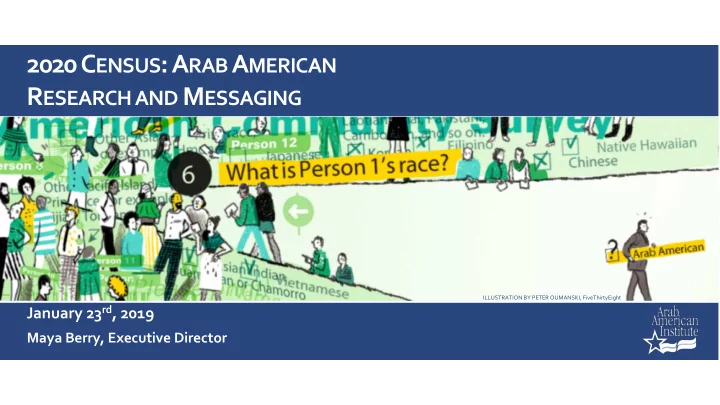
ILLUSTRATION BY PETER OUMANSKI, FiveThirtyEight
represent the interests of 3.7 million Arab Americans. Main - - PowerPoint PPT Presentation
2020 C ENSUS : A RAB A MERICAN R ESEARCHAND M ESSAGING ILLUSTRATION BY PETER OUMANSKI, FiveThirtyEight January 23 rd , 2019 Maya Berry, Executive Director The American-Arab Anti-Discrimination Committee (established 1980) and the Arab American
January 23rd, 2019
Maya Berry, Executive Director
ILLUSTRATION BY PETER OUMANSKI, FiveThirtyEight
The American-Arab Anti-Discrimination Committee (established 1980)
and
the Arab American Institute (established in 1985) represent the interests of 3.7 million Arab Americans.
Main Objectives
Ø Assess the attitudes of & discover potential motivations for participation. Ø Identify at least 3 behavioral opportunities to help overcome barriers to participation Ø Expose audience to messages to assess which will resonate better and ultimately motivate Arab Americans
Further Understanding Of…
Ø Main Reasons for Non-Participation Ø Undercount of Children in Community Ø Concerns Around the Census Ø Best ways to reach Arab Americans Ø Identify trusted messengers
FOCUS GROUPS
Focus Group Round 1: 39 women, 30 men Ethnicities: Egyptian, Iraqi, Lebanese Moroccan, Palestinian, Sudanese, and Syrian. Focus Group Round 2: 20 women, 23 men Ethnicities: Egyptian, Iraqi, Lebanese, Palestinian, Sudanese, and Syrian.
POLLING
Ethnicities: Lebanese, Syrian, Egyptian, Palestinian, Moroccan, Jordanian, Iraqi, Yemeni, and other MENA
July 22nd : Utica, NY July 24th: St. Louis, MO July 27th : Miami, FL August 9th: Jersey City, NJ Nationwide poll conducted August 20-24, 2018
Randomly sampled & stratified to be representative by region.
THE 2020
Ø 32% of Arab Americans either do not plan or are unsure if they will participate in the Census. Ø64% of Arab Americans would be inclined to choose a MENA category (Middle East and North Africa) if presented with the option. Ø28% of Arab Americans were not sure or not likely to respond if they had to report citizenship status.
ARAB AMERICAN COMMUNITY CONCERNS REGARDING GOVERNMENTTARGETING
U.S. government national security approach that treats Arabs as suspect or security threats. Aggressive national security surveillance programs post-9/11. Arab Americans are targeted for their ethnicity or national origin, religion, political views and activism.
THECONTEXT OFTHECENSUS
DATA BREACH + DISTRUST OF CENSUS BUREAU SPECIFICALLY
The Census Bureau came under criticism in 2004 when it was revealed the agency shared data that listed where Arab Americans lived by city and ZIP code with the Department of Homeland Security.
Ø 64% of Arab Americans polled would be inclined to choose MENA (Middle East and North Africa) if presented with the option.
ARABIC SPEAKING POPULATIONS The Bureau has done research on whether to produce the Census questionnaire in Arabic. Arabic is one of the fastest growing language in the US, number of speakers grew 42% from 2010 to 2017. That is a bit over 1.2 million people making it the 6th most spoken language in the US. This growth in language is due to the increased immigration of Arabic speakers and Arab American’s strong sense of cultural identity. Among those who speak Arabic at home, 37% are not proficient in English meaning they speak English less than ”very well.” This is comparable to the 40% English proficiency rate among the 41 million Spanish speakers. The growth of the Arab American community is in part the reason for the push for creating a MENA category to capture more accurately data on Arab Americans.
212 Thousand 358 615 Thousand 687 733 767 786 845 865 952 1 Million 1,053 1,117 1,157 1,231 1.23 Million 200 400 600 800 1,000 1,200 1,400 1975 1980 1985 1990 1995 2000 2005 2010 2015 2020 Number of People (in thousands) Years
NUMBER OF ARABIC SPEAKERS FROM 1980-2017
(AGES 5 AND OLDER)
American Community Survey Data 1980-2017
Ø 28% of Arab Americans said they were not sure or not likely to respond if they had to report citizenship.
10% stated they were “not sure” 18% stated “not likely”
ØThese sentiments were consistent for both, Arab Americans born in U.S. or those foreign born. Ø From the Census Bureau’s focus group, a MENA participant stated “ICE is working with different groups on deportation sweeps, and it would make me feel like I’m aiding in that.”
ARABAMERICANS + HARDTOCOUNTCENSUSTRACTS
HARD TO COUNT CENSUS TRACTS WITH LARGEST ARAB AMERICAN POPULATIONS
Kalamazoo, Ann Arbor, Grand Rapids)
Columbus)
Fairfax)
Harrisburg, Pittsburgh)
areas right outside of DC)
TOP STATES BY ARAB AMERICAN POPULATION 1. California 2. Michigan 3. New York 4. Texas 5. Florida 6. Illinois 7. New Jersey 8. Ohio 9. Virginia 10. Pennsylvan ia 11. Massachus etts 12. Maryland
OFCHILDREN
17% of respondents
were unsure or would not count children in their household.
would not count children.
rate increased from 7% to 9% for those respondents who were foreign born.
Participants generally had positive view of the Census but…of the 32% of Arab Americans that either do not plan or are unsure if they will participate in the census, their: Reasons for Non-Participation
Ø 57% of those polled worried about “giving personal information about me and my family.” Ø For U.S.-born respondents, that number increased to 65% of participants. Ø 66% were ”concerned about online security.” Ø 28% of Arab Americans were “not sure” or ”not likely” to respond if they had to report citizenship.
Ø 40% of Arab Americans were “concerned about immigration enforcement or other government officials using Census answers” Ø 48% expressed concern that the government would use their information against them because they are Arab American Ø Majority (54%) of respondents felt the “data is being used to profile” them as Arab Americans
profiling concern
This concern aligned with the Census Bureau’s own research, where a MENA respondent stated that the information can be used against the community by not “funding certain schools because its in certain ‘bad areas’.”
Concerns about Census Workers coming to their homes & government using Census data against them or their families seen in St. Louis, Jersey City & Miami. Fear about Muslim Ban and worry about being targeted using Census data but felt better once they were told that the Census doesn’t ask about religion was noted with the St. Louis group. Not understanding questions enough to answer & need of help filling out Census was a concern for Arab Americans in Utica. Worries about online security (Jersey City respondents). These concerns were also seen in the Census Bureau’s focus groups where a MENA individual stated “every single scrap of information that the government gets goes to every intelligence agency…”
Of those who prefer mail
Born in U.S.: 42% Foreign Born: 58%
Of those who prefer online submission
Born in U.S.: 51% Foreign Born: 58%
Like NALEO, the vast majority agreed that sending a Census worker to their home was not convenient
46% 52% 18% Mail Online Census Worker
Generally, positive messaging worked the best. Ø 69% of respondents liked the “community will benefit if more from your community participates in the Census” message Ø 71% are more likely to participate if they know that Census numbers “determine funding for state and local services.” Ø 71% said they were more likely to participate if they knew that filling out the Census is “safe, easy, and just a few clicks online.” Ø 72% are more likely to fill out the Census if assured that the “Census protects personal data and your identity is anonymous.” Generally focus group attendees learned about the impact of accurate Census data on funding for schools, social services, health care and local and state government services.
Ø Stress benefits to the Arab American community, especially funding to services and infrastructure. Ø Emphasize the importance to the future & for children Ø Be inclusive in messaging, showing the common culture but also the diversity of the community (most expressed sentiment in focus groups) Ø Convenience is important in encouraging people to fill out the Census (like online version) Ø Focus on the importance of the Census to the family
Ø New immigrant communities responded well to the ”stand up for your community” messaging Ø Established community in Miami also sided with the new immigrants
“It has a very positive feeling to it.”
Ø St. Louis responded best to the message about the Census being all about the people
“I like the focus of the family and about people.”
Ø Jersey City liked the “stand up for your community” & ”it benefits
General sentiment of liking the idea of helping others through the Census messaging “stand up for your community! " “it has a positive feeling to it…"
TRUSTED MESSENGERS FOR ARABAMERICAN COMMUNITY
Ø Family Members Ø Healthcare Providers ØTeachers /Local Educators Ø People from Religious Organizations (not leaders but peers) Ø Notices at Post Offices Ø Arab American Organizations
Social Media polled last with 41% of Arab Americans saying they trust information found online. Religious Leaders polled at 9th place with 49% of Arab Americans trusting them to deliver messaging.
Ø 32% of 18-29 year-olds; 37% of 40-49 year-olds, 50% of 50-59 year-
Twitter. ØTelevision news reports for younger participants were trusted or relied on more than social media. Ø Across all ages, television seems to be the most trusted, specifically local television. Ø 39% of male respondents rely on local television. ØThough most individuals in the focus groups agreed that the online form to fill out the Census is convenient there was still worry from people stating that they would “feel safer to fill out through mail” because “online there really is no privacy.”
MESSAGING STRATEGY
Ø Social Media campaign targeting younger Arab Americans (18- 29) & Arab Americans who are 40 years old and older. Ø Hashtags and video materials in both Arabic and English to reach wider range of Arab Americans. Ø PSA + Ad Campaigns informed by findings from our messaging research to reach both new immigrant populations and Arab Americans who have been here for generations. Ø Outreach + Advertising Campaign to educate Arab Americans about the Census and incentivize their participation in the 2020 Census.
To reach Arab Americans we plan to meet them where they are…. ØThrough blog, magazines, newspaper, community-based event publication dissemination of PSA and Ad. Ø Postcard Mailing to 50K Arab American Households using AAI’s Arab American Voter List with Arabic and English messaging on the postcards. ØTelevision Ads in Arabic for Arabic television and radio broadcasting as well as English for local television broadcasting. Ø Local trainings and event outreach at community events in target areas like California, Texas, New York, etc. Ø All of these outreach methods will be started mid 2019 and carrying
Ø Additional Research in:
California Michigan Texas Illinois
Ø Fill Potential Research Gaps
Local specific research done in key states & other metro-areas with high Arab American population count Greater understanding of the undercount of children for Arab American community Greater understanding of what can be done to mitigate the concern of government targeting and surveillance Greater understanding of the diversity of Arab American community & the impact it can have on outreach efforts to specific populations. Testing GOTC strategies to ensure that they reach intended populations. Ohio DMV Pennsylvania Massachusetts
MAYA BERRY
Executive Director mberry@aaiusa.org @iMayaBerry @aaiusa