
SLIDE 1
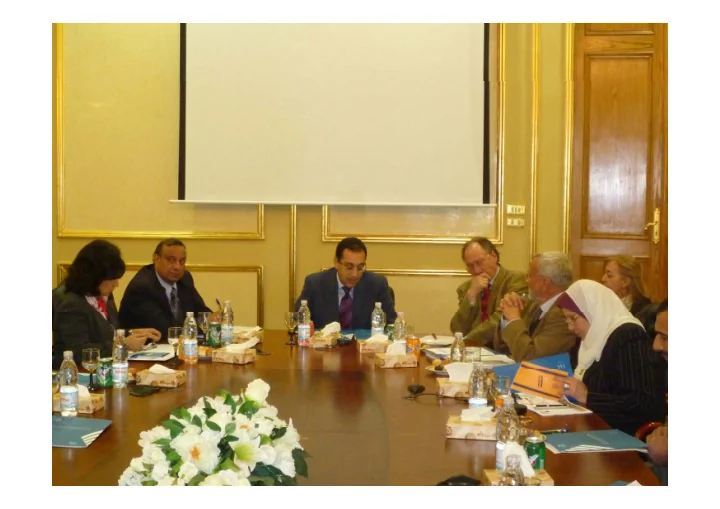
Still a reminder: The Cairo Declaration on Sustainable Arab Cities, - - PowerPoint PPT Presentation
Still a reminder: The Cairo Declaration on Sustainable Arab Cities, Still a reminder: The Cairo Declaration on Sustainable Arab Cities, Security of Tenure and Good Governance We, the representatives of the governments of the Arab countries and
Still a reminder: The Cairo Declaration on Sustainable Arab Cities, Still a reminder: The Cairo Declaration on Sustainable Arab Cities, Security of Tenure and Good Governance
We, the representatives of the governments of the Arab countries and the Arab local authorities and their organizations convening in Cairo, the capital of the Arab Republic of Egypt on the 15th of December 2005 in our high level meeting on Sustained Arab Cities, Security of Tenure and Good urban Governance: id i th t Citi ti l f l b li ti t f lth d
engines of growth that contribute to the development of human settlements both in urban and rural settings, k l d i th t th ti th f A b iti i li k d t th ff ti
implementation of the strategies set to confront urban poverty and its socio-economic roots in rural and urban areas, i b t th h ll f d b A b iti d th t
impact of immigration and the demographic changes resulting from un-employment and exodus of people because of natural disasters, wars, disputes and the Israeli
responsibility towards our Arab society, based on supporting the principles of justice equality democracy with a view of ensuring a continuous urban development
Ismailia 7 December, 2010 O.Univ. Prof. Dr.-Ing. Holger Magel
justice, equality, democracy with a view of ensuring a continuous urban development.
Ismailia 7 December, 2010 O.Univ. Prof. Dr.-Ing. Holger Magel
Human Dignity Human Rights
(Ci il d S i l t t) (Civil and Social contract) Intra-generational Justice Inter-generational Justice
Fairness to E l Equal Opportunities
Bottom-up D l t
Fairness of Procedures (Good Governance, Fairness to Satisfying
Development
Fair procedures between North and South) daily needs (Basic requirements)
Ismailia 7 December, 2010 O.Univ. Prof. Dr.-Ing. Holger Magel
Source: GLOBAL ABER GERECHT Klimawandel bekämpfen, Entwicklung ermöglichen - Ein Report. C.H.BECK Verlag
Education Supplying
Living in community (welfare)
Housing Traffic Communication
Living in community g y (sustainability)
Employment
Recreation
Ismailia 7 December, 2010 O.Univ. Prof. Dr.-Ing. Holger Magel
Economic Development WIRTSCHAFTLICHE ENTWICKLUNG Economic Development
Economic aspect Conservation and improvement of supply
Equity and Fairness
Social and political aspects
Environmental Protection
aspects social fairness in and between North and South Ecological aspect Conservation of the functional capability of ecological systems
UN-Kommission „Brundtland Bericht 1987 Unsere gemeinsame Zukunft“ Rio-Konferenz 1992; Rio+10 2002: „Ressourcenschutz“
ecological systems
Ismailia 7 December, 2010 O.Univ. Prof. Dr.-Ing. Holger Magel
EG-Vertrag, Artikel 2: „Drei-Säulen-Modell“
Source: Prof. Roland Berger Ismailia 7 December, 2010 O.Univ. Prof. Dr.-Ing. Holger Magel
World Bank Report stated:
Source: World Bank (2008): Arab Republic of Egypt. Urban Sector Update, Cairo Ismailia 7 December, 2010 O.Univ. Prof. Dr.-Ing. Holger Magel
Ismailia 7 December, 2010 O.Univ. Prof. Dr.-Ing. Holger Magel
Ismailia 7 December, 2010 O.Univ. Prof. Dr.-Ing. Holger Magel
Source: UN Habitat and the United Nations Economic Commission for Africa (2008): "State of the African Cities Report 2008. A framework for addressing rban challenges in Africa"
Ismailia 7 December, 2010 O.Univ. Prof. Dr.-Ing. Holger Magel
addressing urban challenges in Africa"
Ismailia 7 December, 2010 O.Univ. Prof. Dr.-Ing. Holger Magel
Ambrogio Lorenzetti. Allegory of Good Government: Effects of Good Government in the City.
Source: Web Gallery of Art:
Ismailia 7 December, 2010 O.Univ. Prof. Dr.-Ing. Holger Magel
1338-40. Fresco. Palazzo Publico, Siena, Italy.
y http://www.wga.hu/index.html
Ambrogio Lorenzetti. Allegory of Good Government: Effects of Good Government in the Country.
Source: Web Gallery of Art:
Ismailia 7 December, 2010 O.Univ. Prof. Dr.-Ing. Holger Magel
1337-40. Fresco. Palazzo Publico, Siena, Italy.
http://www.wga.hu/index.html
Ismailia 7 December, 2010 O.Univ. Prof. Dr.-Ing. Holger Magel
Ismailia 7 December, 2010 O.Univ. Prof. Dr.-Ing. Holger Magel
Source: OECD
Ismailia 7 December, 2010 O.Univ. Prof. Dr.-Ing. Holger Magel
Ismailia 7 December, 2010 O.Univ. Prof. Dr.-Ing. Holger Magel
EC (2006): Programming Guide for Strategy Papers p.1. Ismailia 7 December, 2010 O.Univ. Prof. Dr.-Ing. Holger Magel
Source: Federal Office for Building and Regional Planning (BBR):
Ismailia 7 December, 2010 O.Univ. Prof. Dr.-Ing. Holger Magel
Source: Federal Office for Building and Regional Planning (BBR): Spatial Development and spatial Planning in Germany.
Ismailia 7 December, 2010 O.Univ. Prof. Dr.-Ing. Holger Magel
Source: FAO Ismailia 7 December, 2010 O.Univ. Prof. Dr.-Ing. Holger Magel Source: FAO
Shift away from redistribution and subsidies for lagging regions in favour of measures to increase the competitiveness regions in favour of measures to increase the competitiveness
Some key features
this new approach to regional development include: development include
range of direct and indirect factors that affect the performance range of direct and indirect factors that affect the performance
focus
endogenous assets, and less
exogenous investments and transfers;
regional and local government plus other stakeholders, with the l ki l d i l central government taking a less dominant role.
Source: OECD
Ismailia 7 December, 2010 O.Univ. Prof. Dr.-Ing. Holger Magel
Ismailia 7 December, 2010 O.Univ. Prof. Dr.-Ing. Holger Magel
Old approach New approach
Old approach New approach (space based ,cross cutting, multi- level governance) Objectives Equalisation, farm income, Competitiveness of rural areas, j farm competitiveness valorisation of local assets, exploitation of unused resources Key target sector Agriculture Various sectors of rural economies (Rural tourism economies (Rural tourism, manufacturing, ICT industry, etc.) Main tools Subsidies Investments Key actors National governments, farmers All levels of government (supra- national, national, regional and local –vertical and horizontal), ) various local stakeholders (public, private, NGOs)
Source: OECD, 2006: The New Rural Paradigm: Policies and Governance. p.15
Ismailia 7 December, 2010 O.Univ. Prof. Dr.-Ing. Holger Magel
OECD, 2006: The New Rural Paradigm: Policies and Governance. p.15
T diti l hi hi l d i i t ti „Traditional hierarchical administrative structures are likely to be inadequate to administer these policies effectively and adjustments are thus needed along three key governance dimensions: horizontally at both the central and the local levels and vertically across levels of government.
OECD, 2006: The New Rural Paradigm: Policies and Governance. p.17
Ismailia 7 December, 2010 O.Univ. Prof. Dr.-Ing. Holger Magel
Economic ecological and socio Legislation Institutional framework
Economic, ecological and socio- cultural development programmes Institutional framework Awareness and capacity builduing Regional Development Coordination between national regional and local Sustainable spatial planning in urban / rural areas national ,regional and local level Sustainable spatial planning Strategy and policy d l t Regional Good development
Source: European Union and Interreg IVC (adapted by Prof Magel)
Governance
Ismailia 7 December, 2010 O.Univ. Prof. Dr.-Ing. Holger Magel
Source: European Union and Interreg IVC (adapted by Prof. Magel)
Regional Development Regional Development „Regional“ urban development Regional or Integrated rural development
Ismailia 7 December, 2010 O.Univ. Prof. Dr.-Ing. Holger Magel
Ismailia 7 December, 2010 O.Univ. Prof. Dr.-Ing. Holger Magel
Ismailia 7 December, 2010 O.Univ. Prof. Dr.-Ing. Holger Magel
Ismailia 7 December, 2010 O.Univ. Prof. Dr.-Ing. Holger Magel
Ismailia 7 December, 2010 O.Univ. Prof. Dr.-Ing. Holger Magel
Ismailia 7 December, 2010 O.Univ. Prof. Dr.-Ing. Holger Magel
Source: Rainer Müller –Jökel (2003) Sustainable Urban Development in Cases
Ismailia 7 December, 2010 O.Univ. Prof. Dr.-Ing. Holger Magel
April 13-17, 2003
The starting point for the German National Urban Development Policy is the notion of the European City as a spatial, social and value model. p , The National Urban Development Policy provides an
authorities, the planning professions, industry and the scientific community to have their say on topics such as cities, living together in cities urban qualities and good governance living together in cities, urban qualities and good governance.
Ismailia 7 December, 2010 O.Univ. Prof. Dr.-Ing. Holger Magel
The objectives of promoting urban development are: The objectives of promoting urban development are:
also under consideration of protection of historic buildings
urban function losses; the principle indication of such function losses urban function losses; the principle indication of such function losses is permanent oversupply of structural works, such as, vacant dwellings or derelict sites in inner cities, particularly industrial sites, former military sites converted for appropriate re use and railway former military sites converted for appropriate re-use and railway sites
Ismailia 7 December, 2010 O.Univ. Prof. Dr.-Ing. Holger Magel
Six areas of action From the projects submitted, six areas of action were derived which are currently of special significance in urban development practice and which therefore serve as focal points of the National Urban Development Policy: p p y
g pp p g y
global responsibility
Ismailia 7 December, 2010 O.Univ. Prof. Dr.-Ing. Holger Magel
Promotion of urban development Promotion of urban development (Städtebauförderung) The urban development funding programme of Federal and individual State Governments was introduced in 1971 to support underdeveloped communities in tackling problematic situations in urban development policy. To enable cities to cope better with their current tasks and challenges, the Federal p g , Government supports the creation of sustainable urban structures with urban development promotion programmes. To do this, the Federal Government guarantees the federal states financial , g assistance in accordance with Article 104 a Paragraph 4 of the constitution; this assistance is supplemented by federal state and local authority funds. This federal financial aid is made available to the federal states on the basis of an administrative agreement (promotion of urban development administrative g (p p agreement).
Ismailia 7 December, 2010 O.Univ. Prof. Dr.-Ing. Holger Magel
Ismailia 7 December, 2010 O.Univ. Prof. Dr.-Ing. Holger Magel
Ismailia 7 December, 2010 O.Univ. Prof. Dr.-Ing. Holger Magel
comprehensive
Cross cutting
who and Land Rural Village who and where are the experts? consolidation construction g renewal experts? Guiding implementation
Ismailia 7 December, 2010 O.Univ. Prof. Dr.-Ing. Holger Magel
areas
complementary actions in fields such as infrastructure, human ) resources and business development) or support for individual projects
Ismailia 7 December, 2010 O.Univ. Prof. Dr.-Ing. Holger Magel
Ismailia 7 December, 2010 O.Univ. Prof. Dr.-Ing. Holger Magel