Replication Outline Failure Models Mirroring Quorums Spring 2002 - - PDF document

replication
SMART_READER_LITE
LIVE PREVIEW

Replication Outline Failure Models Mirroring Quorums Spring 2002 - - PDF document

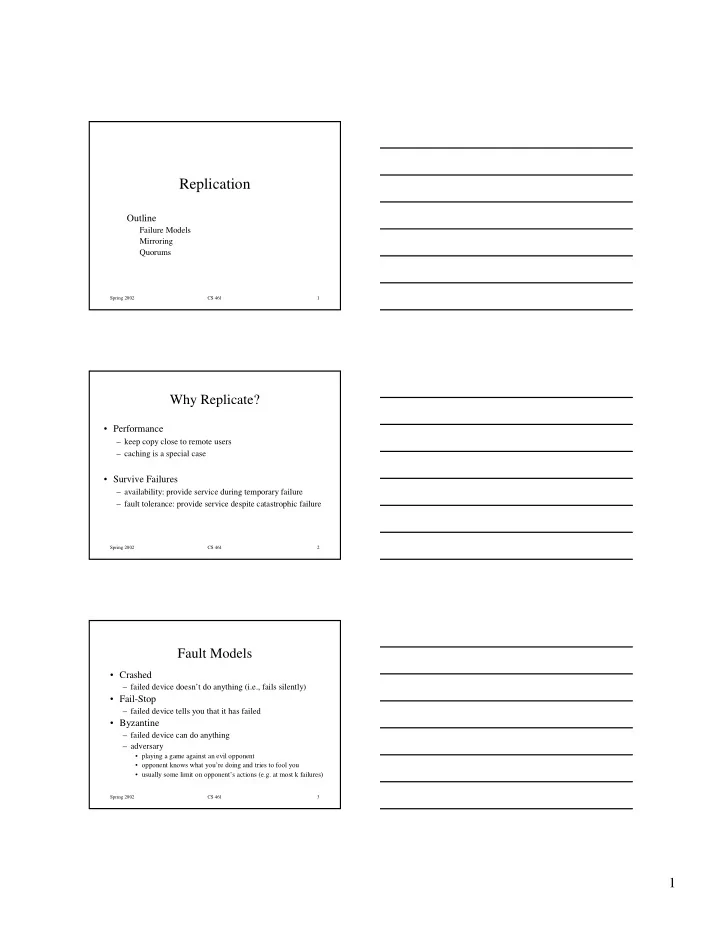
Replication Outline Failure Models Mirroring Quorums Spring 2002 CS 461 1 Why Replicate? Performance keep copy close to remote users caching is a special case Survive Failures availability: provide service during


slide-1
SLIDE 1

1

Spring 2002 CS 461 1

Replication

Outline

Failure Models Mirroring Quorums

Spring 2002 CS 461 2

Why Replicate?

  • Performance

– keep copy close to remote users – caching is a special case

  • Survive Failures

– availability: provide service during temporary failure – fault tolerance: provide service despite catastrophic failure

Spring 2002 CS 461 3

Fault Models

  • Crashed

– failed device doesn’t do anything (i.e., fails silently)

  • Fail-Stop

– failed device tells you that it has failed

  • Byzantine

– failed device can do anything – adversary

  • playing a game against an evil opponent
  • opponent knows what you’re doing and tries to fool you
  • usually some limit on opponent’s actions (e.g. at most k failures)
slide-2
SLIDE 2

2

Spring 2002 CS 461 4

Byzantine Army Problem

3000 Blue Soldiers 3000 Blue Soldiers 4000 Red Soldiers

Spring 2002 CS 461 5

Synchrony

  • Assumptions concerning boundedness of component

execution or network transmissions

  • Synchronous

– always performs function in a finite & known time bound

  • Asynchronous

– no such bound

  • Famous Result: A group of processes cannot agree
  • n a value in an asynchronous system given a single

crash failure

Spring 2002 CS 461 6

Network Partitions

  • Can’t tell the difference between a crashed process

and a process that’s inaccessible due to a network failure.

  • Network Partition: network failure that cuts

processes into two or more groups

– full communication within each group – no communication between groups – danger: each group thinks everyone else is dead

slide-3
SLIDE 3

3

Spring 2002 CS 461 7

Mirroring

  • Goal: service up to K failures
  • Approach: keep K+1 copies of everything
  • Clients do operations on “primary” copy
  • Primary makes sure other copies do operations too
  • Advantage: simple
  • Disadvantages:

– do every operation K times – use K times more storage than necessary

Spring 2002 CS 461 8

Mirroring Details

  • Optimization: contact one replica to read
  • What if a replica fails?

– get up-to-date data from primary after recovering

  • What if primary fails?

– elect a new primary

Spring 2002 CS 461 9

Election Problem

  • When algorithm terminates, all non-failed

processes agree on which replica is the primary

  • Algorithm works despite arbitrary failures and

recoveries during the election

  • If there are no more failures and recoveries, the

algorithm must eventually terminate

slide-4
SLIDE 4

4

Spring 2002 CS 461 10

Bully Algorithm

  • Use fixed “pecking order” among processes

– e.g., use network addresses

  • Idea: choose the “biggest” non-failed machine as

primary

  • Correctness proof is difficult

Spring 2002 CS 461 11

Bully Algorithm Details

  • Process starts an election whenever it recovers or

whenever primary has failed

– how know primary has failed?

  • To start an election, send election messages to all

machines bigger than yourself

– if somebody responds with an ACK, give up – if nobody ACKs, declare yourself the primary

  • On receiving election message, reply with ACK

and start an election yourself (unless in progress)

Spring 2002 CS 461 12

Quorums

  • Quorum: a set of server machines
  • Define what constitutes a “read quorum” and a

“write quorum”

  • To write

– acquire locks on all members of some write quorum – do writes on all locked servers – release locks

  • To read: similar, but use read quorum
slide-5
SLIDE 5

5

Spring 2002 CS 461 13

Quorums

  • Correctness requirements

– any two write quorums must share a member – any read quorum and any write quorum must share a member (read quorums need not overlap)

  • Locking ensures that

– at most one write happening at a time – never have a write and a read happening at the same time

Spring 2002 CS 461 14

Defining Quorums

  • Many alternatives
  • Example

– write quorum must contain all replicas – read quorum may contain any one replica

  • Consequence

– writes are slow, reads are fast – can write only if all replicas are available – can read if any one replica is available

Spring 2002 CS 461 15

Defining Quorums (cont)

  • Example: Majority Quorum

– write quorum: any set with more than half the replicas – read quorum: any set with more than half the replicas

  • Consequences

– modest performance for read and write – can proceed as long as more than half the replicas are available

slide-6
SLIDE 6

6

Spring 2002 CS 461 16

Quorums & Version Numbers

  • Write operation writes only a subset of the servers

– some servers are out-of-date

  • Remedy

– put version number stamp on each item in each replica – when acquiring locks, get current version number from each replica – quorum overlap rules ensure that one member of your quorum has the latest version

Spring 2002 CS 461 17

Version Numbers (cont)

  • When reading, get the data from the latest version

number in your quorum

  • When writing, set version number of all replicas

you wrote equal to 1 + (max version number in your quorum beforehand)

  • Guarantees correctness even if no recovery action

is taken when replica recovers from a crash

Spring 2002 CS 461 18

Quorums and Partitions

  • One group has a write quorum (and thus usually a

read quorum);

– that group can do anything – other groups are frozen

  • No group has a write quorum, but some groups have

a read quorum

– some groups can read – no groups can write

  • No group contains any quorum

– everyone is frozen