
SLIDE 1
REDUCING THE COST OF ENERGY IN ALASKA
REDUCING THE COST OF ENERGY IN ALASKA
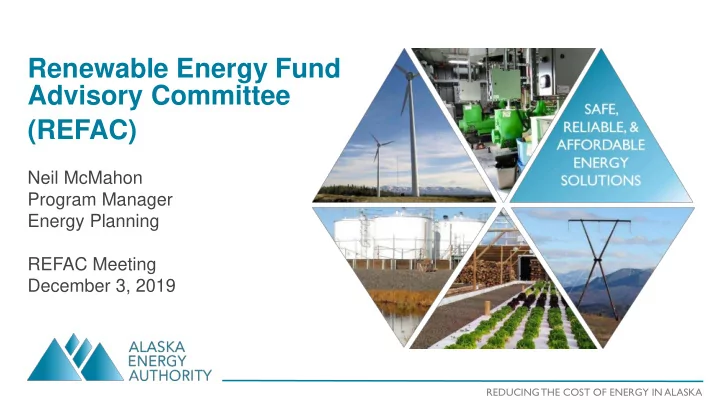
Renewable Energy Fund Advisory Committee (REFAC) Neil McMahon - - PowerPoint PPT Presentation
Renewable Energy Fund Advisory Committee (REFAC) Neil McMahon Program Manager Energy Planning REFAC Meeting December 3, 2019 REDUCING THE COST OF ENERGY IN ALASKA REDUCING THE COST OF ENERGY IN ALASKA 1-1:15 p.m. Welcome and Introductions
REDUCING THE COST OF ENERGY IN ALASKA
REDUCING THE COST OF ENERGY IN ALASKA
REDUCING THE COST OF ENERGY IN ALASKA
2
1-1:15 p.m. Welcome and Introductions 1:15-1:20 p.m. Approve minutes and agenda 1:20-2:10 p.m. Refreshers Energy in Alaska REF Evaluation process REFAC Advisory Role REF impact to date 2:10-2:45 p.m. Informational Items Fund balance One-page description for potential funders Request for Application schedule Incentivizing Operations and Financial Planning Metering requirements 2:45-3 p.m. Break 3-3:45 p.m. Action Items Change funding limits Prioritize early stage projects Increase local match weighting Incentivize supply- and demand-side efficiency 3:45-4 p.m. Member comments 4 p.m. Adjourn
REDUCING THE COST OF ENERGY IN ALASKA
3
REDUCING THE COST OF ENERGY IN ALASKA
4
REDUCING THE COST OF ENERGY IN ALASKA
5
0% 25% 50% 75% 100%
2008 2009 2010 2011 2012 2013 2014 2015 2016 2017
Coal Natural gas Oil Wind Hydro 18% 29% Alaska State Energy Policy (2010): Goal of 50% of electricity generated by renewable source by 2025
REDUCING THE COST OF ENERGY IN ALASKA
most weight being given to projects that serve any area in which the average cost of energy to each resident of the area exceeds the average cost to each resident of other areas
significant weight given to a statewide balance of grant funds and to the amount of matching funds
6
REDUCING THE COST OF ENERGY IN ALASKA
7
Completeness/eligibility (AEA staff) Feasibility and public benefit (AEA, DNR, Contractors) Technical and economic evaluation Qualifications and experience of team Project management, development,
Ranking projects (AEA/REFAC) Cost of energy single biggest criterion (30%) Levelized feasibility score from stage 2 (25%) Other criteria include public benefits, readiness, local support and match Regional spreading (AEA/REFAC)
REDUCING THE COST OF ENERGY IN ALASKA
8
REDUCING THE COST OF ENERGY IN ALASKA
AEA “in consultation with the advisory committee…develop a methodology for determining the order of projects that may receive assistance….” AEA “shall, at least once each year, solicit from the advisory committee funding recommendations for all grants.”
(a) To establish a statewide balance of recommended projects, the authority will provide to the advisory committee established in AS 42.45.045 (i) a statewide and regional ranking of all applications recommended for grants. (b) In consultation with the advisory committee established in AS 42.45.045 (i), the authority will
(1) make a final prioritized list of all recommended projects, giving significant weight to providing a statewide balance of grant money, and taking into consideration the amount of money that may be available, number and types of projects within each region, regional rank, and statewide rank
9
REDUCING THE COST OF ENERGY IN ALASKA
10
REDUCING THE COST OF ENERGY IN ALASKA
11
REDUCING THE COST OF ENERGY IN ALASKA
12
REDUCING THE COST OF ENERGY IN ALASKA
13
REDUCING THE COST OF ENERGY IN ALASKA
Wind $91.5 Hydro $84.8 Biomass $27.0 Heat Recovery $20.3 Heat Pump $16.4 Transmission $12.5 Ocean/River $3.9 Solar $0.5 Other $0.1
14
REDUCING THE COST OF ENERGY IN ALASKA
15
5 10 15 20 25 30 35
Fuel Displaced (diesel equivalent, gallons)
Millions
Biomass Heat Pump Heat Recovery Hydro Biofuel Solar Transmission Wind Wind to Heat
REDUCING THE COST OF ENERGY IN ALASKA
16 16 $- $1,000,000 $2,000,000 $3,000,000 $4,000,000 $5,000,000 2009 2010 2011 2012 2013 2014 2015 2016 2017
Wind to Heat Wind Transmission Solar PV Hydro Heat Recovery
REDUCING THE COST OF ENERGY IN ALASKA
17
REDUCING THE COST OF ENERGY IN ALASKA
18
REDUCING THE COST OF ENERGY IN ALASKA
19
REDUCING THE COST OF ENERGY IN ALASKA
20
REDUCING THE COST OF ENERGY IN ALASKA
21
Current Rules
Statute No Reference Regulations Public benefit… “ability to ..operate
and maintain the project for the life of the project.” Recommended additions to Scoring Criteria and Grant application
Stage 2 Criterion 2 Qualifications and Experience (20% of Stage 2) The applicant, partners, and/or contractors have sufficient knowledge and
experience to successfully complete and operate the project.
The project team has staffing, time, and other resources to successfully complete
and operate the project.
For construction projects, include the final operational and business plan completed
under Phase III--Final Design & Permitting, including financial and operational plans for end-of-life. Operational plans should be detailed and include labor and material costs, training needed, minor and major repair schedules, etc. [This would be added to 4.1.2 Expertise and Resources in grant application
Stage 3: Section 7—Sustainability The capability of the grantee to demonstrate the capacity, both administratively and
financially, to provide for the long-term operation and maintenance of the proposed project
For construction projects, attach and describe how the applicant will implement the
final financial and operational plan to provide for the long-term operation and maintenance of the proposed project. [This would be added to Section 7-- Sustainability in grant application]
REDUCING THE COST OF ENERGY IN ALASKA
22
REDUCING THE COST OF ENERGY IN ALASKA
23
Data Collection Recommended Language Metering Equipment Please provide a short narrative, and cost estimate, identifying the metering equipment that will be used to comply with the operations reporting requirement identified in Section 3.15 of the Request for Applications. Any identified metering equipment will not be included as a project cost. Energy Cost Calculation The Household Energy Cost is calculated as follows: HEC = (cost of power*6,000 kWh/yr) + (cost of heating fuel*regional mean HH gallons/yr) The Cost of Energy Score is then assigned using the following formula: COE Score = (HEC) / $15,254.77 x 10, Score cannot be greater than 10 Communities with an average combined residential energy bill at or above $15,254.77 are assigned the maximum score of 10. This value is the cost that allows 10% of all communities in the state to receive full points for this criterion in the current year.
REDUCING THE COST OF ENERGY IN ALASKA
24
REDUCING THE COST OF ENERGY IN ALASKA
25
REDUCING THE COST OF ENERGY IN ALASKA
26
REDUCING THE COST OF ENERGY IN ALASKA
27
Phase Grant Limits by location Low Energy Cost Areas High Energy Cost Areas Phase I, Reconnaissance The per-project total of Phase I and II is limited to 20% of anticipated construction cost (Phase IV), not to exceed $2M. Phase II, Feasibility and Conceptual Design Phase III, Final Design and Permitting 20% of anticipated construction cost (Phase IV), and counting against the total construction grant limit below. Phase IV, Construction and Commissioning $2M per project, including final design and permitting (Phase III) costs, above. $4M per project, including final design and permitting (Phase III) costs, above. Exceptions Biofuel Projects
Biofuel projects where the applicant does not intend to generate electricity or heat for sale to the public are limited to reconnaissance and feasibility phases only at the limits expressed above.
Geothermal projects
The per-project total of Phase I and II for geothermal projects is limited to 20% of anticipated construction costs (Phase IV), not to exceed $4M. Any amount above the usual $2M cap spent on these two phases combined shall reduce the total Phase III and IV grant limit by the same amount, thereby keeping the same total grant dollar cap as all other projects.
REDUCING THE COST OF ENERGY IN ALASKA
28
$0 $1,000,000 $2,000,000 $3,000,000 Kodiak Northwest Arctic Copper River/Chugach Southeast Bering Straits Lower Yukon-Kuskokwim Aleutians Railbelt Bristol Bay Yukon-Koyukuk/Upper Tanana North Slope Average Grant Amount
Average Grant Amount by AEA Energy Region Round 1-9
$0 $500,000 $1,000,000 $1,500,000 Geothermal Wind Transmission Hydro Heat Pumps Heat Recovery Biomass Ocean/River Solar Average Grant Amount
Average Grant Amount by Technology Type Round 1-9
REDUCING THE COST OF ENERGY IN ALASKA
29
Project Phase Target Allocation – Percentage of Grant Funds Recommended
Study 50%
Conceptual Design
Permitting 50%
Commissioning Additional target Heat projects 30% of total funding
Round 9 Targets
REDUCING THE COST OF ENERGY IN ALASKA
30
More projects will be funded – Pre-construction projects average ~$327k vs. ~$1.5M for construction projects Potentially create a “pipeline” of projects Fewer projects constructed with REF funds Is it consistent with statute and regulations? Biomass projects would likely be represented less Other risks, such as access to capital, may limit the number of projects that make it to construction Assume smaller, less wealthy communities would be less likely to finance construction without state support May not know if projects are ever constructed
REDUCING THE COST OF ENERGY IN ALASKA
31
$0 $1,000,000 $2,000,000 $3,000,000
Average Grant Award by Technology and Phase
15 30 45 60
Number of Grants Awarded by Technology and Phase
Construction Projects Pre-Construction Projects
REDUCING THE COST OF ENERGY IN ALASKA
32
Statute Scoring must be
Cost of energy
Regulations “Significant” Round 1-2 = 25% Round 3-4 = 20% Round 5-9 = 15%
Will it increase match supplied? Will it reduce or change access to program by region,
Would it change order of selections? Will it improve project outcomes? What category(ies) will be decreased in importance?
Without identification of clear, specific need, don’t
REDUCING THE COST OF ENERGY IN ALASKA
33
0% 5% 10% 15% 20% 25% 1 2 3 4 5 6 7 8 9
Average Match Median Match Match weight
REDUCING THE COST OF ENERGY IN ALASKA
34
4 8 12
Lower Yukon-Kuskokwim Bristol Bay Aleutians Northwest Arctic Yukon-Koyukuk/Upper Tanana Bering Straits Copper River/Chugach Southeast North Slope Railbelt
Average match score
Average match score by AEA Energy Region
Passed Stage 2, REF Round 1-9
3 6 9 12 15 HeatRecovery Biomass Solar Wind Geothermal Hydrokinetic Other Hydro Transmission Storage HeatPump Average match score
Average match score by T echnology Type
Passed Stage 2, REF Round 1-9
4 8 12 Government Entity Local Government Utility IPP Average match score
Average match score by Applicant Type
Passed Stage 2, REF Round 1-9
Changing match weight will likely increase the likelihood
being more successful in securing grants.
REDUCING THE COST OF ENERGY IN ALASKA
35
REDUCING THE COST OF ENERGY IN ALASKA
Improve RE integration Improve performance of RE project Care was taken to not negatively impact
Pre- and post-implementation reports, Invoices for work completed, Photos of the work performed, and/or Any other available verification such as
YES Cost included as Match, Efficiency improvement included as a
Cost is included in B/C Improvement may be included in
NO Improvement may be included in
36
REDUCING THE COST OF ENERGY IN ALASKA
37
REDUCING THE COST OF ENERGY IN ALASKA
38
REDUCING THE COST OF ENERGY IN ALASKA
39
SAFE, RELIABLE, & AFFORDABLE ENERGY SOLUTIONS
ALASKA ENERGY AUTHORITY
813 West Northern Lights Blvd. Anchorage, Alaska 99503 Phone: (907) 771-3000 Fax: (907) 771-3044 Toll Free (Alaska Only) 888-300-8534